
Employer Branding
Employer branding: marketing can make a job visible, not make a bad job good
Employer branding aims at a different audience, on a different set of surfaces, with a different definition of success. It helps when good roles are invisible or badly explained. It does nothing at all when the real problem is the pay, the manager or the work itself.
Prefer to talk it through? Book a strategy call
First, the hard part
Four hiring problems that no amount of marketing will solve
This page starts here on purpose. Employer branding is useful, and it is also the service most often sold to companies whose problem is somewhere else entirely.
- The pay is below the market and everyone knows it.
- Salary information circulates freely now, through review sites, job boards that publish ranges, and people simply asking each other. A careers campaign around a role that pays noticeably less than its alternatives will produce applications from people who did not check, and those people find out during the process.
- People are leaving because of one manager.
- This shows up in the pattern rather than the volume: turnover concentrated in one team, exit conversations that are strangely vague, and public reviews that mention the same thing without naming anyone. Recruitment marketing pointed at that team refills a bucket with a hole in it, at agency rates.
- The process itself is driving candidates away.
- Six weeks, five stages, an unpaid task and a long silence between each. Good candidates have other options and use them. This is usually the cheapest problem on the list to fix and the one nobody frames as a marketing problem, which is exactly why it survives.
- The work is less attractive than the alternatives.
- Some roles are harder, less flexible or less interesting than what competitors offer, and no story changes that. What can be done is being precise about who the role does suit and clear about what it involves, which produces fewer applicants and better ones. That is a real improvement even though the headline number falls.
A different audience
Candidates research you somewhere your customers never go
A company can have an excellent website, strong search visibility and a well-known name among buyers, and still be invisible to the people it is trying to hire. The two audiences barely share a surface.
Candidate research runs through employer review sites, job boards, the careers section, and the LinkedIn profiles of people who already work there. Much of it is done privately, before anyone applies, and a substantial part of it happens in conversation with someone who has worked at the company or knows somebody who has. None of that is reachable through the marketing built for customers.
The consequence is that employer branding is a separate production job with its own surfaces to maintain. It also means the material has to answer different questions. What a customer needs to know is whether the product works. What a candidate needs to know is what the day looks like, who they would report to, what happened to the last person in the role, and whether the stated policy on flexible working is what happens.
What they type
The searches that happen before anyone applies
These are illustrative examples of how candidate research is phrased, not claims about how often each one is searched. What they show is that the questions are specific, sceptical and mostly about daily reality.
Checking you out before applying
These almost always land on review platforms rather than your own site, which is why the response process on those platforms is part of the work.
- is [company] a good place to work
- [company] employee reviews
- what is it like to work at [company]
- [company] interview process
- why do people leave [company]
Looking for the role itself
Job listings can appear in Google’s job results when the pages carry valid JobPosting structured data, which is a technical requirement rather than a content one.
- [job title] jobs in [city]
- remote [job title] jobs
- [company] careers
- [job title] salary [city]
- entry level [job title] jobs near me
Deciding after an offer
This is where late-stage withdrawals originate. A candidate who finds a contradiction here after an offer usually declines without telling you why.
- [company] benefits
- [company] work from home policy
- [company] progression and promotion
- should I take a job at [company]
These are examples of how customers in this market search, drawn from keyword research and public search data. They are illustrative, not a volume claim: we size the demand in your area before recommending anything.
Where candidates fall away
The stages a hire has to survive
Employer branding can widen the top of this and clarify the middle. It can do nothing about the last stage, which is where a role that was oversold costs more than not hiring would have.
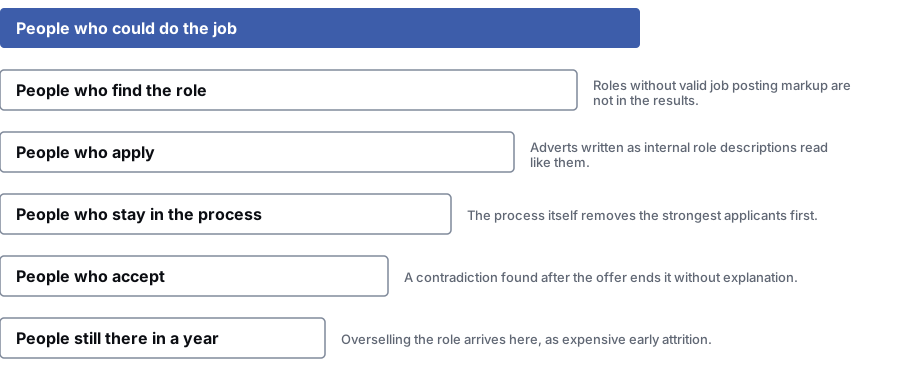
- 1People who could do the job — Most of them are not looking, and almost none of them are reading the marketing you built for customers.
- 2People who find the role — Review sites, job boards, the careers section, and the profiles of people who already work there.Roles without valid job posting markup are not in the results.
- 3People who apply — An advert describing the actual work, the reporting line and the progression reads as an invitation.Adverts written as internal role descriptions read like them.
- 4People who stay in the process — Five stages over six weeks with an unpaid exercise and long silences loses the candidates who have options.The process itself removes the strongest applicants first.
- 5People who accept — Benefits, flexible working and progression get checked again after an offer, on surfaces you do not control.A contradiction found after the offer ends it without explanation.
- 6People still there in a year — The candidate finds out the truth within weeks, and that is the ceiling on what any of this can promise.Overselling the role arrives here, as expensive early attrition.
Scope
What the work covers when it is worth doing
- Interviews with recent joiners, long-tenured staff and recent leavers, which is where a credible proposition comes from
- A written assessment of whether the problem is visibility, explanation, or the offer itself
- An employee value proposition that a current employee would recognise as accurate
- A careers section built as real pages rather than a frame around an applicant tracking system
- Job posting templates that describe the actual work, the reporting line and the progression
- JobPosting structured data implemented so roles are eligible to appear in Google job results
- A review platform presence with a response process that is public, prompt and not defensive
- Content showing the work being done, since a photograph of a desk proves nothing
- Alignment checks so the employer story and the customer story do not contradict each other
- Measurement of applicant source and stage-by-stage drop-out, so the diagnosis can be revisited
Questions
What leaders ask before investing in this
When is employer branding not the answer?
When the pay is below market, when a specific manager is the reason people leave, when the work is worse than the alternatives, or when the interview process takes six weeks and three unpaid exercises. Marketing makes those things more visible, not less.
We will tell you if we think that is the situation. Promoting a role that people leave within a year is expensive for you and unpleasant for them, and it damages the employer brand far more than silence would.
What do candidates look at?
Employer review sites, job boards, your careers pages, and the LinkedIn profiles of people who already work there. Many will also ask someone they know, and that conversation carries more weight than anything you publish.
The searches are mostly questions: what a company is like to work for, what the interview process involves, what the pay is, and whether the flexible working policy is real. A careers presence that answers those directly does more than one built around values statements.
Our reviews are poor. What can be done about that?
Nothing dishonest, and we will not attempt it. Reviews cannot be removed, suppressed or bought, and any agency offering that is describing a risk rather than a service.
What works is responding publicly and without defensiveness, fixing what is repeatedly mentioned, and asking current staff to describe their experience at natural moments rather than in a campaign. That changes the pattern slowly, which is the only way it changes.
How is this different from our normal brand work?
The audience, the surfaces and the definition of success are all different. Customers want to know whether the product solves their problem; candidates want to know what a Tuesday is like, who they report to, and whether the last three people in the role are still there.
It still has to agree with the customer-facing brand. A company that presents itself one way to buyers and another to applicants is noticed quickly, usually by the applicants.
Will this reduce our recruitment agency spend?
It can, over time, and we will not put a figure on it. Building a channel that produces applications directly takes months and depends heavily on how often you hire and how specialised the roles are.
The more reliable early gain is quality of conversation rather than volume. Candidates who arrive already understanding the role interview better and withdraw less, which shortens the process even when the number of applicants has not changed.
Find out whether this is a marketing problem at all
On a strategy call we will look at what candidates find when they research you, where they are dropping out, and whether the proper diagnosis is a visibility problem or something marketing cannot reach. Either answer is worth having.
Prefer to talk it through? Book a strategy call
If we don't deliver the work we agreed to deliver for reasons within our control, you don't pay for the undelivered work. Read our guarantee
References
Sources
The primary documents and published research this page relies on. Platform rules change, so check the source before acting on a detail.
Related
Where to go next
- when a rebrand is the right callThe decision this work follows from, including when the answer is no.
- the language the company already usesThe employer story has to agree with the customer one.
- handling public reviews properlyEmployer review sites behave like customer review sites.
- building the careers sectionMost careers pages are a link to an applicant tracking system.
- the company LinkedIn presence
- editorial production capacity
- marketing for recruitment firms
More to explore
Markets where employer branding is a priority
More in brand strategy & identity
Last updated · Published by Zubair Afzal (responsible editor), on owner authorisation