
Brand
When to rebrand: five good reasons, and what a rebrand costs you
Published by Zubair Afzal, responsible editor
First published Updated 8 min read
A rebrand spends the recognition your name has already earned. You do it in the hope of winning more of it back.
Rebranding can still be the right choice. Before you approve it, know how much recognition you are giving up. Everyone quotes the design cost, and it is the smaller part of what you spend.
Good reasons
When to rebrand: five situations where it is the right answer
In each of these, the name itself is what holds you back.
A legal or ownership reason
A merger or acquisition, a trademark dispute, a licence ending, or a split from a former parent company. The decision is made for you; your task is to carry it out while losing as little as possible. The clearest case, and usually the most rushed.
The name describes the wrong business
It names a product you no longer sell, a town you have outgrown, an old technology, or a service that is now a small part of what you do. You can see it in the enquiries you get, and the ones you don’t.
An association you can’t shake off
Serious damage to your reputation, a past that keeps coming back, or a link to something you don’t want to be linked to. Test this case carefully: a rebrand that looks like hiding can draw more attention than it avoids.
The name blocks a new market
It may be hard to say in the language of a market you are entering, owned by someone else there, or mean something you didn’t intend. A partial answer, such as a separate name for that market, is sometimes better than a full change.
Nobody can make sense of your brands
Several acquired brands with overlapping offers, customers unsure which company they are dealing with, and a sales team explaining the structure before selling anything. This is a brand architecture problem, sometimes solvable without a new name, so check that first.
Poor reasons
When not to rebrand: four reasons that point to another problem
In each case the money would do more if spent on what is causing the discomfort. Otherwise you pay for the rebrand and the problem stays put.
- "The identity looks dated."
- A refresh fixes this and keeps everything the name has earned. Businesses tire of their own look years before customers notice, because nobody sees it as often as the staff. If the case is all about looks, you need a design project at a small part of the cost.
- "Sales are down."
- A new name doesn’t fix your offer, your price, your product or your sales process, and it takes months of senior attention those problems needed. A rebrand is the most expensive way to avoid a harder conversation.
- "There is a new leader who wants to make a mark."
- A rebrand can follow a new leader’s new strategy. Problems start when the new look comes first and the strategy is written later to justify it. That is expensive, and the next leader usually reverses it.
- "A competitor rebranded and now we look old."
- Their decision tells you nothing about your name. It may tell you how brands in your market now look, which is a design point you can act on without changing your name.
The full cost
What a rebrand costs: the design fee is the smaller part
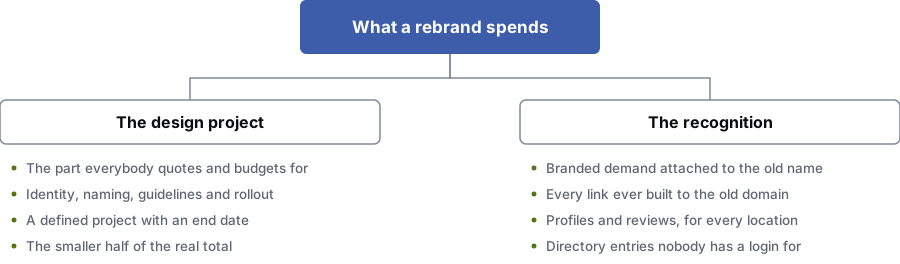
The design fee is the smaller part of what a rebrand costs. Everyone quotes it. The recognition your old name earned is the bigger part. It has to be won back, and it never shows up on an invoice.
The design project
- The part everyone quotes and budgets for
- Identity, naming, guidelines and rollout
- A set project with an end date
- The smaller part of the full cost
The recognition
- Searches for your old name
- Every link ever built to the old domain
- Profiles and reviews, for every location
- Directory listings nobody has a login for
The list
Everything that carries your old name and won’t update itself
Each of these has to be changed by hand. None is a reason not to rebrand, but all of them are a reason to know how big the project is before you agree to it.
- Every link ever built to the old domain, which now relies on redirects being kept in place for good
- Searches for your old name, which people will keep making for years
- Your Google Business Profile and its reviews, for every location
- Directory and citation listings on dozens of sites, many with logins nobody still has
- Review site histories, which may or may not move across to a renamed business
- Email addresses, the sending reputation of a new email domain, and every automated message
- App store listings, integrations, partner directories and marketplace profiles
- Signs, vehicles, packaging, uniforms, printed material and anything already in customers’ hands
- Contracts, invoices, terms and any document that names the legal company
- Descriptions of your business that search engines and AI read, which will disagree for a long time
- Internal systems, templates and the dozens of places the old name is built in and forgotten
Often skipped
How a rebrand affects your search traffic
If your rebrand includes a new domain, the hit to search traffic is the biggest single risk in the project. Google documents how to move a site to new URLs, and the process works, but it isn’t guaranteed or instant. How much you lose, and for how long, depends on your links, your size and how carefully the move is done.
Brand searches surprise people more than redirects. People keep searching for your company by its old name, while the new name starts near zero and has to be built up, usually with paid ads nobody budgeted for.
A second, slower cost is how machines describe you. Search engines and AI tools match a business to one identity, and after a name change the web holds two versions of you: the old name in years of coverage and directories, the new one in whatever you have published since. Until they line up, an AI assistant asked about your market has less reason to name you at all.
Two decisions reduce all of this a lot. First, don’t change the name and rebuild the website at the same time; if results fall, nobody can tell which caused it. Second, if the domain must change, keep your URL paths the same, so the redirect map becomes a simple copying job.
Then budget for the recovery. Many rebrands fail for reasons that have nothing to do with the technology: the business spends everything getting to launch day, with nothing left to make the new name known.
Questions
Common questions about when to rebrand
How much search visibility will we lose by changing domain?
Nobody can give you a number in advance. Google documents how to move a site to new URLs, and the process works, but a domain change still brings a period of disruption whose depth and length depend on your links, your size and how well the move is done.
The shape is predictable: an early dip and a recovery that takes months, while searches for your new name are built up from close to zero.
When is a rebrand clearly the wrong answer?
When the problem would still be there if you kept the name and changed everything else. Poor sales, a weak offer, a confusing website, a product people don’t want and mixed messages are all real problems, and a new name fixes none of them.
It is also wrong when the team is just bored of the brand. Businesses tire of their own look years before customers notice.
Can we change the name without changing the domain?
Sometimes, and it removes the biggest single risk. Some businesses use a new name on their existing domain for a while, so people get used to it before the technical move.
It isn’t always possible: a name that no longer matches the web address is confusing, and trademark or ownership issues may force the change. Where it is possible, it turns one large risk into two smaller ones.
What about our reviews and listings?
You can rename an existing Google Business Profile by editing it, though Google’s help pages note that a name change may mean verifying the business again. Other review sites vary, and some treat a renamed business as a new one, so check each one you rely on before you commit.
Directory listings are the slow part. There will be more than you expect, many on sites nobody has a login for, and descriptions of your business across the web will disagree for a long time.
Is a refresh enough instead?
Often, yes, though it is the option most often skipped. A refresh updates your look, your messaging and your website and keeps the name, so you keep everything the name has earned and fix most of what people dislike.
Ask what exactly goes wrong if the name stays. If the answer is that it looks old-fashioned, or that a new executive dislikes it, you need a refresh, which costs far less and spends none of your recognition.
How long before things settle down?
Longer than the project plan assumes. The technical move can be done in a weekend; recognition takes as long as your market needs to see the new name enough times.
Budget for that second part. A common mistake is spending the whole budget on design and launch, leaving nothing to make the new name known.
References
Sources for when to rebrand
The official documents and research this page is based on. Platform rules change, so check the source before you act on a detail.
Start here
Check the case for a rebrand before you commission one
Tell us why the rebrand is being proposed, and we will check whether a new name solves it, or whether a refresh, new messaging or brand architecture work would do the same job for much less.
Rather check it yourself? Try our free SEO tools