
Should you rebrand?
Should you rebrand? Work out what it puts at risk before you commit
Rebrand only if your current name can’t carry a change customers will notice. Most rankings and reviews lost in a rebrand go because things were done in the wrong order.
Brand basics
ExampleColour
Type
Voice
One line that says what you do and who it is for, used the same way everywhere.
The order to follow
Six stages of a rebrand, and why design comes late
Most rebrand damage comes from doing the right things in the wrong order. This order goes wrong least often, even with a fixed launch date.
Work out what the rebrand is meant to change
Write one sentence about what will be different for a customer after launch, and test it with people outside the business. If nobody can name a change customers will notice, stop here: the rest would cost a lot and fix nothing.
You get: A written statement of the intended change, tested outside the business
List everything that carries the old identity
Every domain, profile, listing, directory, marketplace, review site, email signature, invoice template, vehicle, uniform, supplier record and contract. It takes a few days and is the best predictor of whether a rebrand goes smoothly. Give each line an owner.
You get: A full list of assets, each with a named owner
Sort out legal and platform questions before renaming anything
Check the trading name registration, trademark clearance and references in contracts. Above all, find out what each platform does to your history when the name changes, in writing where it allows. Find out after renaming and your options are gone.
You get: A written answer for each platform and each legal requirement
Move the domain and change nothing else
Keep the same URLs, content, structure and templates, with one-to-one redirects. Verify both domains in Search Console. Keep the old domain and don’t let it expire. Say no to every request to improve something at the same time: a redesign bundled into a domain move turns a manageable change into a loss nobody can explain.
You get: A finished move with a one-to-one redirect map
Roll out the new look once the move has settled
Apply the new visual identity, messaging and templates after the technical side has stopped moving. Everyone wants to do this first, which makes the earlier stages impossible to measure.
You get: The new identity rolled out, with the site move already stable
Keep telling people for longer than feels necessary
Tell customers, suppliers, partners, press and staff, then tell them again three months later. Keep the old name findable and linked to the new one for years, not months. Every search for it is goodwill you paid for.
You get: A communication plan that runs past the launch quarter
Rebrands come in different sizes
Five kinds of rebrand and the risks of each
The word covers everything from a new colour palette to merging two customer bases. Work out which one you’re doing before anyone estimates it.
| Dimension | What is at risk | What has to happen in order | What usually goes wrong |
|---|---|---|---|
| New look only | Recognition, if the change is so big customers don’t connect it | Very little, since the name and domain stay the same | The rollout stalls halfway and two looks run side by side for a year |
| New name, same domain | Listings, profiles, review history and every mention elsewhere online | Platform checks before renaming, then one coordinated update across the asset list | Profiles renamed one at a time over months, leaving mismatched records everywhere |
| New domain, same name | Search rankings, links and anything found by its URL | The move itself, kept apart from every other change | A redesign launched at the same time, so nobody can tell what caused any drop |
| Full rebrand with a domain move | All of the above at once, plus confusion inside the business | Strict stages: asset list, legal, move, new look, communication | A fixed launch date squeezing every stage into one weekend |
| Merger or consolidation | Two customer bases, two sets of reviews, two histories, one of which is going | A decision on which brand survives, made before any technical work starts | Both brands kept going forever because nobody would choose |
What a rebrand costs you
What carries over in a rebrand and what you can lose
Everyone worries about search rankings, and those can mostly be carried over. Nobody checks reviews, and those sometimes can’t be. When you find that out decides how much it costs.
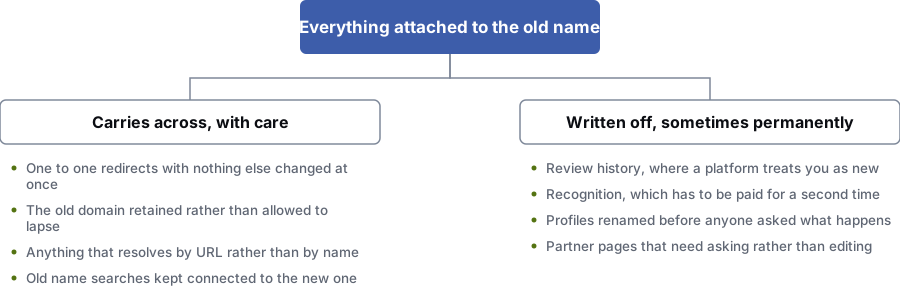
Carries over, with care
- One-to-one redirects, with nothing else changed at once
- The old domain kept, not left to expire
- Anything found by its URL, as opposed to its name
- Searches for the old name kept linked to the new one
Lost, sometimes for good
- Review history, where a platform treats you as new
- Recognition, which you have to pay for a second time
- Profiles renamed before anyone checked what happens
- Partner pages you can’t edit, only ask about
Before you commit
Three times a rebrand is solving the wrong problem
A rebrand is visible, feels decisive and gives you something to show the board. That makes it tempting to use in place of harder work.
- Nobody has heard of you, so you’re changing the name.
- If the market doesn’t recognise your current name, the name isn’t what’s failing. Rebranding spends the budget that would have built recognition and wipes out what little you had. Decide what you want to be known for and invest in that, keeping the current name unless it can’t carry that meaning.
- Sales are down, so the brand must be tired.
- Sometimes, but check the dull explanations first. A competitor may be undercutting you, a channel may have stopped working, the product may have fallen behind, or your best salesperson may have left. A rebrand takes six to twelve months and fixes none of those, while the decline carries on.
- Your own team dislikes the current identity.
- Staff see their brand hundreds of times a day; customers see it now and then. So staff fatigue is an unreliable signal, yet it’s often the unspoken reason for a rebrand. Hiring and morale matter, but call it the reason rather than dressing it up as a customer-facing one. It changes what the project should do.
How we work
How we run a rebrand, and what we won’t sign off
What we stick to
- Keeping the positioning project and the site move separate, with their own plans and sign-off
- Making the full asset list before anything is renamed anywhere
- Getting a written answer on review history from every platform that holds your reviews
- Recording your rankings and brand searches before the move, so you can measure the effect
- Recommending you keep the old domain for good, and don’t let it expire
What we will not do
- Launch a domain move and a site redesign in the same release
- Promise that your search rankings will be fully kept through a move
- Rename a profile before we know what happens to its history
- Squeeze the stages to meet a launch date set before anyone planned the project
- Go ahead with a rebrand when the issue is product, price or sales
The asset list
Everything with your old name on it that won’t update itself
Go through this before the launch date is confirmed, and give each line a named owner and a date.
- Every domain you own, including misspellings, campaign domains and ones a former agency registered
- Your Google Business Profile, and every duplicate of it that exists
- Every directory, marketplace and data aggregator listing, including ones you never created
- Every review site, with a written note on what each does to history when a name changes
- Social accounts, including handles you no longer use but haven’t given up
- Email domains, signatures, automated emails and anything else sent in your name
- Ad accounts, tracking templates, conversion names and audience settings
- Analytics properties, dashboards and any report that filters on the old name
- Legal and financial records: registrations, contracts, invoices, terms, insurance and licences
- Physical items that take a long time to replace: signs, vehicles, uniforms and printed materials
- Partner and supplier pages that mention you, which you’ll need to ask them to change
- Staff profiles and professional listings that name the old business
Questions
Questions to ask before you rebrand
Should we rebrand at all?
Only if you can say what will be different for a customer the day after launch, and your current name can’t carry that change. Good reasons include a merger, a legal dispute over the name, a business that has outgrown its name, or a name that misleads buyers. Being bored with the logo isn’t one.
If your reason holds up, the next question is what the change puts at risk. Our guide to when to rebrand goes through the reasons one at a time.
Will we lose our search visibility if we change domain?
Some short-term movement is normal even when a move is done well, and it’s usually temporary. Lasting damage rarely comes from the change of address. It comes from what’s bundled with it: a new structure, rewritten content, dropped pages and a redirect map thrown together the night before.
Move the domain and change nothing else: same URLs, content and structure, with one-to-one redirects. Redesign later, once the move has settled.
Do our reviews transfer to the new name?
It depends on the platform. Some treat a name change on an existing profile as the same business and keep the history. Others treat a very different business as new, and there’s no way back.
Check every platform that holds your reviews before you rename, in writing where you can. Skip this and you may swap years of reviews for a new logo.
What order should a rebrand happen in?
Decide and test the positioning. List everything that carries the old identity. Deal with legal and platform requirements. Move the domain, with the site otherwise unchanged. Roll out the new look. Then tell people. Design last feels backwards, but it’s the order that goes wrong least often.
If your date is already fixed: never combine the domain move with a redesign, and never rename a profile before you know what happens to its history.
How long before things settle down?
For search, expect ups and downs for several weeks and a clearer picture within a few months, as long as the move was clean and nothing else changed at the same time. Larger sites and competitive markets take longer.
For recognition, much longer. People searching for your old name shows how much goodwill you’re carrying, and it usually goes on for years. Plan to answer to the old name for longer than your internal announcements suggest.
When is a rebrand the wrong answer?
When the product doesn’t deliver, the sales process is weak, or the market has never heard of you. A new identity fixes none of those, and uses up the budget and attention that could have.
If what will be different for a customer the day after launch is "the logo", the rebrand is being used to dodge a harder conversation.
Where to get help
Services that solve this
Technical SEO
Technical SEO makes sure Google can crawl, read and index your pages, and that your site is fast. We fix what blocks them so the rest of your SEO can pay off.SEO & Organic Growth
Phone not ringing while competitors show up above you? Our SEO services fix your site, write the pages buyers search for and show you every call and form it brings in.Reputation & Review Management
Online review management that gets you more real reviews without breaking platform rules. We build the asking into your routine and reply properly to criticism.Website Design, Development & Conversion
Our web design agency builds fast, accessible websites you own, planned for Google and for enquiries before design starts.
Get the order right before the launch date is fixed
Bring us the new name, your current domain and your launch date. We’ll tell you which parts carry real risk, what has to happen in what order, and whether any of your review history is about to be lost.
Prefer to talk it over? Book a free call
Your BOOSTD score improves within 90 days, or your next month is free. After 6 months, more traffic or leads, or we keep working free (up to 6 free months in any 12 months). Read our guarantee
References
Sources for should we rebrand
The official documents and research this page is based on. Platform rules change, so check the source before you act on a detail.
Related
More ways to fix this
- the five triggers that justify a rebrandThe longer version of the first question on this page.
- carrying search rankings through a domain changeThe part of a rebrand that’s a technical project with a deadline.
- reviews that may not follow the new name
- the launch risks that come with it
- the recognition you would be paying for a second time
Last updated · Published by Zubair Afzal, responsible editor