
Administrative & Facilities Services
Marketing for facilities, support and outsourced services
These contracts are awarded by procurement, delivered by people on site and renewed almost silently. The work is getting onto the tender list, proving compliance before anyone asks for it, and becoming difficult to remove from an account once inside it.
Prefer to talk it through? Book a strategy call
The category
Administrative & Facilities Services: what the businesses have in common
Administrative, facilities and support services are bought the way a company buys insurance: reluctantly, on evidence, and with somebody in procurement asking the questions a salesperson would rather avoid. Very little about the process rewards a clever campaign.
What it does reward is being findable at pre-qualification, being obviously compliant before anyone asks, and being difficult to remove once you are inside an account. These pages are organised around those three jobs.
Comparable or scarce
Two support contracts, two arguments that cannot be swapped
Support and facilities work is either priced against a measurable unit or bought because almost nobody else can do it. A provider making the wrong one of those two arguments is sitting in a tender it cannot win.
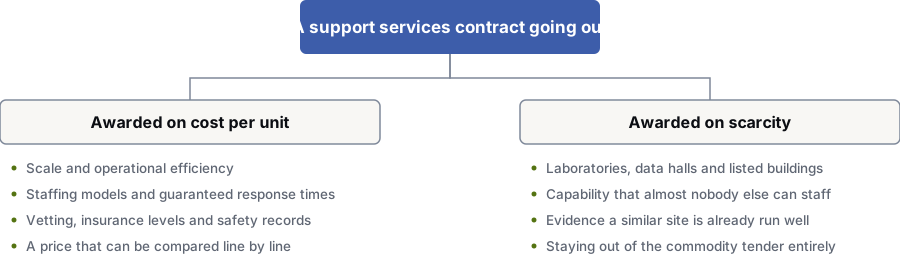
Awarded on cost per unit
- Scale and operational efficiency
- Staffing models and guaranteed response times
- Vetting, insurance levels and safety records
- A price that can be compared line by line
Awarded on scarcity
- Laboratories, data halls and listed buildings
- Capability that almost nobody else can staff
- Evidence a similar site is already run well
- Staying out of the commodity tender entirely
Where they split
Where one business services strategy stops working
These differences are the reason the pages below are written separately rather than as one page with the business type swapped out.
- Service delivered on site and service delivered remotely diverge immediately. A cleaning or maintenance contract is bounded by where staff can travel and by local labour supply; an outsourced administrative function has no geography at all and competes internationally on cost.
- Single-site and multi-site contracts are entirely different sales. One is a conversation with a building manager; the other is a national agreement negotiated centrally, mobilised across twenty locations at once, and awarded largely on whether the bidder can prove they have done it before.
- Parts of this sector are licensed and parts are not. Security, waste handling, catering and staffing carry inspection, right-to-work and certification obligations that a records management supplier does not, and what may be claimed in advertising follows those rules.
- Commodity and specialist providers cannot use the same argument. A contract awarded on cost per square metre rewards scale and operational efficiency; a specialist handling laboratories, data halls or listed buildings sells scarcity and should not be in that tender at all.
Questions
Business services marketing questions, answered
Our work comes through tenders and frameworks. What is marketing actually for?
Getting you into the process and shaping how you are read once you are in it. Being eligible to bid is a marketing outcome: pre-qualification depends on accreditations, insurance, financial standing and demonstrable similar work, and a provider who cannot evidence those never sees the tender at all.
The second job is familiarity. Two submissions of equal quality do not score equally when one comes from a firm the evaluator has read something useful from and the other from a name they have never encountered.
Confidentiality stops us naming who we work for. How do we prove anything?
Describe the work rather than the customer. Sector, site type, floor area, headcount served, shift patterns, response times achieved and the specific problem solved communicate capability without breaching a confidentiality clause.
That description is often more persuasive than a logo. A buyer running three distribution centres cares that you already run three distribution centres; the name above the door tells them considerably less than the operational detail does.
Who are we writing for — procurement or the facilities manager?
Both, in different documents. The facilities or operations lead usually starts the process and decides who they want; procurement decides who is permitted to be chosen and how the scoring works.
In practice that means one set of material aimed at the operational problem and one aimed at eligibility and risk. Providers who write only for the first get championed and then disqualified; those who write only for the second get through the gate with nobody inside wanting them.
Is there any real search demand in facilities and support services?
Less than in consumer markets and more than most providers assume, and it clusters in places they rarely cover. Buyers search by requirement rather than by service name: an accreditation they have been told to insist on, a regulation with a deadline, a problem with a specific building type.
That demand is small in volume and close to uncontested, which is an unusual combination. It also arrives with a date attached, which is why it converts at rates that make the raw numbers misleading.
How should we market to keep contracts rather than to win them?
Treat the renewal as a campaign with a known date, because it is. The notice period, the review meeting and the point at which the client starts looking around are all predictable, and most providers do nothing until the incumbent advantage has already gone.
The work itself is routine: performance reported in a form the client can show their own board, visible improvement against the things they complained about, and a named person raising the next service before somebody else does.
Where to start
Where business services marketing starts
This sector is covered on this page rather than split into separate industry pages. These are the services that apply, and the neighbouring sectors that sell to the same buyers.
Services that do the work
Sectors that share these buyers
More to explore
Last updated · Published by Zubair Afzal (responsible editor), on owner authorisation