
Insurance Brokers marketing
Insurance broker marketing that grows your book and your renewals
Insurance broker marketing that treats renewal as the main event, because a client is worth every renewal after the first sale.

Common problems
Is your insurance broker marketing wasting money?
A brokerage makes its money by keeping policies, more than by selling them. A client is worth the sum of the renewals after the first sale, and almost none of that shows up in a new business report.
So insurance broker marketing puts renewal at the centre. Selling more policies to each client is a growth channel in its own right, and the classes you choose to write matter more than the number of quotes.
- The whole budget goes to new business and none of it goes to renewal.
- Retention is where a broking book is built, yet it is usually left to the account handler and a renewal letter. A few points of extra retention add up to a very different business within a few years. It also costs far less than winning the same premium as new business. If you’ve never run a renewal programme, it is probably the best return available to you.
- Commercial and personal lines run through one brand and one website.
- A homeowner comparing car premiums and a manufacturer buying liability and business interruption cover have nothing in common. The trigger, the decision process, the price sensitivity and the vocabulary all differ. One homepage for both looks consumer-focused to the business buyer and intimidating to the consumer. The commercial side, which is worth more, always suffers most.
- You’re competing with comparison sites on their own ground.
- For most personal lines, aggregators sit across the whole market and rank for the searches. A broker can’t outrank or outbid them on price searches, because they show twenty quotes and you show one. You can win the risks aggregators handle badly: unusual properties and jobs, high-value items, past claims and anything that needs a conversation.
- Nobody markets to the renewal date, even though it is in the system.
- Every policy has a date when the client is free to leave, and you know it months ahead. Most brokerages send one renewal letter, close enough to the deadline to prompt shopping around. Start earlier and review the cover, not just the premium, and the riskiest moment in the relationship becomes the most productive.
- Reputation is built by the claims team and ignored by marketing.
- Clients form their true opinion of a broker when they make a claim. That is also when they’re most willing to say so in public. Brokerages that build a review request into the claims process collect reviews about the one thing prospects want to know. Without it, your reviews come from people who never used the policy.
- The website invites quotes for risks you don’t want to write.
- A generic quote form attracts every risk in the market, including ones no insurer you use will take. Account handlers then spend hours on submissions that could never be placed. Class-specific pages, a form that collects enough to screen the risk, and a clear list of what you don’t write will cut quote volume and raise your bind rate at the same time.
Where to spend
Follow-up and tracking first, then B2B search
In the order we'd put them. Start at the top.
A renewal programme, because renewal is the business
A client is worth the sum of their renewals, and most brokerages touch that date once, with a letter. A structured sequence that starts earlier, reviews the cover, points out gaps and reaches the client before they shop around is usually the cheapest growth you can buy.
Pages for the commercial classes you want to write
Write a page for each class of business, aimed at that trade. Cover the risks it carries and the limits its contracts usually demand. Volume is modest and competition is thin, because most brokers publish one commercial insurance page and stop there. These pages also give account executives something credible to send.
Reviews collected at claim stage
Build a review request into the claims process, within whatever your regulator allows. You get reviews about the moment prospects care about, from people who have used the policy.
Explain what cover does, and leave price to the quote
Price is where aggregators win and where the rules restrict you most. Clear explanations of what a cover does, where the common gaps are and what a contract requirement means reach buyers before they have a quote. They show you as the broker who understood the risk.
A quote path that screens the risk
A generic form brings in submissions no insurer will take and wastes handler time. Build a quote path for each class that asks for trade, turnover, claims history and the limits needed. Then you can route or decline before anyone starts work.
Timing
When the enquiries come in
Demand follows a calendar more closely than in almost any other sector. Every policy has a renewal date, and the shopping window opens a few weeks before it. Outside that window the client is effectively unavailable. So demand is very predictable in your own book and mostly invisible in search data.
Commercial renewals bunch around common dates, and every brokerage already knows its own pattern. Plan staff time, outreach and content around those clusters.
Search volume runs opposite to opportunity. Personal lines produce most of the searches, and aggregators take them. Commercial classes produce a fraction of the volume, with no aggregators, higher value and far weaker competition.
Life and business events create new demand: a first employee, a new vehicle, a property purchase, a new contract with insurance terms, a business purchase. These convert far better than price searches, because there is no existing policy to compare against.
Market cycles move everyone at once. When premiums rise sharply across a class, the whole market starts shopping. That is a chance to win new clients and a threat to your own book in the same quarter.
Volume against value
Most searches are where brokers compete worst
Most searching happens where a broker is weakest, and most of the margin sits where hardly anyone searches. A plan built on traffic gets this backwards.
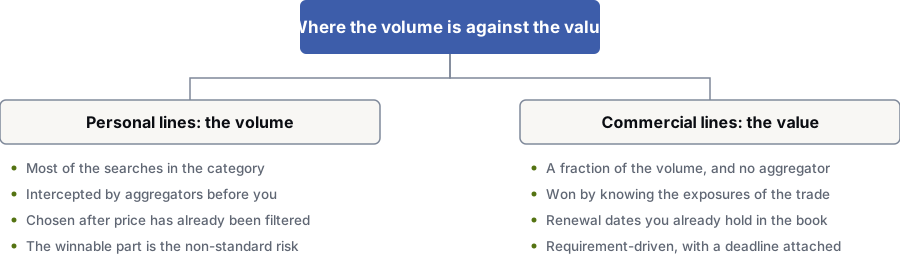
Personal lines: the volume
- Most of the searches in the category
- Aggregators get there before you
- Chosen after price has been filtered
- The winnable part is the unusual risk
Commercial lines: the value
- A fraction of the volume, and no aggregators
- Won by knowing the risks of the trade
- Renewal dates you already hold in the book
- Driven by requirements, with a deadline
What people search
Searches like “public liability insurance for electricians”
Commercial, class specific
Thin volume and no aggregators. The buyer wants someone who knows the trade.
- public liability insurance for electricians
- professional indemnity insurance for architects
- cyber insurance for small business
- restaurant insurance quote
- insurance for a haulage company
- contractors all risks insurance
Requirement driven
Someone has been told to get a specific cover with a specific limit. There is a deadline and no existing policy.
- do i need employers liability insurance
- landlord requires certificate of insurance
- insurance requirements for a construction contract
- minimum professional indemnity limit for consultants
- certificate of insurance for an event venue
Cover questions
Research, not buying. A broker can be useful here without giving a quote.
- what does professional indemnity cover
- difference between public and product liability
- is business interruption covered by my policy
- what is an insurance excess
- does home insurance cover flood damage
Non-standard and problem risks
What comparison sites handle badly. The personal lines demand a broker is most likely to win.
- insurance for a thatched property
- car insurance after a claim
- unoccupied property insurance
- insurance broker near me for non standard risk
- insurer refused to renew my policy
These are example searches from keyword research and public search data. Before we suggest anything, we check how often people search for them in your area.
Your website
What your website needs
- A page for each class of business you want, written in that trade’s language
- A clear list of the risks you don’t write, which filters better than any form field
- Registration and licensing shown clearly, with the markets and insurers you can access
- A quote path that collects enough to screen the risk, not just a generic contact form
- A clear description of what you do when a client makes a claim, since that is what they’re paying for
- Your renewal process explained, including when the client will hear from you and what you’ll review
- Named account handlers and executives, because commercial clients want to know who will answer the phone
- Documents and certificates easy to find, as this is the most common reason an existing client visits
How they choose
How the shortlist gets made
Know how they choose and you know where to show up.
- In personal lines, an aggregator usually builds the shortlist, so price has been filtered before anyone picks a broker. From there you win by being easy to reach, handling what the comparison site couldn’t, and looking like an established business with named people.
- In commercial lines, the question is whether you understand the trade. A broker who knows the specific risks of a class, and says so unprompted, beats a faster quote from a generalist almost every time.
- Access to insurers matters, and buyers increasingly ask about it. Whether you can place an unusual risk, and which insurers you can approach, decides whether the conversation goes on.
- Claims reputation is the strongest single signal, and people read it in reviews, not on your website. A prospect wants proof of what happened when something went wrong. A paragraph about your service values won’t do that.
- Inertia is strong and often underestimated. Most commercial clients stay put until the renewal price jumps, a claim goes badly or a requirement changes. So timing your approach matters more than the strength of your pitch.
- A specific outside requirement often drives the whole purchase. A landlord, a contract, a licensing body or a customer demands a certain cover with a minimum limit. The buyer then searches for that requirement by name.
The rules
Advertising rules to know
Selling insurance is licensed, and its advertising is regulated. The common rules are: disclose the regulated firm and its registration number, follow the rules on calling yourself independent or whole-of-market, keep price and cover claims within limits, make product documents available, and keep records of marketing.
Content about what a policy covers is the riskiest material on a broker’s website, because any explanation of cover can be read as advice. Every such page must match the actual policy wording. It must say clearly that cover depends on the policy issued and the person’s circumstances. Someone qualified in that market must review it before it goes live.
The rules differ a lot between Canada, the United States, the United Kingdom and the United Arab Emirates. Regulators, licence types, the line between information and advice, and how comparisons may be framed all vary. Copy approved in one market must be reviewed again before you use it in another.
Testimonials and reviews have their own rules in several places. Never tie an incentive to what a review says or to the outcome of a claim, and many review platforms ban incentivised reviews altogether. Where a regulator restricts testimonials in financial promotions, reviews on third-party platforms are treated differently from quotes on your own site. Check how that works locally.
We write with these rules in mind and flag anything that needs judgement. Compliance stays with the brokerage. Every claim about cover, price, independence or regulatory status must be confirmed with your own compliance team or regulator. We don’t give legal, regulatory or financial advice.
Sources
Where these rules come from
Each rule above, linked to the body that publishes it. Which ones apply depends on where you work. Rules change, so check the latest version.
- An insurance intermediary must disclose its status and whether it advises on a fair analysis of the market.
- FCA ICOBS 4.1
- Source: UK — FCA Handbook, ICOBS 4.1
- Communications with insurance customers must be clear, fair and not misleading.
- FCA ICOBS 2.2
- Source: UK — FCA Handbook, ICOBS 2.2
- Testimonials in life insurance adverts must be genuine, and any payment or financial interest disclosed.
- NAIC Model 570, s. 5Q
- Source: US — NAIC Advertisements of Life Insurance and Annuities Model Regulation (model for states)
Questions
Questions about insurance broker SEO and ads
Where should we spend if we can only fund one thing?
Renewal, in almost every case. Retention grows the value of the book, it costs less to influence than new business, and most brokerages have never run a structured programme for it.
The exception is a brokerage moving into a new class of business on purpose. There is no book to keep yet, so the whole job is showing you write that class well.
Can we compete with comparison sites in personal lines?
Not on price searches, and it helps to accept that early. An aggregator shows twenty quotes on one page and you can show one. The search results reflect that.
You can compete where they’re weak: unusual properties, unusual jobs, high-value contents, past claims, refused renewals and anything that needs a conversation. That demand is smaller and much less contested. It brings clients who stay, because price was never their only reason for coming.
How do we get reviews when clients only think about insurance once a year?
Ask at claim stage. A client who has just been through a claim has an opinion worth sharing and a reason to share it. It is also the experience every prospect is trying to judge.
Check the request against your own rules first. Nothing may depend on the review or on the claim outcome. Some regulators also restrict testimonials in financial promotions, which affects how you can use reviews once you have them.
Should our commercial and personal lines be on the same website?
They can share a domain, but they need separate front doors. The two buyers have nothing in common. A homepage that greets both looks consumer-focused to a business buyer, and that costs you the more valuable side.
Separate sections, navigation and enquiry paths are usually enough. Some brokerages split the brands completely. That works when the commercial offer is specialised enough to stand alone.
Why is a mortgage brokerage marketed so differently from an insurance brokerage?
Because the revenue behaves differently. A mortgage completes and then goes quiet for years. So its marketing is about catching the event, and the referral partners who see it first.
A policy renews, so the client is a recurring asset with a date attached. That puts retention, cross-selling and claims experience at the centre of the plan. Which classes you write matters far more than how many enquiries you get.
See what to fix first
Start with the free checkup. It shows what to fix first on your website, with no sign-up. Want the full plan for your insurance broker business? Book a call, and we'll look at your market, your competitors and the searches that bring in customers.
Prefer to talk it over? Book a free call
Your BOOSTD score improves within 90 days, or your next month is free. After 6 months, more traffic or leads, or we keep working free (up to 6 free months in any 12 months). Read our guarantee
References
Sources for insurance broker marketing
The official documents and research this page is based on. Platform rules change, so check the source before you act on a detail.
Related
More on insurance broker marketing
Last updated · Published by Zubair Afzal, responsible editor · We check this page every three months. Next check: .