
Hospitality & Food Service
Hospitality marketing for restaurants, hotels and hospitality groups
A table that goes empty tonight cannot be sold tomorrow. Hospitality marketing is mostly the work of moving demand into the hours you cannot fill, and of keeping the commission-taking middlemen from owning your customer.
Prefer to talk it through? Book a strategy call
The category
Hospitality & Food Service: what the businesses have in common
Hospitality has an economic feature almost no other sector shares: the inventory expires nightly. Everything about how the marketing should work follows from that, including the parts that look counterintuitive.
It is also the category most thoroughly intermediated at the point of purchase. Aggregators, booking platforms and map results sit between the venue and the guest, and each of them takes something — a commission, the customer relationship, or the ability to speak to that person again.
The result is a discipline that is less about generating demand than about redirecting it: into the empty sessions, away from the commission channels, and towards the guests who come back without being paid for twice.
Created or only moved
Some hospitality demand can be created, the rest can only be moved
Inventory expires nightly in both halves of this sector, which makes it look like one market. The difference is whether more people can be brought out tonight, or the same people are only choosing between nearby venues.
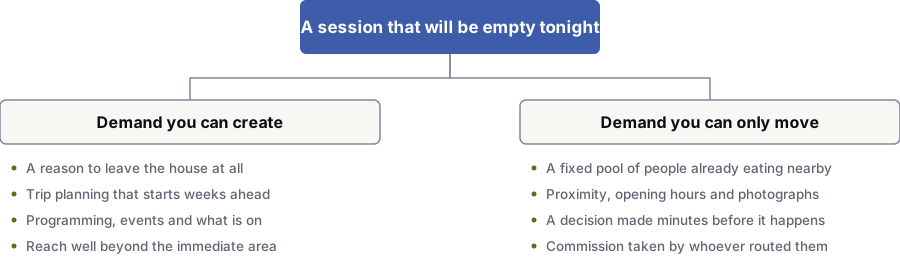
Demand you can create
- A reason to leave the house at all
- Trip planning that starts weeks ahead
- Programming, events and what is on
- Reach well beyond the immediate area
Demand you can only move
- A fixed pool of people already eating nearby
- Proximity, opening hours and photographs
- A decision made minutes before it happens
- Commission taken by whoever routed them
Where they split
Where one hospitality strategy stops working
These differences are the reason the pages below are written separately rather than as one page with the business type swapped out.
- The booking horizon differs by an order of magnitude. A meal is often decided under an hour before it happens, while a hotel stay or an event booking is researched weeks or months ahead, and the two need entirely different search and content work.
- The intermediaries are not the same and do not behave the same. A delivery aggregator takes a commission on food that leaves the building; a booking platform influences whether anyone arrives at all. The strategies for reducing dependence on each are different.
- Single sites and groups have opposite structural problems. An independent has to be findable at all; a group has to stop its venues competing with each other in search and keep a dozen sets of hours, menus and listings accurate at once.
- Some hospitality demand can be created and some can only be moved. A destination venue can attract people who were not going out; a lunch trade in an office district is competing for a fixed number of people who were always going to eat somewhere nearby.
Questions
Hospitality marketing questions, answered
We are fully booked at weekends. What is marketing supposed to do?
Fill the rest of the week, and improve what each covered seat is worth. A venue that is full on Saturday and quiet on Tuesday has the same rent, the same staffing structure and the same equipment on both days, so the midweek gap is where the recoverable profit sits.
That work looks different from awareness advertising. It tends to be offers built for a specific session, content aimed at occasions that happen midweek, and using the list you already have rather than buying new reach.
Can we realistically get off the delivery and booking platforms?
Off them entirely, usually not, and it is rarely the right target. They generate discovery you would struggle to replace, and disappearing from them hands that demand to a competitor.
Shifting the mix is achievable. A significant share of platform transactions come from people who already knew you, and making direct ordering or booking easier — clearer on the site, visible in your profile, worth a small incentive — moves those without giving up the discovery.
How much do reviews actually affect trade?
In hospitality more than in almost any other local category, because the rating appears directly in the results where the decision gets made and there is no other way for a stranger to judge the experience.
The lever most operators underuse is not the score but the response. A calm, specific reply to a real complaint is read by everyone who arrives later, and a steady flow of recent reviews matters more than a high average built years ago.
We are a group with several venues. Should each have its own site?
Usually one site with a properly built page for each venue, rather than either a single blended page or a set of separate domains. Each location needs its own address, hours, menu, photography and booking path so it can compete in its own local results.
Separate domains fragment the effort and separate the reputation; a single blended page means no venue ranks well anywhere. The group structure question is worth settling before any other work, because it determines what everything else is built on.
More to explore
Guides that answer the same questions
Other sectors
Last updated · Published by Zubair Afzal (responsible editor), on owner authorisation