
Restaurant Groups marketing
Restaurant group marketing agency that makes every site count
Restaurant group marketing that helps every site win its own neighbourhood, under one brand and one set of per-site numbers the whole group trusts.

Measuring results
Track the leads that pay
These numbers show if your marketing brings in customers. Website visits alone don't.
- Covers per site against that site's own history, never against the group average
- Review score and how fast new reviews arrive, per site, with the weakest site named, not hidden in an average
- Time from opening to steady covers at a new site, tracked as a curve you can repeat
- Searches for the group name, kept apart from searches for a site plus its town
- Share of direct bookings and orders per site, because the app mix differs by neighbourhood
- How accurate every profile is across the estate, reported as an operational number with a named owner
- Covers at existing sites before and after an opening nearby
- Local marketing spend per site against that site's extra covers, not against group revenue
Common problems
Why your restaurant group marketing isn't bringing in work
Restaurant group marketing isn't marketing one big restaurant. A group is a brand with a central budget plus a set of sites, each with its own neighbourhood, trading pattern, competitors and reputation.
The usual argument is about who decides what. Head office wants consistency; the general manager wants to react to Thursday's road closure. Each is right about different things, so first agree which decisions belong to whom.
- The group average hides the site that is failing.
- Two strong sites can hide one in decline for months. Group-level covers, review score and revenue make problems surface late, after the reviews have slipped for a quarter and the general manager has quit. Report each site on its own, with the worst performer named on page one.
- Menus and hours drift, and you find out from a review.
- One kitchen drops a dish, another changes Sunday hours, a third changes supplier and an allergen with it, while the website and profiles still show the last brand meeting's version. You hear about it in a one-star review. Set up publishing so a site can differ from the group on purpose, and accidental differences show up as errors.
- Every profile is somebody different's side job.
- Profiles were claimed at different times by different people, several tied to departed staff's email addresses. A manager renamed one; two show a fit-out that never happened. They sit in no department, and across twelve sites that loses customers every week. The fix is a named owner and a routine.
- Nobody has decided what a new site inherits.
- Some groups assume the brand carries everything and launch with a poster and a press release; others start from scratch. The answer is in between and knowable in advance. Name recognition carries over where people know the brand; reviews, local ranking history and photos tied to the new address don't.
- Central creative cannot answer a local question.
- A home match, a district school holiday, a bus diversion or a competitor closing moves a site within days, and no quarterly head-office calendar can react. Fully central groups miss that trade; fully local ones get twelve looks and legal risk. The middle ground is a short, pre-approved list of things a site can do without asking.
What people search
Searches such as “[group] restaurants”, grouped by intent
The group by name
Brand demand the group owns. Easy to serve well, yet often it lands on a homepage that lists nothing.
- [group] restaurants
- [group] locations
- [group] menu
- [group] gift card
- [group] jobs
One site, by name and town
Someone has picked a specific venue. These should resolve in one tap, and often land on the wrong site.
- [group] [town] menu
- [group] [town] book a table
- [group] [town] opening hours
- [group] [town] reviews
- [group] [district] parking
Local searches each site must win
Where a site competes with its actual neighbours, and the group brand helps very little.
- best [cuisine] restaurant [neighbourhood]
- brunch near me [town]
- restaurants with private dining [district]
- sunday lunch [town] booking
- restaurants near [station] open late
A site that has not opened yet
A short, busy window with no reviews and no history. Almost every group neglects it.
- [group] opening in [town]
- new restaurants opening [city]
- [group] [town] opening date
- [group] [town] booking now open
These are example searches from keyword research and public search data. Before we suggest anything, we check how often people search for them in your area.
How they choose
Who decides, and what they look for
Know how they choose and you know where to show up.
- Guests choose a site, not a group, on how close it is, the reviews for that building and whether it's open now. The brand only speeds things up for people who know the name.
- Brand recognition is a shortcut. It gets a new site considered, but the first twenty reviews at that address shape the next few months, and group reputation can't replace them.
- Guests compare each site with your other sites, a standard nobody else faces. Someone who ate well at one venue expects the same at another, so inconsistency hurts the brand more than the site.
- Corporate, group and private bookings are made at group level. These buyers want one contact, invoicing across cities and the same standard at four venues. It's a different sale that usually falls to whoever answers the phone.
- Guests can't tell an owned site from a franchised one, which is why a weak franchisee is a risk to the whole group, not just locally.
- Hiring now happens through the same channels as guest choice. Front-of-house candidates read the reviews and profile of the site they'd work at, so visible reputation affects staffing as well as sales.
What the brand buys
What the group name does for each site, and where it stops helping
Guests choose a venue, not a group. The brand just makes that choice quicker. Everything after that is decided at one address.
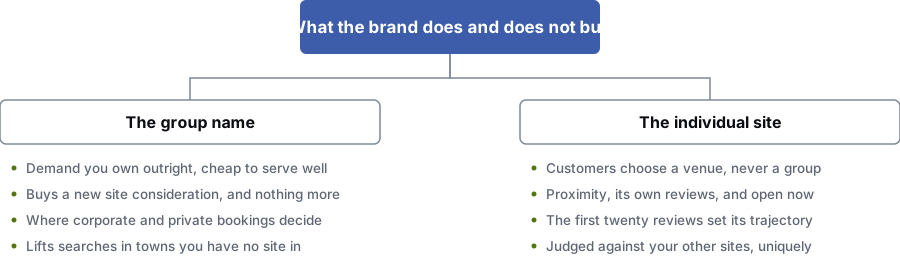
The group name
- Demand you own, and cheap to serve well
- Gets a new site considered, nothing more
- Where corporate and private bookings decide
- Lifts searches in towns with no site
The individual site
- Guests choose a venue, never a group
- How close it is, its reviews, open now
- Its first twenty reviews shape its path
- Judged against your other sites
Where to spend
SEO for each location first, then your Google profile
In the order we'd put them. Start at the top.
A proper page for each site under one brand
Each venue needs a crawlable page with its own address, hours, menu, photos and booking link, built from site-level details, not a template with the town swapped. Decide how group, site and category pages fit together before the estate grows.
One owner and one routine for every profile
Most local choices happen on the map profile, and profiles decay first across an estate. Centralise ownership so a departure doesn't orphan a listing, standardise names and categories, set holiday hours centrally in advance, and give each site a short list of things it can change.
Reviews run and reported per site
Review scores don't carry over between venues, and nor do the problems behind them. Each site needs its own routine for fresh reviews and its own person replying, while the group sets the tone and watches for patterns. One estate-wide score is how a failing kitchen stays hidden for a quarter.
One set of numbers everyone works from
Most marketing arguments in a group come down to measurement: operations reports covers, marketing enquiries, finance revenue. Build a per-site view that operations trusts, including shared catchments and new-site ramp-up curves, so the talk moves to what to do next.
Your website
Make your site easy to buy from
- One domain with its own page for each site, showing that site's address, hours, menu and booking link
- A menu setup where a site can differ from the group on purpose without it looking like an error
- Hours managed once and sent to every profile, with holiday changes set before the holiday
- A group-level route for corporate bookings, private hire and gift cards, separate from any one site
- Site pages naming the head chef or general manager where true, because that makes a site feel local
- A page for a site that hasn't opened yet, with a date and a way to register interest
- Careers content for each site, since hiring happens through the same channels as bookings
- Structured data for each site that matches both the page and that site's profile
- Fast on a phone, because most of this traffic comes from someone standing near one of your doors
The rules
Claims to avoid
Publishing menus from head office for each kitchen brings a duty of care a single restaurant doesn't have. You may need allergen information, and in some markets calorie or nutrition details, depending on your size and where you trade, and a group publishing centrally speaks for kitchens it doesn't stand in. We set up publishing so a site's differences are recorded and dated, not silently overwritten. Please confirm what applies with your food authority or legal adviser. This is not legal advice.
Franchise structures limit who can say what. The franchise agreement sets what a franchisee may publish about the group, what the group may require of franchisee advertising, and how a franchised site must be named, and in several markets franchise disclosure rules apply. If your estate mixes owned and franchised sites, build the marketing around that split first.
A promotion across the estate can be legal in one place and not another. Alcohol offers, price promotions, loyalty schemes and competitions are regulated differently by country and often by state or province, so a multi-market group campaign needs checking in each. We flag the areas that often carry rules; confirming them is for your adviser.
Sources
Where these rules come from
Each rule above, linked to the body that publishes it. Which ones apply depends on where you work. Rules change, so check the latest version.
- US restaurant chains with 20 or more locations must show calories on menus and menu boards.
- FDA menu labelling
- Source: FDA menu labeling requirements (US)
- Requires large out-of-home food businesses in England to display calorie information for non-prepacked food.
- Calorie labelling 2021
- Source: DHSC calorie labelling guidance (England)
- US franchisors must give a prospective franchisee a disclosure document before any agreement is signed.
- FTC Franchise Rule
- Source: FTC Franchise Rule, 16 CFR 436 (US)
Questions
Quick answers on restaurant group marketing
How much should restaurant group sites be allowed to do themselves?
Agree a short, specific list. Things that change within a week and need local knowledge belong to the site: hours, photos, review replies, a local offer, a post about a match or a road closure.
Anything that carries the brand or creates an obligation stays central: identity, menu structure, pricing, claims and allergens. Write it down as a list and the argument stops coming back.
Does a new site inherit the group's reputation?
It inherits recognition, nothing else. People who know the brand give the new site a chance, but the reviews, local search history and photos for that address start at zero.
So an opening needs its own plan: create and verify the profile early, put a detailed page live before the doors open, push for the first reviews on purpose, and expect steady trade to take months.
We are opening two miles from an existing site. What should we expect?
Some of the new site's covers will come from the old one, hidden in the group total. Record the existing site's covers by session before opening so you can see the shift.
That doesn't make the opening wrong; closer sites can suit delivery, staffing and brand presence. It keeps the business case accurate, which matters when the next opening is justified on this one's numbers.
Our general managers have no time for marketing. Is local activity realistic?
Only if it's small and specific. A local marketing plan achieves nothing; four photos a month, review replies within two days and flagging local events gets done, in minutes each.
The central team should do everything it can, including holiday hours, leaving sites the few tasks that need someone in the building.
Should each restaurant have its own social account?
Yes, if the venue has a local identity and someone who'll post. Otherwise an abandoned account is worse than none; a feed last updated in March looks like a business in trouble.
Ask whether the site has something to say the group account can't. A match, a neighbourhood, a chef or a room earns an account; the same specials as everywhere else don't.
Get a free website check
Start with the free checkup. It shows what to fix first on your website, with no sign-up. Want the full plan for your restaurant group business? Book a call, and we'll look at your market, your competitors and the searches that bring in customers.
Prefer to talk it over? Book a free call
Your BOOSTD score improves within 90 days, or your next month is free. After 6 months, more traffic or leads, or we keep working free (up to 6 free months in any 12 months). Read our guarantee
References
Sources for restaurant group marketing agency
The official documents and research this page is based on. Platform rules change, so check the source before you act on a detail.
Related
More on restaurant group marketing
Guides for restaurant group
Other hospitality businesses
Last updated · Published by Zubair Afzal, responsible editor