
Multi-Location Retail marketing
Multi-location retail marketing that shows what each store stocks
Multi-location retail marketing for store chains: show shoppers what each store has in stock, and credit the sales that end at a till.

How they choose
How customers decide who to hire
Know how they choose and you know where to show up.
- Shoppers weigh distance and stock at the same moment. They don’t want the nearest store. They want the nearest store that has the item today. A retailer who answers only half of that loses to one who answers both, even if the second shop is further away.
- The decision usually happens on a Google Business Profile. Hours, directions, photos, the latest review, whether the phone gets answered and whether anything was posted this month all count. Often the shopper never reaches the site.
- Click-and-collect wins because the item is guaranteed to be there on arrival. It is a promise about stock more than speed, and it is the strongest answer to a marketplace’s delivery window.
- In categories where fit, weight, colour or feel matter, the store visit is the point. People research online and save the decision for a room where they can handle the product. So the marketing job ends at the shop door.
- Shoppers judge staff from reviews before they visit. In retail the product is the same everywhere, so reviews are mostly about whether anyone in the shop knew anything. That is why reviews vary so much between stores in the same chain.
- Loyalty schemes and familiarity matter for regular shopping. Someone who knows the layout of one branch will drive past a competitor to reach it. So overlap between your own stores’ areas can matter more than where a rival is.
Distance and stock together
Nobody wants the nearest store. They want the one with it
Shoppers decide on distance and stock in the same moment. A warehouse can’t answer that question, and most store pages don’t either.
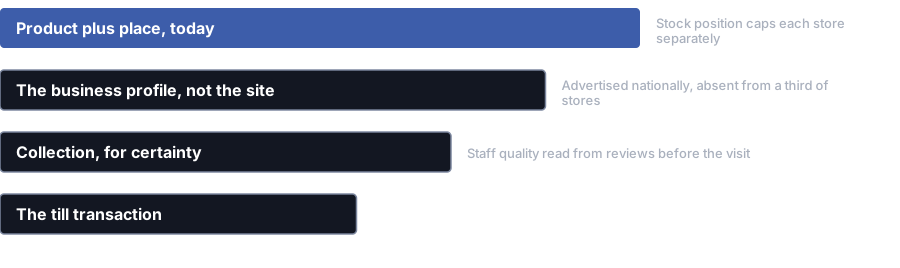
- 1Product plus place, today — A shopper wants the nearest store that has the item today. A warehouse can’t answer that.Each store is capped by its own stock
- 2The business profile — Hours, directions, photos, the latest review and whether the phone gets answered. The decision happens here.Advertised nationally, missing from a third of stores
- 3Collection, for certainty — It wins because the item is sure to be there on arrival. That is a promise about stock more than speed.Staff judged from reviews before the visit
- 4The sale at the till — Researched online and saved for the shop for fit, weight, colour or feel. Nobody credits it without a planned measurement model.
Common problems
Why multi-location retail websites lose enquiries
A shopper checks their phone, decides they want the item today, and looks for somewhere nearby that has it. That moment is the whole advantage a store network holds over a warehouse.
Most chains can’t serve it. The website knows what the company sells, not what this shop has. The store locator is a map with no pages behind it. And a sale at the till links back to nothing in the reports. Multi-location retail marketing fixes those three gaps.
- The site knows the range but not the shelf.
- Product pages describe what the chain sells nationally. A shopper can’t tell whether the item is in the store six minutes away or in a warehouse four days away, and that is the one question they came with. Chains that answer it turn a search into a visit. Chains that don’t send the shopper to a marketplace that will at least give a delivery date.
- The store locator is a widget, not a set of pages.
- A map that loads results from a script gives search engines nothing to index and shoppers nothing to link to. Every store becomes invisible except through its profile. You’ve no page to rank for a “town plus product” search, and each store’s address, hours and services exist only inside that widget.
- Stock data is treated as too messy to publish.
- Counts drift, items go missing, and a figure saying “two left” is sometimes wrong. The instinct is to publish nothing, which guarantees the shopper learns nothing. A stock status with a stated refresh time, a reserve-and-collect option and a policy for when it is wrong beats silence by a wide margin. Its mistakes can be fixed. Lost visits can’t.
- Store profiles across the estate contradict each other.
- One store is listed under a different category. Another shows holiday hours from two years ago. A third was renamed by a manager who has since left, and several show photos of a refit that never happened. At six stores this is untidy. At two hundred it costs real demand, because the profile is where most local retail decisions are made, and wrong hours lose a customer for good.
- Digital is judged on the half of revenue it can see.
- Online orders are counted and store sales aren’t credited, so the channels driving people into shops look weak. Budget then moves to whatever produces a trackable sale. In a chain with stores, that means moving money away from what brings in most of the revenue. The fix is a different way of measuring, not better campaign management.
What people search
Searches like “[product] in stock near me”
Product plus place, to collect today
The most valuable search in this category, and one a warehouse can’t answer.
- [product] in stock near me
- where to buy [product] today [town]
- [brand] stockist [city]
- [product] click and collect [town]
- shops that sell [product] near me
Store details before a visit
Short phrases and immediate intent, usually answered on a profile more than a website.
- [chain] [town] opening hours
- [chain] near me open now
- [chain] [town] parking
- does [chain] do returns in store
- [chain] [town] phone number
Research online, buy in person
These searches end in a sale at the till that nobody can credit without a planned measurement model.
- best [product type] for [use]
- [product] size guide try in store
- can i see [product] before buying
- [product a] vs [product b] which to buy
Store services and appointments
Often the most profitable reason to visit, and usually missing from the store page.
- [chain] fitting service [town]
- book an appointment at [chain] [town]
- [chain] repairs [city]
- does [chain] price match in store
These are example searches from keyword research and public search data. Before we suggest anything, we check how often people search for them in your area.
Where to spend
Start with local SEO, then your Google profile
In the order we'd put them. Start at the top.
Every store found for what that store carries
Local visibility in retail means more than the chain name plus a town. It covers the product, category and service searches made near each store, answered by a store that stocks or offers them. So set categories, attributes and services correctly for each site. Don’t copy them across every store from a template.
Profiles run like a shop window
For most store visits, the profile is where the decision happens. Keep hours accurate, including holidays. Add product and service details, photos of the current fit-out, answers to questions and posts with local offers. Across many stores this is an ongoing job with named owners.
Store pages that show stock, services and local range
Give each store a page search engines can crawl, built from local details and linked to what that site stocks and offers. A swapped town name isn’t enough. The big decision is how store, product and category pages relate without competing. Make it once, because it is expensive to change later.
Linking the search to the till
Store visits, collection orders, loyalty sign-ins at the till, coupon use and local sales trends are all imperfect signals. Together they give a clear picture. The goal is a model everyone accepts, so budget stops flowing to whichever channel happens to be easy to measure.
Your website
Your website checklist
- Store-level stock shown on the product page, with a stated refresh time, not a promise
- A page for every store that search engines and customers can reach without running a script
- Store pages built from local details: services offered, ranges carried, staff, access, parking and transport
- Reserve or collect built into the product page, because certainty of stock turns a search into a trip
- Holiday and seasonal hours managed once and published everywhere, since wrong hours lose a customer for good
- Links from each store page to the products and categories that store carries
- Structured data for stores and products that matches the page, including stock and hours
- Fast pages on a mid-range phone on mobile data, for a shopper outside deciding where to go
- A clear path for closed or moved stores, so visitors go to the next nearest store and not to a dead end
Measuring results
What we track each month
These numbers show if your marketing brings in customers. Website visits alone don't.
- Store visits from local search, plus calls and direction requests for each store
- In-store revenue credited to digital through loyalty, collection and coupon signals
- Click-and-collect orders, and extra items added at the counter on collection
- Each store’s revenue trend against its own local area, not the chain average
- Units sold of locally advertised lines, checked against the stock those stores held
- Stock accuracy: how often the published status matched what the shopper found
- Profile accuracy across all stores, tracked as an operating number with a named owner
- Share of stores bringing in less local demand than their area should support
The rules
What regulators expect
Price and promotion advertising is more tightly regulated than most retailers expect, and the rules differ by country and often by state or province. Reference prices, was-now claims, how long a previous price must have applied and what a sale sign must disclose are common enforcement areas. A national campaign can be fine in one market and break the rules in another.
Stock and location claims carry their own duties. Advertising an item as in stock when it isn’t can break consumer protection rules in several markets. Local inventory ad platforms also set rules on feed accuracy and update frequency. That is a good reason to publish cautious stock figures, not optimistic ones.
Accurate store data matters for compliance too. Accessibility details, opening hours and services published for a physical store can create duties to the people relying on them. Website accessibility is also a legal requirement in a growing number of countries.
We write campaigns to the rules of the markets you trade in and flag anything that needs review. Your legal or compliance team confirms the detail for each country. Nothing here is legal advice.
Sources
The official wording
Each rule above, linked to the body that publishes it. Which ones apply depends on where you work. Rules change, so check the latest version.
- US guides on former-price comparisons: the earlier price must be genuine and offered in good faith.
- 16 CFR Part 233
- Source: FTC Guides Against Deceptive Pricing (US)
- A regular-price comparison needs a substantial volume sold, or a good-faith offer for a reasonable period.
- Ordinary price claims
- Source: Competition Bureau Canada — ordinary price claims
- US guides against bait advertising, including advertised goods not stocked to meet expected demand.
- 16 CFR Part 238
- Source: FTC Guides Against Bait Advertising (US)
Questions
Things to know about multi-location retail marketing
Our stock counts aren’t perfect. Should we publish availability anyway?
Almost always yes, with the accuracy stated clearly. A status such as “in stock this morning”, with a reserve option and a clear policy if it turns out wrong, converts far better than showing nothing.
Showing nothing isn’t neutral. A shopper who can’t tell if the item is there either drives over and gambles, causing the complaint you wanted to avoid, or orders from someone who gave a delivery date.
How do we justify digital spend when the sale happens at a till?
Agree a measurement model before the budget discussion starts. No single signal credits an offline sale. Store visits, collection orders, loyalty sign-ins at the counter, coupon use and local sales trends together give a defensible picture.
Agreement is the key part. Once finance and retail operations accept the model, the debate moves to what to do next. Without it, whichever channel produces a trackable sale wins the budget, whatever drove the revenue.
Do we need a page for every store as well as a profile?
Usually yes, because they do different jobs, as long as the page has something to say. The profile answers the immediate questions: is it open, where is it, what do people say. Many local decisions are made there.
The page is where a store can show its range, services, appointments, staff and access details, and search engines can index and link to it. A store with nothing beyond an address and phone number doesn’t need a page. It needs a well-run profile and a mention on a page that does.
Should online and store marketing be run by the same team?
They should at least share one set of numbers, whoever runs them. The usual problem is that ecommerce is measured on online revenue and retail on store revenue. Both teams act sensibly and pull in opposite directions.
A shared view of demand by local area, and an agreed value for a store visit, fixes most of it without any restructuring.
We’re opening eleven stores next year. What should the marketing look like?
A repeatable opening plan that starts weeks before the doors open. Create and verify the profile early. Put the store page live with local details. Run local awareness activity in the area. Connect the stock feed before the first weekend.
At opening, a new store has no reviews, no history and no local familiarity. It is the one moment when marketing can change how a store’s whole future goes.
Want more customers from Google?
Start with the free checkup. It shows what to fix first on your website, with no sign-up. Want the full plan for your multi-location retail business? Book a call, and we'll look at your market, your competitors and the searches that bring in customers.
Prefer to talk it over? Book a free call
Your BOOSTD score improves within 90 days, or your next month is free. After 6 months, more traffic or leads, or we keep working free (up to 6 free months in any 12 months). Read our guarantee
References
Sources for multi location retail marketing
The official documents and research this page is based on. Platform rules change, so check the source before you act on a detail.
Related
More on multi-location retail marketing
- selling online without stores
- multi-location marketing for groups
- online-to-store measurement
- franchised store networks
Guides for multi-location retail
Other retail businesses
Last updated · Published by Zubair Afzal, responsible editor