
Specialty Retail marketing
Specialty retail marketing that wins on what a marketplace can't offer
Specialty retail marketing for independent and niche shops. Get found for the expertise a marketplace can't offer, and turn visitors into regulars.

Timing
What makes someone search
Interest in your niche is national, but the sale is local. Far more people search your category than could reach your door, and content that serves the national audience is what gets you found by the local share who can drive over.
Demand follows the rhythm of the hobby, not the retail calendar. A racing season, a new release, a school term, a winter pastime or an annual event moves a specialist shop more than chain sale dates.
Footfall and demand are different things. A street closure, two weeks of rain, an empty unit next door or lost parking can move a week more than any campaign, and no website fixes those weeks.
Your customer base is small and loyal. A few hundred people can make up most of a year's sales, so an existing customer is worth far more than an unknown visitor.
Special orders and repairs create demand with no search volume. Someone who can't find a part will travel a long way to a shop known for finding them, a reputation that spreads through forums and clubs.
What a marketplace cannot stock
How a hobbyist goes from a question to a regular at your counter
Interest in your niche is national and the sale is local. That sounds like a problem, but it's how this works. What travels is knowing the subject well enough to be specific.
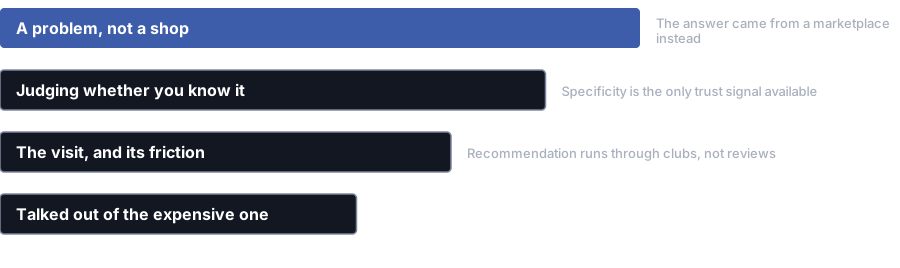
- 1A problem, not a shop — Someone wants to take up, replace or fix something. Interest is national and the sale is local.The answer came from a marketplace instead
- 2Judging whether you know it — A stranger checks whether you can tell apart options that look the same. Vague copy reads as not knowing.Being specific is the only trust signal here
- 3The visit, and what gets in the way — Parking, which side of the street the door is on, and whether the Saturday hours suit someone with a job.Recommendations spread through clubs, not reviews
- 4Talked out of the expensive one — The clearest proof the advice is sound. It wins a customer for a decade, not a single sale.
Common problems
What stops specialty retail marketing paying off
A specialist shop can't beat a warehouse on price, range or next-day delivery. What it has is someone behind the counter who's used the thing, can tell you which of four options is wrong for you, and will take it back if they were wrong.
Specialty retail marketing makes that visible before anyone walks in. Most independents are invisible to the people who'd become regulars, because everything that makes the shop worth a visit lives in conversations nobody has written down.
- The expertise never leaves the shop floor.
- Staff answer the same questions every week: which one for a beginner, what size, why the cheap one fails, how to look after it, what to do when it breaks. The answers are already formed in someone's head and nowhere people can find them. Publish twenty properly and the shop becomes the local result for searches competitors never noticed.
- You are invisible for the searches your customers make.
- Independents target their category name plus the town, a small and crowded set. Customers ask how to choose, what size, whether something can be repaired, who stocks a brand nearby, where to try one first. Those searches are longer, less crowded, and come from people looking for someone to ask.
- There is no reason to make the trip.
- If everything you sell can be delivered tomorrow, a visit needs a reason delivery can't match: fitting, trying, servicing, repairs, a workshop, an evening with an expert, stock nobody else has, or holding three and being told which is right. Shops that build their calendar around those reasons get visits.
- The web store was built once and competes with nobody.
- A hundred products online, no traffic and prices above the marketplace is a channel that eats time and earns almost nothing. Rather than close it, be clear about its job: show what you carry, take special-order deposits, sell the few things where you have an edge, and support the local decision.
- The regulars are a community with no list attached.
- Specialist shops gather people who care about the same thing, and it's almost never captured: no email list, no purchase record, no way to tell forty people the thing they asked about last spring has arrived. That's your cheapest revenue, and collecting it takes a clipboard and a habit.
Where to spend
Local SEO first, then search content
In the order we'd put them. Start at the top.
Show up when people search for someone nearby who knows
The deciding search is rarely just the category name. It's someone looking for a shop that stocks a brand, offers fitting, does repairs or understands the subject. Set up categories, services and attributes properly, keep hours right and show photos of the real shop.
Write down what you say twenty times a week
Every conversation you repeat on the shop floor is a page: how to choose, what size, why the cheap one fails, how to maintain it, what can be repaired. Write it the way you explain it. It reaches enthusiasts nationally, brings the local ones in, and a marketplace can't copy it.
Reviews that describe the advice, not the product
Anyone can buy the same item elsewhere, so "good product" proves little. A review about being talked out of the expensive option, fitted properly, or getting a repair another shop refused persuades a stranger. Ask at the right moment, and ask for that detail.
What people search
What people type, like “[category] shop near me”
Looking for someone who knows
They have already decided they want expert help in person, not a delivery. Few searches, very high intent.
- [category] shop near me
- specialist [category] store [city]
- where to buy [niche product] in person
- [category] repairs near me
- shop that does [service] [town]
A problem, before a shop is chosen
National interest, local sales. A specialist outranks a marketplace here, because the answer needs someone who knows.
- how to choose a [product] for a beginner
- what size [product] do i need
- is [product a] or [product b] better for [use]
- how to fix [common failure] on a [product]
- how long should a [product] last
Brands and stock, in person
Someone who wants a specific thing and wants to see it first. Often a special order, not a shelf sale.
- who stocks [brand] in [city]
- try [product] before buying [city]
- [brand] stockist near me
- second hand [category] shop [town]
- can you order in [product] [town]
Events, classes and community
The searches that turn interest into a visit on a set evening. Almost no independent publishes for them.
- [category] workshop [city]
- beginners [activity] class near me
- [category] club [town]
- repair evening [town]
- [category] fair [region] dates
These are example searches from keyword research and public search data. Before we suggest anything, we check how often people search for them in your area.
Measuring results
Numbers that matter
These numbers show if your marketing brings in customers. Website visits alone don't.
- Visits from search, tracked through direction requests, calls and asking people at the counter
- Customers who mention something they read or watched before coming in
- Share of revenue from repeat customers over twelve months
- Average basket, and add-on sales when advice was involved
- Email list size, and the share of revenue from people on it
- Event and workshop attendance, and how many attendees buy afterwards
- Reviews that mention advice, fitting or repair
- Special orders placed, which is demand that would otherwise go to a warehouse
Your website
Make your site easy to buy from
- A page for each thing you know best, written the way you explain it in person
- Correct hours, including the bank holiday nobody remembers to change
- The services worth a visit: fitting, repairs, servicing, trials, special orders and valuations
- An events and workshops page with actual dates, because that turns interest into a visit
- What you carry: brands, ranges and what you can order in, even if you don't sell it online
- Photos of the actual shop, bench and people, not stock images
- An easy way to ask a question before travelling, answered by your staff, not an auto-reply
- An email sign-up placed where someone who just had a good chat will use it
- Local directions that matter: parking, which door, and whether the step is manageable
The rules
Claims to avoid
Specialist categories often carry licensing or age rules that general retail doesn't, covering what you may advertise, to whom and sometimes where. Alcohol, blades, air weapons, tobacco and vaping products, second-hand dealing, live animals and some chemicals each have their own rules, which differ by country and often municipality. We write campaigns to the rules where you trade and ask you to confirm details with your regulator or legal adviser. This is not legal advice.
Claims about origin and authenticity need proof before publication. Handmade, locally made, restored, original, vintage and ethically sourced are the words specialist shops use and the words consumer regulators check most closely. If a claim can't be backed up from your own records, we take it out rather than water it down.
Second-hand, repaired and refurbished goods often carry their own disclosure rules on condition, warranty and the right to return. How your listings and shop pages describe condition is a compliance question as well as a sales one, so settle it with your adviser first.
Sources
Go to the source
Each rule above, linked to the body that publishes it. Which ones apply depends on where you work. Rules change, so check the latest version.
- UK non-broadcast advertising rules for alcohol, including not targeting or appealing strongly to under-18s.
- CAP Code section 18
- Source: ASA/CAP Code, section 18: Alcohol (UK)
- An unqualified Made in USA label claim requires all or virtually all of the product to be made in the US.
- Made in USA Rule
- Source: FTC Made in USA Labeling Rule, 16 CFR 323 (US)
- Goods supplied to a consumer by description must match that description.
- Consumer Rights Act s.11
- Source: Consumer Rights Act 2015, section 11 (UK)
Questions
What to ask before you pay for specialty retail marketing
We cannot compete with online prices. Is marketing pointless?
Not at all, but competing on price is. A warehouse with lower costs and no staff will win that fight, so your marketing has to make a different case.
Make the case a marketplace can't answer: being told which option is wrong for you, being fitted, getting something repaired, seeing three side by side, bringing it back to the counter. Good reasons to pay more, if people know you offer them.
Who is supposed to write all this content for a specialist shop?
Whoever answers the questions in the shop. The material already exists in how you explain things. Record rather than compose: a voice memo after a good conversation, edited into a page.
It doesn't need to be frequent. Twenty useful answers, written once and kept current, do more than a weekly blog nobody reads, and keep working for years.
Should we be selling online at all?
Only where you have an edge: ranges you know better than anyone, things that need advice to buy, or special orders where the value is you finding it.
A general online store carrying what everyone else carries, at prices above the marketplace, eats time better spent on the shop.
How do we get people to come to an event?
Give it a date, a subject and a limit. A workshop on a set evening with twelve places and a named host gets sign-ups; the limit is what makes people book.
Then use your list. Events are nearly always filled by existing customers and the friends they bring, which is why collecting email addresses matters more than advertising.
Our reviews are good but generic. Does that matter?
Yes. A review saying the product was great could be about any seller of it, and gives a stranger no reason to travel to you.
After a fitting, a repair or a chat where you steered someone away from a pricier option, ask for a review about that. Reviews describing what only you offer are the ones that persuade.
See what to fix first
Start with the free checkup. It shows what to fix first on your website, with no sign-up. Want the full plan for your specialty retail business? Book a call, and we'll look at your market, your competitors and the searches that bring in customers.
Prefer to talk it over? Book a free call
Your BOOSTD score improves within 90 days, or your next month is free. After 6 months, more traffic or leads, or we keep working free (up to 6 free months in any 12 months). Read our guarantee
References
Sources for specialty retail marketing
The official documents and research this page is based on. Platform rules change, so check the source before you act on a detail.
Related
More on specialty retail marketing
Last updated · Published by Zubair Afzal, responsible editor