
Serving Ontario remotely
SEO and digital marketing for Ontario businesses
Ontario holds the largest share of Canadian commercial search demand and the fiercest competition for it. SEO and digital marketing in Ontario has to treat Toronto finance, southwestern manufacturing and Waterloo and Ottawa technology as different markets.
Prefer to talk it through? Book a strategy call
Who is here
Who does business in Ontario
Toronto and its ring account for the province's financial, legal and professional-services concentration — banks, insurers, brokerages, law firms, accountancy practices and the agencies that serve them. Competition for those categories is national, not local, and the buyers are sophisticated.
The southwestern corridor from Windsor through Chatham, London, Cambridge and Kitchener to Hamilton is manufacturing, automotive supply, agri-food and logistics. Many of these firms have decades of engineering credibility and almost no digital footprint, which is a straightforward and unusually cheap opportunity.
Waterloo Region and Ottawa carry the province's technology weight — one built around the university and its engineering graduates, the other around federal procurement, telecommunications and defence-adjacent software. Both sell far beyond Ontario, so their search strategy is rarely local at all.
Underneath all of that sits the same base as everywhere in Canada: trades, clinics, brokerages, restaurants and regional retail. In Ontario they are simply competing against more of each other, and against franchise and multi-location operators with real marketing budgets.
The market
What makes Ontario different
Ontario contains roughly two in five Canadians and the largest provincial economy in the country, which means most national keyword volume for any commercial term is really Ontario volume wearing a national label. Forecasts built on Canada-wide data usually turn out to be Ontario forecasts once you segment them.
The province is not one market. The Greater Toronto Area behaves like a global city; the Golden Horseshoe around it is dense suburban commerce; southwestern Ontario is industrial and agricultural; eastern Ontario is government-adjacent; the north is spread thin over enormous distances. A campaign that ignores those differences overspends in one place and underspends everywhere else.
Auction prices vary more inside Ontario than between most Canadian provinces. The same query can cost several times more in Mississauga than in Sudbury, which makes geographic bid segmentation less of an optimisation and more of a precondition for the campaign working at all.
Because Ontario sits directly across the border from Michigan, Ohio and New York, its results pages carry more American competition than the rest of the country. Buffalo and Detroit businesses appear in southern Ontario searches, and Ontario businesses appear in theirs.
Reading a national number
Most Canadian keyword volume is really Ontario volume
A Canada-wide forecast for a commercial term is usually a description of one province. Segment it and the number changes; then the region, the auction and the competitor set change it again.
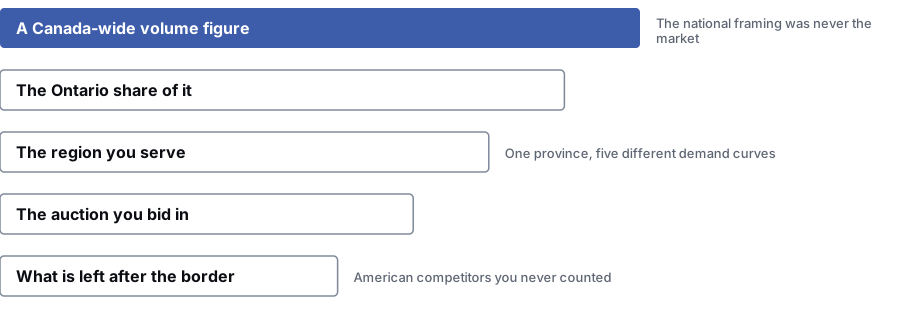
- 1A Canada-wide volume figure — Most national totals for a commercial term are largely Ontario volume wearing a national label, because roughly two in five Canadians live here.The national framing was never the market
- 2The Ontario share of it — This is the largest provincial economy in the country, so the figure survives segmentation far better than the rest of Canada does.
- 3The region you serve — The GTA behaves like a global city, the Golden Horseshoe is suburban commerce, the southwest is industrial and the north is spread thin.One province, five different demand curves
- 4The auction you bid in — The same query can cost several times more in Mississauga than in Sudbury, so geographic bid segmentation is a precondition rather than a refinement.
- 5What is left after the border — Southern Ontario results carry Buffalo and Detroit businesses that treat the province as an extension of their home market.American competitors you never counted
Strong fit
Industries with the clearest opportunity in Ontario
Sectors worth a look in Ontario
- IT Services & Managed Service Providers marketingA pipeline of contracts from your actual service area, built around the trigger events that start the search rather than a steady stream that does not exist.
- Mortgage Brokers marketingMore funded deals from the demand your market is producing this quarter, split properly between purchase and refinance and measured to funding rather than to lead.
- Medical Clinics marketingMake the clinic accurate and usable everywhere patients look, move routine enquiries off the phone, and market to the audience that is scarce — which is often a clinician rather than a patient.
- Roofing marketingBe one of the three companies quoting, and be the one that looks least risky by the time the homeowner decides.
Search behaviour
How search works in Ontario
Search is not uniform across markets. Engine share, language, device mix and local platforms all shift what a strategy in Ontario should prioritise.
- Ontario results are the most contested in Canada. National brands, franchise networks, aggregator directories and well-funded American sites all compete for the same commercial terms, so the gap between an ambitious keyword and a winnable one is wider here than anywhere else in the country.
- Regional query patterns are strong and stable. People search "Kitchener-Waterloo" as one thing, treat "GTA" as a region rather than a city, and use highway corridors — the 401, the 400, the QEW — as informal geography in the way other provinces use municipal names.
- French-language search exists in Ontario but is highly localised, concentrated in the east around Ottawa and in northeastern communities. It is a targeted opportunity for specific service categories rather than a province-wide requirement.
- Ottawa behaves differently from the rest of the province because so much of its audience works inside managed federal environments, which lifts Bing's practical share for B2B and government-adjacent buyers well above the Canadian norm.
- Seasonality is sharper than the national average in weather-dependent categories. Heating, roofing, landscaping and vehicle services all show demand curves that a flat annual budget consistently gets wrong.
Constraints
Marketing rules in Ontario
- Ontario does not have its own private-sector privacy statute. Federal PIPEDA applies to commercial handling of personal information in the province, while the Personal Health Information Protection Act governs health information specifically and is overseen by the Information and Privacy Commissioner of Ontario. Health-adjacent marketing has to be built with PHIPA in mind from the outset.
- Ontario consumer-protection legislation, administered provincially, restricts unfair practices, misrepresentation and certain contract and cancellation terms. It has been modernised in recent years, so the practical answer for any specific claim, offer or subscription mechanic is to have the current rules checked rather than relying on how it worked previously.
- Professional regulators are usually the tighter constraint. The Law Society of Ontario, the College of Physicians and Surgeons of Ontario, the Royal College of Dental Surgeons of Ontario and the province's financial regulators each publish advertising and marketing standards that go well beyond general advertising law — covering testimonials, comparative claims, specialist titles and how results may be described.
- We flag where a rule appears to touch a campaign and we write to stay inside it, but we are not lawyers and we do not give legal advice. Regulated businesses should confirm the current requirements with their own counsel or their regulator before anything goes live.
Primary sources
Where to read the rules for Ontario
The statutes and regulators behind the rules above. They are the authority, not this page, and none of this is legal advice.
- Ontario's Personal Health Information Protection Act, 2004
PHIPA
Ontario's Personal Health Information Protection Act, 2004
Source: Ontario e-Laws
- Ontario's rules on unfair practices, misrepresentation and consumer contracts
Consumer Protection ON
Ontario's rules on unfair practices, misrepresentation and consumer contracts
Source: Government of Ontario
- Law Society of Ontario Rules of Professional Conduct, including the rules on marketing legal services
LSO Rules
Law Society of Ontario Rules of Professional Conduct, including the rules on marketing legal services
Source: Law Society of Ontario
Where to start
Services that fit businesses in Ontario
SEO services
SEO services make your business easier to find on Google and Bing for the searches that lead to enquiries. They suit owners and marketing leads who need qualified leads, not just traffic. Included: technical fixes, local SEO, demand mapping, content, authority building and reporting tied to enquiries.
B2B SEO
In B2B the person searching is often not the person signing. A handful of searches a month can be worth more than a hundred thousand sessions, and the page has to survive being forwarded to a finance director, a security reviewer and a procurement team.
Paid media
PPC and paid media management across Google, Microsoft, Meta, LinkedIn, TikTok and YouTube, judged on cost per acquired customer and lead quality rather than clicks. It is for businesses spending on ads without knowing which spend produced revenue. Included: tracking, account structure, bidding, creative, landing pages and reporting.
Multi-location SEO
Head office wants consistency and compliance. The branch wants to sound like it belongs to its town. Every multi-location search problem lives in that gap — identical location pages, contested profiles, franchisees building their own sites. We design the system that resolves it.
How we work here
We serve Ontario remotely, and we say so
We serve Ontario businesses remotely. We do not have an office, staff or a phone number in the province, and we would rather state that on the page than list a mail-forwarding address as a location the way a good deal of the industry does.
Working in Eastern Time makes the practical side easy. Calls, workshops and reviews happen inside the Ontario working day, and reporting arrives on an Ontario calendar rather than an offset one.
Where a piece of work needs someone physically present — product photography at a plant in Cambridge, an on-site brand workshop, a video shoot — we scope and quote it as its own line rather than implying it is included.
Questions
Working with us from Ontario
Can a business outside the GTA realistically compete in Ontario search?
Yes, and often on much better economics. Outside the Greater Toronto Area the same categories have fewer serious competitors, lower auction prices and thinner content, so a modest budget goes considerably further.
What does not work is trying to rank across the whole province from a single location page. We would rather build real depth where you can serve customers, then expand outward as the results support it.
How should we split budget between Toronto and the rest of Ontario?
Start from where the margin is, not where the volume is. Toronto has the most demand and the highest acquisition cost, so it earns its share of the budget only if your average order value or lifetime value can carry that cost.
For a lot of Ontario businesses the better allocation is a smaller, tightly-targeted Toronto presence funding itself, with the bulk of spend in secondary markets where the same money buys several times the visibility.
Our profession has advertising rules. Will that limit what you can do?
It shapes the work rather than limiting it. Ontario's professional regulators restrict testimonials, comparative and superlative claims, and how outcomes may be described, and those rules apply to your marketing regardless of who wrote it.
In practice the restriction pushes toward better content: explaining process, credentials, scope and cost clearly instead of making claims. That tends to convert better anyway. Anything near the line goes to your regulator or your counsel before it publishes.
Do we need French content for Ontario?
For most Ontario businesses, no. French-language demand in the province is concentrated in the east around Ottawa and in specific northeastern communities rather than spread across it.
If you serve those areas, or you sell into Quebec from an Ontario base, the calculation changes and it is worth doing properly rather than machine-translating a site. We would size the actual French query demand in your category before recommending it.
Do you have an office in Ontario?
No. We serve Ontario businesses remotely and we are not going to imply otherwise by renting a virtual address in Toronto.
For search, website and brand work it makes no practical difference — the work happens in your accounts and your systems, with calls in Eastern Time. If a project needs someone on the ground, we arrange and quote that separately.
Talk to us about growing in Ontario
Start with the free Growth Scan: an indicative read of your website and the few things to fix first, with no sign-up. BOOSTD is in early access, so the market question — who is winning the searches that matter in Ontario, and whether the opportunity justifies the investment — is worked through with our team on a strategy call. If it does not, we will say so.
Prefer to talk it through? Book a strategy call
If we don't deliver the work we agreed to deliver for reasons within our control, you don't pay for the undelivered work. Read our guarantee
References
Sources
The primary documents and published research this page relies on. Platform rules change, so check the source before acting on a detail.
More to explore
Elsewhere in Canada
Last updated · Published by Zubair Afzal (responsible editor), on owner authorisation