
Enter a new market
Entering a new market? Prove the demand before you spend
Before you enter a new market, prove people there are searching for what you sell. Launches fail on assumed demand, bolt-on websites and translated copy.
Your free checkup
ExampleScore 58 out of 100. Could reach 74
Tap a check to see what we’d fix first. Anything big waits for your approval.
Google Business ProfileNeeds work
Pick the main category people search for and list every service you offer.
Mentioned in AI answersMissing
Answer the questions customers ask, clearly, on the pages AI tools read.
Speed on phonesGood
Nothing to fix now. We keep an eye on it as you add pages.
Pages Google can findGood
All found. New pages get linked from your menu so they stay that way.
The costliest assumptions
Three beliefs that make entering a new market expensive
Each of these sounds reasonable and is a common reason expansion budgets produce nothing. They apply as much to a new industry as to a new country.
- You assume demand because the market is big.
- Population and sector size aren’t demand. What matters is how many people are looking for what you sell, in that market, in a way you can reach, and you can measure that. Businesses often build a localised site for a market where demand is a fraction of home, and find out after the build.
- You assume your brand will travel.
- Recognition is local and mostly doesn’t transfer. In the new market you’re an unknown supplier with no reviews anyone can read, no local references and a name that means nothing. That’s a reason to budget for building trust, not to stay out. It’s the line most often missing from expansion plans.
- You assume the current site and its copy just need extending.
- The new market gets a page, or a translated section bolted onto a site built for somewhere else. It competes with your existing pages and confuses search engines about which market it serves. The words change while the argument stays the same, though buyers there have different worries and want different proof. A polished translation of the wrong argument is worse than a clumsy one, because nothing hides the mismatch.
Check first
What to check before you build anything for a new market
All of this costs a small part of the launch, and any single step could fairly stop the project. That’s why it comes first.
Measure the search demand
Forget market size. Measure how many people search for what you sell, in the local language and phrasing, in that market. Include the words competitors there use as well as your own; they’re often different words for the same thing.
You get: A demand estimate, with the method and search terms noted
See who already owns the demand
Check who ranks, who advertises, which businesses the marketplaces favour and how settled they are. A market with strong local leaders and one with none need very different entry budgets, and you can see which in an afternoon.
You get: A map of competitors and platforms in the target market
Talk to people in the market
Have a dozen conversations with buyers, partners or distributors there. You’ll hear the worries, local words, expected proof and odd rules that desk research never finds. This step is the most likely to change your plan.
You get: A written list of local worries and the proof buyers need
Run a small, clean test
Run a small paid campaign to one purpose-built page in the local language and measure enquiries, not clicks. It answers one question, will people in this market act, for far less than full localisation.
You get: A measured test with a set stopping point
Make the structure decision on purpose
Choose the domain, language targeting and site structure for the markets you plan to run in five years, not just this one, and write down why. It’s the most expensive decision to undo, and it’s usually made in a corridor.
You get: A written structure decision with its trade-offs
Only then build, and build locally
Have someone from the market write the copy, answering the worries you gathered, and show the local proof and trust signals that market expects. If the earlier steps said no, this step never happens, which saves the most money of all.
You get: A local presence written for the market, not translated
Three checks before you build
Three questions that decide whether to enter a new market
Each check costs a small part of the launch it could save you from. A no is a useful answer, not a setback. The expensive version is finding the same answers after the localised site is built.
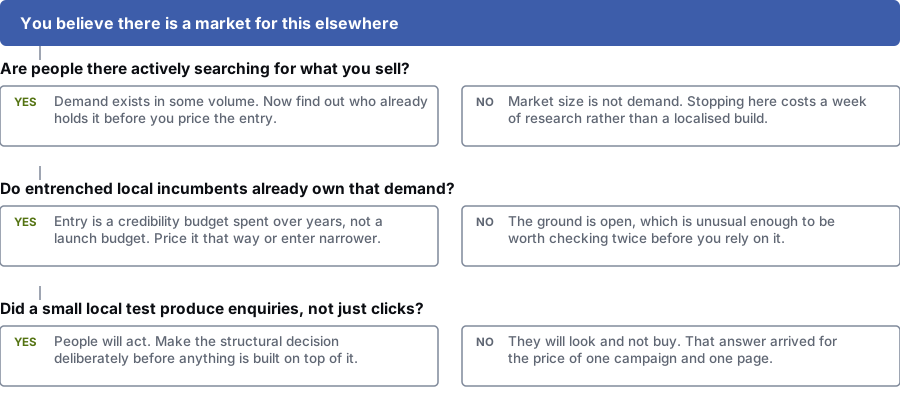
Are people there searching for what you sell?
Yes: There is demand. Now find out who already has it before you price the entry.
No: Market size isn’t demand. Stopping here costs a week of research, not a localised build.
Do strong local businesses already own that demand?
Yes: Getting in means years of building trust, not one launch budget. Price it that way or aim narrower.
No: The field is open. That’s rare enough to check twice before you rely on it.
Did a small local test bring in enquiries?
Yes: People will act. Make the structure decision carefully before you build anything on it.
No: They’ll look and not buy. You found that out for the price of one campaign and one page.
The decision that’s hard to undo
Four ways to set up your website for a new market
For a new country, read this as a choice of domains. For a new industry, read it as sections and sub-brands. The trade-offs work the same way.
| Dimension | What it signals | What it costs to run | When it’s the right choice | What it makes hard later |
|---|---|---|---|---|
| A section on your existing site | One business serving an extra market | The least of the four, and it inherits your existing authority | One or two markets, a shared brand, few local differences | Very little, which is why it’s the sensible default |
| A subdomain | A related business run separately | Moderate, with some doubled effort | Separate operations under one name | Authority is shared less reliably than people expect |
| A country domain | A local business, as clearly as you can show it | The most, and it starts with no authority at all | A committed market with local staff and big plans | Every market needs its own build, authority and budget |
| A separate brand | An unrelated company, which is sometimes the point | Two of everything, for good | When links to your current business would hurt you in the new market | Nothing carries over, including the reason you felt confident enough to expand |
Listen before you write
Searches that show how a new market differs from yours
These are the kinds of search where a new market tends to differ from the one you know. Run them and read what comes back.
These are examples, not volume figures. Swap in your own product and market, and watch for results that contradict your assumptions.
Same product, different word
Where translation fails first. Categories, job titles and legal terms often have no clean equivalent.
- what is [your product category] called in [market]
- [local term] vs [your usual term]
- [product] alternative names
- [service] equivalent in [country]
Local worries and proof
Worries you’ve never had to answer at home. Each one is a page your local site needs that the original never had.
- is it safe to buy [category] from an overseas supplier
- do i need a local [licence or certification] for [service]
- what happens if [category] goes wrong in [market]
Who the market already trusts
Shows you the local leaders, the platforms that sit in the middle, and how much trust you’d need to build.
- best [category] providers in [market]
- [well known local competitor] reviews
- [category] comparison [market]
Checking you’re legitimate
What buyers check before they commit. These map straight onto the trust signals your new site needs.
- is [company type] regulated in [market]
- how to check a [category] supplier is legitimate
- [category] consumer protection rules [market]
These are example searches from keyword research and public search data. Before we suggest anything, we check how often people search for them in your area.
By decision
Help with each market entry decision
Is there demand?
How should it be set up?
Questions
Questions to answer before entering a new market
We already have customers in the market. Is that not validation?
It shows the market has people who want what you sell. It doesn’t show you can win a share of it, because those customers came while you did nothing and competitors weren’t fighting for them.
Ask them how they found you and who else they considered. If most couldn’t find a local supplier, you have an opening. If they name three local competitors and picked you on price, getting in will be much harder than the spreadsheet suggests.
Should we use a country domain, a subfolder or a subdomain?
For most businesses entering one or two markets, a subfolder on your existing domain is the practical choice: it inherits your main site’s authority and is far cheaper to run. A country domain sends the strongest local signal, but starts from nothing.
Decide for the next five markets, not this one. Changing the structure later means a site move nobody will approve once revenue depends on it.
Is translating our existing site enough?
Rarely. Translation changes the words and keeps the argument, which was built for another market. Buyers there have different worries, want different proof, face different rules and sometimes call the product something else.
The test is whether someone from that market could tell it was written elsewhere. If they can, so can everyone else, and that damages the local trust you need.
Does this apply to entering a new industry, as well as a new country?
Yes, and things go wrong in almost the same ways. A new industry has its own words, buying process, worries and proof. A site that speaks fluently to your current sector sounds like an outsider to the new one.
The structure question becomes a section on your existing site, a sub-brand or a separate company. The same rule applies: decide based on where you want to be in five years.
How much should validation cost before we commit?
A small share of the launch cost. Demand research, a competitor scan, a few conversations with people in the market and a small paid test usually cost far less than building a localised site, and any one of them could stop the project.
You aren’t aiming for certainty. You’re turning a guess into an estimate with a method behind it, so the go or no-go decision rests on evidence.
Where to get help
Services that solve this
International SEO
International SEO starts with one choice: country domains, subfolders or subdomains. Then hreflang that validates and pages adapted to each market.Keyword Research & Strategy
Our keyword research services map each search need to one page, so you know what to build and your own pages stop competing with each other.Content, Digital PR & Authority
A content marketing agency that writes from what only your business knows, so people mention and link to you. We earn coverage with good stories and never buy links.
Check the market before you build for it
Tell us which market you’re considering and what you sell. We’ll estimate the search demand, map who already owns it and tell you what a believable entry would need, or that you shouldn’t go.
Prefer to talk it over? Book a free call
Your BOOSTD score improves within 90 days, or your next month is free. After 6 months, more traffic or leads, or we keep working free (up to 6 free months in any 12 months). Read our guarantee
References
Sources for enter a new market
The official documents and research this page is based on. Platform rules change, so check the source before you act on a detail.
Related
More ways to fix this
Last updated · Published by Zubair Afzal, responsible editor