
Personal Injury Law marketing
Personal injury lawyer marketing for cases worth taking
Personal injury lawyer marketing that filters out weak claims early and helps intake sign the good cases you paid for.

How they choose
How the shortlist gets made
Know how they choose and you know where to show up.
- Many claimants contact more than one firm. How fast you respond often decides it, ahead of reputation or fees.
- They want to know the claim is worth pursuing and won’t cost them money up front. A page that explains contingency fees clearly beats one that lists practice areas.
- They read reviews for how firms communicate, more than for results. Claimants fear being ignored for two years more than a lower settlement.
- A recommendation from family or a professional they trust still counts most. Google often confirms that recommendation but rarely replaces it.
- In serious injury cases, the family often decides for the injured person, so your content has to speak to them too.
The window after the incident
How an injured person picks a lawyer in the days after an accident
People search within days of the incident, sometimes within hours. Many decide before they’ve compared reputation or fees at all.
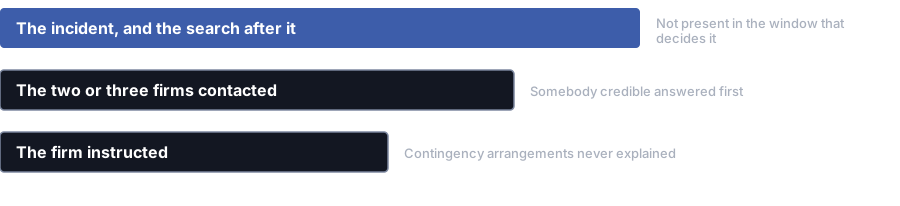
- 1The incident, and the search after it — Not seasonal, but people search in a short window afterwards. Often within days, sometimes within hours.Not showing up in the window that decides it
- 2The two or three firms contacted — Many claimants contact more than one firm. Speed of response often decides it, ahead of reputation and fees.Another credible firm answered first
- 3The firm hired — The one that said the claim is viable and costs nothing up front, with reviews that show good communication.Contingency fee terms never explained
Common problems
Why personal injury leads dry up
Want more good cases, not just more calls? Personal injury has the priciest clicks in local advertising and the widest gap between an enquiry and a case worth taking.
So don’t chase volume. Bring in fewer, better enquiries and hand them to an intake team that can sign them.
- Your ads buy enquiries you can’t use.
- Broad injury targeting brings in minor claims, claims past the limitation period, cases in the wrong jurisdiction and people after free advice. Each eats intake time a good case needed. Screen in the ad, on the page and in the first thirty seconds of the call, not once a file is open.
- Intake is the bottleneck, and nobody measures it.
- A firm can pay a lot for an enquiry and then take four hours to call back. Claimants often talk to several firms, so that delay decides everything. Answer rate, speed to first contact and steady follow-up usually win more signed cases than any campaign change.
- You’re bidding against firms with TV money.
- Outspending a TV advertiser on the broadest accident terms won’t work. You can win on specific injury types, circumstances and places, with detailed content on the questions those claimants ask.
- Nobody can connect spend to signed cases.
- Marketing reports on leads. Your case management system knows about retainers. Until someone matches the two, every decision rests on a number that doesn’t reflect the business. We fix this first, and it usually changes where the budget goes.
What people search
“Car accident lawyer near me” and similar searches
Straight after an incident
A short window, high intent and the most competition.
- car accident lawyer near me
- what to do after a car accident not my fault
- do i need a lawyer for a car accident
- injured at work who do i call
Is my claim worth it, and how does it work
Where you earn trust before the call. Most firms publish nothing here.
- how long do i have to file an injury claim
- do i pay anything if i lose my case
- how much is my injury claim worth
- how long does a personal injury claim take
- what is a contingency fee
Specific injury and circumstance
Where a smaller firm can beat the big advertisers.
- slip and fall lawyer
- long term disability denied lawyer
- motorcycle accident lawyer
- pedestrian hit by car lawyer
- traumatic brain injury lawyer
Comparing firms
Reviews and signs of good communication matter most here.
- best personal injury lawyer [city]
- personal injury lawyer reviews
- questions to ask a personal injury lawyer
- how to choose an injury lawyer
These are example searches from keyword research and public search data. Before we suggest anything, we check how often people search for them in your area.
Where to spend
Spend on follow-up and tracking first, then organic search
In the order we'd put them. Start at the top.
Measure intake first
This comes first on purpose. Until answer rate, speed to contact and signed cases are matched against spend, every other decision uses the wrong number. It’s usually the fastest return.
Answer the questions claimants ask
People search constantly about whether they have a claim, how long it takes, fees and process, and most firms answer badly. Good answers build trust before the call, cost far less than paid clicks and let you compete without a TV budget.
A site that screens and converts
Explain contingency fees clearly. Give each matter type its own page, use an enquiry form that asks screening questions and make sure the phone reaches someone who answers. The site should reassure the right people and filter out the wrong ones.
Your website
Turn more visits into enquiries
- Contingency and other fee terms explained in plain words, early on the page
- A separate page for each matter type, not one general injury enquiry
- An enquiry form with screening questions (incident date, circumstances, jurisdiction), not just name and email
- Guidance on limitation periods, worded carefully and never as advice
- Your lawyers named, with credentials and photos, not stock images
- Reviews that speak to communication and process, within the rules that apply to you
- A phone number people can call straight away, since many claimants won’t use a form
- Answers to the “do I have a claim” questions people search before they’re ready to call
Measuring results
What we track each month
These numbers show if your marketing brings in customers. Website visits alone don't.
- Cost per signed case, split by matter type. This is the number that matters
- How many enquiries become consultations, and how many consultations become retainers
- Speed to first contact, in minutes
- Answer rate during and outside office hours
- The mix of cases you sign, against the mix you want
- How many enquiries are screened out, and why
- Marketing spend matched monthly against your case management system
The rules
What you can say in your ads
Law society and bar advertising rules cover most of what goes on a personal injury site, and they vary by jurisdiction. The usual limits are on testimonials and endorsements, advertising past results or settlement amounts, claiming specialist or expert status, and how fees and contingency terms are described.
We write with those limits in mind and flag anything that needs your professional judgement. Responsibility for compliance stays with your firm; no agency can take that on.
So campaigns can’t promise outcomes. Content about what a claim is worth must explain how value is assessed and never suggest what a reader might receive.
Sources
The rulebooks, linked
Each rule above, linked to the body that publishes it. Which ones apply depends on where you work. Rules change, so check the latest version.
- Bars misleading claims, including guarantees of a result and past results that raise unjustified expectations.
- Cal. RPC 7.1
- Source: State Bar of California — Rules of Professional Conduct, rule 7.1
- Citing sums recovered or past success needs a statement that past results do not indicate future outcomes.
- LSO Rule 4.2-1
- Source: Law Society of Ontario — Rules of Professional Conduct, rule 4.2-1
- Publicity about a practice must be accurate and not misleading, including about its charges.
- SRA Code 8.8
- Source: Solicitors Regulation Authority (England and Wales) — Code of Conduct for Solicitors, para 8.8
Questions
Personal injury marketing questions and answers
Our cost per lead is fine but our cost per case is terrible. What is wrong?
Almost always one of two things: your campaigns aim for form fills, not signed cases, or intake loses good enquiries before they sign.
Both can be fixed without more budget. Sending signed-case data back to the ad platforms changes what they buy, and measuring speed to first contact often uncovers a gap nobody knew about.
How do we compete against personal injury firms advertising on television?
Not on the broadest accident terms. Those are expensive and brand-driven, and a smaller firm bidding there pays for a bigger firm’s reach.
You can win on specific matter types, circumstances and places, and with detailed answers to the questions claimants ask before they call. Big advertisers are usually thin on exactly that content.
Can you guarantee a number of signed cases?
No. Case numbers depend on how many incidents happen, your competition, your fees, your intake and your own case rules. Most of that is outside our control.
We commit to doing the agreed work and reporting your cost per signed case. If the numbers won’t work in your market, you’ll hear it from us early.
Should we buy leads from a vendor?
Sometimes, for overflow, but rarely as your main source. Bought leads are often sold to several firms at once, which turns each one into a race and squeezes your margin.
They also build nothing. A firm that bought leads for two years is where it started; one that put the same money into its own search presence now owns that demand.
We want serious injury work, not minor claims. Can marketing do that?
Partly, and mostly by filtering. You can’t target by how badly someone is hurt, but you can shape who gets in touch with content on specific matter types, careful wording and an enquiry process that screens.
Intake is the bigger lever. Screen early for viability, jurisdiction and limitation, and be willing to say no. That changes your case mix faster than any campaign setting.
Get a clear first step
Start with the free checkup. It shows what to fix first on your website, with no sign-up. Want the full plan for your personal injury business? Book a call, and we'll look at your market, your competitors and the searches that bring in customers.
Prefer to talk it over? Book a free call
Your BOOSTD score improves within 90 days, or your next month is free. After 6 months, more traffic or leads, or we keep working free (up to 6 free months in any 12 months). Read our guarantee
References
Sources for personal injury lawyer marketing
The official documents and research this page is based on. Platform rules change, so check the source before you act on a detail.
Related
More on personal injury marketing
Last updated · Published by Zubair Afzal, responsible editor · We check this page every three months. Next check: .