
Criminal Defence marketing
Criminal defence lawyer marketing built for the 2am call
Criminal defence lawyer marketing that wins the retainer after an arrest. Be found and answer first at night, with discreet pages that follow the conduct rules.

Timing
When the enquiries come in
Demand peaks when nobody’s at work. Arrests cluster on Friday and Saturday nights, public holidays and long weekends, the hours your firm is least able to answer.
People decide within hours, and a court date sets the deadline. A first appearance or bail hearing is usually days away, leaving no time for research.
Matter value can differ tenfold between offence types. A minor driving charge may take a few appearances; a serious indictable matter can run two years. Split figures by offence type before judging anything.
Your catchment follows the courthouses, not city limits. Clients hire lawyers who appear where their case is listed, so three courthouses are three separate local search problems.
Repeat and referred clients make up more of a defence practice than most firms admit, and it only shows in a report if someone records how each matter came in.
Two callers, one number
Many calls come from a relative of the person arrested
Both callers need different things from the same page, at the same hour of the night. Almost no defence firm writes anything for the relative, which makes it the cheapest gap to fill.
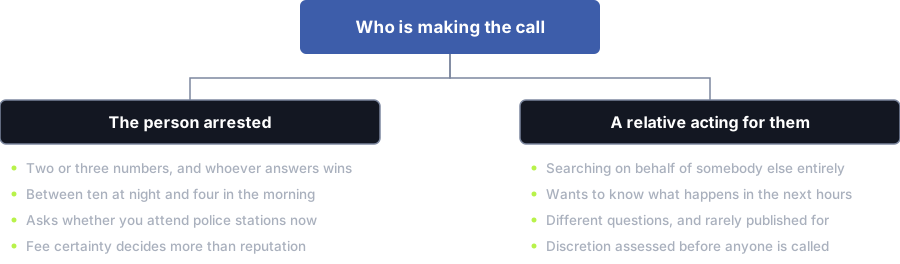
The person arrested
- Two or three numbers, and the first to answer wins
- Calls between ten at night and four in the morning
- Asks if you can come to the police station now
- Clear fees count for more than reputation
A relative calling for them
- Searching on behalf of someone else
- Wants to know what happens in the next few hours
- Has different questions that few firms answer
- Judges how discreet you are before calling
How they choose
How buyers choose between you and a rival
Know how they choose and you know where to show up.
- The first firm to answer usually wins. The caller has two or three numbers and is scared; once someone speaks to them calmly, they stop working down the list.
- They check whether the firm goes to police stations and custody suites. Their worry is a lawyer tonight, not a trial in eight months.
- Knowing the local courthouse counts for a lot. Callers ask if the lawyer appears there often, and firms rarely say so anywhere.
- Clear fees count for more than reputation. A set price for a first appearance beats an hourly rate nobody can turn into a number.
- People judge discretion instinctively: whether the site feels careful, and whether they can get in touch without leaving a trace.
- People read reviews to see if the lawyer answered and explained things, not for outcomes. Many clients here never leave a review.
Common problems
Criminal defence marketing problems to fix first
When someone’s arrested, a decision about who represents them gets made within hours — often overnight, on a phone, often by a relative on the accused’s behalf.
The usual things that win legal clients matter less here. Credentials, reviews and brand name all come second to one question: did someone at your firm pick up the phone?
- The calls come in overnight and go to voicemail.
- Arrests bunch into evenings, nights and weekends. The caller has two or three numbers, and a voicemail saying the office opens at nine makes the choice for them. You don’t need a partner awake all night: a rota, a trained answering service and a written morning handover catch most of the calls you lose now.
- Every page talks to the accused, but the caller is his mother.
- Many first calls come from family, because the person charged is in custody and can’t search. The relative asks where he’s being held, whether they can see him, and what happens at a bail hearing. Most firms write about charges and defences and answer none of this.
- A retargeting ad followed a client onto the family tablet.
- Privacy drives everything here. Clients clear their history, won’t leave voicemail, and are alarmed by ads that seem to know what they searched. Retargeting on a criminal defence site damages trust and can expose a client at home. Switch it off and say so on the site; that line helps people decide to call.
- Nobody mentions legal aid, so half the callers could never pay.
- Silence about legal aid and duty counsel brings a steady run of calls from people who could never have paid. Explain in plain words who’s likely to qualify and what a private retainer offers. It filters calls, helps people, and gives your intake team hours back.
- The fee is never mentioned because it’s not a contingency.
- Clients pay for criminal defence themselves, usually up front, as a flat or staged fee. Someone who’s never hired a lawyer can’t tell if that means five hundred or fifteen thousand, and asking feels exposing. Say what a first appearance costs and what changes at trial.
What people search
Searches such as “criminal lawyer near me open now”, grouped by intent
The night of the arrest
The most valuable searches in this area. Nearly all happen on a phone, between ten at night and four in the morning.
- criminal lawyer near me open now
- 24 hour criminal lawyer
- lawyer for someone in custody tonight
- how do i get someone out on bail
- police want to interview me do i need a lawyer
A relative searching for someone else
A different reader with different questions. Almost no defence firm writes anything for them.
- how to find a lawyer for my son
- where is someone taken after being arrested
- can i visit someone in custody
- what happens at a bail hearing
- are jail phone calls recorded
First offence and what it means later
People who are not in a rush yet. They worry more about the long-term effect than about the hearing.
- do i need a lawyer for a first offence
- what happens at a first court appearance
- will a charge show up on a background check
- can i travel with a criminal record
- what is a diversion program
Fees and legal aid
The question that stops people calling. Answer it and you filter your calls and free up intake time straight away.
- how much does a criminal lawyer cost
- do i qualify for legal aid
- criminal lawyer flat fee
- duty counsel vs private lawyer
- can i get a lawyer if i cannot afford one
Searches for a specific charge
Where a smaller firm can compete, because the big advertisers tend to bid on the broad terms.
- impaired driving lawyer [city]
- assault charge lawyer near me
- drug possession lawyer
- domestic violence charge lawyer
- breach of conditions lawyer
These are example searches from keyword research and public search data. Before we suggest anything, we check how often people search for them in your area.
Where to spend
Why local SEO comes before the website
In the order we'd put them. Start at the top.
Show up on the map near the courthouses you appear at
Clients pick a lawyer by the court their case is listed in more than where they live. We set your hours to show overnight availability, make calling one tap from your profile, and treat each court separately, in front of someone deciding in the next twenty minutes.
A website built for a scared person on a phone
One-tap calling first, then a page for the relative, a clear fee structure, and a contact option that leaves nothing in a shared inbox. Remove any tracking that could expose a reader on a family device; speed matters more here than anywhere else in legal.
Articles about consequences, where most firms only define charges
Every firm publishes charge definitions. People want to know what a first offence means for their job, travel and immigration status, and how legal aid works. They search this around a charge, and almost nobody answers it well.
Reviews about being reachable, gathered with care
The most useful review says someone answered at midnight and explained what would happen next. Ask at the right moment, never as pressure. Replying to a review can confirm that a named person was charged, so confidentiality comes first.
Your website
Your website checklist
- A phone number that dials with one tap from the first screen, at any hour
- A page for the family member calling on behalf of someone in custody
- A clear fee structure covering a first appearance, a bail hearing and a staged retainer
- An easy explanation of legal aid and who’s likely to qualify
- A contact option that avoids a shared household inbox and needs no voicemail
- Your hours outside the working day, and what happens at three in the morning
- Each court you regularly appear in, named one by one
- No retargeting, no session recording, and a clear note that says so
- Pages that load in under two seconds on a weak mobile signal
Measuring results
Track the leads that pay
These numbers show if your marketing brings in customers. Website visits alone don't.
- Share of out-of-hours calls answered by your team
- How quickly someone answers overnight, counted in rings
- Consultations booked from overnight and weekend calls
- Matters opened by offence type, since value can differ tenfold
- Cost per retained matter, split between private and legal aid work
- Share of callers screened out as eligible for legal aid
- Retained matters by courthouse, against the courts you want to grow in
- Matters referred by former clients and other lawyers
The rules
Before you publish an ad
Criminal defence advertising falls under law society and bar association conduct rules. The rule that bites hardest is about results — publishing acquittals, charge reductions or any success figure runs into restrictions in most jurisdictions, because it invites a reader to guess what will happen in their own case. Nothing you publish may imply a guaranteed result.
Testimonials are restricted or banned in a number of jurisdictions. Here, confidentiality is a problem before the advertising rule is — a former client’s endorsement confirms that a named person was charged, and so does a reply to a review, even one that says nothing about the case.
Words like “specialist”, “expert” or comparisons with others have their own rules. Calling a lawyer a specialist or “the leading defence lawyer” in a region isn’t allowed in several markets unless the governing body has granted that title.
Solicitation rules need extra care here. Several jurisdictions restrict direct approaches to people recently charged, with waiting periods or labelling rules for targeted letters based on court lists or arrest records. Treat any audience built from public charge information as restricted until confirmed otherwise.
These rules differ by regulator and market, and change from time to time. We write to the rules we understand apply and flag anything needing professional judgement. Confirm your position with your own regulator — nothing we produce is legal advice.
Sources
Links to each rule
Each rule above, linked to the body that publishes it. Which ones apply depends on where you work. Rules change, so check the latest version.
- Referring to past success needs a statement that past results do not indicate future outcomes.
- LSO Rule 4.2-1
- Source: Law Society of Ontario — Rules of Professional Conduct, rule 4.2-1
- Bars seeking work by in-person, live phone or real-time electronic contact for pecuniary gain, with narrow exceptions.
- Cal. RPC 7.3
- Source: State Bar of California — Rules of Professional Conduct, rule 7.3
- No unsolicited approaches to members of the public to advertise legal services, except to current or former clients.
- SRA Code 8.9
- Source: Solicitors Regulation Authority (England and Wales) — Code of Conduct for Solicitors, para 8.9
Questions
Short answers on criminal defence marketing
We can’t have a lawyer awake every night. How do we answer overnight calls?
Almost no firm uses a lawyer for this. A rota shared across the practice, or a trained answering service told exactly what it may say, covers most calls that now go to voicemail.
What matters most is the handover: a clear note and a set time for a lawyer to ring back. That can matter more than any campaign, because these callers have already found you.
Should we publish our fees when every matter is so unpredictable?
Yes, publish how your fees are structured, even without one number. Criminal defence is normally a flat or staged fee, and a caller can’t guess whether that means hundreds or tens of thousands.
Explain what a first appearance covers and what changes at trial. That answers the question that stops people calling, and filters out calls that would never become private retainers.
Is retargeting a problem for a defence practice?
Yes, one of the few places the standard playbook does harm. An ad for a criminal lawyer on a shared family device can expose a client at home, and clients notice.
We’d switch it off, keep session recording off your criminal pages entirely, and state on the site that the firm doesn’t track visitors that way.
Can we mention cases we’ve won?
Usually not in the way firms would like. Outcome ads and success rates are restricted in most jurisdictions, because they encourage a reader to expect a result in their own case.
You can usually describe your process: how you prepare a case, what happens at each stage, how you keep clients informed. Confirm your position with your regulator before publishing anything here.
Most of our work comes from other lawyers and from the cells. Why market at all?
To stop losing the calls you already get. Overnight calls that go to voicemail are lost outright, and once counted, the number is usually higher than expected.
The second reason is mix. Referrals bring the cases others choose to send; showing up for particular charges and courthouses lets you build the practice you want.
Find out where you stand
Start with the free checkup. It shows what to fix first on your website, with no sign-up. Want the full plan for your criminal defence business? Book a call, and we'll look at your market, your competitors and the searches that bring in customers.
Prefer to talk it over? Book a free call
Your BOOSTD score improves within 90 days, or your next month is free. After 6 months, more traffic or leads, or we keep working free (up to 6 free months in any 12 months). Read our guarantee
References
Sources for criminal defence lawyer marketing
The official documents and research this page is based on. Platform rules change, so check the source before you act on a detail.
Related
More on criminal defence marketing
Last updated · Published by Zubair Afzal, responsible editor · We check this page every three months. Next check: .