
Corporate & Commercial Law marketing
Corporate law firm marketing for a field almost nobody searches
Corporate law firm marketing that opens matters from your target list, through partner-led content, panel places and referrals, in a field with few searches.

Measuring results
What good looks like
These numbers show if your marketing brings in customers. Website visits alone don't.
- Matters opened, by named source, logged when the file opens
- Average matter value, against the mix you want more of
- Panel invitations received, and prequalification bids submitted
- Pitch invitations, and how many become appointments
- Named target organisations that engaged with partner content
- Referrals by referring firm or adviser, tracked as relationships
- Directory submission results against the bands you’re aiming for
- Time from first recorded contact to first instruction
Common problems
What's holding your corporate law marketing back?
Corporate law firm marketing gets judged by odd numbers. A corporate practice can be excellent and well known among the people who matter, yet look invisible in every figure an agency usually reports. That’s normal when a practice area gets a few dozen relevant searches a month and matters are worth six or seven figures.
So the useful question is whether your firm is on the list: named when a founder rings their accountant, on the shortlist a general counsel builds, known when procurement opens a panel review. Website traffic comes a long way second.
- Your website lists the same services as every competitor.
- Mergers and acquisitions, corporate governance, joint ventures, restructuring: a general counsel comparing four firms reads the same list four times, then falls back on the name they know. Commit in public to something specific: the deal size you’re built for, the sectors you know, the work you turn down.
- The panel review happened and nobody told you.
- Large companies and public bodies buy legal services through panels on fixed cycles of several years. If procurement doesn’t know your practice when the review opens, you’re never considered. Track which target organisations run panels and when; it’s routine admin that decides years of revenue.
- Nothing you publish carries a partner’s name.
- This audience reads legal commentary as part of the job, so good content goes a long way, unless the byline is the firm rather than a person. Build the process around one hour of a partner’s time: we interview them, draft, send it back for correction, and publish under their name.
- The referrals that matter most are the ones nobody records.
- Accountants, corporate finance advisers and other law firms bring in a large share of corporate matters, none of it visible in analytics. Record where every new matter came from, by name. It’s the cheapest change you can make, and often shifts the budget within a quarter.
- Your best evidence is confidential.
- The deals that would most impress a buyer are often confidential, and asking for consent years later is awkward. Ask as the matter closes instead. If the client says no, describe the deal without naming anyone: sector, deal type, size band, the difficulty you solved.
What people search
“Do i need a shareholders agreement” and similar searches
Founders and finance leads with a problem
Few searches, high value, and often years before any instruction. This is where a firm becomes a known name.
- do i need a shareholders agreement
- what does legal due diligence involve
- cost of legal fees on a share sale
- how to structure an employee share scheme
- asset purchase or share purchase which is better
In-house counsel and procurement research
The buyer checking a shortlist or preparing a panel review. Small numbers, with a lot of commercial weight behind them.
- law firm panel review process
- outside counsel guidelines template
- corporate law firms advising [sector] companies
- legal directory rankings corporate [country]
- alternative fee arrangements law firm
Checking a named lawyer or firm
Someone has been given a name and is looking it up. Almost every instruction passes through this search at some point.
- [partner name] corporate lawyer
- [firm name] reviews in house counsel
- corporate partner [sector] experience
- [firm name] directory ranking
New laws and regulatory change
Searches jump when a law is announced and when it takes effect. A clear explainer published that week gets read across the market.
- [new act] what it means for companies
- new merger control thresholds [year]
- directors duties changes [jurisdiction]
- company filing requirements changes
How fees and engagements work
Finance leads and legal operations teams search this more and more. Firms rarely answer it.
- fixed fee legal work for startups
- law firm capped fee arrangement
- when to hire in house counsel instead of a law firm
- how are corporate legal fees calculated
These are example searches from keyword research and public search data. Before we suggest anything, we check how often people search for them in your area.
How they choose
What makes them pick you
Know how they choose and you know where to show up.
- They start with a name they already have — a colleague, an accountant, a directory band — and use your website to check it.
- They hire a named partner and follow that partner from firm to firm. Track record and published views matter more than anything on your homepage.
- Directory rankings give boards and general counsel a safe reason for their choice, which makes the yearly submission cycle worth taking seriously.
- Predictable fees now often decide between two strong firms. In-house teams look closely at fixed and capped fees and how clearly you explain billing.
- Conflicts and sector coverage get checked early, and can end a conversation before anyone discusses your skills.
- Responsiveness is judged over a day. A same-day reply from the named partner tells the client how their matter would be handled.
A buying cycle measured in years
From a partner’s article to a share sale three years later
A whole corporate practice area may produce a few dozen commercial searches a month. If you judged it on volume, you would never fund the writing and relationships that make a name.
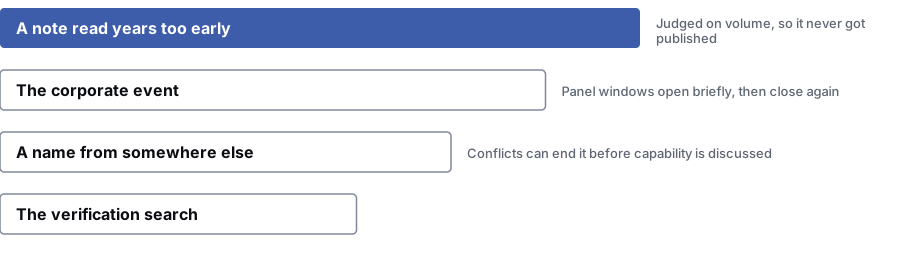
- 1An article read years early — Someone reads about shareholder agreements one year and hires the author for a share sale three years later. No attribution model will link them.Judged on traffic, so it never got published
- 2The corporate event — A funding round, an acquisition, a shareholder dispute, a restructure, or a new law coming into force. Events trigger the need.Panel windows open briefly, then close again
- 3A name from someone they trust — A colleague, an accountant, a previous firm or a directory band supplies it. Clients hire a named partner and follow them between firms.A conflict can end it before skills are discussed
- 4The search to check the name — Almost every instruction passes through someone checking a name. Predictable fees often decide between two strong firms.
Where to spend
Spend on B2B search first, then content and PR
In the order we'd put them. Start at the top.
Search for a practice area with very few searches
Aim at the few dozen queries a founder or general counsel types before hiring a firm, not volume-sorted keyword lists. Cover deal structure, cost and process, one page each, under a named partner, and judge success by which organisations visited.
Press comment on new laws, plus the yearly directory cycle
Useful quotes when the law changes put a partner in front of the people who hire. The yearly directory submission, with evidence, referees and consent, is the closest thing this field has to a scheduled sales event.
Cited when a founder asks AI who to call
Founders and finance directors now ask AI assistants which firms handle a given transaction in their city. The firms named have clear practice pages, consistent directory entries and partner profiles with the matters they can lawfully mention. Keep those consistent and current, within your regulator's rules on publicity.
Your website
What your website needs
- A clear statement of who the firm is built for, including the matters it turns down
- Partner pages up front, with sector experience and direct contact details
- Deal experience described by structure, sector and size band where the client must stay anonymous
- A clear explanation of fees, including fixed and capped options
- A contact route for referring advisers, with a named contact
- Sector pages that show you know the client’s industry as well as the law
- Commentary on new laws, dated and signed by a named lawyer
- Directory rankings shown accurately, and only where you can back them up
- A conflicts check and onboarding process a client can start without three emails
The rules
Keep your ads compliant
Corporate legal marketing falls under the same professional conduct rules as any other practice area. The two that come up most are outcome language and comparisons — describing a deal in a way that implies a result for a future client, publishing win rates, or claiming to be the “leading” firm all run into restrictions in most jurisdictions. Nothing you publish may imply a guaranteed result, including by implication through a matter description.
Publicising a client or matter is a confidentiality question first, an advertising question second. You may not disclose a client name, deal value or logo without permission — far easier to get as the matter closes than years later. Testimonials are also restricted in a number of jurisdictions, whether or not the client consents.
Specialist titles, accreditations and directory rankings may only be used where the governing body or directory allows, and each sets its own conditions on how a band or tier may be described.
A corporate practice often markets into jurisdictions where its lawyers aren’t admitted. Rules on advertising and calling a practice “international” differ by country and state or province — compliant at home doesn’t mean compliant where the reader is.
These rules differ by regulator and market, and change from time to time. We work to the rules we understand apply and flag what needs professional judgement. Confirm your position with your own regulator — we give no legal advice.
Sources
Read the rules yourself
Each rule above, linked to the body that publishes it. Which ones apply depends on where you work. Rules change, so check the latest version.
- Suggesting superiority to other lawyers, or citing misleading awards or rankings such as “best”, can breach it.
- LSO Rule 4.2-1
- Source: Law Society of Ontario — Rules of Professional Conduct, rule 4.2-1
- Client affairs, current or former, stay confidential unless law requires or permits disclosure, or the client consents.
- SRA Code 6.3
- Source: Solicitors Regulation Authority (England and Wales) — Code of Conduct for Solicitors, para 6.3
- A lawyer may not claim to be a certified specialist unless currently certified by an approved body, which is named.
- Cal. RPC 7.4
- Source: State Bar of California — Rules of Professional Conduct, rule 7.4
Questions
Corporate law marketing, answered
Nobody searches for corporate legal services. How can search marketing help us?
A few very specific searches happen at exactly the right moment, and the pages that answer them are what a buyer reads when checking your name. Judged on volume it looks pointless; judged on which organisations visited and later hired you, it often pays.
Search is a supporting channel. Referrals, panels and partner reputation bring most new matters; search makes sure that when someone looks you up, they find something that stands up to scrutiny.
Our partners won’t write. Is a content programme realistic?
Yes, if you stop asking them to write. The blocker is rarely willingness: a partner’s hour has a visible price, and one writing task tends to grow into six.
What works is a 45-minute interview. We draft, the partner corrects, and it goes out under their name. Partners who’ve refused to write for years will usually give you an hour.
How do we get onto a panel we’ve never been invited to?
Find out when the review happens and get known to the right people well before it opens. Panels usually run on multi-year cycles, and prequalification windows are short and rarely advertised.
You need a target list with cycle dates, a relationship with the people who run the process, and prequalification evidence ready early — insurance, rate cards, matter references — so you’re not scrambling in a two-week window.
Most of our best work is confidential. What can we publish?
More than most firms think, if you ask for consent as the matter closes, while the client is pleased. Many will agree to some description, even if not to being named.
If not, describe the shape of the deal without naming anyone: sector, structure, size band, the problem you solved. That helps a buyer judge whether you’ve handled something like theirs, and discloses nothing.
How should we measure this when a matter can take three years to arrive?
Skip last-click attribution. It credits a seven-figure instruction to whichever page the general counsel opened last, and with a cycle this long it misleads.
Record where every matter came from when you open it, by name, and track activity by organisation. You can act on those signals while the instruction is still two years away.
Is our sector focus worth the conflicts it creates?
That’s a deliberate business decision for the partners. Sector depth gets a firm shortlisted and supports a higher rate, but conflicts end conversations early more often.
The option we’d push back on is claiming several sectors lightly: it brings the conflicts without the credibility, and the same service list as every competitor.
See how your site stacks up
Start with the free checkup. It shows what to fix first on your website, with no sign-up. Want the full plan for your corporate law business? Book a call, and we'll look at your market, your competitors and the searches that bring in customers.
Prefer to talk it over? Book a free call
Your BOOSTD score improves within 90 days, or your next month is free. After 6 months, more traffic or leads, or we keep working free (up to 6 free months in any 12 months). Read our guarantee
References
Sources for corporate law firm marketing
The official documents and research this page is based on. Platform rules change, so check the source before you act on a detail.
Related
More on corporate law marketing
- criminal defence, where every call is urgent
- new work beyond the partners’ own contacts
- marketing for accountants, consultants and recruiters
Guides for corporate law
Other legal businesses
Industries close to corporate law
Last updated · Published by Zubair Afzal, responsible editor · We check this page every three months. Next check: .