
Immigration Law marketing
Immigration lawyer marketing that brings in qualified applicants
Immigration lawyer marketing that screens applicants before they book and reaches them abroad in their own language. Fewer dead-end enquiries, more signed matters.

Timing
What makes someone search
Immigration demand comes from policy, not life events, and moves faster than in any other legal area. A programme opening, a quota filling or a threshold changing can transform enquiry numbers within days, so you need to publish accurate updates fast.
The person searching is often outside the country where you practise. What matters is where the applicant comes from or lives now, and Google Maps results barely touch much of this demand.
Language brings in clients by itself. Many people search in their first language, where competition is thinner than in English, and one page written by a fluent speaker can earn more than several English ones.
Timing splits two ways. Some matters are urgent to the day: an expiring status, a submission deadline, a refusal with a fixed window to respond. Others get researched for two or three years before anyone hires a firm. Track them separately.
Business and family work behave differently. Employer-sponsored work comes through HR teams on a hiring cycle; family sponsorship comes from individuals on a personal timeline. Same law, different ways to find clients.
Demand driven by policy
How applicants abroad pick a representative after a rule change
This is the fastest-moving demand in legal work. Most of it comes from another country, in another language, from people checking if they qualify at all.
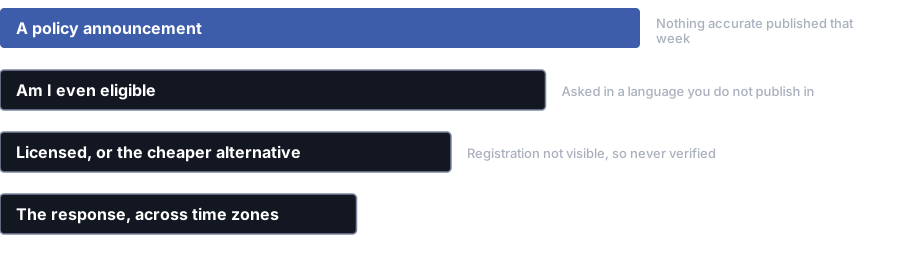
- 1A policy announcement — Demand here comes from policy, not life events. Searches spike within hours.Nothing accurate published that week
- 2Do I even qualify? — By far the most searches. Screen people here, before anyone books a call.Asked in a language you don’t publish in
- 3Licensed, or the cheaper option — Applicants compare a licensed lawyer with an unlicensed agent. Whoever explains the difference usually wins.Registration not shown, so never checked
- 4The reply, across time zones — Someone who writes in their working day and hears nothing for eighteen hours has usually written to another firm.
Common problems
Paying for immigration law marketing that doesn't work?
Drowning in enquiries from people you can’t help? Immigration law rarely lacks demand. What it needs is screening, reach abroad and proof you’re licensed.
The person searching is often thousands of miles away, reading in their second or third language. They may be weighing you against an unlicensed agent who promises what you can’t. And they may not qualify for any route.
- Lots of enquiries, and almost none can go anywhere.
- Immigration pulls in more unqualified enquiries than almost any other practice area. People with no route, no eligible qualification or a history that rules them out still get in touch, and each one eats staff time. Chasing volume makes the practice less profitable the busier it gets.
- Your website assumes the reader already lives here.
- Office hours in one time zone, one local phone number, prices in one currency, a form that wants a local address. Many clients apply from abroad, so each of these shuts someone out, and none shows up in a report as a lost enquiry.
- A rule changed and half your site is now wrong.
- Programmes close, thresholds move and processing rules get rewritten, sometimes with little warning. Old pages keep ranking and bring in enquiries about routes that no longer exist. Without a list of which page depends on which rule, you find out from a client.
- Unlicensed agents win clients with promises you can’t make.
- Agents not authorised to give immigration advice often hint at guarantees and quote success rates, and applicants abroad can’t always tell. If licensed firms stay quiet, the other side does all the explaining. Show your licence, your registration and what nobody may promise.
- Your other-language pages came from a translation plugin.
- Machine-translated pages read that way to a native speaker, which hurts trust where it is weakest. Without separate URLs and language tags, Google often never shows the right version. A few languages done properly beat ten done by a plugin.
- A client wants to hire you and can’t pay you.
- Cards get declined. Transfer fees are high next to a retainer. Identity checks need documents that are hard to send remotely, and the engagement letter needs signing by someone who can’t visit your office. Fix this and you sign clients you already paid to attract.
Where to spend
Organic search first, then conversion fixes
In the order we'd put them. Start at the top.
A page for each route, in your clients’ languages
One page per programme with the criteria set out clearly, plus proper language versions on their own URLs, tagged for language and region and written by a fluent speaker. You reach applicants your English-only rivals never touch.
Screen people before the consultation
A short eligibility check does more for profit than extra traffic. It asks about status, nationality, qualifications, family and timing. People with a likely route book a paid consultation; everyone else gets a clear answer, at far lower cost.
Publish accurate updates within days of a rule change
When a rule changes, the firm with an accurate, dated explanation live that week catches a surge that won’t come back. That takes a list of which pages depend on which rule, a fast review routine and one agreed approver.
Show you’re licensed, in a way people can check
Applicants hear constant warnings about unauthorised agents and can’t easily check from abroad. Reviews in your clients’ languages, a published registration number and a regulator listing they can verify turn that worry into a signed client.
What people search
What people type, like “am i eligible to move to [country]”
Eligibility questions, asked before anyone is chosen
By far the most searches. Screen people here, before anyone books a call.
- am i eligible to move to [country]
- minimum points required for [programme]
- can i apply for [permit] from outside the country
- does my degree qualify for [visa]
- how much money do i need to show for [application]
Policy changes and deadlines
Spikes within hours of an announcement. Publish something accurate that week and you get most of it.
- [programme] new rules [year]
- is [category] still open
- [programme] draw cut off score
- what happens if my permit expires while waiting
- deadline to apply for [scheme]
Choosing a representative
Where licensed versus unlicensed gets decided, usually by whoever explained it.
- immigration lawyer or consultant which is better
- how to check if an immigration consultant is licensed
- immigration lawyer fees [country]
- best immigration lawyer for [nationality] applicants
- do i need a lawyer to apply for [permit]
Refusals, appeals and problems
Urgent and high value. Often searched by people who tried once already, sometimes with an unlicensed agent.
- [application] refused what now
- how to appeal a visa refusal
- misrepresentation finding immigration
- lawyer for immigration appeal [city]
- inadmissibility waiver help
Employer and sponsorship searches
A different buyer: a company, working to a hiring timetable.
- how to sponsor a foreign worker
- employer requirements for [work permit]
- labour market assessment lawyer
- immigration counsel for hr teams
These are example searches from keyword research and public search data. Before we suggest anything, we check how often people search for them in your area.
Measuring results
How you'll know it's working
These numbers show if your marketing brings in customers. Website visits alone don't.
- Signed matters by programme, since routes vary hugely in value and effort
- Share of enquiries that pass eligibility screening, your main quality number
- Paid consultations booked, and how many people turn up across time zones
- Consultation to retainer rate, for applicants inside and outside the country
- Cost per signed matter by home country and by language
- Enquiries by route, checked against policy announcements so you spot shifts early
- Time to first reply, measured in the applicant’s working hours
- How many retainer payments go through, because a failed cross-border payment is a lost client
Your website
What visitors need to see
- An eligibility check before the contact form, so people learn if a route exists before they book
- Language versions on their own URLs, written by a fluent speaker and tagged so Google shows the right one
- Your regulator, registration number and practising status, shown where a worried reader will look
- Consultation fees in a currency an overseas applicant knows, with what the consultation covers
- Payment options that work across borders, including bank transfers and international cards
- Contact and booking that work across time zones, on a channel your client communities use
- Every key page dated and linked to the rule version it reflects, so your team can spot an out-of-date page
- A clear explanation of what a licensed representative is, and what nobody in this field may promise
- Remote onboarding: identity checks, engagement letters and document collection without an office visit
The rules
Advertising rules to know
Immigration marketing falls under legal advertising and professional conduct rules, which vary by jurisdiction. The tightest limits are on outcomes: claims about results, success rates and processing times, testimonials, and any specialist or expert title the governing body hasn’t granted. Explain how a route is assessed. Never suggest what a reader will get.
There’s also a licensing layer most legal areas don’t have. Several countries control who may give immigration advice or represent someone for a fee, keep public registers of authorised representatives and may require registration details in ads. Suggesting authorisation you don’t hold is a regulatory issue in itself.
Ads that reach applicants abroad can bring in the rules of the reader’s country too: advertising standards, limits on approaching clients and rules on foreign legal providers all differ. Choose where you target on purpose.
Regulators, registers and wording rules differ by country, often by state or province, and they change. We build these limits into our drafts and flag anything that needs your professional judgement. You confirm what your regulator allows. Nothing here is legal advice.
Sources
Check the rules at the source
Each rule above, linked to the body that publishes it. Which ones apply depends on where you work. Rules change, so check the latest version.
- Only law society members, Quebec notaries and licensed consultants may advise or represent on immigration for a fee.
- IRPA s 91
- Source: Government of Canada — Immigration and Refugee Protection Act, s 91
- Immigration advice or immigration services may be provided only by a qualified person, such as a registered adviser.
- IAA 1999 s 84
- Source: UK legislation — Immigration and Asylum Act 1999, s 84
- A lawyer may not advertise as a specialist in a field unless certified as one by the Law Society.
- LSO Rule 4.3-1
- Source: Law Society of Ontario — Rules of Professional Conduct, rule 4.3-1
Questions
Questions about immigration law SEO and ads
We get hundreds of enquiries and almost none are eligible. What fixes that?
A short eligibility check before anyone reaches a booking page. It asks about nationality, status, qualifications, family, funds and timing, and in a few minutes separates people with a likely route from people without one.
It feels like turning business away, but enquiries that could never go anywhere were unpaid time, not revenue. Firms that screen first often see enquiries fall and signed matters rise.
How do we compete with consultants who promise results we cannot promise?
Explain the difference. Most applicants don’t know authorisation exists, that registers are public, or that nobody in this field can promise a decision.
Publish your regulator and registration number. Explain what an authorised representative may do and how you assess a case, including weak ones. Let the reader compare that with a promise. The applicants who respond are the ones you want.
Should we translate our website, and into how many languages?
Yes, into the languages your clients read, and properly. Two languages written by a fluent speaker, on their own URLs, with the right tags, will do more than ten from a plugin.
Pick languages from your own client files, not a list of the world’s biggest languages: the communities you already serve and the countries where people search for your routes.
A programme just changed. How quickly should we be publishing?
Within days. The limit is your internal process, not the writing. Agree in advance who drafts, reviews and approves, so an update doesn’t wait for a partner to get back from court.
You also need to know which existing pages the change makes wrong. A list linking each page to the rules it depends on turns a scramble into a checklist and stops old pages sending people to a closed route.
Is local SEO worth anything for an immigration practice?
Partly, and much less than in other legal work. If you serve clients already in the country, showing up on Google Maps matters for their searches. If most clients apply from abroad, Maps reaches almost none of them.
That split decides your budget. Check where your current clients were when they first got in touch; the answer often differs from what the firm assumes.
Can we publish our approval rates?
Generally no. Success rates and outcome figures break legal advertising rules in most jurisdictions, because they suggest a result for the reader. Immigration decisions also depend on facts and policy you don’t control.
You can show how you work: how you assess eligibility, what you do with a borderline case, what you tell people whose case is weak. A careful reader trusts that more than a percentage they can’t check.
Check your site before you spend more
Start with the free checkup. It shows what to fix first on your website, with no sign-up. Want the full plan for your immigration law business? Book a call, and we'll look at your market, your competitors and the searches that bring in customers.
Prefer to talk it over? Book a free call
Your BOOSTD score improves within 90 days, or your next month is free. After 6 months, more traffic or leads, or we keep working free (up to 6 free months in any 12 months). Read our guarantee
References
Sources for immigration lawyer marketing
The official documents and research this page is based on. Platform rules change, so check the source before you act on a detail.
Related
More on immigration law marketing
Last updated · Published by Zubair Afzal, responsible editor · We check this page every three months. Next check: .