
South Australia market guide
SEO and digital marketing for South Australian businesses
SEO and digital marketing for South Australian businesses in a concentrated market small enough to cover properly, from defence to wine.
Plans are open to US and Canadian businesses today. Australia is on our launch list. Your free SEO audit and every note on this page work for businesses in South Australia and across Australia right now. Talk to us and we will tell you the day plans open for you.

The market
A small state where one plan can reach almost everyone
Most of South Australia's population and commercial activity sit in and around Adelaide, with the Barossa, the Riverland, the Limestone Coast, the Eyre Peninsula and the Upper Spencer Gulf forming distinct, much smaller economies around it.
That concentration changes the arithmetic. Here a state-wide strategy is a coherent plan, because a well-built programme can plausibly reach most of the people who would ever buy from you.
Continuous naval shipbuilding at Osborne commits decades of work and has pulled an engineering and technology supply chain behind it, giving ordinary industrial firms a demand outlook measured in decades.
The Barossa, Clare, McLaren Vale, Coonawarra and the Adelaide Hills carry recognition well beyond Australia. Their businesses sell at the door, to distributors and online: three marketing jobs sharing one brand.
With the national space agency headquartered in Adelaide, space and defence technology has become a sector of small firms selling globally from a small city, so their search problem is international from day one.
One brand, two demand channels
The cellar door and the direct sale are not the same job
Wine and food producers here sell to visitors who taste before they buy, and to people who never will. The second group needs somebody to supply what the room used to, and treating the website as a version of the cellar door is why the direct channel underperforms.
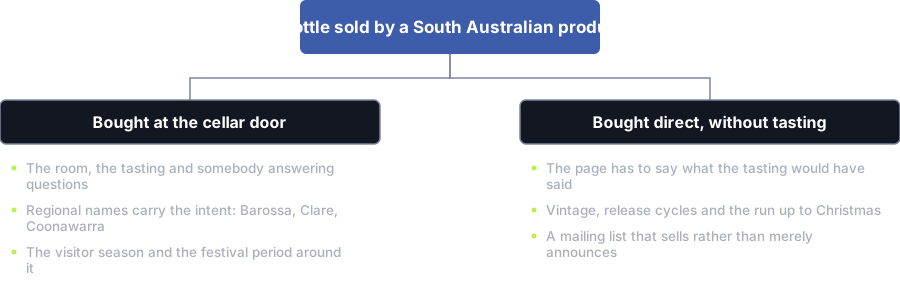
Bought at the cellar door
- The room, the tasting and somebody answering questions
- Regional names carry the intent: Barossa, Clare, Coonawarra
- The visitor season and the festival period around it
Bought direct, without tasting
- The page has to say what the tasting would have said
- Vintage, release cycles and the run up to Christmas
- A mailing list that sells, not just announces
How people search
Regional names and accreditation language
How do people in South Australia look for a business like yours? The answer changes what we fix first.
- Volumes in most South Australian commercial categories are modest, so stop measuring the programme on volume. When a category holds a few hundred buyers in the state, the question is what share of them can see you.
- People search the Barossa, the Fleurieu, the Riverland, the Adelaide Hills and the Limestone Coast as destinations and addresses, and for food, wine, accommodation and services those terms carry more intent than the towns inside them.
- Industrial and defence buyers search in accreditation and capability language: standards, certifications, materials, tolerances, security requirements. Firms that publish that detail get found by people already qualifying them.
- Direct-to-consumer wine and food demand moves around vintage, release cycles, the state's festival period and the run-up to Christmas, a predictable pattern that is rarely planned for.
- With a small competitive set, many queries name a specific producer or firm, so owning your own name, including on pages other people control, is a bigger share of the job than in a big market.
Good fit
Industries we’d start with
Industries we help
- B2B SaaS marketingPipeline that gets through a buying committee and a vendor review, with marketing aimed at the expansion revenue that decides whether the business compounds.
- Ecommerce & DTC marketingFind the number holding your store back and fix it. Judge every channel on profit per order, not a revenue chart.
Local businesses
Defence suppliers, wine estates and agribusiness
Defence and its supply chain (shipbuilding, systems integration, electronics, precision engineering, fabrication, testing and certification) is the state's most structurally important B2B sector.
Wine production runs from very large operations to small family estates. The large ones need distribution and category presence; the small ones need direct relationships and a mailing list that sells.
Grain, livestock, horticulture and seafood, with the machinery, agronomy and processing behind them, buy on cycles set by season, weather and commodity prices.
Technology and software firms, many in Adelaide's innovation precinct, sell nationally and internationally in space systems, defence software, health technology and agricultural technology.
Engineering consultancies, accounting practices, specialist recruitment and advisory firms serve all of the above and compete on named individuals and sector knowledge, not scale.
Where to start
Services that fit best
Entity optimisation
Entity optimisation helps Google and AI tools recognise your business as one clear company, not three weak versions described three different ways.
Digital PR
A digital PR agency that earns coverage in the publications your buyers read, with new data and timely expert comment. We never pay for placements.
Conversion tracking
We check and rebuild conversion tracking so each conversion fires once, respects consent and survives a checkout on another domain. Get it wrong and every report built on it is wrong.
Content SEO
Our SEO content services start with the pages you already have. We decide which to update, rewrite, merge or remove, and fix the links between them.
Working with us
What working with us looks like
For a market this size, working remotely costs little. Covering a South Australian category properly is finite work with an end to it, and we'd rather commit to finishing that than to an open-ended retainer.
For a vineyard photographed at vintage, a workshop filmed or a defence trade show stand, engage a South Australian supplier directly. We'll help specify what's needed without adding a margin.
The rules
What you can and can’t say
- Geographical indications such as Barossa Valley or Coonawarra have defined boundaries, and describing a product as coming from a region it doesn't come from is a compliance failure. Wine Australia administers the framework; producers should confirm current requirements for labels and advertising.
- Alcohol marketing carries extra obligations, including not appealing to minors and not linking drinking with success or risk-taking, alongside liquor licensing conditions that can restrict promotions. Check campaigns against both.
- The Australian Consumer Law governs substantiation for everything else. In the defence and engineering supply chain, buyers routinely check claims about certification, security status, capacity and delivery.
- The Spam Act applies to the mailing lists wine and food businesses depend on. Consent collected at a cellar door, festival stand or competition entry has to be real and recorded, and every message needs sender identification and an unsubscribe.
- None of this is legal advice. We write to the rules as we understand them, raise what looks close to a line, and expect each business to confirm the current position with its own advisers or regulator.
Sources
The laws behind this
These are the laws and regulators behind the rules above. Check the source before you act. This page isn’t legal advice.
- The register of protected geographical indications such as Barossa Valley and Coonawarra
- Wine Australia GIs
- Source: Wine Australia
- The Alcohol Beverages Advertising Code, which covers alcohol marketing in Australia
- ABAC
- Source: ABAC Scheme
- Consent, identification and unsubscribe rules for commercial email and SMS
- Spam Act 2003
- Source: Federal Register of Legislation
Questions
Common questions from South Australia businesses
Our market is small. Is search worth doing at all?
In a small market, search is usually worth more for the effort, because becoming the visible option is finite work. With a dozen competitors, being better than all of them is an achievable project.
Change the measure. Judged on traffic, a South Australian programme always looks weak. Judge it on how many buyers in your category can find you, and what one of them is worth.
We supply into defence. What should our website contain?
What a supplier assessment asks for: current quality and safety accreditations, machine and capability lists, capacity and lead times, the standards you work to, named engineers with credentials, and project history as precise as your obligations allow.
Many firms in this supply chain publish a homepage, a services list and a contact form. The evaluator was never going to fill in the form; they were checking whether you look like a company that could survive an audit.
How do we sell wine online to people who cannot taste it first?
Replace what the tasting room supplied: the setting, the person pouring, the story, the comparison between vintages. Online, all of that has to be written, photographed and structured, and most producer sites do none of it.
Write specific tasting notes and food pairings, show vintage-by-vintage differences, make delivery information clear, and give regular buyers a reason to open the email. Direct sales are a relationship conducted in writing.
Should we be marketing outside South Australia?
It depends on whether what you sell travels. For wine, food, defence engineering, space systems and software, the state is a base, not a market.
For services delivered in person, the state is the market, and widening targeting mostly buys unqualified enquiries. We work out which you are first, because the two lead to different programmes.
Can you help with the naming rules for wine and regional food?
We can build to them and flag copy heading somewhere it shouldn't, but we don't sign off on labelling or regional claims.
We write origin and regional language accurately from the first draft, and anything borderline goes to your own advisers or the relevant authority before it publishes.
Cities
Where we work in South Australia
Ready for more customers?
Start with the free checkup. It shows what to fix first on your website, with no sign-up. Want to know who wins the searches that matter in South Australia? Book a call with our specialists.
Prefer to talk it over? Book a free call
References
Sources for SEO and digital marketing south australia
The official documents and research this page is based on. Platform rules change, so check the source before you act on a detail.
Related
More on marketing in South Australia
- Adelaide considered separately
- marketing for manufacturers
- earning attention outside search
- pipeline for long industrial sales
- consumer and retail brands
Elsewhere in Australia
Last updated · Published by Zubair Afzal, responsible editor