
Serving England remotely
SEO and digital marketing for businesses in England
England holds most of the UK economy and most of its competition. SEO and digital marketing in England turns on two questions: which place name your customers use for where they live, and who already owns that word in the results.
Prefer to talk it through? Book a strategy call
The market
What makes England different
England carries most of the United Kingdom economy and most of its competition, but it is not one market. The commuter belt around the capital, the northern city regions, the industrial Midlands and the rural and coastal periphery behave differently enough that a single national plan usually overspends in one and underinvests in another.
The practical consequence is that allocation matters more than tactics. The same query can be far more expensive to win in the South East than in the North East while the customer is worth roughly the same, so where a business chooses to compete is a bigger decision than how it competes.
Rural and coastal England is a different environment again. Smaller populations, longer travel times and thinner competition mean organic search can still be won quickly, and the businesses that manage it are frequently the only ones in their category who bothered to try.
Allocation before tactics
The same customer, priced differently across England
England is not one market. The same enquiry can cost several times more to win in the commuter belt than in the North East while the customer is worth roughly the same, so where a business competes decides more than how well it competes.
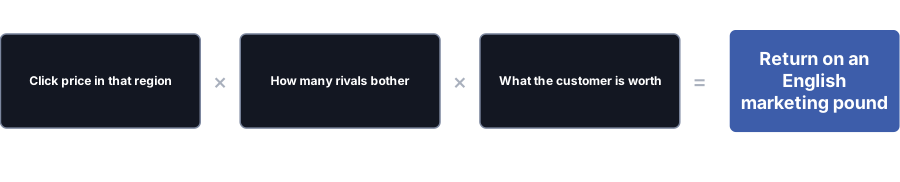
- Click price in that region
- The same query is bid far higher in the South East than in the North East, and the gap is not a small one.
- How many rivals bother
- Thinner competition in rural and coastal England means an organic position can still be taken quickly.
- What the customer is worth
- Roughly the same at either end of the country, which is why the price gap is not matched by a value gap.
Who is here
Who does business in England
Most English businesses that need this work are owner-managed firms serving a defined travel-to-work area: trades and property maintenance, dental and veterinary practices, high street professional firms, independent retail and hospitality. They compete locally, and they are usually one or two people away from having no marketing capacity at all.
Above that sits a large tier of regional operators — multi-branch practices, franchise networks, distributors and contractors covering several counties. Their recurring problem is a website naming one city while the business quotes across five, which leaves most of the trading area unrepresented.
England also holds a deep business-to-business base outside the capital, from engineering and logistics to software and financial intermediaries. Those buyers research over months, compare shortlists, and are barely affected by local search but heavily affected by whether a site answers a technical question.
Search behaviour
How search works in England
Search is not uniform across markets. Engine share, language, device mix and local platforms all shift what a strategy in England should prioritise.
- People search by the name they use for home, and in England that is usually a town, a postal town or a borough rather than a county or a region. A firm optimising for a county name is frequently invisible to the ten towns inside it.
- Administrative names and everyday names diverge constantly. Residents of Solihull, Sale or Stockport do not describe themselves as living in a combined authority area, and search volume follows the everyday name almost every time.
- Commercial results in English consumer categories are unusually crowded with directories, comparison sites and lead marketplaces, which occupy the positions above the businesses that do the actual work. That pushes a realistic organic target down the page and towards narrower queries.
- Postcode districts appear inside queries far more than most businesses expect, especially in property, trades and delivery categories, because a postcode is the shortest way for someone to be precise about where they are.
- Mobile and voice queries skew heavily towards immediate need — an emergency plumber, a dentist open on Saturday, a garage that can take a car today — and those are resolved by profile completeness and opening hours far more than by page content.
Strong fit
Industries with the clearest opportunity in England
Sectors worth a look in England
- Home Services & Trades marketingHVAC, roofing, plumbing, restoration and the trades around them. High-intent local search, phones that have to ring, and a service area that decides most of what is winnable.
- Law Firms & Legal Services marketingLegal is the most expensive search category in most markets and the most heavily constrained by professional conduct rules. What works depends almost entirely on the practice area, which is why these pages are written separately.
- Real Estate & Property marketingAgents, brokerages and property managers work the same streets and run on completely different economics. One is paid once per transaction, the other every month. This is where the strategies split.
- Retail & Ecommerce marketingRetail runs on margin, inventory and a marketplace that is simultaneously your largest sales channel and your most aggressive competitor. That combination sets the boundaries for everything marketing can usefully do.
Where to start
Services that fit businesses in England
Local SEO
Local search is decided by different signals than the rest of SEO — proximity, profile quality, review behaviour and how clearly your service area is defined. We work all of them, for single locations and for multi-location businesses.
SEO services
SEO services make your business easier to find on Google and Bing for the searches that lead to enquiries. They suit owners and marketing leads who need qualified leads, not just traffic. Included: technical fixes, local SEO, demand mapping, content, authority building and reporting tied to enquiries.
Web design & development
Web design and development plans a site for search and conversion before design starts, then builds it fast, accessible and yours to own. It is for businesses whose site looks fine but does not bring in enquiries. Included: SEO structure, UX, design, build, migrations, Core Web Vitals, accessibility and conversion work.
Conversion optimisation
Most sites do not have the traffic for valid A/B testing, and pretending otherwise wastes months. The work that moves conversion at normal volumes is research, friction removal and fixing paths that are plainly broken. We test when testing can answer something.
Constraints
Marketing rules in England
- England and Wales share a single legal jurisdiction. That shapes vocabulary rather than advertising rules: solicitors, conveyancing, freehold and leasehold, the county court. A firm marketing legal or property services across the border into Scotland needs a different vocabulary entirely, and should take it from its own advisers rather than from a keyword tool.
- Advertising claims fall under the CAP Code, enforced by the Advertising Standards Authority across websites and paid media. Substantiation is expected, comparative claims need evidence, and rulings are published. We write claims that can be evidenced and flag anything needing your sign-off before it goes live.
- Data and electronic marketing sit under UK GDPR and PECR, overseen by the Information Commissioner. Cookie consent and email consent are the two places where English smaller businesses most often fall short of what the regulator expects. We build the mechanics properly and leave the legal interpretation to your advisers.
- Regulated sectors add a further layer — the SRA for solicitors, the FCA for financial promotions, professional body guidance in healthcare. Requirements move, so treat all of this as context and confirm your current obligations with your own compliance adviser before publishing.
Primary sources
Where to read the rules for England
The statutes and regulators behind the rules above. They are the authority, not this page, and none of this is legal advice.
- The UK Code of Non-broadcast Advertising and Direct & Promotional Marketing
CAP Code
The UK Code of Non-broadcast Advertising and Direct & Promotional Marketing
Source: Advertising Standards Authority
- ICO guidance on direct marketing, cookies and electronic communications
PECR
ICO guidance on direct marketing, cookies and electronic communications
- Financial promotions and adverts: what firms must do and who may approve them
FCA
Financial promotions and adverts: what firms must do and who may approve them
Source: Financial Conduct Authority
How we work here
We serve England remotely, and we say so
We serve England remotely. We hold no address, no phone number and no staff anywhere in the country, and we would rather write that on the page than leave you to work it out from a company registration.
In practice that means scheduled calls in UK hours, shared working documents instead of status meetings, and written recommendations you can circulate to people who were not on the call. The model is built so that half an hour of calls a week is enough, with the rest in writing.
Where a piece of work needs someone physically present — photography, a site survey, an event — we say so, and either arrange it locally and quote it separately or tell you it is better handled by a supplier you can drive to.
Questions
Working with us from England
Should we target the town, the city or the county?
Start with the town, because that is what people type. County and region names attract research traffic and comparison shopping rather than enquiries, and they rarely convert at the same rate.
The exception is a business whose customers think county first, which in England tends to mean rural services, agriculture and some professional categories. That is a question we answer from your enquiry data rather than from a general rule.
We built a page for every town we cover. Why did nothing happen?
Because in almost every case those pages carried the same three paragraphs with the place name swapped, and that pattern has been recognised and discounted for years.
A location page earns its place when it says something only true of that place: the specific work you do there, the constraints of the area, the customers you serve in it. If you cannot write that, the straight answer is fewer pages that are about your service.
Can we outrank the comparison sites in our category?
On the broadest terms, usually not, and spending two years finding that out is expensive.
What is winnable is the layer underneath: a specific service, a specific problem, a specific place. Those queries carry someone who has already decided roughly what they want, which is why they convert better even at lower volume.
Do we need different content for northern and southern England?
Not different content, but often a different plan. Click prices, competitor density and how far people will travel all vary enough across England to change what a sensible budget buys in each place.
Where the writing does need to change is in reference points rather than dialect. Copy that assumes every reader is a forty-minute train ride from a major city reads oddly across a large part of the country.
Are you based in England?
No. We serve English businesses remotely and we do not maintain an address, a team or a phone number anywhere in the country.
For search, web and brand work it changes nothing about delivery. If it matters to you that a supplier can visit, that is a fair requirement and you should hire on it.
Talk to us about growing in England
Start with the free Growth Scan: an indicative read of your website and the few things to fix first, with no sign-up. BOOSTD is in early access, so the market question — who is winning the searches that matter in England, and whether the opportunity justifies the investment — is worked through with our team on a strategy call. If it does not, we will say so.
Prefer to talk it through? Book a strategy call
If we don't deliver the work we agreed to deliver for reasons within our control, you don't pay for the undelivered work. Read our guarantee
References
Sources
The primary documents and published research this page relies on. Platform rules change, so check the source before acting on a detail.
More to explore
Elsewhere in United Kingdom
Last updated · Published by Zubair Afzal (responsible editor), on owner authorisation