
Serving London remotely
SEO and digital marketing for London businesses
London is not a local market with high prices. It is an international market that happens to be a city. For SEO and digital marketing in London, that means a London keyword and a national keyword are usually the same auction against the same well-funded bidders.
Prefer to talk it through? Book a strategy call
Who is here
Who does business in London
London businesses tend to have more marketing maturity than those elsewhere in the UK. There is usually an in-house marketer, an analytics setup that half works, a previous agency relationship that ended badly, and a board asking why the numbers stopped improving.
The categories are concentrated: financial and professional services, law, technology and software, creative and media production, property, and a large hospitality and retail sector serving residents and visitors at the same time. Each has its own bidding pressure and its own regulator.
There is also a substantial population of small London businesses with entirely local catchments — clinics, practices, trades, restaurants — whose competition is measured in streets rather than counties, and who are frequently sold a national strategy they do not need.
The market
What makes London different
London competes internationally for the same words its local businesses need. A consultancy in Farringdon and a consultancy in New York or Singapore are visible to the same searcher, and the auction reflects that.
The specific consequence for budgets is that the entry price to be visible is set by the best-funded bidder in a category, not by the average one. A sensible London plan is built around what happens when you deliberately decline that auction.
The city also rewards specificity harder than anywhere else in the country. Broad category positioning is already occupied, and a narrow, credible claim to a defined type of client or problem is the one thing a larger budget cannot immediately copy.
Two markets, one city
London competes at a few hundred metres and at global scale at once
The word London buys almost no relief from competition in professional categories, because the firms competing nationally are mostly headquartered here. Walk-in demand, meanwhile, is settled within a few hundred metres. The same business lives in both.
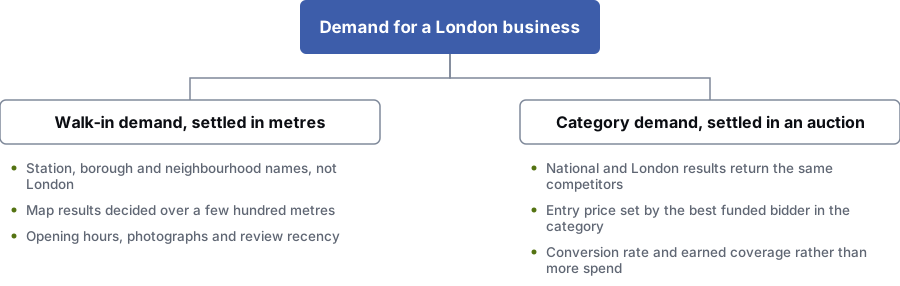
Walk-in demand, settled in metres
- Station, borough and neighbourhood names, not London
- Map results decided over a few hundred metres
- Opening hours, photographs and review recency
Category demand, settled in an auction
- National and London results return the same competitors
- Entry price set by the best funded bidder in the category
- Conversion rate and earned coverage rather than more spend
Strong fit
Industries with the clearest opportunity in London
Sectors worth a look in London
- Financial Services marketingFinancial services sits in the highest-stakes category search engines recognise, under advertising rules that differ by country and change without notice. The work is building visibility and trust inside those constraints rather than pretending they are not there.
- Technology & Software marketingTechnology is the sector where the industry label tells you least. What decides the strategy is the business model underneath it: self-serve product, enterprise contract, or regional service agreement. These pages are written to that split.
- IT Services & Managed Service Providers marketingA pipeline of contracts from your actual service area, built around the trigger events that start the search rather than a steady stream that does not exist.
- Personal Injury Law marketingLower cost per signed case of the type you want, by qualifying earlier and closing the gap between enquiry and retainer.
Search behaviour
How search works in London
Search is not uniform across markets. Engine share, language, device mix and local platforms all shift what a strategy in London should prioritise.
- National and London queries return substantially the same competitive set in professional categories, so a London modifier buys much less relief from competition than the same modifier would in Leeds or Bristol.
- Within the city, physical search collapses to walking distance. Station names, borough names and neighbourhood names carry more weight than the word London, and map results are decided over a few hundred metres.
- A meaningful share of demand originates outside the UK, from people researching a London supplier, a London office or a London visit. That traffic behaves differently: longer research windows, currency and time zone questions, and a much higher bar for trust signals.
- Branded search is heavily defended. Established competitors bid on their own names and often on each other, so the cost of appearing beside a known brand is kept deliberately high.
- Conversion rate does more work here than ranking position. When a click costs what it costs in London, a landing page that converts poorly is not an optimisation task, it is the entire problem.
Constraints
Marketing rules in London
- Financial promotion rules are the strictest regime most London marketers meet. The FCA governs how regulated products and services may be promoted, including on websites and social media, and approval is a formal internal process rather than a copywriting preference. We write to your compliance function rather than around it.
- Law firms operate under SRA transparency and publicity requirements, including obligations about price and service information on websites. We build those pages to be found as well as compliant, and we take the wording itself from your risk and compliance team.
- The CAP Code covers everything else, and London consumer categories draw complaints more readily than most because the audience is large and the claims are ambitious. Anything comparative or superlative needs its evidence attached before it goes live.
- None of this is legal advice and requirements move. Confirm your current obligations with your own regulator-facing advisers before publishing, particularly in financial services and law.
Primary sources
Where to read the rules for London
The statutes and regulators behind the rules above. They are the authority, not this page, and none of this is legal advice.
- Financial promotions and adverts: what firms must do and who may approve them
FCA
Financial promotions and adverts: what firms must do and who may approve them
Source: Financial Conduct Authority
- The UK Code of Non-broadcast Advertising and Direct & Promotional Marketing
CAP Code
The UK Code of Non-broadcast Advertising and Direct & Promotional Marketing
Source: Advertising Standards Authority
- ICO guidance on UK GDPR and the Data Protection Act 2018
UK GDPR
ICO guidance on UK GDPR and the Data Protection Act 2018
Where to start
Services that fit businesses in London
B2B SEO
In B2B the person searching is often not the person signing. A handful of searches a month can be worth more than a hundred thousand sessions, and the page has to survive being forwarded to a finance director, a security reviewer and a procurement team.
Paid media
PPC and paid media management across Google, Microsoft, Meta, LinkedIn, TikTok and YouTube, judged on cost per acquired customer and lead quality rather than clicks. It is for businesses spending on ads without knowing which spend produced revenue. Included: tracking, account structure, bidding, creative, landing pages and reporting.
Digital PR
Digital PR is the work of producing something a journalist would run without being asked twice: original data, expert comment at the moment it is needed, a new angle. The links follow the coverage rather than the other way round.
AI search optimisation
AI search optimisation gets your business found and described accurately in Google AI Overviews, ChatGPT, Copilot, Gemini and Perplexity. It suits businesses whose buyers ask an assistant for a shortlist. Included: crawler access checks, answer-ready pages, entity consistency, corroborating coverage and honest measurement.
How we work here
We serve London remotely, and we say so
We serve London businesses remotely, and we are not going to describe a coworking membership as an office. There is no London address, no London telephone number and no London staff attached to this page.
What that removes in practice is very little. Strategy, search, build and brand work happen in documents, repositories and calls, and the part of agency life that requires a room is mostly the part businesses resent paying for.
Where a project needs presence in the city — a shoot, a launch, a set of interviews for a research piece — we source it locally, quote it separately and tell you who is doing it.
Reviews and sign-off run in UK hours, and we write recommendations to be read rather than presented, because London teams are usually the ones with the least appetite for another meeting.
Questions
Working with us from London
Our cost per click has doubled. Do we just accept it?
No, but the fix is usually not inside the ad account. When an auction is set by better-funded bidders, the ways out are a narrower target, a page that converts far better, or a shift of budget into channels those bidders are not buying.
We would start by working out what a qualified enquiry is worth to you. A good deal of London paid search is unprofitable at current prices, and the correct answer there is to spend less, not to optimise harder.
Does adding London to our keywords make them easier to win?
Less than you would expect. In professional and B2B categories the London result and the national result are contested by the same companies, because most of them are based here and target both.
It does help for local demand — a clinic, a restaurant, a practice with a catchment measured in streets. There, borough and station names do considerably more than the word London.
We already have an in-house marketing team. What would you do?
Usually the parts that need concentrated specialist time rather than continuous attention: technical search work, content architecture, digital PR, and the analysis nobody in-house has a free week to finish.
We are also useful as the party willing to say a campaign is not working. That is a much easier sentence to say from outside an organisation than from inside it.
How do we compete against a rival who has just raised funding?
Not by matching the spend. Funded competitors buy attention efficiently, but they rarely buy depth, and category authority built on real expertise is slow for them to replicate.
In practice that means owning a narrower definition of the problem, publishing work worth citing, and making sure the parts of your site that convert are simply better than theirs.
Does it matter that you are not in the city?
Not for the work itself. Search, build and brand projects run on shared documents and scheduled calls, and no part of them improves because a supplier is twenty minutes away on the Central line.
It matters for anything needing a body in a room, and we are direct about which those are. We hold no London address and no London number, and we will not imply one.
Talk to us about growing in London
Start with the free Growth Scan: an indicative read of your website and the few things to fix first, with no sign-up. BOOSTD is in early access, so the market question — who is winning the searches that matter in London, and whether the opportunity justifies the investment — is worked through with our team on a strategy call. If it does not, we will say so.
Prefer to talk it through? Book a strategy call
If we don't deliver the work we agreed to deliver for reasons within our control, you don't pay for the undelivered work. Read our guarantee
References
Sources
The primary documents and published research this page relies on. Platform rules change, so check the source before acting on a detail.
More to explore
Other cities in United Kingdom
Last updated · Published by Zubair Afzal (responsible editor), on owner authorisation