
Serving Scotland remotely
SEO and digital marketing for Scottish businesses
Scotland has its own legal system, and that changes the words your customers use. SEO and digital marketing in Scotland needs keyword research done for Scotland, because research from an English desk misses the query set in law, property and public services.
Prefer to talk it through? Book a strategy call
Search behaviour
How search works in Scotland
Search is not uniform across markets. Engine share, language, device mix and local platforms all shift what a strategy in Scotland should prioritise.
- The single biggest difference is vocabulary. Scottish searchers use Scottish process words — confirmation rather than probate, missives and the Home Report in a house purchase, the Sheriff Court rather than the county court — and an English keyword list simply does not contain them.
- Adding the word Scotland to a national page is not a substitute. The query set is different rather than a regional variant of the same one, and a page describing an English process reads as wrong to anybody who has been through the Scottish one.
- Place naming is Central Belt first. Glasgow and Edinburgh dominate commercial volume, Aberdeen and Dundee carry their own sector-specific demand, and beyond that people search by town, island or area rather than by council name.
- Cross-border intent is common and easy to misread. A large volume of searches for Scottish services comes from people elsewhere in the UK who are buying property, relocating or dealing with an estate here, and their questions start from English assumptions the content has to unpick.
- Gaelic is a small but real consideration for public bodies and organisations with Gaelic language plans, mostly in the Highlands and Islands. It is an obligation and credibility question far more than a traffic one, and it should be done properly or left alone.
A separate legal system
Adapting a UK page for a Scottish reader
Scotland is a separate jurisdiction and the divergence is lexical as much as procedural. Adding the word Scotland to an English page is no substitute, because the query set is different rather than a regional variant of the same one.
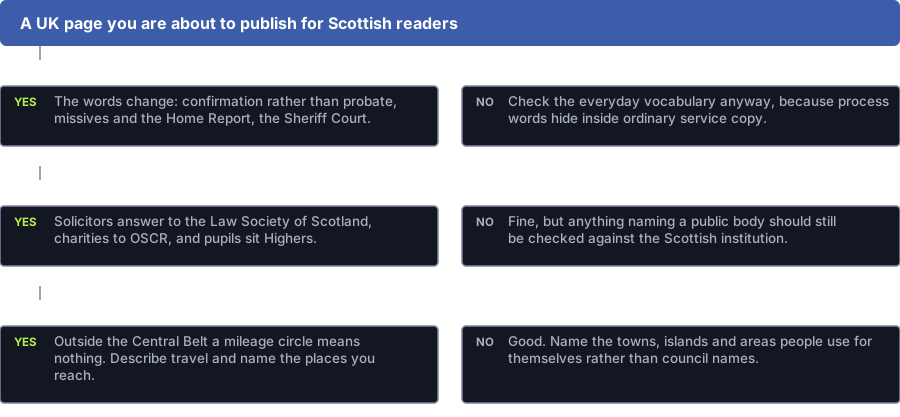
Does it name a legal or property process?
Yes: The words change: confirmation rather than probate, missives and the Home Report, the Sheriff Court.
No: Check the everyday vocabulary anyway, because process words hide inside ordinary service copy.
Does it name a regulator or a qualification?
Yes: Solicitors answer to the Law Society of Scotland, charities to OSCR, and pupils sit Highers.
No: Fine, but anything naming a public body should still be checked against the Scottish institution.
Does it describe coverage as a radius?
Yes: Outside the Central Belt a mileage circle means nothing. Describe travel and name the places you reach.
No: Good. Name the towns, islands and areas people use for themselves rather than council names.
The market
What makes Scotland different
Scotland is often treated as a region of a UK plan and it does not behave like one. The legal system, the regulators, the public institutions and a good deal of the everyday terminology are distinct, so content written for England is visibly inaccurate rather than merely less relevant.
Sector strength is concentrated and easy to identify: energy and its supply chain around Aberdeen, asset management and financial services in Edinburgh, life sciences across Dundee and Glasgow, and food, drink and tourism across the whole country.
The market is smaller than England, which cuts both ways. Volumes are lower, but so is the number of organisations doing the work properly, and a genuinely Scottish content programme still returns more than the same effort would south of the border.
Who is here
Who does business in Scotland
Scottish professional firms are our most frequent conversation — solicitors, solicitor estate agents, accountants and financial advisers, all working under processes their English equivalents do not share.
The energy supply chain around Aberdeen is a distinct market with long procurement cycles, technical buyers and a live transition from oil and gas into offshore wind and related services. The marketing question there is authority rather than lead volume.
Tourism, hospitality and food and drink form a third group, selling largely to people who are not in Scotland yet, which turns local search into something closer to a national and international content problem.
Public and third sector organisations make up a larger share of the Scottish economy than of the English one, and they bring procurement rules, accessibility obligations and language plans that a purely commercial agency tends not to expect.
Where to start
Services that fit businesses in Scotland
SEO services
SEO services make your business easier to find on Google and Bing for the searches that lead to enquiries. They suit owners and marketing leads who need qualified leads, not just traffic. Included: technical fixes, local SEO, demand mapping, content, authority building and reporting tied to enquiries.
Content & digital PR
Content marketing and digital PR give people a reason to cite you: pages that answer questions properly, original research, and coverage earned on the story. It is for businesses publishing with no return. Included: content strategy, copywriting, digital PR, thought leadership, original research, video and podcasts. No bought links.
Analytics & attribution
Perfect attribution does not exist. What does exist is a measurement setup you trust, a written account of where it is blind, and a way to test the questions attribution cannot answer. That is a better position than most businesses are in.
Local SEO
Local search is decided by different signals than the rest of SEO — proximity, profile quality, review behaviour and how clearly your service area is defined. We work all of them, for single locations and for multi-location businesses.
Strong fit
Industries with the clearest opportunity in Scotland
Sectors worth a look in Scotland
- Family & Divorce Law marketingBe the firm they have already been reading for a month by the time they are ready to make the call.
- Residential Real Estate marketingBecome the agent a homeowner in your patch already recognises by the time they decide to sell, so the appraisal is a conversation rather than a competitive pitch.
- Healthcare, Dental & Clinics marketingDental practices, cosmetic dentistry and medical clinics share a catchment, a trust problem and a regulator. They do not share a business model — one is selling a discretionary purchase, another is trying to answer the phone less. These pages are written separately.
- Hospitality & Food Service marketingA table that goes empty tonight cannot be sold tomorrow. Hospitality marketing is mostly the work of moving demand into the hours you cannot fill, and of keeping the commission-taking middlemen from owning your customer.
How we work here
We serve Scotland remotely, and we say so
We serve Scotland remotely and hold nothing here — no address, no telephone number, no staff in Edinburgh, Glasgow or anywhere else in the country. Saying that first tends to save everybody a conversation.
What we do commit to is never writing Scottish content from English assumptions. Terminology comes from your own practitioners, we check it back with them, and we do not lift it from a UK page and adjust it.
Where a business serves the Highlands and Islands we describe coverage in the terms customers use — which towns, which islands, what the journey involves — instead of drawing a radius that implies something untrue.
Calls run in UK hours and we deliver written work as documents you can send to a colleague, which matters more than usual for firms where a partner has to approve the wording.
Constraints
Marketing rules in Scotland
- Scots law is a separate system rather than a variation. Property, succession, family law and court procedure all differ from England and Wales, so content describing an English process to a Scottish audience is inaccurate rather than approximate. We write from your instructions on process and we do not draft the legal substance ourselves.
- Professional regulation differs accordingly. Solicitors are regulated by the Law Society of Scotland, and firms should take their advertising and publicity requirements from that body rather than from guidance written for the regulator in England and Wales.
- UK-wide regimes still apply unchanged. UK GDPR, PECR and the CAP Code operate across Scotland exactly as they do elsewhere, so consent, cookie and substantiation obligations are identical wherever you trade.
- Public bodies and organisations delivering public functions may carry additional duties, including accessibility requirements and in some cases a Gaelic language plan. Confirm what applies to your organisation with your own advisers; we build to WCAG 2.2 AA regardless of sector.
Primary sources
Where to read the rules for Scotland
The statutes and regulators behind the rules above. They are the authority, not this page, and none of this is legal advice.
- Solicitors (Scotland) Act 1980, which sets up regulation by the Law Society of Scotland
Solicitors Act 1980
Solicitors (Scotland) Act 1980, which sets up regulation by the Law Society of Scotland
Source: legislation.gov.uk
- The UK Code of Non-broadcast Advertising and Direct & Promotional Marketing
CAP Code
The UK Code of Non-broadcast Advertising and Direct & Promotional Marketing
Source: Advertising Standards Authority
- ICO guidance on direct marketing, cookies and electronic communications
PECR
ICO guidance on direct marketing, cookies and electronic communications
Questions
Working with us from Scotland
Can we reuse our English content with the place names changed?
No, and this is the point we would push back on hardest. Scottish processes have different names and different steps, so an adapted English page is not slightly off, it is wrong.
The practical route is to write the Scottish version from your own practitioners, keep it on its own pages, and let it target the terms Scottish clients search for.
Is the Scottish market big enough to justify its own programme?
For most categories yes, precisely because so few organisations write specifically for it. Lower search volume is offset by considerably less competent competition on the terms that matter.
The exception is a business selling identically across the whole UK with no Scottish process differences at all. There, a separate Scottish programme is usually a distraction.
How should we describe a service area that covers the Highlands?
In travel terms and named places rather than in miles. A radius drawn across northern Scotland describes journeys nobody makes and coverage you may not offer.
Listing the towns and islands you serve, and saying plainly how you serve them, is both more accurate and more convincing to somebody comparing suppliers.
Do we need Gaelic on our website?
Almost certainly not, unless you are a public body, an organisation with a Gaelic language plan, or a business trading somewhere it carries real cultural weight.
If you do it, do it properly: human translation, and a considered decision about URLs and language tagging. A machine-translated Gaelic page reads worse than no Gaelic at all.
Our agency is in London. Why would we add a Scottish specialist?
You may not need one. What you do need is somebody who knows Scotland is a separate jurisdiction and builds the keyword and content plan from that fact, rather than translating an English plan northwards.
We are not in Scotland either, and we say so plainly. What we offer here is method rather than a postcode.
Talk to us about growing in Scotland
Start with the free Growth Scan: an indicative read of your website and the few things to fix first, with no sign-up. BOOSTD is in early access, so the market question — who is winning the searches that matter in Scotland, and whether the opportunity justifies the investment — is worked through with our team on a strategy call. If it does not, we will say so.
Prefer to talk it through? Book a strategy call
If we don't deliver the work we agreed to deliver for reasons within our control, you don't pay for the undelivered work. Read our guarantee
References
Sources
The primary documents and published research this page relies on. Platform rules change, so check the source before acting on a detail.
More to explore
Elsewhere in United Kingdom
Last updated · Published by Zubair Afzal (responsible editor), on owner authorisation