
Research
Marketing research, and the standard a study must meet first
Our original SEO and marketing research will be published here. None is out yet, so this page sets out the standard every study must meet first.
No original research published yet
We have not published any research yet. When we do, it will be work we ran ourselves, with the sample, the method and the dates on the page.
We could fill this page tomorrow. A common practice in marketing is to take a free public dataset, cut it a new way, add a year to the title and call it a study.
That is not research. A page full of those would be less useful to you than this empty one.
Why this page is empty
Why we will not publish a benchmark we did not run
A benchmark is a claim about the world. Once published, people quote it, then quote it without a link, then AI tools and summary sites repeat it, and by then nobody can correct it. A careless benchmark does more harm than none.
You can usually tell the difference. A proper study tells you how many things it measured, where they came from, when they were measured and what it could not see. A weak one gives you a headline percentage and a chart.
We are a new company without enough of our own data to make some of these studies meaningful, and we will not dress up a small sample as an industry benchmark. Where we can run a study from public sources, we will describe the sample clearly enough for someone to challenge it.
Why the bar is high
How a published figure loses its method as it gets shared
Each time a figure is repeated, something drops away, until nothing is left that anyone can correct.
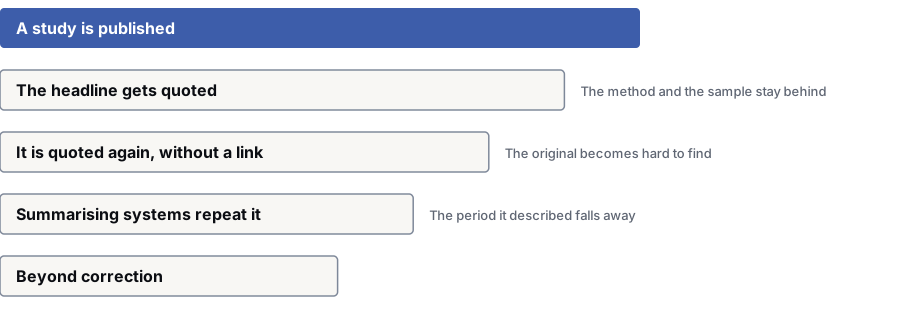
- 1A study is published — The sample, the method and the dates the data covers are all on the page, not just in the title.
- 2The headline gets quoted — A percentage is easy to share. The number it was based on usually gets left out.The method and sample are left behind
- 3It gets quoted again, without a link — Now people repeat it who never opened the study and could not check it if they tried.The original gets hard to find
- 4AI tools and summaries repeat it — A snapshot of one moment gets repeated as a lasting fact, in answers that show no method.The time period drops away
- 5Nobody can correct it — Fixing the original no longer reaches the places repeating it. That is why a weak benchmark does more harm than an empty page.
Our research standard
What every study must show before we publish it
We wrote this before running any study, so we cannot bend it later to fit a result we liked.
Every study will state
- The question it set out to answer, and why that question matters now
- Where the data came from, by name, and whether it is public, our own or licensed
- The sample: what was measured, how many, and how they were chosen
- How the data was collected, in enough detail for someone with the same access to repeat it
- The dates the data covers, on the page as well as in the title
- What the study cannot tell you, and how it could be wrong
No study will
- Present a correlation as a cause because it makes a better headline
- Give a percentage without the number it was based on
- Stretch findings from one sector or one country to "the industry"
- Use a sample picked because it gave an interesting answer
- Reuse another organisation’s figures and present them as our research
- Stay up without a correction note once we know part of it is wrong
Planned research
SEO and marketing topics we plan to study
How AI answer engines choose their sources
Which pages get cited when an AI assistant answers a buying question, and what they have in common. Most of what is written on this so far is guesswork from a few screenshots.
Website speed for real users, by industry
Real-world site speed varies a lot by sector, and public datasets let us compare industries without any client data. The value is in the industry breakdown, not another site-wide average.
How local businesses show up in map results
This can be observed and repeated, yet most writing on it repeats the same advice every year without testing it.
What a marketing budget buys
We can only run this properly once we have enough of our own client work to describe. Until then, we would rather say so than publish a model dressed up as evidence.
How websites convert, by type of buyer
There is a wide gap between what agencies claim about conversion and what anyone can show. Any study would need permission from every business whose data appears in it, which will take time.
In the meantime
Where to find our sourced guides
Guides with their sources linked
- guides and comparisonsHow search and websites work, with every source linked.
- our sourcing rulesWhat has to be true before a figure can appear on this site.
The same rules on other pages
- the rules our work followsIncluding some that would help us win clients.
Questions
Questions about our research plans
- When will you publish your first study?
When a study meets the standard on this page. We won’t set a date, because deadlines push thin data out the door as a benchmark.
The first studies will most likely use public data only. They don’t need years of our own data to be worth running.
- Why not summarise research other people have published?
We do, inside our guides, with a link to the original and the period it covers. We won’t put someone else’s figures under a new title and call it our research.
That habit is why so many marketing statistics have no clear origin. Each retelling loses context until the number is quoted with no method, sample or year.
- Would you publish the underlying data?
Yes, where we can. If a study uses public data, we will describe how we collected it in enough detail for someone else to repeat it and challenge our conclusions.
Data from client accounts would only ever appear combined, anonymised and with written permission. The write-up would say which parts cannot be shared and why.
- Can our business take part in a study?
Possibly. Any study that needs participants will say so and explain what taking part involves before you agree to anything.
Taking part would never be a condition of working with us. No client data appears in anything we publish without written permission for that specific use.
- What would make you retract a study?
A flawed method, a sample that was not what we described, or a conclusion the data does not support. Any one of these is enough.
We would leave the retracted study visible with a note explaining what was wrong. Silently deleting a study others have cited would be worse than the original error.
Last updated · Published by Zubair Afzal, responsible editor