
AI marketing agents
An agent is a narrow worker, not a marketing department
The word agent has been attached to everything from a chat window to a content factory. This page uses the narrow definition — software given one job, a set of tools and a boundary — and sets out the four marketing jobs that are genuinely worth handing over, plus the ones that are not.
Prefer to talk it through? Book a strategy call
Definition
The narrow definition, and why the loose one is useless
An agent is software given one job, a set of tools it is allowed to use, and a boundary it may not cross. It chooses its own next step inside that boundary until the job finishes. That is all the word means, and it is worth insisting on the narrow version because the loose one — anything involving a language model — makes every product in the category sound identical.
Two consequences follow from the narrow definition and both are practical. Because an agent chooses its next step, you cannot predict the exact path it takes, so the thing you specify is the boundary rather than the sequence. And because it keeps going until the job is done, a job with no natural end is the most expensive mistake available in this category.
So the question to ask about any agent, ours included, is not what it can do. It is what it is allowed to touch, what makes it stop, and what checks the output before anything acts on it.
Failure modes
Where marketing agents go wrong
These are the four we design against. None of them are exotic, and all four have shown up in the pilots businesses describe to us on the first call.
It is worth being specific about this, because the sales version of the category never is. An agent failing loudly is a good day — the bad days are the quiet ones, where something plausible happens at a scale nobody can review.
- The work is plausible and nobody can check it
- Output that reads well, is internally consistent and cites nothing verifiable is the hardest thing to review, because skimming it produces no alarm. Review then becomes a formality, and a formality is not a control. The fix is not better review, it is only giving agents jobs whose answers can be checked against something outside the agent.
- The job has no end, so the volume becomes the problem
- An agent told to improve content will improve content indefinitely. Publishing at that scale is precisely what search engines treat as scaled content abuse, and it puts a site that already ranks at risk in exchange for pages nobody searched for. Every job we hand over has a finish line written into it.
- It acts on a stale picture of the site
- An agent working from a crawl taken last week will confidently fix a page that was fixed on Tuesday, or redirect a URL that somebody restored. Anything that writes has to re-check the live state immediately before it acts, and stop if the state has changed since it decided.
- Nobody can say afterwards why it did that
- If the log records only that a change happened, the change cannot be defended to a client, a regulator or the person who has to undo it. Every action an agent takes is recorded with the evidence it acted on, the rule that permitted it, and the state it replaced.
The useful list
Four marketing jobs genuinely worth giving an agent
Each one passes the same test: the answer can be verified against something outside the agent, and checking it costs less than doing it.
- Finding the problem in a large site — which of nine hundred URLs are non-indexable, redirect twice, contradict the pricing page, or lost their heading in a template change
- Watching a market continuously — what competitors published, repriced or rewrote this week, and which of those changes sits on a query you care about
- Assembling the evidence behind a decision — the rankings, the impressions, the conversion path, the assistant answers and the gap between them, gathered before the meeting rather than during it
- Preparing work for a person to release — briefs with sources attached, metadata drafted against the live page, technical fixes written as a diff somebody can read in a minute
The test
Whether a job is worth handing over, in two questions
Run any proposed agent job through this before buying it. Most of the things sold as agent use cases fail at the first question, which is why they produce output nobody trusts.
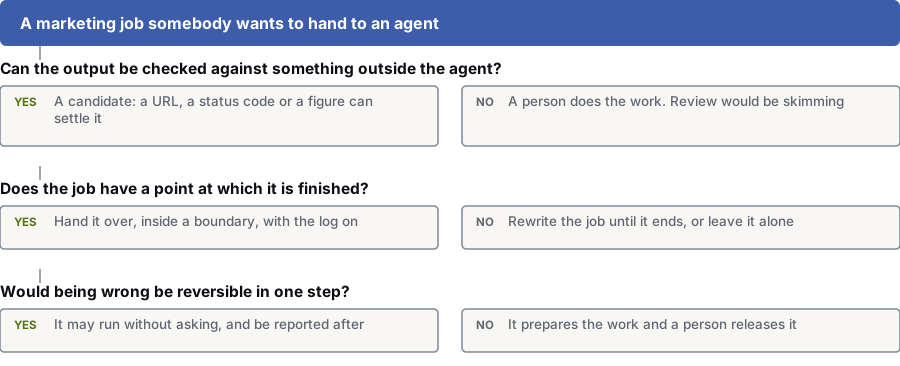
Can the output be checked against something outside the agent?
Yes: A candidate: a URL, a status code or a figure can settle it
No: A person does the work. Review would be skimming
Does the job have a point at which it is finished?
Yes: Hand it over, inside a boundary, with the log on
No: Rewrite the job until it ends, or leave it alone
Would being wrong be reversible in one step?
Yes: It may run without asking, and be reported after
No: It prepares the work and a person releases it
Questions
What people ask about agents doing real work
What is an AI marketing agent, in one sentence?
Software given a single job, a set of tools it may use, and a boundary it may not cross, which decides its own next step within that boundary until the job is finished or it runs out of room.
Two parts of that matter more than the rest. It chooses its next step, which is what separates an agent from a scheduled script. And it has a boundary, which is what separates a useful agent from an expensive way to make a mess quickly.
Can an agent write our blog posts?
It can produce drafts. Whether that is worth having depends entirely on how expensive the checking is, and for anything that makes a claim about your business, your market or your prices, the checking costs more than the writing.
We use agents to prepare: the brief, the sources, the outline, the internal links, the gaps against what already ranks. A person writes the argument and a person signs it off, because that is the part a reader is actually paying attention to.
How do you stop an agent producing too much?
By giving it a job that has an end. An agent asked to find every page that contradicts the pricing page finishes; an agent asked to produce content does not, and will happily keep going until somebody notices the bill or the index.
Publishing at volume because it became cheap is what Google’s spam policies describe as scaled content abuse. It is a real risk to a site that already ranks, and it is the main reason our agents prepare work rather than release it.
What do you do when an agent is confidently wrong?
Assume it will be, and design so that being wrong is cheap. Every job an agent runs has a defined output, a check that output has to pass, and a person who sees the result before anything acts on it.
The cases that worry us are not the obvious errors — those get caught. They are the plausible ones, where the output reads correctly and is not. That is why agents are only given jobs where the answer can be verified against something outside the agent, such as a live URL, a status code, a search result or an analytics figure.
Do agents replace the people doing this work?
They remove the waiting, not the judgement. Most of the elapsed time in marketing work is not thinking, it is gathering: pulling data, checking pages, comparing what a competitor changed, finding which of six hundred URLs have the problem.
What is left after that is the decision, which is where the value was all along and which we are not attempting to hand over.
Bring us a job you would like to hand over
On the call, take one task that eats a day a month and we will run it through the two questions above with you. If it fails them, that is a useful answer and it costs you nothing.
Prefer to talk it through? Book a strategy call
Related
Where to go next
- where agents sit in the wider approachThe boundary that governs all of them.
- the same argument applied to searchWhich search tasks pass the verification test.
- the category definitionIncluding the questions to ask a supplier.
- the technical side of searchThe work with the cheapest verification of all.
- content and digital PRWhere a person writes and an agent only prepares.
- how assistants choose what to quoteA different problem, frequently confused with this one.
- our standardsWhat we will not publish, whoever wrote it.
- our editorial policy
- bring us one of these jobs
Last updated · Not yet approved for publication