
Agentic SEO
Search work splits cleanly into what can run daily and what cannot
Agentic SEO, or autonomous SEO, describes search work run continuously instead of in a monthly cycle. Some of it genuinely improves when it runs every day. Some of it gets materially worse. This page draws the line between the two and explains what decides which side a task falls on.
Prefer to talk it through? Book a strategy call
The distinction
Why some search tasks improve daily and others degrade
Agentic SEO — autonomous SEO, in the other common phrasing — means running search work continuously rather than in a monthly or quarterly cycle. The interesting question is not whether that is possible. It is which tasks actually get better when you do it, because a fair number get worse.
The tasks that improve share one property: their correct answer is a fact that changes without anybody touching it. Whether a page is indexed, whether a redirect has started chaining, whether a competitor published something new against a query you care about. None of those are opinions, all of them go stale, and a monthly cadence means carrying a stale answer for up to thirty days at a cost you never see itemised.
The tasks that degrade are the ones where the answer is a judgement: what this page should say, whether this URL should exist, whether this is the right structure for a catalogue. Running those more often does not make them better. It produces churn, and churn on a site that already ranks is a cost with no matching benefit.
Task by task
What we run daily, what we run in a cycle, and what never runs alone
This is the actual working split rather than a principle. The middle column is the one most suppliers leave vague, and it is where the money is.
| Dimension | Examples | Why it sits here |
|---|---|---|
| Runs continuously | Indexation and coverage checks, redirect chains, broken internal links, status codes, canonical drift, structured data validity, page speed regressions, form delivery, competitor publishing. | The correct answer changes without anybody acting, and every one of these is verifiable against the live site rather than against an opinion. |
| Runs on a cycle, prepared continuously | Content refreshes, metadata rewrites, internal linking changes, new page briefs, schema additions, local profile updates. | The evidence is gathered as it changes, so a person arrives at a decision instead of starting one — but the release is still a decision. |
| Never without a person | URL changes, redirects, canonical decisions, site structure, deletions, anything published in your name, anything on checkout, login, legal or payment pages. | Being wrong here is expensive, slow to detect and hard to attribute. Convenience is not worth that trade on a site that already earns. |
Why frequency matters
What a monthly cycle actually costs when something breaks
The argument for running checks daily is not that daily is thorough. It is that the damage between a break and its discovery compounds, and nothing on a report tells you it is happening.
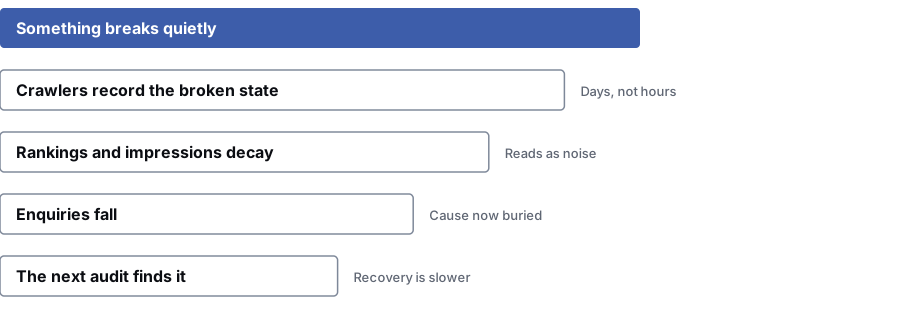
- 1Something breaks quietly — A deployment, a plugin, a template edit or a well-meaning content change. No alert fires, because nothing was watching.
- 2Crawlers record the broken state — The new state is taken as the intended one, and re-crawled at whatever frequency the site has earned.Days, not hours
- 3Rankings and impressions decay — Gradually enough to read as normal variance on a chart nobody is looking at closely.Reads as noise
- 4Enquiries fall — The symptom arrives weeks after the cause, which is why the first explanation offered is usually the wrong one.Cause now buried
- 5The next audit finds it — The fix is still ten minutes. Recovering the position the site held is not, and that is the part the cycle actually cost.Recovery is slower
Commitments
What this means for a site that already ranks
Automated SEO earned its reputation honestly, so these are stated as commitments rather than principles, and they apply to our own site as well as to yours.
What we commit to
- No URL, redirect or canonical change without a person deciding it
- Nothing published in your name without you approving it
- Every automatic change logged with the state it replaced
- A one-step undo on anything that ran without asking
- You hear about a regression from us, not from your own report
- The daily checks shown to you, including the days nothing happened
What we will not do
- Generate pages at volume because the marginal cost is low
- Rewrite live copy on a rule nobody reviews
- Insert internal links automatically into published pages
- Claim a ranking movement was caused by something we cannot isolate
- Run anything continuously that a quarterly audit would answer better
Questions
What people ask about automating search work
Is agentic SEO the same as autonomous SEO?
They are used interchangeably, and both describe search work that runs continuously and chooses its own next check rather than waiting for a scheduled audit. We prefer agentic because autonomous implies nobody is accountable, and somebody always is.
Neither term describes a product category with agreed boundaries yet, which is why the only useful question to a supplier is a specific one: name the changes you would make to my site without asking me first.
Would you ever change a URL automatically?
No. URL changes, redirects and canonical changes are decided by a person, tested against what the page currently earns, and applied deliberately.
This is the hard line in automated search work. A redirect applied to a page that was quietly bringing in enquiries costs weeks of traffic, and the cause is invisible until somebody goes looking in a changelog. The upside of automating it is convenience. The downside is the site.
What does continuous monitoring actually catch?
The category of problem that is silent, sudden and caused by somebody else: a deployment that added a noindex tag, a plugin that rewrote canonical tags, a form that stopped sending, a redirect chain introduced by a marketing campaign, a page removed by a content editor who did not know it ranked.
None of those announce themselves, and all of them are cheap to fix on the day and expensive to fix in a quarter. That gap is most of the value here.
Does this replace an SEO audit?
No, and they answer different questions. An audit asks whether the strategy, structure and priorities are right, which is a judgement made by a person looking at a whole business.
Continuous checking asks whether anything broke since yesterday. A site with the wrong structure will pass every daily check while continuing to lose, which is exactly why one does not substitute for the other.
Do you publish pages automatically?
No. Content is prepared continuously and released by a person, every time, on our own site as much as on a client’s.
Publishing at volume because it has become cheap is the behaviour search engines classify as scaled content abuse, and it is the fastest way to turn a site that ranks into one that does not. The constraint on publishing is not capacity. It is whether the page should exist.
Find out what is quietly broken on your site right now
The free site review is a real diagnostic run by a person, and it usually finds at least one silent problem of exactly the kind described above. There is no obligation attached to it and no report generator involved.
Prefer to talk it through? Book a strategy call
If we don't deliver the work we agreed to deliver for reasons within our control, you don't pay for the undelivered work. Read our guarantee
Related
Where to go next
- the approach this belongs toWhere the approval boundary comes from.
- the test a job has to passWhy some search tasks qualify and others do not.
- SEO and organic growthThe engagement this runs inside.
- crawling, indexing and site healthMost of the continuously checkable work lives here.
- a one-off SEO auditSometimes the right answer instead of anything continuous.
- why URL changes are handled by handThe most expensive reversible mistake in search.
- traffic that has already droppedThe situation continuous monitoring exists to prevent.
- the category, defined
- have us look at your site
Last updated · Not yet approved for publication