
Choosing an agency
Marketing agency vs in-house vs freelancer: which fits you?
Published by Zubair Afzal, responsible editor
First published Updated 8 min read
Start here
Do you need a project, a function or a capability?
Name the kind of help you need before you compare cost. Each option is good at one kind of help and mediocre at the others.
A project has a start, an end and a clear output, such as a site migration, a rebrand rollout or rebuilding a paid search account. Projects suit freelancers and contractors.
A function is ongoing work that needs knowledge you can’t easily hand over: the products, the customers and why the last three attempts failed. Functions suit employees, because that knowledge builds up and stays.
A capability is expertise you need now and then, at a level you can’t justify hiring for, such as technical SEO on a large site, digital PR or analytics set-up. Hire for these and you pay a specialist with nothing to do half the year. That’s the gap agencies fill.
Most businesses need some of each, so the best set-up is usually a mix.
The first question
Three questions that point to the right option
Answer these before you price anything. They usually rule out two of the three options.
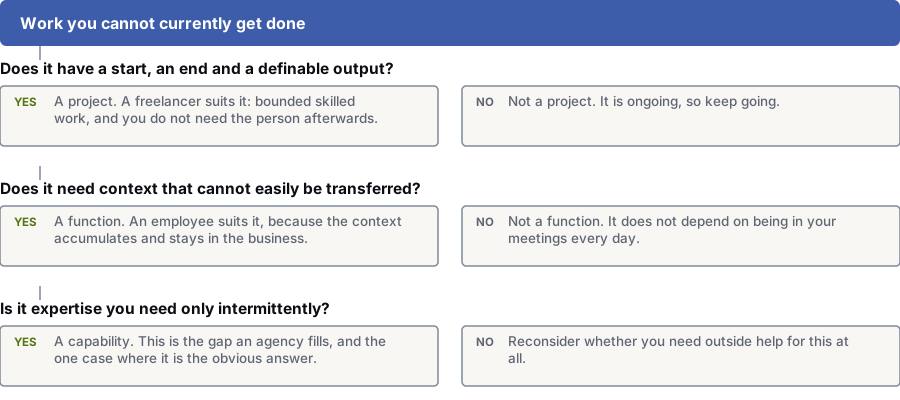
Does it have a start, an end and a clear output?
Yes: A project. A freelancer suits it: defined skilled work, and you don’t need them afterwards.
No: Not a project. It’s ongoing, so keep going.
Does it need knowledge that’s hard to hand over?
Yes: A function. An employee suits it, because that knowledge builds up and stays in the business.
No: Not a function. It doesn’t depend on being in your meetings every day.
Is it expertise you only need now and then?
Yes: A capability. This is the gap an agency fills, and the case where it is the obvious choice.
No: Ask whether you need outside help for this at all.
Agency, employee and freelancer side by side
There are no prices in the table, because pay varies too much by market and role. The FAQ below gives public wage data.
| Dimension | Agency | In-house employee | Freelancer |
|---|---|---|---|
| How you pay | Variable. Scale up or down with notice. No employment liability, equipment or tool costs. | Fixed, and more than the salary: add taxes, pension, tools, recruitment, cover and management time. | Variable, and usually the lowest hourly rate, because you pay for one person with no structure behind them. |
| Range of specialisms | Wide. Several skills available without hiring for each one. | Narrow unless you hire several people. One generalist covering six specialisms goes deep on none. | Usually one specialism, sometimes two done well. |
| Knowledge of your business | Moderate. Grows over time, but never matches someone in your meetings every day. | Highest. Knows the products, the customers and why the last attempt failed. | Varies. A long-term freelancer can learn a lot. A one-off project hire won’t. |
| Time to get going | Weeks. Onboarding is a known process and the skills are already there. | Months. Recruitment, notice period, then a learning curve before you can trust the output. | Days to weeks. Usually the fastest start of the three. |
| Key-person risk | Moderate. Cover exists on paper. In practice the risk sits with whoever holds the account knowledge. | Low if documented, high if not. One marketer with nothing written down is as risky as one freelancer. | High. If they’re ill, busy or gone, everything stops until you replace them. |
| How much they can take on | A lot. More capacity is a commercial conversation, with no hiring round. | Limited. One person has fixed hours, and adding another takes months. | Low. Limited to one person, who has other clients too. |
| Where knowledge ends up | Partly with the supplier. Insist that documents and accounts stay in your name. | With you, if you write it down. With the individual, if you don’t. | With the individual, almost always. |
| Best suited to | Skills needed now and then, campaigns across several channels, and situations that need senior judgement more than hours. | The ongoing role: owning strategy, coordinating internally, and holding the brand and company memory. | Defined projects and steady single-specialism tasks. |
How each one fails
How does each option go wrong?
- The agency account turns into activity reports.
- Tasks get done, reports arrive, and nothing changes for the business, because retainers reward staying busy. Agree up front what result the retainer is for, and review against it.
- The single in-house marketer is asked to be six people.
- One person is expected to run SEO, paid ads, social, email, content and the website. They do it all adequately and none of it well enough to beat a rival with a specialist for each, and it usually ends with the person leaving.
- The freelancer disappears at the worst moment.
- Illness, a bigger client or burnout is more likely than bad faith. With nothing written down and no shared accounts, everything stops. The fix: you hold every login, and there’s a written handover you could give a replacement tomorrow.
- Nobody in the business owns the result.
- Suppliers are appointed, tasks get done, and nobody inside the business answers for whether marketing produced anything. This makes all three options look like failures, and it’s the one problem you can fully prevent yourself.
Our position
When should you hire a marketing agency?
An agency makes sense when
- You need several specialisms and can’t justify hiring for any one of them.
- The job needs senior judgement at key moments more than it needs constant hours.
- You need to move faster than hiring allows, and your needs may change within a year.
- Someone inside the business can brief, decide and hold the supplier to a result.
Don’t hire an agency when
- You need one channel run steadily and nothing else. A specialist contractor will be cheaper and better.
- Your budget is so low you’d be paying for account management and getting little expertise.
- Marketing is tied up with your product and the knowledge lives with your product team.
- You’ve already decided to build the team in-house. An agency would delay what you are trying to build.
Questions
Agency, in-house or freelancer: common questions
Is an agency more expensive than hiring someone?
On the headline number, usually yes. On full cost, often no. An employee costs salary plus employer taxes, pension, equipment, software, recruitment, holiday and sick cover, management time, and months of lower output while they learn your business.
Public data shows how much sits on top of pay. The US Bureau of Labor Statistics reported that in June 2026, wages and salaries were 70.0 percent of private employers' compensation costs, and benefits were the other 30.0 percent. In Canada, Job Bank lists a median of $35.58 an hour for professional occupations in advertising, marketing and public relations (NOC 11202), for the 2023–2024 reference period.
A better question is what each option buys. One salary buys one person. A retainer of a similar size buys part-time access to several specialisms, none of them only for you.
When is a freelancer the right answer?
For a clear project, a single specialism, or steady tasks that don’t need coordinating with anything else: a site migration, a paid search account or a content plan with a clear brief.
Freelancers also make sense when your budget can’t buy senior attention at an agency. A good freelancer beats a junior account manager at the same price.
When is an agency the wrong choice?
When you need one channel run steadily and nothing else (a specialist contractor is cheaper and usually better), when marketing is tied up with your product, or when agency overhead would eat most of a small budget.
Skip an agency, too, if you’ve decided to build the team in-house. It delays the skills you’re trying to build, and what it learns leaves when the contract ends.
What does agency overhead buy?
Several specialisms under one roof, cover when someone is away, senior review of junior work, tools you’d otherwise pay for, and lessons from many businesses.
That’s worth having only if you use it. If your account touches one specialism and one person, you’re paying for a structure you don’t use.
How do I stop the account being handed to a junior?
Ask before you sign: who will do the day-to-day tasks, how many accounts they handle, and what happens if they leave. Get the names in writing, and make senior involvement part of the written scope.
Also ask how the hours split between doing the work and managing the account. If most hours go on management, you have your answer.
Can I combine the models?
Yes, and a mix is often the best set-up: an in-house owner who holds strategy and company knowledge, plus outside specialists for tasks that need depth.
The risk is having nobody in-house in charge. Suppliers then make decisions on their own, nobody sees the whole picture, and the knowledge leaves with the contract.
Where does marketing software fit alongside these three?
Software is a fourth option for part of the job. Monitoring, crawling, rank and visibility checks, and preparing routine fixes can run all the time for a fixed monthly price. Someone on your side still decides what the business competes on and approves what gets published.
Software suits a business with an in-house owner who has the judgement but not the hours; without that owner, it builds a queue of tasks nobody acts on. BOOSTD offers both platform plans with published prices and a managed service where our specialists run everything.
References
Sources for marketing agency vs in house
The official documents and research this page is based on. Platform rules change, so check the source before you act on a detail.
Related
Keep reading on marketing agency vs in house
- the services we offer
- what an SEO programme includesUseful for writing the brief, whichever option you choose.
- published platform pricesThe software-only route, for teams with an in-house owner.
- how the software and an in-house owner share the tasks
- an in-house SEO hire costed against BOOSTD
- a freelancer weighed against BOOSTD
Start here
Not sure which of the three fits your business?
Tell us what you need and our specialists will say which option fits. Sometimes that is a freelancer or a new hire, and we’ll point you there.
Rather check it yourself? Try our free SEO tools