
Serving Melbourne remotely
SEO and digital marketing for Melbourne businesses
A city organised around suburban strips rather than a single centre, with an audience that renews each semester. SEO and digital marketing in Melbourne has to follow a retail and hospitality culture where discovery starts on social and finishes on Maps.
Prefer to talk it through? Book a strategy call
The market
What makes Melbourne different
Melbourne is organised around retail and hospitality strips rather than one dominant centre. Brunswick Street, Lygon Street, Chapel Street, Sydney Road, Victoria Street and a dozen others each function as a small market with its own reputation, its own foot traffic and its own competitive set, and a business succeeds or struggles at that scale long before city-level positioning matters.
Tram lines define catchments better than a radius does. People move along a line, not outward in a circle, and a venue three stops away is closer in practice than one the same distance across an arterial road. Campaign targeting drawn as a circle around a pin routinely includes places nobody travels from.
The international student population gives the city a large, recurring audience that arrives with no local knowledge each intake. Unlike a general transient population, it renews on a known timetable, which makes it plannable in a way most acquisition audiences are not.
The competitive culture differs from Sydney in a way that matters commercially. Independent, owner-operated businesses hold more ground here in hospitality and retail, chains are relatively less dominant on the strips, and taste signals — the room, the photography, the menu writing — do more of the selling than scale or price position.
Search is the last step
In Melbourne the search happens after the decision
For hospitality and independent retail here, discovery starts on the strip or on social and finishes in search. Someone sees the room, then types the name to check the menu, the hours and the booking link. The result does not have to persuade, only to remove friction.
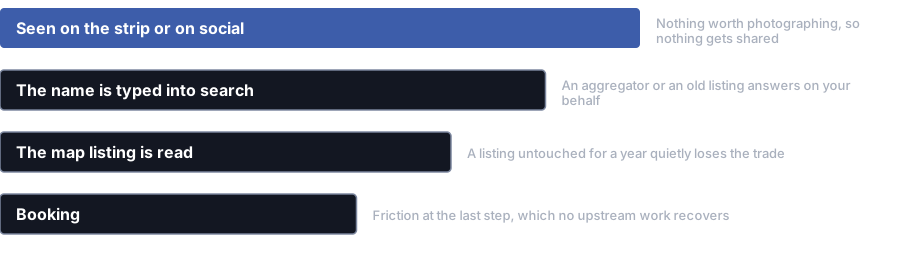
- 1Seen on the strip or on social — Brunswick Street, Chapel Street, Sydney Road, or a video of the room. The discovery happens here, not in a search box.Nothing worth photographing, so nothing gets shared
- 2The name is typed into search — A navigational query rather than a comparison. The job is to be the obvious and correct result for your own name.An aggregator or an old listing answers on your behalf
- 3The map listing is read — Photographs, opening hours, a pin in the right place and recent reviews settle it before the website is opened.A listing untouched for a year quietly loses the trade
- 4Booking — Intent is immediate and unforgiving, and a booking path of three taps and a login sheds people who had already chosen you.Friction at the last step, which no upstream work recovers
Search behaviour
How search works in Melbourne
Search is not uniform across markets. Engine share, language, device mix and local platforms all shift what a strategy in Melbourne should prioritise.
- People search the suburb, not the city. A query names Fitzroy, Brunswick, Richmond or Footscray, and results are dominated by proximity, so a business two suburbs away is essentially invisible for the query regardless of how strong its site is.
- For hospitality and independent retail, discovery frequently begins on social and finishes in search. Someone sees a venue on Instagram or TikTok, then searches the name to check the menu, the hours and the booking link. That reframes what the search result needs to do: not persuade, but remove friction.
- Map results decide walk-in categories outright. Photos, opening hours, recent reviews and whether the pin is right settle more decisions than the website does, and a listing that has not been touched in a year quietly loses trade to one that has.
- A share of Melbourne discovery happens outside Google altogether. Mandarin-speaking students and residents use platforms such as Xiaohongshu and WeChat for recommendations, and for some categories a business invisible on those platforms is invisible to a substantial local audience.
- Booking intent is immediate and unforgiving. If the booking widget takes three taps and a login, a meaningful proportion of interested people abandon, and no amount of upstream marketing recovers them.
Strong fit
Industries with the clearest opportunity in Melbourne
Sectors worth a look in Melbourne
- Restaurants marketingWin the short-notice local decision reliably, then move as much of the resulting trade as possible onto direct booking and direct ordering where the margin survives.
- Ecommerce & DTC marketingIdentify which term in the revenue equation is limiting the business, work on that one, and hold every channel to contribution margin rather than to a revenue chart.
- Cosmetic Dentistry marketingEarn the consultation from a self-paying patient who has been researching for months, then make the consultation convert — because the consultation, not the enquiry, is where this business is won.
- Dental Practices marketingGrow attended new patient appointments inside a realistic catchment, then keep them, because retention is worth more per pound than acquisition ever is.
Who is here
Who does business in Melbourne
Independent hospitality — cafés, restaurants, wine bars, bakeries and roasters — is unusually strong and unusually competitive, with businesses opening and closing on the same strip within a single year.
Independent and small-chain retail, particularly fashion, homewares and specialist food, often runs a physical store and an online store as one business with two very different demand patterns.
Aesthetic and elective healthcare — cosmetic dentistry, skin and dermatology clinics, orthodontics — clusters in the inner and eastern suburbs and competes on presentation within tight advertising restrictions.
Ecommerce brands that grew out of physical stores are common here, and their central problem is usually that the online channel was built as an afterthought and now carries revenue it was never structured for.
Services aimed at students and new arrivals — accommodation, migration advice, tutoring, telecommunications, driving schools — operate on an intake cycle rather than a calendar year.
Where to start
Services that fit businesses in Melbourne
Ecommerce SEO
Ecommerce SEO is mostly an architecture problem. Facets multiply URLs, collections compete with categories, variants split one product across a dozen thin pages, and stock changes daily. We decide what should exist, what should be indexed, and what should redirect.
Paid social
Paid social creates demand rather than capturing it, which is why comparing its cost per lead with search makes it look like a failing channel. This page is about where paid social belongs in a mix, what it costs to feed, and how to measure it.
Social media
Social media marketing run as a demand and brand channel with a defined job, not a posting schedule. It is for businesses unsure which platforms are worth the effort. Included: strategy, day-to-day management, paid social, LinkedIn, Instagram, TikTok and creator partnerships, measured against the job, not follower count.
Landing page design
A landing page exists for one campaign and one action. Its first job is message match — saying back to the visitor what the ad said to them. Everything else on the page either supports that or is costing you money.
How we work here
We serve Melbourne remotely, and we say so
We serve Melbourne businesses remotely from outside Australia, and for hospitality and retail that raises a practical question about speed rather than distance: campaigns here change weekly, sometimes daily.
We handle that by giving you direct control over the things that need to move fast — listings, posts, promotions — and taking on the work that benefits from being done properly and slowly: the site, the booking path, the structured data, the organic positions and the reporting. Splitting it that way is more accurate than promising a same-hour response we cannot sustain across time zones.
We do not have a Melbourne office and we do not have a photographer on Sydney Road. For content that has to be shot in the room, we will tell you to hire a local photographer directly, because the results are better and you should not be paying us a margin to book one.
Constraints
Marketing rules in Melbourne
- Advertising of cosmetic and elective procedures is more tightly restricted than general health advertising, with specific expectations around testimonials, before-and-after imagery and any language that trivialises a procedure or creates unrealistic expectations. Practices in this category should confirm current guidance before publishing imagery of any kind.
- Food and menu claims are enforceable. Statements such as gluten free, organic or a specific origin are regulated representations, and publishing them on a website or a delivery platform carries the same weight as printing them on a menu.
- Discount and comparison claims in retail attract consistent regulatory attention under the Australian Consumer Law, particularly was-and-now pricing that was never charged and free-offer claims where the cost has been built into another item.
- Booking systems, loyalty programmes and Wi-Fi sign-ups all collect contact details, and the Spam Act consent that comes with them is narrower than most operators assume. A reservation is not a subscription.
Primary sources
Where to read the rules for Melbourne
The statutes and regulators behind the rules above. They are the authority, not this page, and none of this is legal advice.
- Guidance for practitioners who perform and advertise cosmetic procedures
Ahpra cosmetic
Guidance for practitioners who perform and advertise cosmetic procedures
- The Australian Consumer Law, Schedule 2 of the Competition and Consumer Act 2010
ACL
The Australian Consumer Law, Schedule 2 of the Competition and Consumer Act 2010
Source: Federal Register of Legislation
- Consent, identification and unsubscribe rules for commercial email and SMS
Spam Act 2003
Consent, identification and unsubscribe rules for commercial email and SMS
Source: Federal Register of Legislation
Questions
Working with us from Melbourne
People find us on Instagram. Is search still worth it?
Yes, but not for the reason you might expect. In Melbourne hospitality and retail, social is often where people discover you and search is where they confirm you — they look up the name to check the menu, the hours and how to book.
If that search returns stale hours, no menu and a booking link that does not work on a phone, the discovery you paid for on social is wasted at the final step. Search here is a conversion channel more than an awareness one.
How do we compete with the venue three doors down?
By winning the map result and the first thirty seconds after someone taps your name. On a strip, the practical competitive set is the businesses within a couple of hundred metres, and proximity plus recency of activity decides most of the map ranking.
That means current photos, accurate hours, a steady flow of recent reviews, and a booking path that takes one tap. It is routine work and it moves the number more reliably than another content campaign.
Should we market to international students specifically?
If your category serves them, it is one of the few predictable acquisition opportunities in the city — a large audience arriving each intake with no established providers and a need to find everything at once.
Be aware that a meaningful share of their discovery happens on platforms outside Google and in languages other than English. A plan that only covers Google search will reach some of that audience and miss the rest.
We run a clinic. What can we show in advertising?
Less than most marketers assume, particularly for cosmetic and elective work. Testimonials about clinical care are restricted, and imagery showing results is subject to specific expectations that have tightened in recent years.
Confirm the current position for your speciality before you publish anything visual. What works within the rules is clear procedural information, frank discussion of cost and recovery, and visible practitioner credentials — which also attracts better-qualified enquiries.
Our online sales all come from one channel. How do we fix that?
Slowly and deliberately, while the existing channel is still working. Channel concentration usually becomes a crisis at the moment the channel gets expensive, which is the worst possible time to start building an alternative.
The durable replacements are organic search on your product and category pages, and an owned email list built from actual customers. Neither replaces paid social quickly, but both cost less per order once established and neither can be repriced by someone else.
Talk to us about growing in Melbourne
Start with the free Growth Scan: an indicative read of your website and the few things to fix first, with no sign-up. BOOSTD is in early access, so the market question — who is winning the searches that matter in Melbourne, and whether the opportunity justifies the investment — is worked through with our team on a strategy call. If it does not, we will say so.
Prefer to talk it through? Book a strategy call
If we don't deliver the work we agreed to deliver for reasons within our control, you don't pay for the undelivered work. Read our guarantee
References
Sources
The primary documents and published research this page relies on. Platform rules change, so check the source before acting on a detail.
Related
Where to go next
Last updated · Published by Zubair Afzal (responsible editor), on owner authorisation