
Podcast Marketing
Podcast marketing: most branded podcasts fail before the first episode is recorded
Not because the audio is bad, but because nobody decided who the show is for, why it should exist, or how anyone would ever find it. We start with whether you should host at all — guesting on established shows is cheaper, faster and frequently the better answer.
Prefer to talk it through? Book a strategy call
Before you commission anything
A podcast is a distribution problem wearing a production costume. Recording is the part that feels like work and is the easy part. Getting a stranger to press play is the hard part, and it is usually addressed after twelve episodes already exist.
Shows fail for two reasons, and neither is audio quality. The first is that no one can say who the show is for in a sentence, so every episode is aimed at a slightly different person and nobody builds a habit. The second is that distribution was never planned, so publication consists of an announcement post and hope.
Both are decisions, and both are cheap to make properly before anything is recorded and expensive to fix afterwards. That is why this page argues its way to the recording rather than starting there.
The first decision
Appear on other shows, or build your own?
| Dimension | Guesting on established shows | Hosting your own show |
|---|---|---|
| What you are buying | Access to an audience somebody else spent years assembling | An asset you own, and the obligation that comes with owning it |
| Time to first result | Weeks — pitching, recording, then the host’s publication schedule | Months, and often a year before an audience is worth the name |
| Recurring commitment | None beyond preparing properly for each appearance | A named person available every fortnight, indefinitely |
| Main risk | Pitches are declined, or the show’s audience turns out to be smaller than claimed | A show that quietly stops after eleven episodes and stays online |
| What it produces | Credibility by association, links from episode pages, and clips you can use | Deeper relationships with an audience that already knows you, and a library of material |
| Who it suits | Almost every business considering podcasting for the first time | Businesses with an existing audience, a committed host and something to say beyond the product |
What goes wrong
Why shows stop at episode eleven
- It was launched because a competitor launched one.
- This produces a show with no stated audience and no argument, which means every episode has to be invented from nothing. Two months in, booking guests becomes somebody’s least favourite task and the calendar slips. A show needs a reason to exist that would survive the competitor cancelling theirs.
- Distribution was never planned.
- Publishing to the podcast directories is not distribution; it makes the episode available, which is not the same as making it findable. Without a plan covering who is emailed, which clips go where, which communities it is shared into and which guest will share it, an episode reaches the people who already follow you and stops.
- Every episode is the raw recording.
- Editing feels like discarding work that has already been paid for, so nothing is cut. The result is a first five minutes of scheduling chat and technical checks, which is exactly where a new listener decides. Cutting a ninety-minute conversation to a tight forty is the cheapest improvement available.
- The audio is the only artefact.
- No transcript, no episode page worth reading, no clips. An hour of good material sits in a format that cannot be searched, quoted, skimmed or cited, and the only people who benefit are those who listened to all of it in the week it came out.
The neglected half
Audio that also exists as text
Spoken material is invisible to most of the systems that decide what people find. Search engines index the page an episode sits on far more readily than the audio file itself, and language models draw on text. An episode that exists only as audio is an episode that can only be discovered by someone already browsing a podcast app.
A corrected transcript changes that. It gives each episode a substantial page in your own domain, with the guest’s name, the topics covered and the actual argument in readable form. Those pages accumulate, and unlike the audio they keep being found by people who were searching for the subject rather than for a show.
Automated transcription gets most of it right and gets the important parts wrong, because the errors cluster on names, products and technical vocabulary. A person corrects the transcript, adds speaker labels and headings, and pulls out the two or three passages worth quoting. It takes under an hour per episode and it is the part almost every programme skips.
Transcripts are also an accessibility matter. A show published without one is not usable by people who are deaf or hard of hearing, and by anyone who cannot listen at the moment they want the information.
Measurement
Where the evidence of a listener goes
Podcasting has almost no click signal, so the effect and the evidence part company early. Every stage below is real, and only the last of them ever reaches a report, which is why measurement is designed before launch.
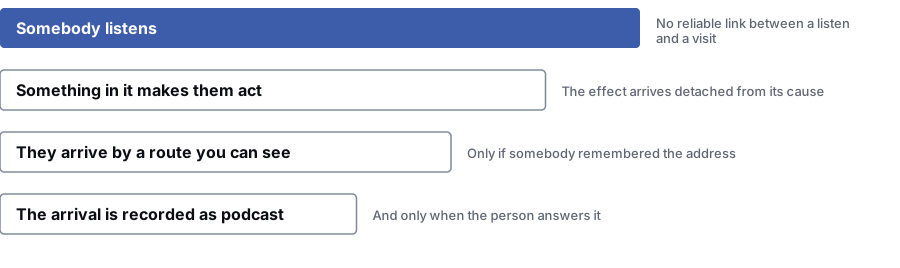
- 1Somebody listens — It happens inside an app that passes almost no signal back to you, so there is no equivalent of a click to count.No reliable link between a listen and a visit
- 2Something in it makes them act — Usually days later, and usually nowhere near the podcast app. The route they take is one you did not build.The effect arrives detached from its cause
- 3They arrive by a route you can see — A dedicated address mentioned on air, a link on the episode page, or a named account turning up after an appearance.Only if somebody remembered the address
- 4The arrival is recorded as podcast — A question on the enquiry form asking how they heard of you. It is the only place most of this ever gets written down.And only when the person answers it
The work
What we do on a podcast engagement
Roughly half of the engagements we take on end with a recommendation to guest rather than host, at least for the first year. The scope below covers both, and the first item decides which parts of the rest apply.
- A written host-or-guest recommendation with the reasoning set out
- Research on shows whose audience overlaps with your buyers
- Topic-led pitching to hosts, with the episode idea rather than a biography
- Preparation for the person appearing, including the questions they will be asked badly
- Show concept, audience definition and format design where hosting is justified
- A distribution plan written and agreed before the first recording
- Editing that cuts the recording to the part worth publishing
- Corrected transcripts, speaker labels and episode pages built to be read
- Short clips cut for feeds, captioned for sound-off viewing
- Measurement design: vanity URLs, enquiry-form questions and what will stay unattributable
Questions
What people ask before starting a show
Should we start a podcast?
Probably not yet, and that is not a discouraging answer. Most businesses asking the question would get more from six good guest appearances than from twelve episodes of their own show, at a fraction of the recurring cost.
Hosting makes sense when you have a real audience relationship to deepen, a person who will show up every fortnight for two years, and something to talk about that is not simply your product. Missing any of those three, the show becomes an obligation nobody wants to be responsible for.
How do you get us onto other people’s podcasts?
The same way good digital PR works: research shows whose audience overlaps with your buyers, then pitch a specific topic the host has not covered, with a reason this guest can speak to it.
Hosts turn down guests who pitch themselves rather than a subject. A pitch that names the episode you would make, and what listeners would take away, gets accepted far more often than a biography.
How do you measure a podcast?
Imperfectly, and it is better to say so before launch than to invent a number afterwards. Listening happens inside apps that pass almost no signal back, so there is no reliable equivalent of a click-through.
What does work: a dedicated URL mentioned on air, a question on your enquiry form asking how people heard of you, tracking on the episode pages themselves, and watching whether named accounts start arriving after an appearance. Together those give a defensible read, not a precise one.
Do transcripts matter?
Yes, and they are the single most neglected part of most podcast programmes. An audio file is opaque to search engines and to AI systems; a transcript on a real page is not.
Transcripts also make episodes usable — quotable, skimmable, linkable and accessible to people who cannot or would rather not listen. Publishing each episode as a proper page with a corrected transcript is usually the highest-return hour in the whole workflow.
How long should episodes be?
As long as the conversation is good and not one minute longer. The common failure is publishing the raw recording because editing feels like waste, which leaves fifteen minutes of throat-clearing at the front of every episode.
A tightly edited thirty minutes is listened to. An unedited ninety is started and abandoned, and the abandonment is invisible to you.
Get a straight answer on whether you should host at all
On a strategy call we will look at who you are trying to reach and where they already listen, then tell you whether a show is worth the commitment or whether six guest appearances would do more for less.
Prefer to talk it through? Book a strategy call
References
Sources
The primary documents and published research this page relies on. Platform rules change, so check the source before acting on a detail.
Related
Where to go next
- digital PR and link building, comparedWhich of the two you are buying, and what each one costs.
- building a named expert’s standingGuesting is one of the fastest routes into this.
- earning coverage from journalistsPodcast pitching and press pitching use the same discipline.
- filming the recording as well as taping itVideo podcasting changes the production and the distribution.
- being readable to language modelsTranscripts are how spoken material becomes machine-readable.
- measuring channels with weak click data
- earning authority over time
More to explore
More in content & digital pr
Last updated · Published by Zubair Afzal (responsible editor), on owner authorisation