
Websites for therapists and counsellors
Therapist website design that makes reaching out feel safe
Therapist website design for psychotherapists, psychologists, social workers and counsellors: help choosing the right clinician, a consultation call booked online, fees and coverage explained without an awkward phone call, and intake that asks only what the first session needs. SEO built in, so the person searching late at night finds a practice that feels safe to contact.
- Website from $150/month, yours after 12 payments
- SEO plans from $149/month
The short answer
What should a therapist’s website include?
A therapist’s website should help people choose a clinician by need and approach, book a consultation online, see fees, sliding-scale options and coverage, and start a private intake with no ad tracking. It should show each clinician’s protected title, a crisis line such as 988 or 9-8-8, and in Ontario no testimonials or promoted reviews.
- Price
- $1,500 upfront, or $150/month × 12
- Ownership
- Yours after 12 payments
- Hosting and care
- $29 or $49/month
- Build time
- About 4 weeks for a local site
Our designs
Our website and app designs for therapists and counsellors
Ready-to-launch concept designs for fictional businesses: pick one and make it yours. 8 websites, 1 app and 1 software design, each opening on a desktop and a phone, with your brand, content and photos going in. All apps and software
10 of 10 examples shown
Concept website
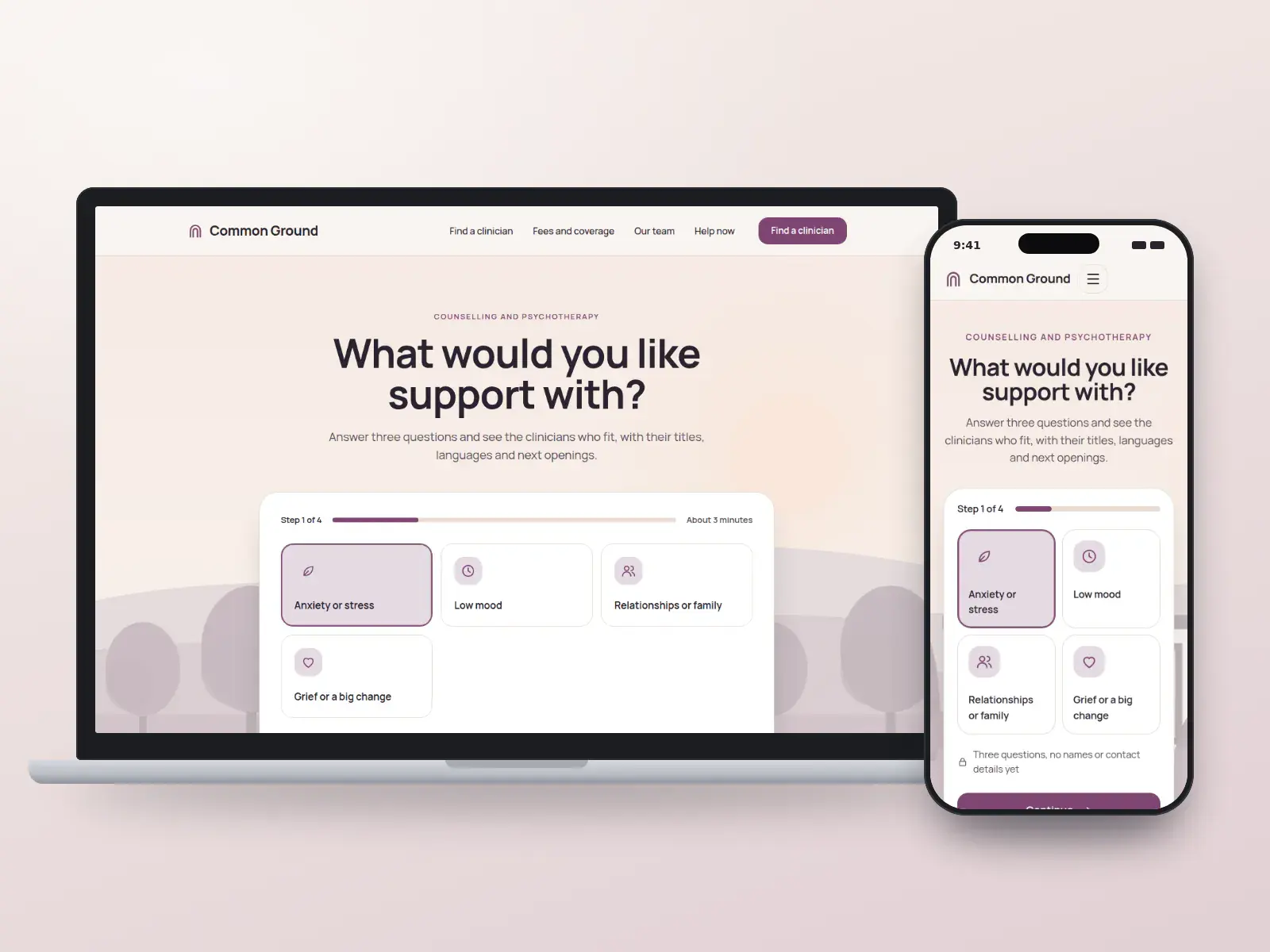
Common Ground Counselling
Group practices with many clinicians
Concept design. The business is fictional.
- Tool-first
- Warm
Growth website: yours after 12 payments, or $4,000 upfront
Concept website
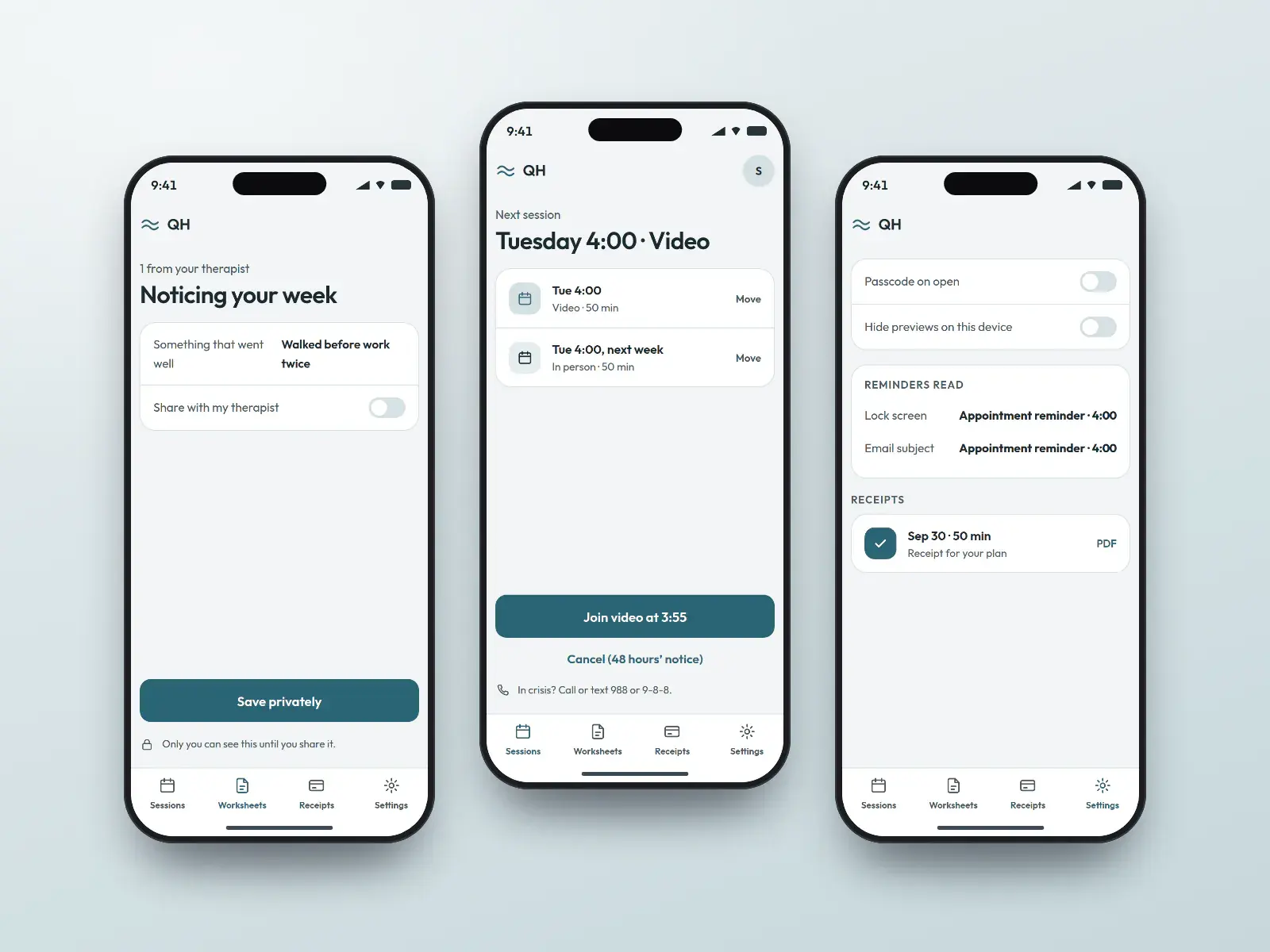
Quiet Hour Therapy
Solo and small practices with openings
Concept design. The business is fictional.
- Minimal
- Tool-first
Local website: yours after 12 payments, or $1,500 upfront
Concept website
Open Door Psychotherapy
Practices that want cost to stop no one
Concept design. The business is fictional.
- Warm
- Friendly
Local website: yours after 12 payments, or $1,500 upfront
Concept website
Wren & Ash Psychology
Psychologists known for their writing
Concept design. The business is fictional.
- Editorial
- Minimal
Local website: yours after 12 payments, or $1,500 upfront
Concept website
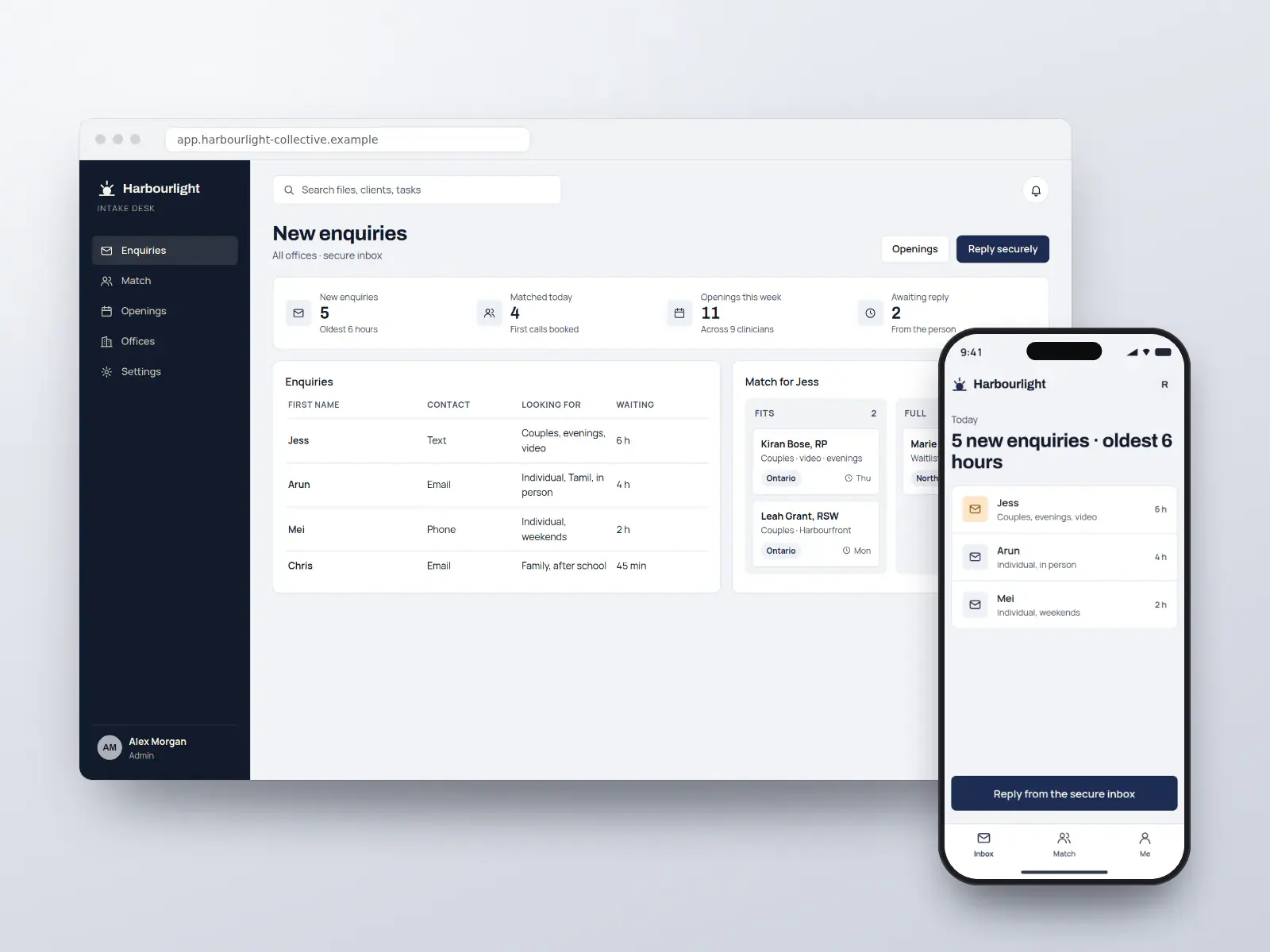
Harbourlight Counselling Collective
Collectives with several offices
Concept design. The business is fictional.
- Corporate
- Map-led
Growth website: yours after 12 payments, or $4,000 upfront
Concept website
Crossings Virtual Therapy
Practices seeing clients by video across borders
Concept design. The business is fictional.
- Map-led
- Tool-first
Local website: yours after 12 payments, or $1,500 upfront
Concept website
Two Rivers Couples Therapy
Practices for couples and families
Concept design. The business is fictional.
- Luxury
- Warm
Local website: yours after 12 payments, or $1,500 upfront
Concept website
Kitestring Child & Family Therapy
Practices seeing children, teens and their parents
Concept design. The business is fictional.
- Bold
- Friendly
Local website: yours after 12 payments, or $1,500 upfront
Concept app
Quiet Hour client app
Clients between sessions
Concept design. The business is fictional.
- Minimal
- Friendly
Quoted per project after a call
Concept software
Harbourlight intake desk
Intake coordinators matching new clients
Concept design. The business is fictional.
- Data-led
- Corporate
Quoted per project after a call
Pay monthly, own it
High-converting websites from $150/month
Pick a design, add your brand, content and photos, and launch. Yours after 12 payments, with SEO built in from day one.
- Local website
- $150/monthUp to 25 pages · yours after 12 payments, or $1,500 upfront
- Growth website
- $400/monthUp to 100 pages · yours after 12 payments, or $4,000 upfront
Built in
What every therapy practice website includes
Therapist matching that respects privacy
A short questionnaire about concern, approach, language and availability narrows the team to a few clinicians, without asking for a name until the visitor is ready. Answers are not stored or sent anywhere unless the person chooses to.
Consultation calls booked online
A calendar for short introductory calls, connected to the practice management tool you already use where it offers an integration, so someone can reach out at midnight without having to speak first. Reminders say only the time, never the reason.
Fees, sliding scale and coverage
A page for session fees, benefit plans, employee assistance programs and reduced-fee spots, with a private request form for the last. US practices add the notice that uninsured and self-pay clients can ask for a good-faith estimate, and explain how superbills work.
Intake that asks less
An encrypted intake that collects only what the first session needs, with no ad pixel or session recording anywhere near it, and a clear note that forms and email are not watched for emergencies.
A crisis line on every page
A quiet footer line, “In crisis? Call or text 988” in the US or “9-8-8” in Canada, plus emergency services, shown as good practice. Someone in distress should never have to hunt for it, and every form says it is not watched for emergencies.
Titles each college accepts
Registered Psychotherapist (RP), psychologist, social worker or counsellor shown as each person is registered. In Ontario no “Dr.” for psychotherapists when offering services, and “psychologist” only for psychologists.
Video sessions within licence
Secure video through a vendor suited to health data, and a booking step that asks where the client will be, because licensure generally follows the client’s location. The site lists the provinces and states each clinician can serve, including any PSYPACT or Counseling Compact authority they hold.
No testimonials or promoted reviews
The site carries no client quotes, review widgets or rating badges, and the practice does not ask clients for reviews where its college forbids it. What persuades instead: clear writing about how the practice works.
Must-have pages
The pages every therapy practice website needs
Each page answers a question people ask before they book, and each one can rank for that question on its own.
Book a consultation
A free or short introductory call picked from open times, asking only a first name and how to reach the person, so reaching out takes one minute and no explanation.
Find a clinician
Each therapist with their registered title, number, approaches, languages, age groups and where they can see clients by video, so people choose by fit rather than by headshot.
Fees, benefits and sliding scale
Session fees, receipts for extended health plans or superbills in the US, employee assistance programs, reduced-fee spots, and the good-faith estimate notice for US self-pay clients.
What therapy here is like
The first session, how often people come, confidentiality and its limits, cancellation terms, and in-person versus video, written for someone who has never been to therapy.
Help now
Crisis lines (988 in the US, 9-8-8 in Canada), emergency services and local walk-in options, plus a plain note that forms and email are not watched for emergencies. Linked from every page.
Video sessions and where we practise
The provinces and states each clinician can serve, why location matters for licensing, and what to do when travelling, so no one books a session the therapist cannot hold.
Accessibility and the office
Step-free entry, lifts, a quiet waiting area, gender-neutral washrooms if you have them, transit, and an accessibility statement with a way to ask for an accommodation.
Privacy notice
What the site and intake collect, who receives it, how long it is kept, and that the contact form is for a name and a way to reach you, not for describing what you are going through.
Search, AI answers and maps
How clients search for therapists and counsellors
People looking for a therapist usually search privately on a phone, often in the evening, and compare several profiles before contacting anyone. What decides the click is fit and cost: the right kind of help, someone they can afford, and a first step that does not require explaining themselves to a receptionist.
How clients search
“Therapist near me” and “counsellor near me”
Map results and directories lead. A Business Profile, hours and a booking link that match the site, plus office pages, earn the local click.
“Anxiety therapist”, “couples counselling” and “grief counselling”
Searches by concern. One page per area of practice, naming who offers it and how, answers these better than a single services list.
“Sliding scale therapy” and “therapist covered by my benefits”
Cost searches. A fees page in plain text, with plans, receipts and reduced-fee options, keeps the visitor from returning to the results page.
“Online therapy Ontario” or “virtual therapist in my state”
Location-bound video searches. A page listing where each clinician is registered or authorised answers it honestly.
“What happens in the first therapy session?”
Questions asked before booking. A short, warm explainer is quoted by AI answers and lowers the bar to the first call.
What we build for search, AI answers and maps
- 01
Business Profile and directories that agree
Primary category “Psychotherapist” (or “Psychologist” or “Counselor” as registered), the same name, address, hours and titles on Psychology Today, your college’s public register and the site.
- 02
Structured data, no ratings
MedicalBusiness or LocalBusiness markup with address and hours, Person markup for each clinician with their credential, FAQ and breadcrumb markup, and no review or rating markup.
- 03
Concern pages AI answers can quote
Each area-of-practice page opens with two plain sentences on what the work involves and who it suits, with no outcome promised, so assistants and snippets can cite it.
- 04
Reviews handled for your college
Where your college bars soliciting or promoting reviews, as CRPO does in Ontario, the site neither asks for nor embeds them; elsewhere, any request goes to every client alike and replies never confirm someone is a client.
- 05
Monthly report
Consultation bookings, calls from the profile, searches by concern and area, and pages losing ground, reported each month with no client data in the analytics.
No one can promise a ranking or a place in an AI answer. We build the pages, data and profile that search engines and assistants read, and report what changes.
Compliance
The rules for therapists and counsellors, handled in the design
Therapy practice websites answer to psychotherapy and psychology colleges or state boards, to professional ethics codes, and to health-privacy law, including the stricter federal rules for substance use records. Here is what each asks, and how every design handles it.
Sources gathered October 1, 2026. This is how our designs handle these rules, not legal advice: rules change and differ by province and state, so your college or licensing board, your privacy officer or your lawyer has the final word, and you approve every page before it goes live.
- Ontario
Testimonials and curated reviews are not allowed
CRPO’s advertising standard bars testimonials and endorsements from clients or anyone else, and asking for them. Third-party review sites are acceptable if the psychotherapist neither solicits nor curates them, but they should not be embedded or promoted. It also bars promised outcomes, superlatives and fear appeals. The designs carry none of these.
- Ontario
RP shown first, no “Dr.” for psychotherapists
CRPO protects “psychotherapist”, “Registered Psychotherapist” and “Registered Mental Health Therapist”, wants the RP title shown most prominently, and says an RP does not use “Dr.” when offering services, even with a doctorate. Psychotherapist footers lead with “Registered Psychotherapist (RP)” and no concept pairs “Dr.” with an RP.
- Ontario
Psychologists: no testimonials or solicitation
The CPBAO’s standards of professional conduct are located on its site; a summary says psychologists and behaviour analysts may not use testimonials, must make ads identifiable as ads, and must not solicit clients directly. Psychology concepts follow the same no-testimonial approach, and the section number is on the review list.
- US
APA Standard 5.05 on testimonials
The APA ethics code, which binds APA members and which some state boards adopt, says psychologists do not solicit testimonials from current clients or others vulnerable to undue influence. State boards may add stricter rules. The designs leave testimonials out entirely rather than sort who may be asked.
APA — Ethical Principles of Psychologists and Code of Conduct
- US
Crisis line as good practice
The FCC designated 988 as the number for the 988 Suicide and Crisis Lifeline, by call or text; Canada’s 9-8-8 Suicide Crisis Helpline has taken calls and texts since 30 November 2023. No law found requires a therapy website to show either, so the designs present them as good practice, with emergency services and a note that forms are not monitored.
- US
Trackers on intake and booking
HHS says covered providers must not let tracking technologies disclose protected health information to analytics or ad vendors. For a therapy practice, the fact of seeking care is itself sensitive, so booking, intake and client-portal pages carry no ad pixel or session replay, and form vendors sign a business associate agreement.
HHS OCR — Use of online tracking technologies by HIPAA covered entities
- US
Substance use records under 42 CFR Part 2
HHS’s 2024 Part 2 rule has required compliance since 16 February 2026, with HIPAA-style penalties enforced by OCR, and covers federally assisted substance use disorder programs. For a practice that is one, intake forms, analytics and CRM links must not reveal that someone is a client without the required consent. Whether a practice is covered is a question for its lawyer.
- US
Video sessions across state lines
A US therapist generally needs authority in the state where the client sits during the session. PSYPACT lets a psychologist holding its telepsychology authorisation see clients in other member states, and the Counseling Compact began issuing privileges to practise state by state from late 2025. Each clinician’s page lists only the states where they actually hold that authority.
- US
Good-faith estimates for self-pay clients
Under the No Surprises Act, providers must tell uninsured and self-pay clients, on their website among other places, that they can ask for a good-faith estimate of expected charges, and give one in writing when a session is booked. US fee pages carry that notice and a link to request the estimate.
Everything for therapists and counsellors
Websites, apps, branding and SEO for therapists and counsellors
Websites
Therapists and counsellors websites built on the designs above, fast and set up for search.
From $150/month
Apps
For practices whose clients want less friction between sessions: a private client area that handles scheduling and paperwork, and nothing that feels like social media.
Quoted per project
Apps for therapists and counsellorsBranding
A therapy brand has to feel safe before it feels polished. The name, colours and words should lower the bar to reaching out, without promising outcomes or borrowing a title the clinicians do not hold.
Quoted per project
Branding for therapists and counsellorsSEO and leads
Ongoing SEO that checks your site every week and fixes what is safe to fix, for more consultation calls and new clients.
From $149/month
SEO plans and prices
Pricing
What a therapy practice website costs
The price of a therapy practice website is the same as any website we build: pay upfront and save, or spread it over 12 months.
Local website
$150/month × 12
or $1,500 upfront. Yours after the 12th payment.
- Up to 25 pages
- Any design on this page
- Technical SEO at launch
- Hosting and care $29/month
Growth website
$400/month × 12
or $4,000 upfront. Yours after the 12th payment.
- Up to about 100 pages
- Teams, offices and more integrations
- Planned with an advisor
- Hosting and care $49/month
SEO plans
$149/month
Local $149 · Growth $399
- Checks your site every week and fixes what is safe to fix
- New pages every month
- 7-day trial
Prices in US dollars. How payments, hosting and ownership work.
How it works
How your therapy practice website goes live
- 01
Pick a design
Choose a concept, or ask for a new one. Tell us your clinicians, the concerns you see, and the practice tool you use.
- 02
Send your details
Logo, each clinician’s registered title and jurisdictions, fees and sliding-scale policy, and the intake questions you really need.
- 03
Privacy review
We keep trackers off intake and booking, add the crisis line, check titles, and you approve every page.
- 04
Launch and grow
Old pages redirected, directory and Google profiles updated, and SEO so people searching for help find you.
Pick my design
See your website before you pay for it
Choose a design and tell us about your business. An advisor emails you to plan a preview with your name, your colours and your details, and the price options. Nothing is charged until you decide.
- 1An advisor replies by email
- 2We plan your preview and scope
- 3You decide, with every price in writing
Questions
Therapists and counsellors: common questions
- How much does a therapy practice website cost?
- A therapy practice website of up to 25 pages is $1,500 paid upfront, or $150 a month for 12 months, and it is yours after the 12th payment. A larger site of up to about 100 pages is $4,000, or $400 a month. Hosting and care is $29 or $49 a month. Prices are in US dollars.
- Can the website help clients choose the right therapist?
- Yes. A short matching questionnaire asks about the concern, preferred approach, language and availability, then shows the few clinicians who fit, each with their registered title and how they work. It asks for no name or contact details until the person chooses to book a consultation call.
- Why are there no testimonials or reviews on the designs?
- Because most therapy colleges forbid them. Ontario’s CRPO bars testimonials and also bars embedding or promoting reviews from third-party sites, the CPBAO bars testimonials for psychologists, and the APA code bars soliciting them from current clients. The designs persuade with clear writing about how you work instead.
- How do I show fees when I offer a sliding scale?
- The fees page explains your standard session fee, which benefit plans and employee assistance programs you work with, and that reduced-fee spots exist, with a private form to ask for one. No one has to prove their income on the website, and the request goes to you over a secure form, not plain email.
- Can I offer video sessions to clients in other provinces or states?
- Only where you are registered, licensed or otherwise authorised, because licensure generally follows where the client is during the session. The site lists the provinces and states each clinician can serve, the booking step asks where the client will be, and video runs on a platform suited to health information.In the US, PSYPACT authorises psychologists to practise telepsychology into member states, and the Counseling Compact has been issuing privileges to practise state by state since late 2025. Both change often, so we check the current position for your licences before launch.
- Should a therapy website show a crisis line?
- We recommend it, as good practice rather than a legal rule. Each design carries a quiet footer line, call or text 988 in the US or 9-8-8 in Canada, plus emergency services, and a note that forms and email are not monitored for emergencies, so no one in crisis waits on a reply.
- What should a therapist website include?
- A therapist website should include a way to book a consultation call online, a profile for each clinician with their registered title and approach, a fees page covering benefits, sliding scale and receipts, a page on what the first session is like, crisis lines on every page, and a privacy notice. Each answers a question people have before they reach out.
- Does a therapist need a HIPAA-compliant website?
- A US therapist who bills insurance electronically is usually a HIPAA covered entity, so any page that collects client information (intake, booking, a portal) needs encrypted forms, a vendor that signs a business associate agreement, and no ad pixels. The general contact form should not collect health details at all, and says so beside the message box.In Ontario the same forms follow PHIPA, and elsewhere in Canada the provincial or federal privacy law that applies to your practice.
- How do therapists get more clients from their website?
- Make the first step small and private: a consultation call booked online with just a first name, fees answered in plain text, and a page for each concern you work with. Keep your Google profile, directory listings and site identical, and write plain answers to the questions people ask before therapy, which search engines and AI assistants quote.
- Will my therapy practice website rank on Google?
- It launches with the technical SEO done: fast pages, clean structure, structured data, local pages and redirects from your old site. To keep climbing, a BOOSTD SEO plan from $149 a month runs 262 checks on your site every week, fixes what is safe to fix and gets the rest ready for your OK.No one can promise a position on Google, and we never do. Google warns businesses about anyone who does.
- Can I get one of these therapy website designs?
- Yes. Each is a complete, ready-to-launch website design BOOSTD made for therapists and counsellors. Pick one and we make it yours, with your name, colours, photos, content and the licence or compliance details your industry expects, from $150 a month and yours after 12 payments.Approved client sites are shown with a “Client work” tag, and only with the client’s written permission.
Guides for therapists and counsellors
Reading for therapists and counsellors before you build
- Planned guideTherapy practice website checklist: matching, intake, fees and privacyPlanned: written with a named author and published once reviewed
- Planned guideTestimonials, reviews and titles on a therapist’s websitePlanned: written with a named author and published once reviewed
- Google profileGoogle Business Profile optimization guide, field by field
- Local SEOLocal SEO checklist: every step, in the right order
More on therapist website design
- Marketing for mental health practices Local SEO and directory marketing for therapy practices.
- Websites for dietitians and nutritionists Virtual consults, secure intake and title rules for nutrition practices.
- Websites for medical clinics and family doctors
- Websites for yoga studios
- A quote for therapists and counsellors with several locations More locations than a plan covers? Tell us about the network.
Free, about a minute, nothing changes on your site
Start with a free checkup of your current site
See what holds your current website back across every point, free, before you choose a design.
- Free, no cardNo sign-up to see your preview.
- Read-onlyNothing changes on your website.
- 90-day guaranteeIf you join: a better score, or your next month free.