
Websites for accountants and cpas
Accounting firm website design that earns the engagement letter
Websites for CPA firms and accounting practices that make a careful profession easy to hire: credentials tied to the board that issued them, a secure portal so tax slips never travel by email, a page for each service you actually offer, and a consultation calendar that fills before the busy season does.
- Website from $150/month, yours after 12 payments
- SEO plans from $149/month

The short answer
What should an accounting firm website have?
An accounting firm website needs a clear page for each service, from tax and bookkeeping to assurance and advisory, a secure client portal for documents, and an easy way to book a first consultation. It should show each person’s credential and licensing board, never call an unlicensed staff member a CPA, and keep audit clients off the testimonials.
- Price
- $1,500 upfront, or $150/month × 12
- Ownership
- Yours after 12 payments
- Hosting and care
- $29 or $49/month
- Build time
- About 4 weeks for a local site
Our designs
Our website and app designs for accountants and cpas
Ready-to-launch concept designs for fictional businesses: pick one and make it yours. 7 websites, 1 app and 1 software design, each opening on a desktop and a phone, with your brand, content and photos going in. All apps and software
9 of 9 examples shown
Concept website
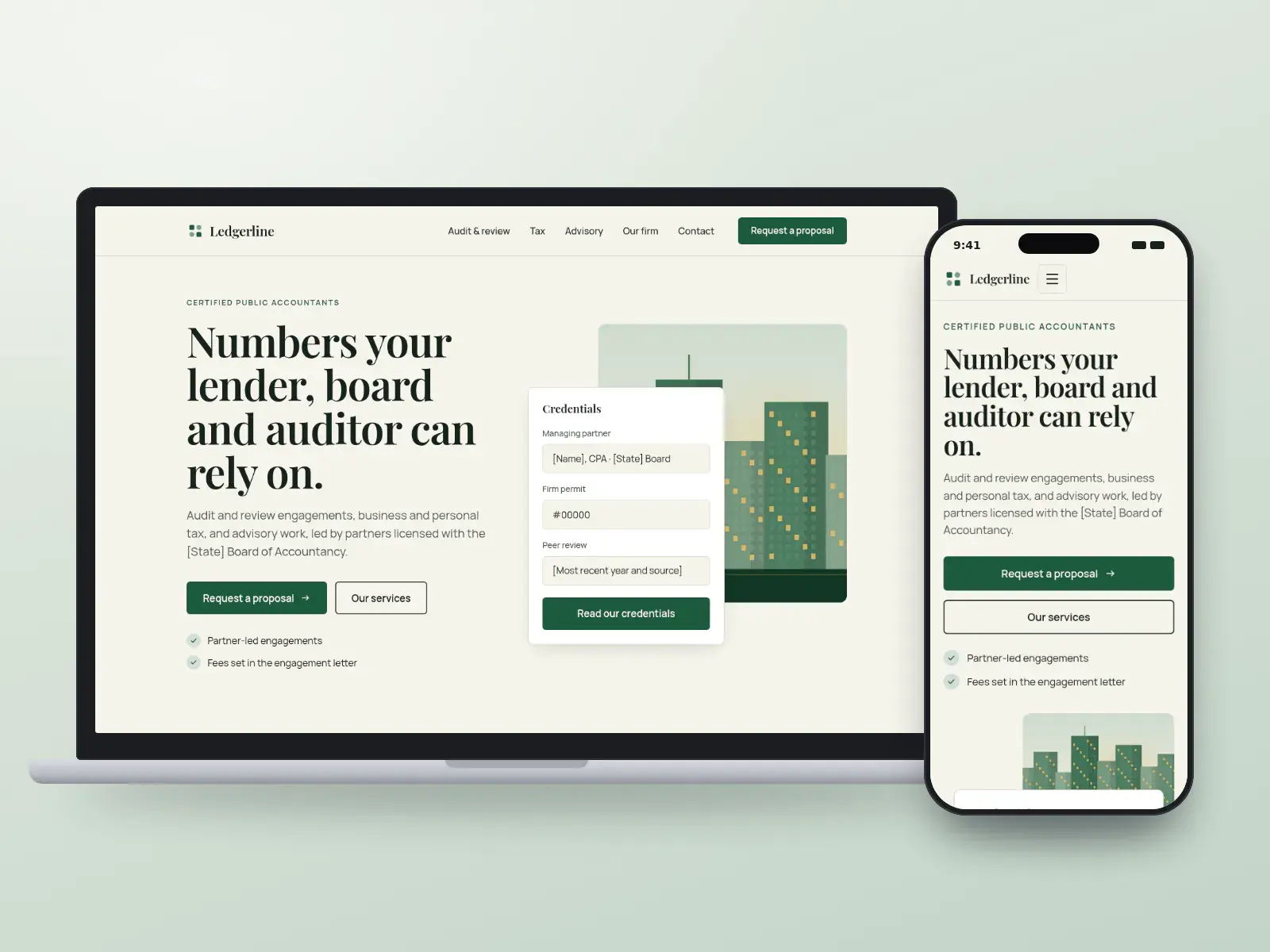
Ledgerline CPA Partners
Regional CPA firms with assurance and tax
Concept design. The business is fictional.
- Editorial
- Corporate
Growth website: yours after 12 payments, or $4,000 upfront
Concept website
Strongroom Accounting
Tax-heavy practices with a client portal
Concept design. The business is fictional.
- Dark
- Tool-first
Local website: yours after 12 payments, or $1,500 upfront
Concept website
Fourfold Accounting Group
Multi-service firms with many partners
Concept design. The business is fictional.
- Corporate
- Bold
Growth website: yours after 12 payments, or $4,000 upfront
Concept website
Almanac CPA
Practices whose clients miss deadlines
Concept design. The business is fictional.
- Friendly
- Tool-first
Local website: yours after 12 payments, or $1,500 upfront
Concept website
Hearth & Rowe Accounting
Sole practitioners and two-partner practices
Concept design. The business is fictional.
- Editorial
- Warm
Local website: yours after 12 payments, or $1,500 upfront
Concept website
Concorde Accounting
Firms serving immigrant business owners
Concept design. The business is fictional.
- Warm
- Friendly
Local website: yours after 12 payments, or $1,500 upfront
Concept website
Keelstone Advisory CPAs
Fractional CFO and cash-flow advisory
Concept design. The business is fictional.
- Dark
- Data-led
Local website: yours after 12 payments, or $1,500 upfront
Concept app
Strongroom client app
Clients sending documents and signing
Concept design. The business is fictional.
- Minimal
- Tool-first
Quoted per project after a call
Concept software
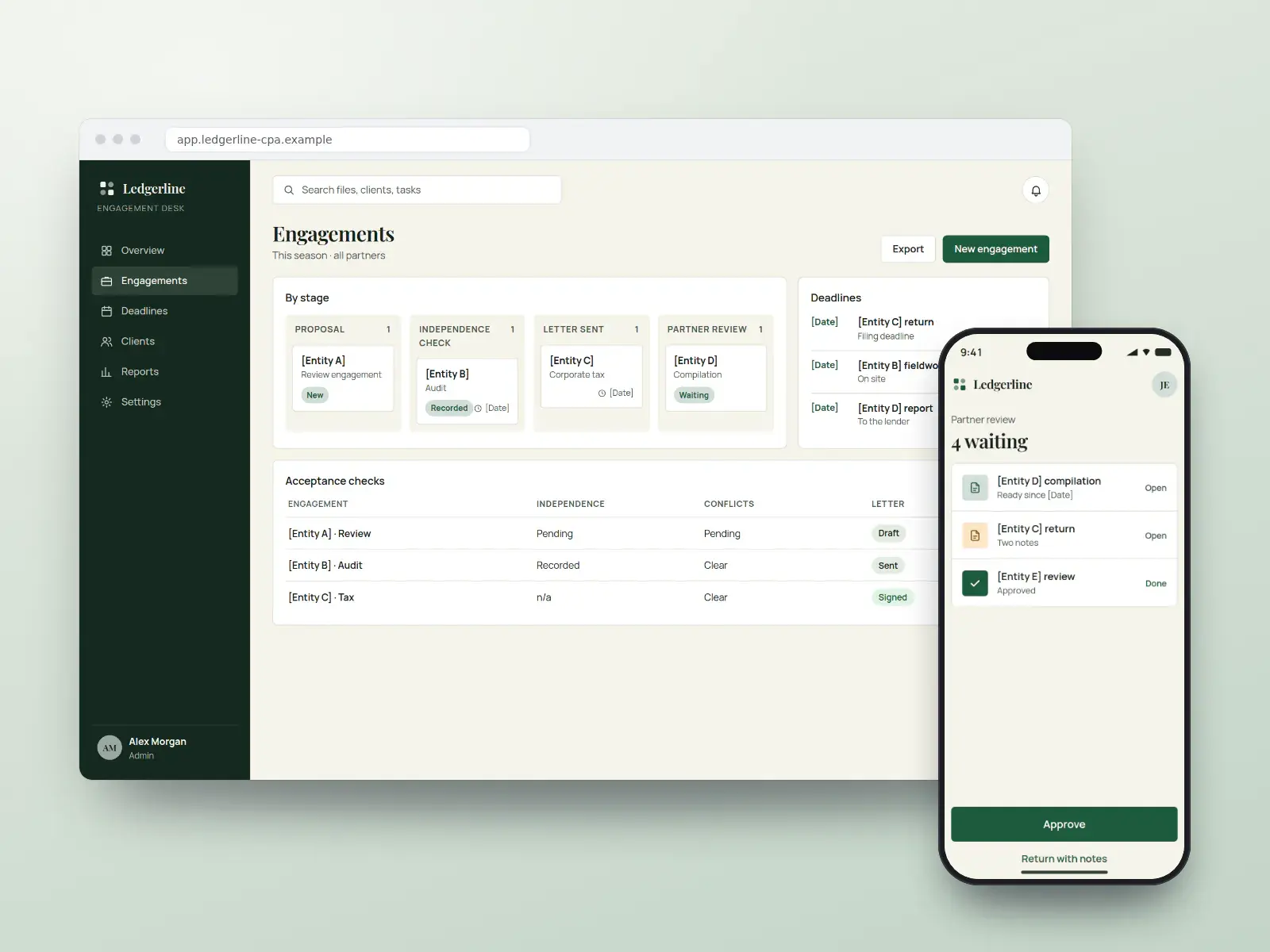
Ledgerline engagement desk
Firms tracking engagements from proposal to delivery
Concept design. The business is fictional.
- Data-led
- Corporate
Quoted per project after a call
Pay monthly, own it
High-converting websites from $150/month
Pick a design, add your brand, content and photos, and launch. Yours after 12 payments, with SEO built in from day one.
- Local website
- $150/monthUp to 25 pages · yours after 12 payments, or $1,500 upfront
- Growth website
- $400/monthUp to 100 pages · yours after 12 payments, or $4,000 upfront
Built in
What every accountant website includes
A page for each service, written for search
Business tax, personal tax, payroll, assurance, estates and advisory each get a page that says who it is for, what the client provides and how the engagement is priced, so the firm ranks for the work it wants more of.
Secure document exchange
A portal link on every page for slips, statements and signed engagement letters, with multi-factor sign-in, so a client never has to email a social security or social insurance number.
Credentials tied to their board
Every team profile shows the person’s real designation and the licensing board or institute behind it, and “CPA” only beside licensees, so the site never implies a staff accountant holds a licence.
Fee information you can stand behind
Published fees come from your own schedule and carry the date they were set, so a “from” price on the site matches what the engagement letter says when the client signs.
A deadline calendar clients return to
Quarterly estimates, payroll filings and return due dates maintained by the firm, each with the documents it needs, plus calendar files a client can add to their own phone.
Structured data for an accounting practice
AccountingService schema, office hours, service areas and named professionals, so search engines can read correctly what the firm does and where. The same facts in plain text on the page are what AI assistants can repeat.
How clients search
The searches and pages an accountant website needs
Business owners usually go looking for an accountant at a turning point: a first profitable year, a new corporation, a tax notice, a lender asking for reviewed statements, or a bookkeeper who has moved on. They search “accountant near me”, “CPA for small business” or the problem itself, read service pages and team bios, and often look up a referral’s name online before calling. Individuals search in a burst from January to April. Both now ask AI assistants what a CPA costs or whether they need one, then pick a firm whose pages answer the same question plainly.
- “cpa for small business near me”
- “accountant for self employed”
- “how much does a cpa charge for a business tax return”
- “do i need a cpa or a bookkeeper”
- “accountant for rental property owners”
- “audit firm for nonprofit”
- “corporate tax accountant toronto”
- “cpa for startup”
- 01
One page per engagement
Business tax, personal tax, audit, review, compilation, payroll and advisory each get a page saying who it suits, what the client provides and how the fee is set. A single list of services rarely ranks; a page per engagement gives search engines and assistants something specific to cite.
- 02
Industry pages you can back up
Construction, dental practices, nonprofits or whichever sectors your client base really covers, written from that experience. They state your focus plainly, without calling the firm a specialist in a field no board certifies.
- 03
Team and credentials
Each person with a photo, their real designation and the state board or provincial body behind it, so a prospect can check a licence on the regulator’s public lookup. Unlicensed staff are listed by role, and nobody borrows the firm’s CPA label.
- 04
Fees and how engagements work
How fees are set, what a first meeting costs, any published ranges, and the step from proposal to signed engagement letter. A finance director or owner shortlisting firms wants this before booking a call.
- 05
Client portal and security
How to upload documents, the second sign-in step, how long records are kept and that the firm keeps a written information security program. It answers the question clients now ask before emailing a statement.
- 06
Tax calendar
Filing and payment dates by entity type, refreshed each season, with what each date needs from the client. It brings people back several times a year and gives the firm a reason to send a reminder.
- 07
Office pages
One page per office with hours, parking, the partners based there and the cities it serves, so the firm can appear in local results for each place it really works from.
SEO, AEO and GEO
How accountants and cpas get found in Google and in AI answers
Business Profile categories that match the licence
Google Business Profile offers categories such as Accountant, Certified public accountant and Tax preparation service. Pick the primary one that matches what the firm is licensed to do, list services under each office, and keep hours current through the filing season.
Credential citations
Licensee lookups, CPA society “find a CPA” directories and the IRS directory of preparers with credentials all name your people. Matching names and addresses across them help Google connect the firm to its licences. In many US areas Google also runs Local Services Ads for tax services; Google sets eligibility.
AccountingService and Person markup
AccountingService schema for each office with address, hours and areaServed, and Person markup for partners with their credential and licensing body. It helps search engines read correctly what the firm does, where and by whom, and can earn richer results in Google Search. It does not make AI assistants cite the firm. Clear facts on the page, and listings on the directories and review sites assistants cite, correlate more with mentions.
Signed, dated guidance
Tax and money pages are what Google treats as “your money or your life” content, so each article names the CPA who wrote or reviewed it, their credential and the date it was last checked. Short direct answers near the top give AI Overviews and assistants a passage to quote.
Compliance
The rules for accountants and cpas, handled in the design
CPA advertising is governed by the AICPA Code of Professional Conduct, each state board of accountancy and, in Canada, the provincial CPA bodies, with IRS and FTC rules on top for tax work and client data. These are the rules that shape an accounting firm’s credentials, fees and client mentions, and what each design does about them.
Sources gathered October 6, 2026. This is how our designs handle these rules, not legal advice: rules change and differ by province and state, so your state board, provincial CPA body or ethics counsel has the final word, and you approve every page before it goes live.
- US · AICPA Code 1.600
No false or unjustified expectations
The AICPA Code’s advertising rule bars members in public practice from seeking clients in a false, misleading or deceptive way, and its interpretation names creating false or unjustified expectations of favourable results. The designs describe services and process; they never promise a refund size, a tax saving or an audit outcome.
- US · AICPA Code 1.800
A firm name that tells the truth
The Code’s form of organisation and name rule says a firm name must not be misleading, for example about the firm’s legal form or who owns it, such as a corporate suffix the firm is not entitled to. Each concept prints the firm’s registered name and legal form in the footer, and the client confirms both against its board registration before launch.
- US · state boards and the UAA
“CPA” only for licensees
Under the Uniform Accountancy Act that most state accountancy laws are modelled on, only licensees and permitted firms may use “CPA” or titles likely to be confused with it, and firms doing attest or compilation work enrol in peer review. Team directories show each person’s own designation, firm pages carry the permit number, and peer review appears only where the firm has one.
- US · AICPA independence
Audit clients are not testimonials
The Code’s independence interpretations treat endorsing an attest client’s products or promoting its interests as an advocacy threat. Logos, quotes and case stories are off by default, and a client’s name goes on the site only after the firm confirms it is not an attest client and holds written consent.
- US · IRS Circular 230 §10.30
Published fees are fees you must honour
Circular 230 covers CPAs, attorneys and enrolled agents who practise before the IRS. Its section 10.30 lets them publish fixed fees for routine services, hourly rates, fee ranges and first-consultation fees, but they may charge no more than a published rate for at least 30 calendar days after it last appeared. Fee lines are read from the firm’s own schedule and dated when changed.
- US · FTC Safeguards Rule
A security program for client data
The FTC Safeguards Rule counts firms that prepare taxes or give financial advice among the “financial institutions” that need a written information security program, and since May 2024 they must report a breach of unencrypted data affecting 500 or more people to the FTC. The portal concepts keep uploads out of email, require a second sign-in factor and log who opened each file.
- Ontario · CPA Ontario Rule 217
Advertising that does not reflect on the profession
CPA Ontario’s Code of Professional Conduct, Rule 217, lets members and firms advertise if it is not false or misleading and makes no unfavourable reflection on the competence or integrity of the profession or any member, and bars persistent, coercive or harassing solicitation. Under the Public Accounting Act, 2004, audits and reviews need a public accounting licence, so Ontario versions offer them only for licensed firms.
Everything for accountants and cpas
Websites, apps, branding and SEO for accountants and cpas
Websites
Accountants and CPAs websites built on the designs above, fast and set up for search.
From $150/month
Apps
For firms that chase the same documents every spring: a client app turns the year-end paperwork into a checklist that clients finish on their own phone.
Quoted per project
Apps for accountants and cpasBranding
Accounting firms tend to look identical: navy, a column, a surname list. A brand can stay sober and still be the one a business owner remembers when the tax notice arrives.
Quoted per project
Branding for accountants and cpasSEO and leads
Ongoing SEO that checks your site every week and fixes what is safe to fix, for more consultation requests and signed engagement letters.
From $149/month
SEO plans and prices
Pricing
What an accountant website costs
The price of a accountant website is the same as any website we build: pay upfront and save, or spread it over 12 months.
Local website
$150/month × 12
or $1,500 upfront. Yours after the 12th payment.
- Up to 25 pages
- Any design on this page
- Technical SEO at launch
- Hosting and care $29/month
Growth website
$400/month × 12
or $4,000 upfront. Yours after the 12th payment.
- Up to about 100 pages
- Teams, offices and more integrations
- Planned with an advisor
- Hosting and care $49/month
SEO plans
$149/month
Local $149 · Growth $399
- Checks your site every week and fixes what is safe to fix
- New pages every month
- 7-day trial
Prices in US dollars. How payments, hosting and ownership work.
How it works
How your accountant website goes live
- 01
Pick a design
Choose one, or ask for something new. Tell us your services, the industries you focus on and where you are licensed.
- 02
Send your details
Logo, team photos, each person’s designation and licensing board, firm permit number and your fee schedule.
- 03
Review before launch
Your partners check every credential, fee line and client mention against your board’s rules and the AICPA Code.
- 04
Launch and grow
We connect the portal and calendar, redirect old pages, and build service and city pages that bring in engagements.
Pick my design
See your website before you pay for it
Choose a design and tell us about your business. An advisor emails you to plan a preview with your name, your colours and your details, and the price options. Nothing is charged until you decide.
- 1An advisor replies by email
- 2We plan your preview and scope
- 3You decide, with every price in writing
Questions
Accountants and CPAs: common questions
- How much does an accounting firm website cost?
- A CPA or accounting firm website of up to 25 pages is $1,500 paid upfront, or $150 a month for 12 months, and it is yours after the 12th payment. A larger site of up to about 100 pages is $4,000, or $400 a month. Hosting and care is $29 or $49 a month. Prices are in US dollars.
- Can a CPA firm put client logos or testimonials on its website?
- Sometimes, with care. A client must agree in writing, and the AICPA independence rules treat promoting an attest client’s interests as a threat, so audit and review clients are normally left off. Testimonials must be real and unpaid, or disclose any connection. Every design starts with client mentions switched off until your partners approve each one.
- Who on my team can be called a CPA on the website?
- Only people who hold an active CPA licence or certificate from a state board, or a CPA designation from a provincial body in Canada. Everyone else is listed with their real title, such as enrolled agent, tax associate or bookkeeper. The team directory has a designation field and a licensing-board field for each person, and nobody inherits the firm’s CPA label.
- Why do accountants need a client portal instead of email?
- Because tax slips and statements carry identity numbers that email does not protect well, and the FTC Safeguards Rule expects accountants and tax preparers to run a written information security program. A portal gives clients one encrypted place to upload, sign engagement letters and see what is missing, and gives the firm a record of who opened what.
- Can I publish my fees on an accounting firm website?
- Yes. Fixed fees for routine work, hourly rates, fee ranges and the cost of a first consultation can all be published. If you represent clients before the IRS, Circular 230 then holds you to a published rate for at least 30 calendar days, so the site reads fees from your own schedule and records the date each one changed.
- Do accountants need a website if most clients come from referrals?
- Yes, because referred prospects check the firm online before they call. A business owner given your name looks for proof that you handle their kind of company, see who would do the work and gauge the fee. Clear service pages, named credentials and an easy first-meeting booking turn that check into an engagement instead of a call to the next firm.
- Will my accountant website rank on Google?
- It launches with the technical SEO done: fast pages, clean structure, structured data, local pages and redirects from your old site. To keep climbing, a BOOSTD SEO plan from $149 a month runs 262 checks on your site every week, fixes what is safe to fix and gets the rest ready for your OK.No one can promise a position on Google, and we never do. Google warns businesses about anyone who does.
- Can I get one of these accounting website designs?
- Yes. Each is a complete, ready-to-launch website design BOOSTD made for accountants and cpas. Pick one and we make it yours, with your name, colours, photos, content and the licence or compliance details your industry expects, from $150 a month and yours after 12 payments.Approved client sites are shown with a “Client work” tag, and only with the client’s written permission.
Guides for accountants and cpas
Reading for accountants and cpas before you build
- Planned guideShowing CPA credentials and client logos without breaking independence rulesPlanned: written with a named author and published once reviewed
- Planned guideMoving an accounting practice off email attachments and onto a client portalPlanned: written with a named author and published once reviewed
- ReviewsHow to ask for Google reviews without breaking the rules
- Local SEOLocal SEO checklist: every step, in the right order
More on accounting firm website design
- Property manager websites
- Websites for business law firms
- Marketing for accounting firms SEO and lead generation for CPA and accounting practices.
- Websites for bookkeepers
- Websites for tax preparers
- Websites for financial advisors
- A quote for an accountant with many offices More locations than a plan covers? Tell us about the network.
Free, about a minute, nothing changes on your site
Start with a free checkup of your current site
See what holds your current website back across every point, free, before you choose a design.
- Free, no cardNo sign-up to see your preview.
- Read-onlyNothing changes on your website.
- 90-day guaranteeIf you join: a better score, or your next month free.