
Websites for veterinarians
Veterinary website design that books the visit before the phone rings
Veterinary website design for clinics and animal hospitals: appointments booked by visit type, a new-client and new-pet form owners fill in before the first exam, emergency hours that are clear at two in the morning, and wellness plans explained without a sales pitch. SEO built in, so pet owners nearby can find you when they search.
- Website from $150/month, yours after 12 payments
- SEO plans from $149/month
The short answer
What should a veterinary clinic website include?
A vet clinic website needs online booking by visit type, a new-client and pet history form, plain emergency and after-hours instructions, and wellness plan details. In Ontario the college bars superlatives and comparisons, and in the US AVMA guidance reserves “specialist” for board-certified diplomates. HIPAA does not cover animal records; state veterinary law and Canadian privacy law protect client information instead.
- Price
- $1,500 upfront, or $150/month × 12
- Ownership
- Yours after 12 payments
- Hosting and care
- $29 or $49/month
- Build time
- About 4 weeks for a local site
Our designs
Our website and app designs for veterinarians
Ready-to-launch concept designs for fictional businesses: pick one and make it yours. 7 websites, 1 app and 2 software designs, each opening on a desktop and a phone, with your brand, content and photos going in. All apps and software
10 of 10 examples shown
Concept website
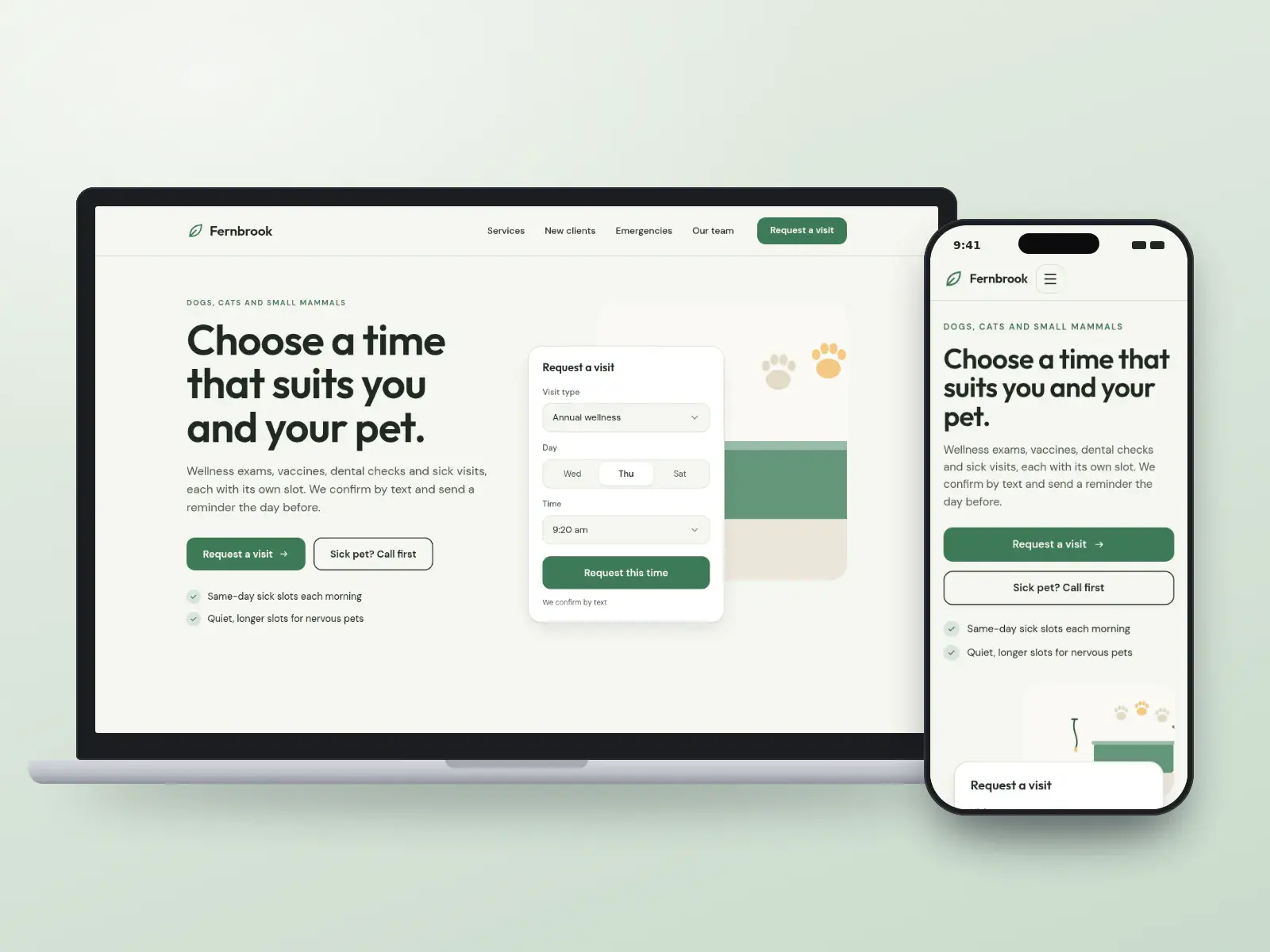
Fernbrook Animal Hospital
Clinics whose phones never stop
Concept design. The business is fictional.
- Tool-first
- Friendly
Local website: yours after 12 payments, or $1,500 upfront
Concept website
Tallgrass Veterinary Clinic
Clinics taking on new clients
Concept design. The business is fictional.
- Friendly
- Warm
Local website: yours after 12 payments, or $1,500 upfront
Concept website
Nightwatch Emergency Veterinary
Emergency and after-hours hospitals
Concept design. The business is fictional.
- Dark
- Bold
Local website: yours after 12 payments, or $1,500 upfront
Concept website
Kindred Paws Veterinary
Clinics selling wellness plans
Concept design. The business is fictional.
- Playful
- Bold
Local website: yours after 12 payments, or $1,500 upfront
Concept website
Riverbend Veterinary Group
Groups with general and referral hospitals
Concept design. The business is fictional.
- Corporate
- Tool-first
Growth website: yours after 12 payments, or $4,000 upfront
Concept website
Harrow & Hound Veterinary
Clinics adding virtual follow-ups
Concept design. The business is fictional.
- Warm
- Editorial
Local website: yours after 12 payments, or $1,500 upfront
Concept website
Meadowlark Mobile Vet
House-call and mobile practices
Concept design. The business is fictional.
- Map-led
- Friendly
Local website: yours after 12 payments, or $1,500 upfront
Concept app
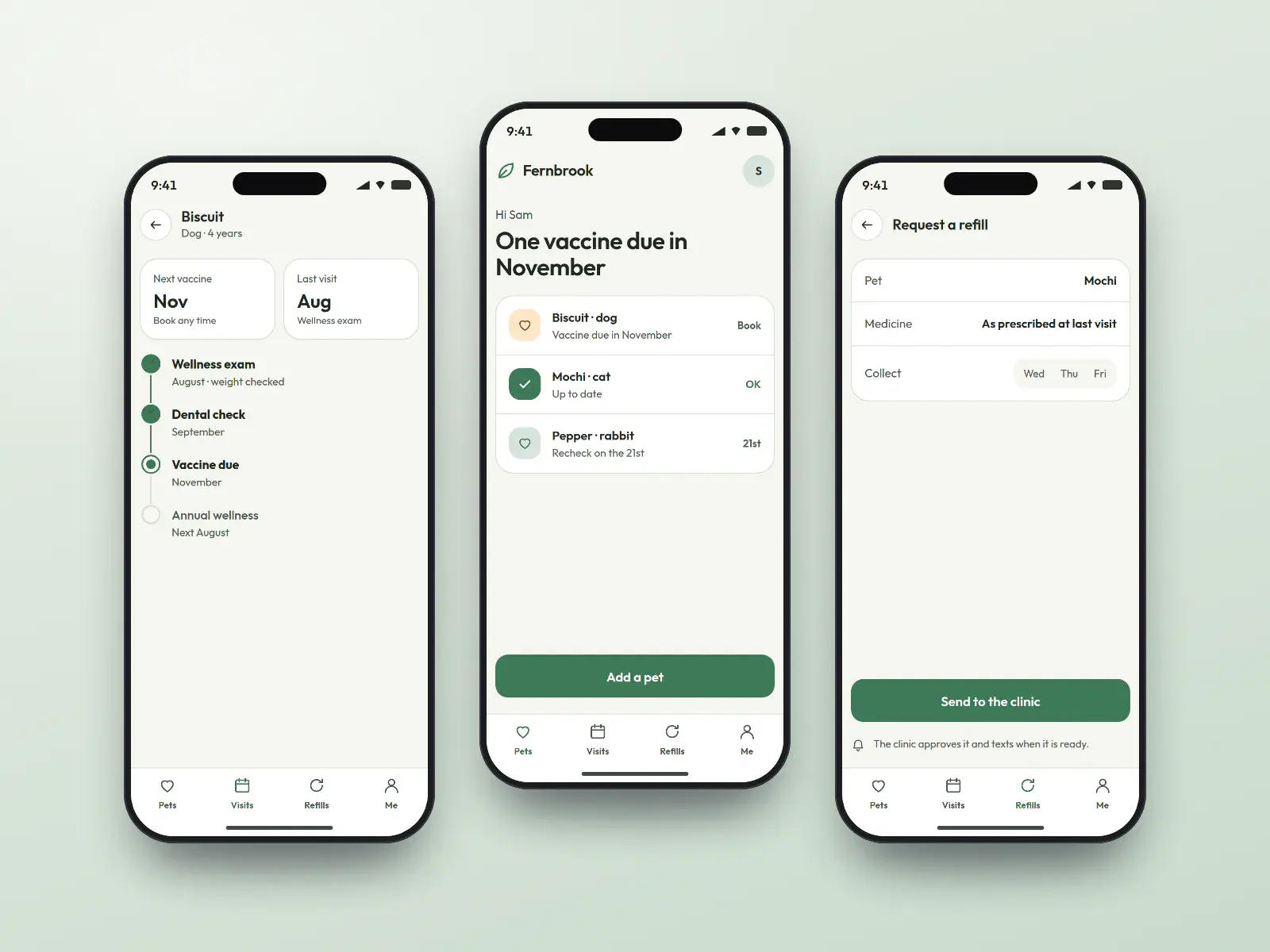
Fernbrook pet timeline app
Households with several pets
Concept design. The business is fictional.
- Friendly
- Minimal
Quoted per project after a call
Concept software
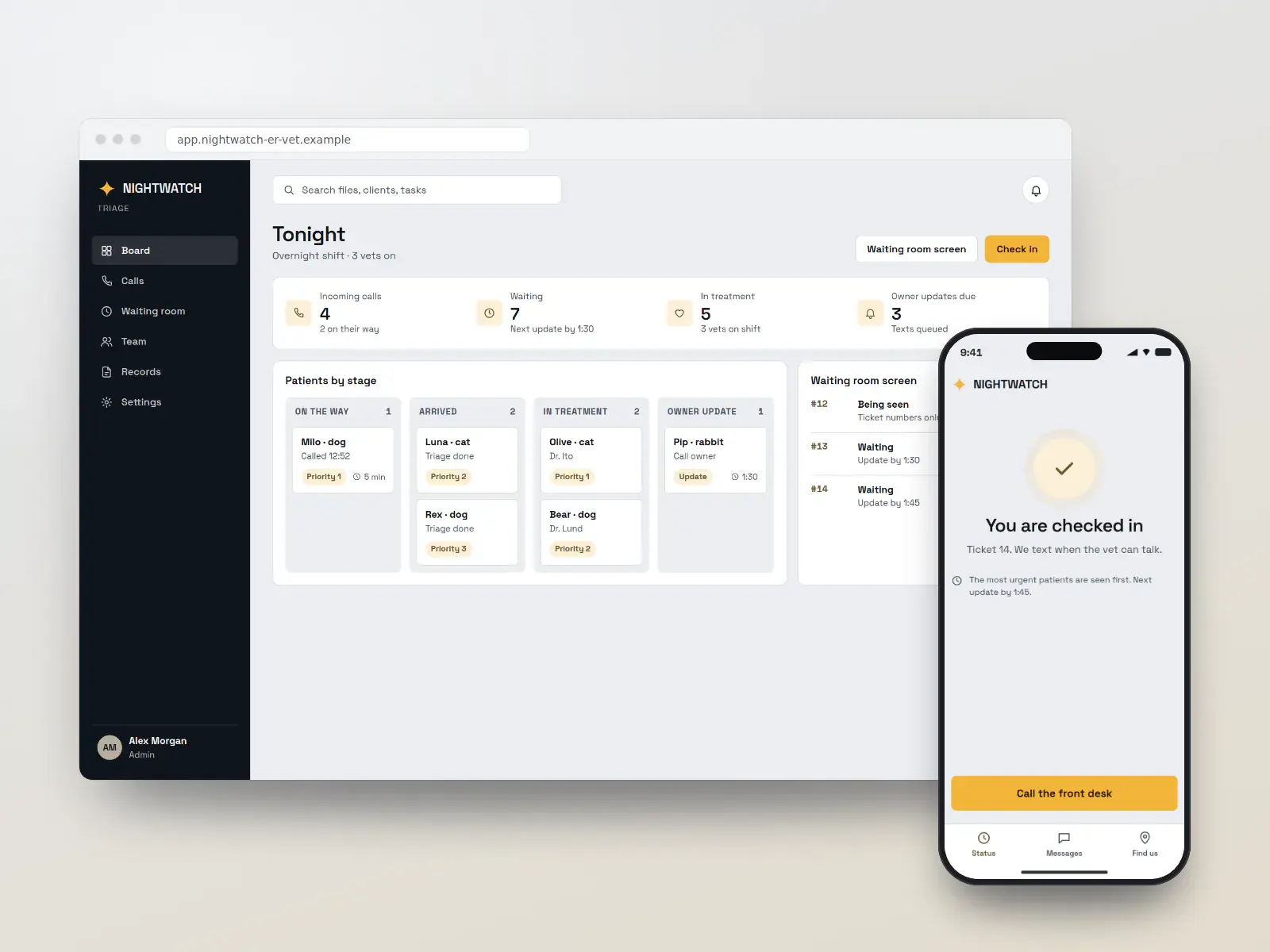
Nightwatch triage board
Emergency teams and their waiting rooms
Concept design. The business is fictional.
- Dark
- Data-led
Quoted per project after a call
Concept software
Riverbend referral portal
Referring vets sending cases to the group
Concept design. The business is fictional.
- Corporate
- Minimal
Quoted per project after a call
Pay monthly, own it
High-converting websites from $150/month
Pick a design, add your brand, content and photos, and launch. Yours after 12 payments, with SEO built in from day one.
- Local website
- $150/monthUp to 25 pages · yours after 12 payments, or $1,500 upfront
- Growth website
- $400/monthUp to 100 pages · yours after 12 payments, or $4,000 upfront
Built in
What every veterinary clinic website includes
Booking by visit type
Owners choose wellness, vaccines, sick visit or surgery drop-off, and each lands in a slot sized for it, through the practice software you already run where it offers an integration, or as a request your team confirms. Text confirmations and a reminder the day before help cut no-shows.
A new-client and new-pet form
Species, breed, age, diet, medicines, vaccine certificates as photo uploads, and a signed records-release request to the previous clinic, collected on a secure form before the first exam rather than at the counter with a pen.
An emergency page that works at night
Whether you are open, the after-hours hospital you refer to when you are not, the signs that mean leave now, and what to bring if a pet swallowed something. It is the page owners search for in a panic, so it loads fast and is plain.
Wellness plans, explained clearly
What each life-stage plan includes, how monthly billing and renewal work, how to cancel, and a clear line that a plan is not pet insurance. Fees are set by you and shown in writing at sign-up, not promised in a hero banner.
Client data handled as client data
Animal records sit outside HIPAA, so we never label the site “HIPAA compliant”. Owner names, phone numbers and payment details are still personal information: forms are encrypted, analytics carry no form contents, and the privacy notice follows PIPEDA or your provincial law, or your state.
Titles your college and the AVMA would accept
“Specialist” and “board-certified” appear only beside a veterinarian who is a current diplomate of a recognised specialty college, with the certification named. General practitioners with a special interest say so in those words.
Reviews requested from every client
Review requests go to every client after a visit, never only the happy ones, and replies never discuss a pet’s condition or treatment. Ontario’s college has allowed testimonials and review requests since 2022 but still bars comparative claims, so no “best vet in town” quote is ever featured.
Accessible to every owner
Built to WCAG 2.2 AA: large tap targets on the booking flow, forms that work with screen readers and keyboard alone, and colour contrast that holds up on a phone in a dark car park outside the clinic.
Must-have pages
The pages every veterinary clinic website needs
Each page answers a question people ask before they book, and each one can rank for that question on its own.
Book an appointment
Visit types for wellness, vaccines, sick visits and surgery drop-off, open times, and a text confirmation, or a request form the front desk confirms where the practice software has no integration.
Emergencies and after hours
Whether you are open right now, the emergency hospital you send owners to when you are closed with its address and phone, signs that mean go now, and a reminder to call before driving in.
New clients and new pets
The secure history form, records transfer from the previous clinic, vaccine certificates as uploads and what to bring to the first exam.
Services by species
Dogs, cats, rabbits, birds or exotics: which ones you see, and a page for dentistry, surgery, senior care and end-of-life care with who provides each.
Fees, wellness plans and payment
How estimates work, payment options, and wellness plan terms with renewal and cancellation, stating plainly that a plan is not pet insurance and how pet-insurance claims are handled.
Prescriptions and refills
How to request a refill of a current medicine, when an exam is needed first, and how long approval takes, so refill calls drop.
Team and credentials
Each veterinarian and technician with their licence or registration, and any board certification named in full, so “specialist” is never implied.
Accessibility and getting here
Step-free entry, parking near the door for carrying a heavy dog, transit, and an accessibility statement with a contact for help.
Search, AI answers and maps
How pet owners search for veterinarians, and how your site answers
Pet owners search for a vet on a phone, and the search splits in two: planned care such as vaccines or a new puppy, and urgent care when something is wrong, often at night. For planned visits the map listing, reviews and online booking decide; for emergencies it is whether you are open right now and how far away you are.
How pet owners search
“Vet near me” and “vet accepting new patients”
Map-pack searches. Accurate hours, a booking link and a new-client page that says you are taking patients win the click.
“Emergency vet open now” and “24 hour vet”
Urgent, late searches. An emergency page with live hours, the after-hours hospital you refer to and a phone number gets the call.
“Cat vaccine schedule” and “how much is a dog dental cleaning”
Planning questions. Plain answers on service pages, with fees explained as estimates, bring owners who are still deciding.
“Exotic vet”, “rabbit vet near me”
Species searches. A page per species you actually see is what matches them, and it keeps away visits you cannot take.
“Mobile vet” and “at-home euthanasia”
House-call searches. A service-area page and a gentle end-of-life page answer these with dignity.
What we build for search, AI answers and maps
- 01
Business Profile done right
Primary category “Veterinarian” (or “Animal hospital” or “Emergency veterinarian service” where accurate), real hours including holidays, and booking and emergency links matching the site.
- 02
Markup that fits a clinic
VeterinaryCare markup with address, hours and services, FAQ and breadcrumb markup, separate location pages for each clinic, and no review stars about yourself.
- 03
Answers owners and AI tools quote
Service and species pages open with two plain sentences (what it is, when to book it, how long it takes), and the emergency page lists signs in short, clear lines.
- 04
Consistent clinic facts
The same name, address, phone and hours on Google, Apple Maps, Bing, your association’s find-a-vet listing and the site, updated the same day hours change.
- 05
Reviews and monthly results
Every client gets the same review request, replies never discuss a pet’s treatment, and a monthly report covers bookings, calls, map views and pages losing ground.
No one can promise a ranking or a place in an AI answer. We build the pages, data and profile that search engines and assistants read, and report what changes.
Compliance
The rules for veterinarians, handled in the design
Veterinary websites answer to a veterinary college or state board, to privacy law for owners’ details and to consumer law on reviews. Here is what each asks of a clinic site, and how every design handles it.
Sources gathered October 1, 2026. This is how our designs handle these rules, not legal advice: rules change and differ by province and state, so your veterinary college or state board, your privacy officer or your lawyer has the final word, and you approve every page before it goes live.
- Ontario
No superlatives, no comparisons, no guaranteed cures
The CVO’s advertising standard, revised in July 2022, says clinic content must be factual, accurate and verifiable, rules out comparative or superlative statements and anything a client would read as a guaranteed cure, and limits claims about a treatment to what professional opinion supports. Testimonials have been permitted since July 2022. The designs describe services, hours and visit types, and name no drug or product brands.
College of Veterinarians of Ontario — Professional Practice Standard: Advertising
- Ontario
New legislation on the way
The Veterinary Professionals Act, 2024 received Royal Assent on 6 June 2024 but, as far as could be found in October 2026, has not been proclaimed in force. When it is, the College becomes the College of Veterinary Professionals of Ontario, with new regulations that may change advertising rules. Footers carry the college name as a field, so a rename is one edit.
College of Veterinarians of Ontario — Modernized legislation
- US
“Specialist” and “board-certified”
AVMA guidance limits “specialist” and “board-certified” to current diplomates of a specialty organisation the AVMA’s board recognises, and says never to use “board eligible” or “board qualified”. A specialist listing general services should not imply specialist status for them. The referral concept names each certification.
AVMA — Guidelines on identification of board-certified veterinarians
- US · state law
Animal records are not HIPAA records
HIPAA does not apply to veterinary records; confidentiality of client and patient records is set by state veterinary law, which varies widely, and general privacy law still covers owners’ personal information. The sites never claim HIPAA compliance, and the privacy notice follows your state.
AVMA — Principles of veterinary data ownership and stewardship
- Canada
Owners’ personal information under PIPEDA
Ontario has no general private-sector privacy statute, so a clinic’s handling of owners’ names, contact and payment details falls under PIPEDA, whose consent principle asks that people know what is collected and why. Each form says what it collects and why, and analytics see no form contents.
Office of the Privacy Commissioner of Canada — PIPEDA consent principle
- US
Fake, staff and incentivised reviews
The FTC’s rule on consumer reviews bars invented or AI-written reviews, undisclosed reviews from staff, rewards tied to a positive review, and hiding negative ones. Review requests go to every client the same way, and the sites carry no review widget that filters out low scores.
FTC — 16 CFR Part 465, consumer reviews and testimonials final rule
- US · California
Telehealth and the VCPR
Since 1 January 2024, AB 1399 lets a California veterinarian establish the veterinarian-client-patient relationship by synchronous video, but caps prescriptions issued that way (six months generally, 14 days for antimicrobials) and bars controlled substances without an in-person exam. Many states still require an in-person exam first, so virtual-visit pages are worded per state.
California Veterinary Medical Board — AB 1399 frequently asked questions
- Ontario
Telemedicine in Ontario
The CVO’s telemedicine standard lets a veterinarian establish a veterinarian-client-patient relationship virtually if it meets the same expectations as in person, and asks for professional judgment each time on whether telemedicine is appropriate. The designs offer video for follow-ups and send new problems to an exam.
College of Veterinarians of Ontario — Professional Practice Standard: Telemedicine
- US · California
Monthly wellness plans that renew
A wellness plan billed monthly is an automatic renewal under California’s law (amended by AB 2863, in force since 1 July 2025): terms shown clearly before payment, express consent, and online cancellation for plans bought online. Federal ROSCA applies too. Plan pages show terms, renewal date and how to cancel before anyone pays.
California — Business and Professions Code §17600 and following (automatic renewal)
Everything for veterinarians
Websites, apps, branding and SEO for veterinarians
Websites
Veterinarians websites built on the designs above, fast and set up for search.
From $150/month
Apps
For clinics with a long list of pets due for something: an app or client area that keeps vaccines, refills and rechecks on time without a phone call each.
Quoted per project
Apps for veterinariansBranding
A veterinary brand has to reassure the owner and not frighten the animal’s person on the worst day, and in Ontario it cannot claim to be better than the clinic down the road.
Quoted per project
Branding for veterinariansSEO and leads
Ongoing SEO that checks your site every week and fixes what is safe to fix, for more booked visits and new-client registrations.
From $149/month
SEO plans and prices
Pricing
What a veterinary clinic website costs
The price of a veterinary clinic website is the same as any website we build: pay upfront and save, or spread it over 12 months.
Local website
$150/month × 12
or $1,500 upfront. Yours after the 12th payment.
- Up to 25 pages
- Any design on this page
- Technical SEO at launch
- Hosting and care $29/month
Growth website
$400/month × 12
or $4,000 upfront. Yours after the 12th payment.
- Up to about 100 pages
- Teams, offices and more integrations
- Planned with an advisor
- Hosting and care $49/month
SEO plans
$149/month
Local $149 · Growth $399
- Checks your site every week and fixes what is safe to fix
- New pages every month
- 7-day trial
Prices in US dollars. How payments, hosting and ownership work.
How it works
How your veterinary clinic website goes live
- 01
Pick a design
Choose a concept, or ask for something new. Tell us the species you see, your visit types and the practice software you run.
- 02
Send your details
Logo, team and clinic photos, each veterinarian’s licence and any board certification, hours, after-hours referral and wellness plan terms.
- 03
Forms and review
We connect the new-client form and booking securely, write the privacy notice for your province or state, and you review every page.
- 04
Launch and grow
Old pages redirected, Google profile hours and services updated, and SEO added so local pet owners keep finding you.
Pick my design
See your website before you pay for it
Choose a design and tell us about your business. An advisor emails you to plan a preview with your name, your colours and your details, and the price options. Nothing is charged until you decide.
- 1An advisor replies by email
- 2We plan your preview and scope
- 3You decide, with every price in writing
Questions
Veterinarians: common questions
- How much does a veterinary website cost?
- A veterinary clinic website of up to 25 pages is $1,500 paid upfront, or $150 a month for 12 months, and it is yours after the 12th payment. A larger site of up to about 100 pages is $4,000, or $400 a month. Hosting and care is $29 or $49 a month. Prices are in US dollars.
- Can pet owners book appointments and fill in new-client forms online?
- Yes. Owners pick a visit type and a time, and the booking page links to the practice software you already use where it offers an integration, or sends a request your team confirms. New clients complete a pet history form, upload vaccine certificates and sign a records-release request before the first exam.A direct connection to a specific practice-management system is scoped and quoted, since each vendor sets its own access rules.
- Does a veterinary website need to be HIPAA compliant?
- No. HIPAA covers human health information, not animal records, so we never label a vet site HIPAA compliant. Client records are kept confidential under state veterinary law in the US, and owners’ personal details fall under PIPEDA or a provincial law in Canada. Forms are still encrypted and analytics never see what owners type.
- Can we list our board-certified specialists?
- Yes, with the certification named. In the US, AVMA guidance limits “specialist” and “board-certified” to current diplomates of a recognised specialty college, and rules out “board eligible”. Each specialist’s page names their college, and general practitioners with a special interest describe it in those words instead of a specialist title.
- Can we offer virtual visits or telehealth on the site?
- Often, for existing patients. Whether a veterinarian may advise or treat virtually depends on the veterinarian-client-patient relationship rules where the animal is, which differ by state and province. California (AB 1399) and Ontario allow the relationship to be set up by video with limits; many states still require an exam first. The designs offer video rechecks to pets the clinic has already examined.We set the wording to your jurisdiction’s rules, which you confirm with your college or board before launch.
- How should a vet site show wellness plans and emergency hours?
- A wellness plan page lists what each life-stage plan includes, how monthly billing and renewal work, how to cancel, and that a plan is not insurance, with fees shown in writing at sign-up. The emergency page says whether you are open now, names the after-hours hospital you refer to, and lists signs that mean come in immediately.
- What should a veterinary clinic website include?
- A veterinary clinic website should include online booking by visit type, an emergency and after-hours page, a new-client and pet history form, the species and services you offer, fees and wellness plan terms, prescription refill requests, each veterinarian’s licence and any board certification, accessibility details and a privacy notice. Those pages answer what owners ask before calling.
- What should a vet emergency page say?
- It should say whether you are open right now, and if not, name the emergency hospital you send owners to, with its address and phone number. List the signs that mean come in now, such as trouble breathing, collapse, or a swollen belly with retching, ask owners to call ahead, and warn not to induce vomiting unless a vet says to.Keep it short, fast and checked every time your hours or the referral hospital change: a wrong number on this page at night costs more than any other error on the site.
- What can a vet clinic contact form ask for?
- A name, phone or email, the pet’s name and a short reason for the visit is enough. Card numbers and full records belong in the secure new-client form or your practice software, not a contact form, and the form says it is not checked after hours, so an owner with a sick pet calls instead of waiting for a reply.
- Will my veterinary clinic website rank on Google?
- It launches with the technical SEO done: fast pages, clean structure, structured data, local pages and redirects from your old site. To keep climbing, a BOOSTD SEO plan from $149 a month runs 262 checks on your site every week, fixes what is safe to fix and gets the rest ready for your OK.No one can promise a position on Google, and we never do. Google warns businesses about anyone who does.
- Can I get one of these veterinary website designs?
- Yes. Each is a complete, ready-to-launch website design BOOSTD made for veterinarians. Pick one and we make it yours, with your name, colours, photos, content and the licence or compliance details your industry expects, from $150 a month and yours after 12 payments.Approved client sites are shown with a “Client work” tag, and only with the client’s written permission.
Guides for veterinarians
Reading for veterinarians before you build
- Planned guideVeterinary clinic website checklist: booking, new clients and emergency pagesPlanned: written with a named author and published once reviewed
- Planned guideWellness plans on a vet website: how to explain them without oversellingPlanned: written with a named author and published once reviewed
- ReviewsHow to ask for Google reviews without breaking the rules
- Local SEOGoogle Business Profile optimization guide, field by field
More on veterinary website design
- Marketing for vet practices Local SEO, reminders and review marketing for clinics.
- Asking every client for a review
- Websites for dentists Booking by visit type, intake forms and recall reminders for dental practices.
- Websites for medical clinics
- Websites for pharmacies
- Pricing for a group or franchise of veterinarians More locations than a plan covers? Tell us about the network.
Free, about a minute, nothing changes on your site
Start with a free checkup of your current site
See what holds your current website back across every point, free, before you choose a design.
- Free, no cardNo sign-up to see your preview.
- Read-onlyNothing changes on your website.
- 90-day guaranteeIf you join: a better score, or your next month free.