
Websites for physiotherapists
Physiotherapy website design that turns injuries into bookings
Physiotherapy website design for physiotherapists and physical therapy clinics: online booking by therapist and visit type, intake that tells people whether they need a referral, claims routes for car accidents and workplace injuries in plain words, and virtual visits with home exercise programs. Local SEO is built in, so people nearby with a new injury can find your clinic.
- Website from $150/month, yours after 12 payments
- SEO plans from $149/month
The short answer
What should a physiotherapy clinic website include?
A physiotherapy website should let people book by injury and therapist, explain whether a referral is needed where they live, list the benefit plans and accident or workplace claims you handle, and offer virtual visits with home exercise programs. In Ontario, therapists appear as “Physiotherapist (PT)” without “Dr.”, and testimonials now need consent and verification.
- Price
- $1,500 upfront, or $150/month × 12
- Ownership
- Yours after 12 payments
- Hosting and care
- $29 or $49/month
- Build time
- About 4 weeks for a local site
Our designs
Our website and app designs for physiotherapists
Ready-to-launch concept designs for fictional businesses: pick one and make it yours. 7 websites, 2 apps and 1 software design, each opening on a desktop and a phone, with your brand, content and photos going in. All apps and software
10 of 10 examples shown
Concept website
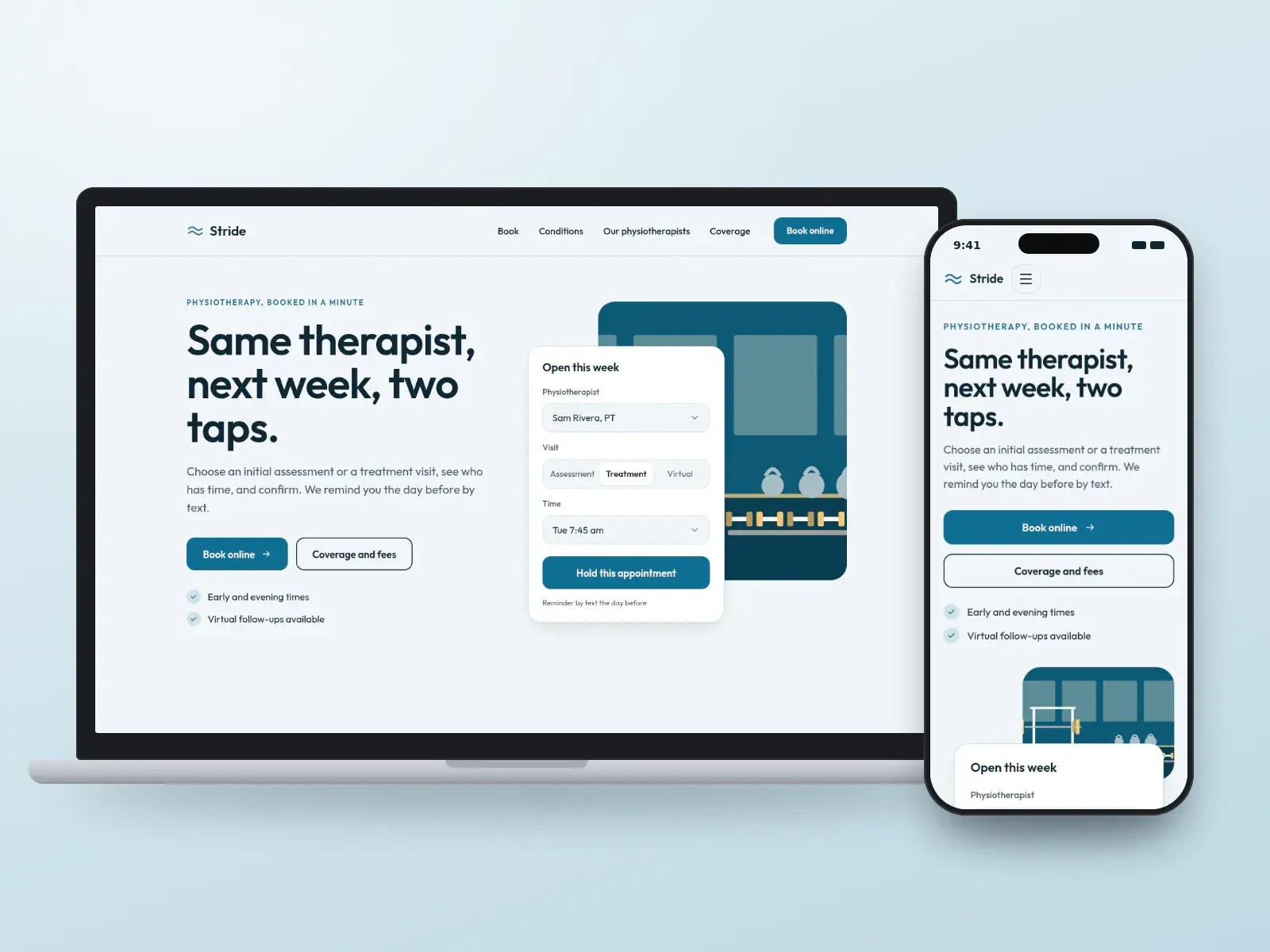
Stride Physiotherapy
Clinics with several therapists to book
Concept design. The business is fictional.
- Tool-first
- Minimal
Local website: yours after 12 payments, or $1,500 upfront
Concept website
First Step Physio
Clinics where people are unsure how to start
Concept design. The business is fictional.
- Friendly
- Tool-first
Local website: yours after 12 payments, or $1,500 upfront
Concept website
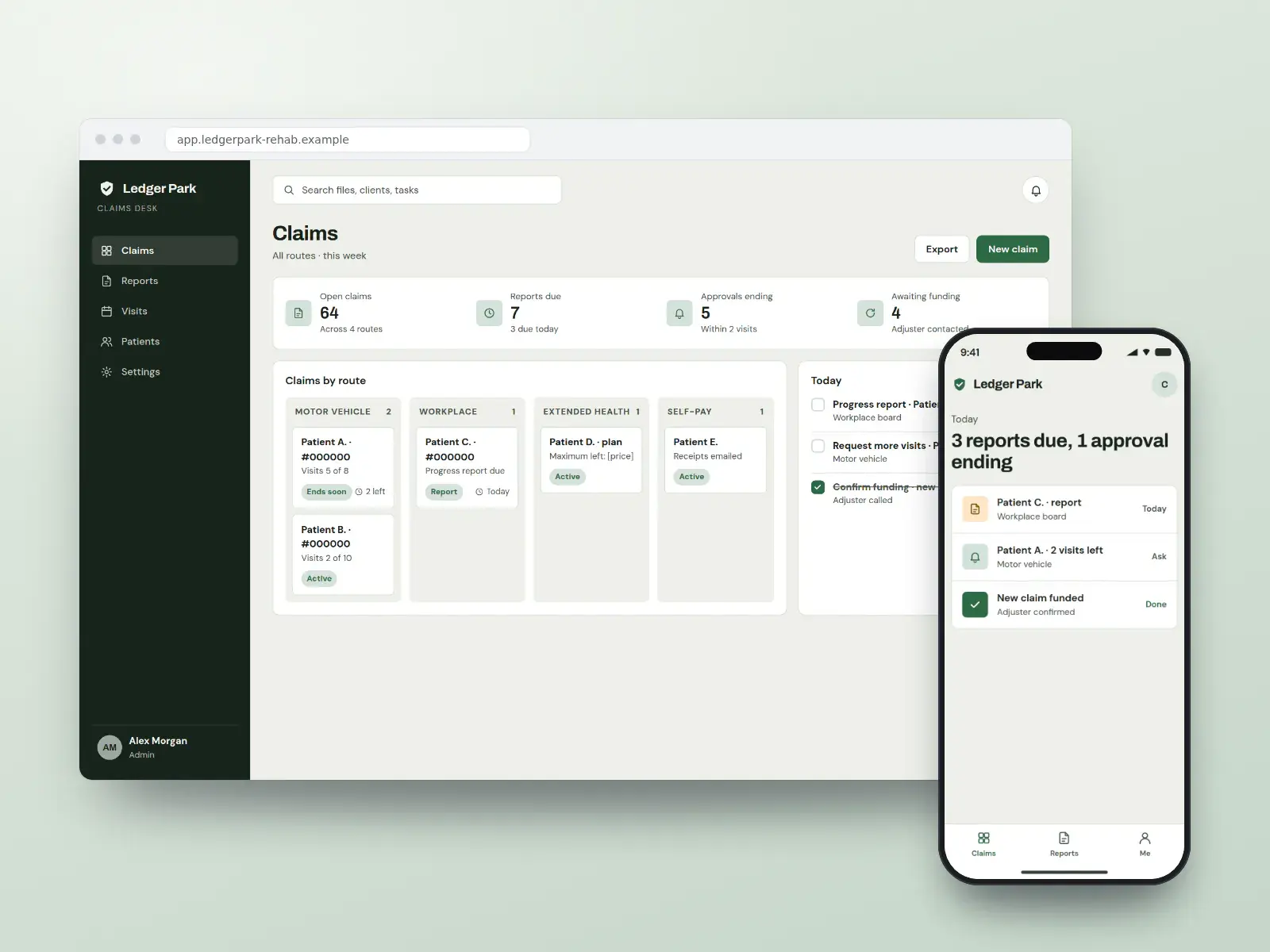
Ledger Park Rehab
Clinics with many accident and injury claims
Concept design. The business is fictional.
- Corporate
- Tool-first
Local website: yours after 12 payments, or $1,500 upfront
Concept website
Homeward Telerehab
Clinics adding virtual care
Concept design. The business is fictional.
- Playful
- Bold
Local website: yours after 12 payments, or $1,500 upfront
Concept website
Kinetic Collective Physiotherapy
Clinic groups across a city
Concept design. The business is fictional.
- Map-led
- Bold
Growth website: yours after 12 payments, or $4,000 upfront
Concept website
Tempo Sport Physio
Sport clinics working with athletes
Concept design. The business is fictional.
- Dark
- Data-led
Local website: yours after 12 payments, or $1,500 upfront
Concept website
Steadfoot Balance Physio
Clinics running balance classes for older adults
Concept design. The business is fictional.
- Editorial
- Warm
Local website: yours after 12 payments, or $1,500 upfront
Concept app
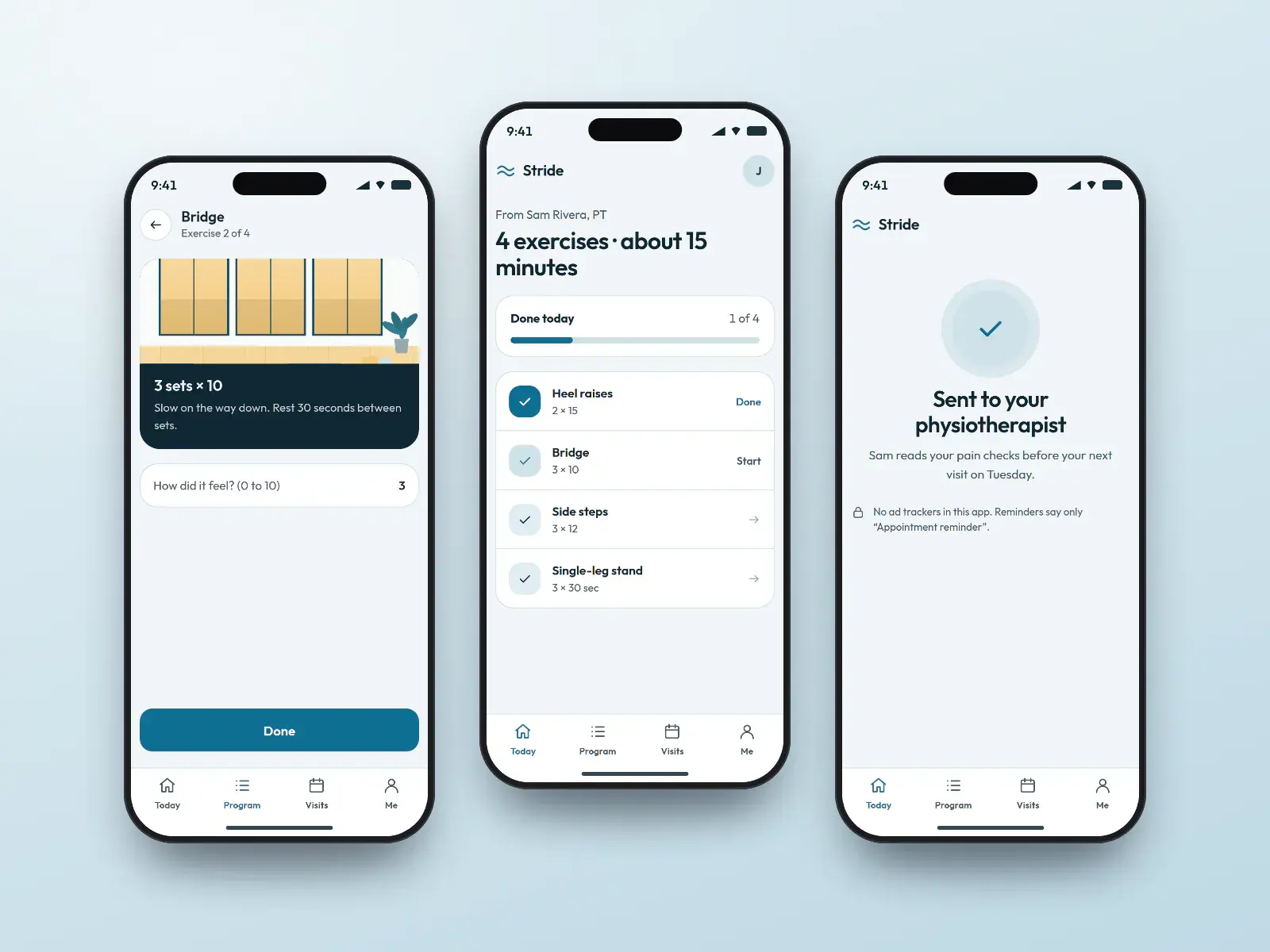
Stride exercise app
Patients doing a home exercise program
Concept design. The business is fictional.
- Minimal
- Friendly
Quoted per project after a call
Concept app
Homeward video visit app
Patients seen by video
Concept design. The business is fictional.
- Dark
- Friendly
Quoted per project after a call
Concept software
Ledger Park claims desk
Clinic staff tracking claims and approved visits
Concept design. The business is fictional.
- Data-led
- Corporate
Quoted per project after a call
Pay monthly, own it
High-converting websites from $150/month
Pick a design, add your brand, content and photos, and launch. Yours after 12 payments, with SEO built in from day one.
- Local website
- $150/monthUp to 25 pages · yours after 12 payments, or $1,500 upfront
- Growth website
- $400/monthUp to 100 pages · yours after 12 payments, or $4,000 upfront
Built in
What every physiotherapy clinic website includes
Booking by therapist and visit length
Patients pick an initial assessment, a treatment visit or a virtual follow-up, and the therapist they saw last time, linked to the clinic scheduling tool you already run where it offers an integration. Cancellations open the slot to the waitlist by text.
Direct access, answered for each patient
An intake step that asks where the patient lives and how they are paying, then says whether a referral is needed by law or by their plan. No blanket “no referral needed” banner that is wrong in some states.
Claims routes in plain words
Separate pages for extended health benefits, motor-vehicle accident claims and workplace injury claims, each saying what to bring and who the clinic contacts. Clinics that bill directly say which insurers and boards they are registered with, and the rest explain how receipts work; nothing promises that a claim will be approved.
Virtual visits and home exercise programs
Video appointments through a platform that signs a business associate agreement in the US or keeps data in Canada, and exercise programs patients open on their phone, with no ad tracking on either.
Titles the college accepts
Each therapist appears as their register lists them, followed by “Physiotherapist (PT)”. No “Dr.” on Ontario pages even for doctorate holders, and “specialist” only beside a certification recorded on the register.
Patient stories, only with consent
Where your college now allows testimonials, each story is from a real patient, unpaid, verified, and published with written consent to use their name and health details. Where it does not, or the patient declines, there is none.
Condition pages that earn search
Plain-language pages for the problems people search, such as rotator cuff pain, ankle sprains or post-surgery knee rehab, each saying what physiotherapy can do and when to see a physician instead.
Analytics that leave health data out
Visits counted without an ad pixel on booking, intake, claims or video pages, and nothing typed into a form reaches an ad network. In Canada, any tracking tied to health browsing waits for the visitor’s opt-in.
Must-have pages
The pages every physiotherapy clinic website needs
Each page answers a question people ask before they book, and each one can rank for that question on its own.
Book an assessment
Initial assessments, treatment visits and virtual follow-ups as separate bookings, filtered by physiotherapist, with what to wear in the confirmation.
Do I need a referral?
Direct access explained for where the clinic practises, plus the plans and claims that still ask for a doctor’s note, so nobody books and is then turned away.
Car accident and workplace claims
How motor-vehicle and workplace injury claims work at the clinic, what to bring, who the claims desk contacts, and what the patient may pay.
Benefits and direct billing
The extended health insurers the clinic bills directly, how receipts work for the rest, and what a visit costs when paying yourself.
Conditions and services
One page each for the injuries and services people search, such as sprains, post-surgery rehab, concussion or pelvic health, with when to see a physician instead.
Our physiotherapists
Each therapist as “Name, Physiotherapist (PT)”, with registration number, recorded certifications and the visit types they offer.
Virtual care
Who video visits suit and who they do not, how to prepare, and that the therapist must be registered where the patient is.
Accessibility and getting here
Step-free entry, parking close to the door, a lift or ground-floor rooms, an accessible washroom, and an accessibility statement for people arriving on crutches.
Search, AI answers and maps
How patients search for physiotherapists, and how your site answers
Physiotherapy searches tend to follow an injury, a surgery date or a doctor’s suggestion, and most happen on a phone within days of it. People pick from the map by distance and hours, then check two things on the site: whether they need a referral and how the visit will be paid.
How patients search
“Physiotherapy near me” and “physio clinic open Saturday”
Map results lead. Hours, therapist availability and a booking link that matches the profile decide the click.
“Physio after car accident” and “WSIB physiotherapy”
Claim-driven searches. A claims page that says which routes the clinic handles and what to bring wins these patients.
“Do I need a referral for physiotherapy”
A referral page that answers for the clinic’s province or state and for common plans removes the most frequent reason to phone.
“Physiotherapy for knee pain” and “ACL rehab”
Condition pages that describe assessment and treatment, without a promised recovery date, rank for the injury itself.
“Physical therapy direct billing” and “physio covered by insurance”
A billing page naming the insurers the clinic bills in plain text answers it before the call.
What we build for search, AI answers and maps
- 01
Business Profile in the right category
Primary category “Physiotherapist” (or “Physical therapist” in the US), services such as sports injury rehab named as the site names them, one profile per location, and hours that match.
- 02
Physiotherapy structured data
Physiotherapy markup, a schema.org medical business type, with address, hours and each physiotherapist as a Person, plus FAQ and breadcrumb markup, and no self-awarded rating stars.
- 03
Quotable answers for AI search
Referral, claims and condition pages open with a direct two-sentence answer for the clinic’s jurisdiction, which AI overviews and assistants can cite without guessing.
- 04
Consistent facts across the web
Clinic name, address, phone, hours and each therapist’s register name and title the same on the site, the Business Profile, the College register and insurer provider directories.
- 05
Fair reviews and clear reporting
One review request to every patient at discharge, staff never posting, critical reviews left up, and a monthly report on bookings, calls and map visibility by service.
No one can promise a ranking or a place in an AI answer. We build the pages, data and profile that search engines and assistants read, and report what changes.
Compliance
The rules for physiotherapists, handled in the design
Physiotherapy websites answer to a physiotherapy college or state board, to direct-access and title laws, and to health-privacy law. Here is what each asks of a clinic site, and how every design handles it.
Sources gathered October 1, 2026. This is how our designs handle these rules, not legal advice: rules change and differ by province and state, so your physiotherapy college or state board, your privacy officer or your lawyer has the final word, and you approve every page before it goes live.
- Ontario
Testimonials, under conditions, since May 2025
The College of Physiotherapists of Ontario’s Advertising and Marketing Standard took effect on 1 May 2025 and, by the college’s summary, allows testimonials that are true, verifiable, unpaid and from real patients, with consent to use their name, photo or health information. The designs show none; a clinic adds consented stories itself.
College of Physiotherapists of Ontario — Advertising and Marketing Standard
- Ontario
“Physiotherapist (PT)”, never “Dr.”
The college’s titles standard reserves “Physiotherapist”, “Physical Therapist” and “PT” for registrants, asks for the register name followed by “Physiotherapist (PT)”, bars “Dr.” in anything patient-facing even for doctorate holders, and allows “specialist” only for a recorded certification. Every footer and team page follows that format.
College of Physiotherapists of Ontario — Titles, Credentials and Specialty Designations Standard
- US
PT title and “Doctor of Physical Therapy”
The FSBPT model practice act, a template states adapt rather than law itself, has “PT” follow the name and lets a DPT holder say “Doctor of Physical Therapy” but not “Doctor” alone. Each state’s act decides, so US versions of the designs print “PT, DPT” after the name and never a bare “Dr.”
- US · state law
Direct access varies by state
APTA’s state-by-state summary says every state allows some direct access to physical therapy, but many cap visits or days without a referral, and payers may still ask for one. The intake wizard asks for the patient’s state and plan instead of promising “no referral needed” everywhere.
- US
Vendors that touch patient information
Under HIPAA, a telerehab platform, exercise-program app, form tool or host that receives patient information for a covered clinic is a business associate and needs a business associate agreement; HHS publishes sample provisions. Vendors that will not sign one are kept away from intake, video and program data.
- Canada
Tracking health browsing needs opt-in consent
The Privacy Commissioner’s online advertising guidance treats health-related information as sensitive, so tracking it for ads needs express consent, and visitors must be able to decline. Outside Ontario’s health privacy act this is PIPEDA territory; the designs ask before any ad cookie and put none on clinical pages.
Office of the Privacy Commissioner of Canada — Online behavioural advertising guidelines
- US
No fake or filtered reviews
The FTC’s rule on consumer reviews bars fake reviews, undisclosed reviews from staff, rewards for positive ones and suppressing negative ones. Now that some colleges allow testimonials, the review request goes to every patient, staff never post, and nothing is hidden for being critical.
FTC — 16 CFR Part 465, consumer reviews and testimonials final rule
Everything for physiotherapists
Websites, apps, branding and SEO for physiotherapists
Websites
Physiotherapists websites built on the designs above, fast and set up for search.
From $150/month
Apps
For clinics where recovery happens mostly between visits: an app that carries the exercise program home and keeps the therapist in the loop.
Quoted per project
Apps for physiotherapistsBranding
A physiotherapy brand should look active and capable without promising a recovery date, and its name must not imply a specialty or a doctor’s title the team cannot use.
Quoted per project
Branding for physiotherapistsSEO and leads
Ongoing SEO that checks your site every week and fixes what is safe to fix, for more initial assessments and claim visits.
From $149/month
SEO plans and prices
Pricing
What a physiotherapy clinic website costs
The price of a physiotherapy clinic website is the same as any website we build: pay upfront and save, or spread it over 12 months.
Local website
$150/month × 12
or $1,500 upfront. Yours after the 12th payment.
- Up to 25 pages
- Any design on this page
- Technical SEO at launch
- Hosting and care $29/month
Growth website
$400/month × 12
or $4,000 upfront. Yours after the 12th payment.
- Up to about 100 pages
- Teams, offices and more integrations
- Planned with an advisor
- Hosting and care $49/month
SEO plans
$149/month
Local $149 · Growth $399
- Checks your site every week and fixes what is safe to fix
- New pages every month
- 7-day trial
Prices in US dollars. How payments, hosting and ownership work.
How it works
How your physiotherapy clinic website goes live
- 01
Pick a design
Choose a concept, or ask for a new one. Tell us your visit types, the claims you handle and your scheduling tool.
- 02
Send your details
Logo, clinic photos, each therapist’s register name and certifications, the insurers you bill, and exercise videos if you have them.
- 03
Privacy and title check
We check titles against your college’s standard, set up tracking-free intake and video pages, and you approve every page.
- 04
Launch and grow
Old pages redirected, condition pages live, Google profile updated, and SEO to keep bookings coming.
Pick my design
See your website before you pay for it
Choose a design and tell us about your business. An advisor emails you to plan a preview with your name, your colours and your details, and the price options. Nothing is charged until you decide.
- 1An advisor replies by email
- 2We plan your preview and scope
- 3You decide, with every price in writing
Questions
Physiotherapists: common questions
- How much does a physiotherapy website cost?
- A physiotherapy clinic website of up to 25 pages is $1,500 paid upfront, or $150 a month for 12 months, and it is yours after the 12th payment. A larger site of up to about 100 pages is $4,000, or $400 a month. Hosting and care is $29 or $49 a month. Prices are in US dollars.
- Can patients book without a referral?
- Often, but not always. Ontario lets patients see a physiotherapist directly, and every US state allows some direct access, yet many states limit visits or days without a referral and many plans still ask for one. The intake asks where the patient lives and how they are paying, then tells them what they need before they book.
- Can my clinic show patient testimonials now?
- In Ontario, since 1 May 2025, yes under conditions: the testimonial must be true, verifiable and from a real patient, not paid or written by staff, with consent to use their name, photo or health details. The site stores that consent with each story. In the US the FTC’s review rule applies, and state boards may add more.
- Can I use “Dr.” if I have a DPT or PhD?
- Not in Ontario on anything patient-facing: the college asks for your register name followed by “Physiotherapist (PT)”. In the US, model practice language lets a DPT holder say “Doctor of Physical Therapy” but not “Doctor” alone, and each state decides. The site shows the title your jurisdiction accepts.
- Does the site support virtual visits and home exercise programs?
- Yes. Patients book video follow-ups like any other visit, on a platform that signs a business associate agreement in the US or keeps data in Canada, and open their home exercise program on their phone. Neither page carries ad tracking, and the therapist must be licensed where the patient is.
- What should a physiotherapy website include?
- Booking by visit type and therapist, a page answering whether a referral is needed where you practise, separate pages for benefits, car accident and workplace claims, one page per condition or service, each physiotherapist as “Name, Physiotherapist (PT)”, virtual-care details if you offer them, and an accessibility statement. Each answers a question people ask before booking.
- Can a physiotherapy website explain car accident and WSIB claims?
- Yes, in general terms that stay accurate: which claim routes the clinic handles, what to bring, who the clinic contacts, and that funding is decided by the insurer or board, never promised by the clinic. In Ontario, the auto insurance changes of 1 July 2026 made the auto insurer the first payer for medical and rehabilitation benefits, ahead of workplace health plans.Only say you bill an insurer or the WSIB directly if the clinic is set up to, and keep each claims page dated so changes in the rules are caught.
- How do physiotherapy clinics get more patients from their website?
- Let people book an initial assessment on a phone in a few taps, answer the referral and payment questions on the page instead of by phone, and keep the Google Business Profile, hours and site identical. Condition pages written for real injuries, without promised recovery dates, then reach people before they choose a clinic.
- What should a physiotherapy contact form collect?
- Only a name, a way to reply and a short reason for getting in touch, with a line asking people not to include health details. Injury descriptions, medical history and claim numbers go through the secure intake instead, which is encrypted, never sent by plain email, and covered by a vendor agreement under PHIPA, PIPEDA or HIPAA.
- Will my physiotherapy clinic website rank on Google?
- It launches with the technical SEO done: fast pages, clean structure, structured data, local pages and redirects from your old site. To keep climbing, a BOOSTD SEO plan from $149 a month runs 262 checks on your site every week, fixes what is safe to fix and gets the rest ready for your OK.No one can promise a position on Google, and we never do. Google warns businesses about anyone who does.
- Can I get one of these physiotherapy website designs?
- Yes. Each is a complete, ready-to-launch website design BOOSTD made for physiotherapists. Pick one and we make it yours, with your name, colours, photos, content and the licence or compliance details your industry expects, from $150 a month and yours after 12 payments.Approved client sites are shown with a “Client work” tag, and only with the client’s written permission.
Guides for physiotherapists
Reading for physiotherapists before you build
- Planned guidePhysiotherapy website checklist: booking, direct access, claims and telerehabPlanned: written with a named author and published once reviewed
- Planned guideTestimonials on a physiotherapy website after Ontario’s 2025 standardPlanned: written with a named author and published once reviewed
- Local SEOLocal SEO checklist: every step, in the right order
- ReviewsHow to respond to Google reviews: good, bad, fake and unfair
More on physiotherapy website design
- Marketing for allied health clinics Local SEO and review marketing for physio and rehab clinics.
- Websites for chiropractors First-visit booking, intake and benefits pages for another allied health clinic.
- Websites for massage therapists
- Websites for personal trainers For rehab clinics that also run strength and conditioning.
- Websites for medical specialists
- A quote for a physiotherapy clinic with many offices More locations than a plan covers? Tell us about the network.
Free, about a minute, nothing changes on your site
Start with a free checkup of your current site
See what holds your current website back across every point, free, before you choose a design.
- Free, no cardNo sign-up to see your preview.
- Read-onlyNothing changes on your website.
- 90-day guaranteeIf you join: a better score, or your next month free.