
Websites for personal trainers
Personal trainer website design that books intro sessions
Personal trainer website design that gets the right clients booked: a clear way to book an intro or apply for coaching, a readiness questionnaire on a secure form before the first session, and packages that say what renews before anyone pays. Certifications are named honestly, nobody is promised a body change, and local SEO helps people near you, or online, find your coaching.
- Website from $150/month, yours after 12 payments
- SEO plans from $149/month
The short answer
What should a personal trainer website include?
A trainer’s website needs a clear way to book or apply, a pre-exercise readiness questionnaire on a secure form, packages with renewal and cancellation terms shown before payment, and certifications named accurately, since personal training is not a licensed title. Leave out weight-loss promises and before-and-after body photos, and never use a protected title such as physiotherapist.
- Price
- $1,500 upfront, or $150/month × 12
- Ownership
- Yours after 12 payments
- Hosting and care
- $29 or $49/month
- Build time
- About 4 weeks for a local site
Our designs
Our website and app designs for personal trainers
Ready-to-launch concept designs for fictional businesses: pick one and make it yours. 8 websites, 2 apps and 1 software design, each opening on a desktop and a phone, with your brand, content and photos going in. All apps and software
11 of 11 examples shown
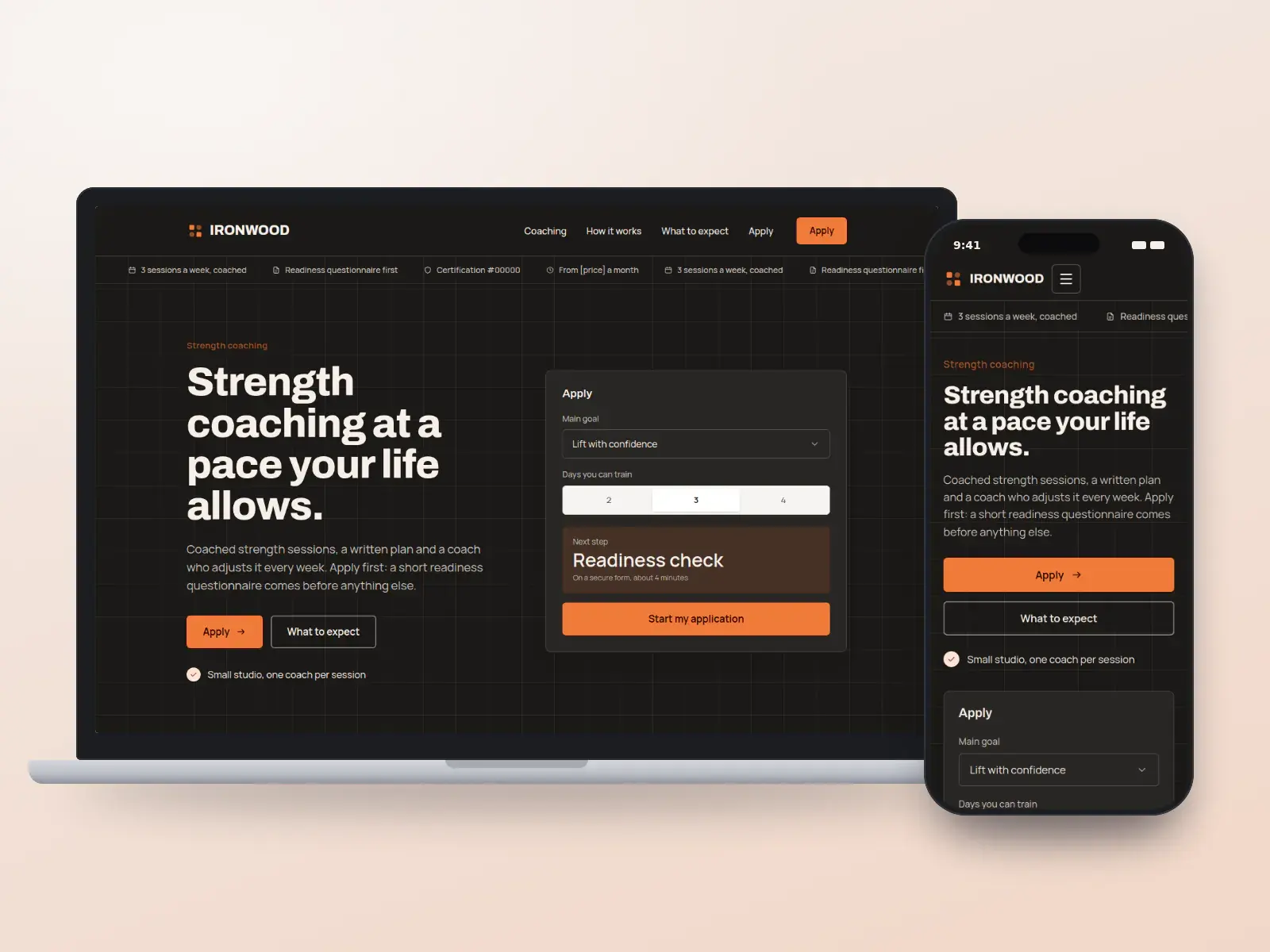
Concept website
Ironwood Coaching
Coaches whose clients’ progress sells the work
Concept design. The business is fictional.
- Dark
- Bold
Local website: yours after 12 payments, or $1,500 upfront
Concept website
Steadfast Training
Trainers who work with beginners and older adults
Concept design. The business is fictional.
- Friendly
- Tool-first
Local website: yours after 12 payments, or $1,500 upfront
Concept website
The Forge Room
Small-group training studios
Concept design. The business is fictional.
- Tool-first
- Minimal
Local website: yours after 12 payments, or $1,500 upfront
Concept website
Kestrel Online Coaching
Coaches who train clients online
Concept design. The business is fictional.
- Minimal
- Tool-first
Local website: yours after 12 payments, or $1,500 upfront
Concept website
Tempo Personal Training
Trainers selling packages and memberships
Concept design. The business is fictional.
- Bold
- Playful
Local website: yours after 12 payments, or $1,500 upfront
Concept website
Maison Strength
Private one-to-one studios
Concept design. The business is fictional.
- Luxury
- Minimal
Local website: yours after 12 payments, or $1,500 upfront
Concept website
Fieldwork Fitness
Mobile trainers who come to the client
Concept design. The business is fictional.
- Map-led
- Friendly
Local website: yours after 12 payments, or $1,500 upfront
Concept website
Northbound Run Coaching
Running coaches with group runs and race plans
Concept design. The business is fictional.
- Editorial
- Bold
Local website: yours after 12 payments, or $1,500 upfront
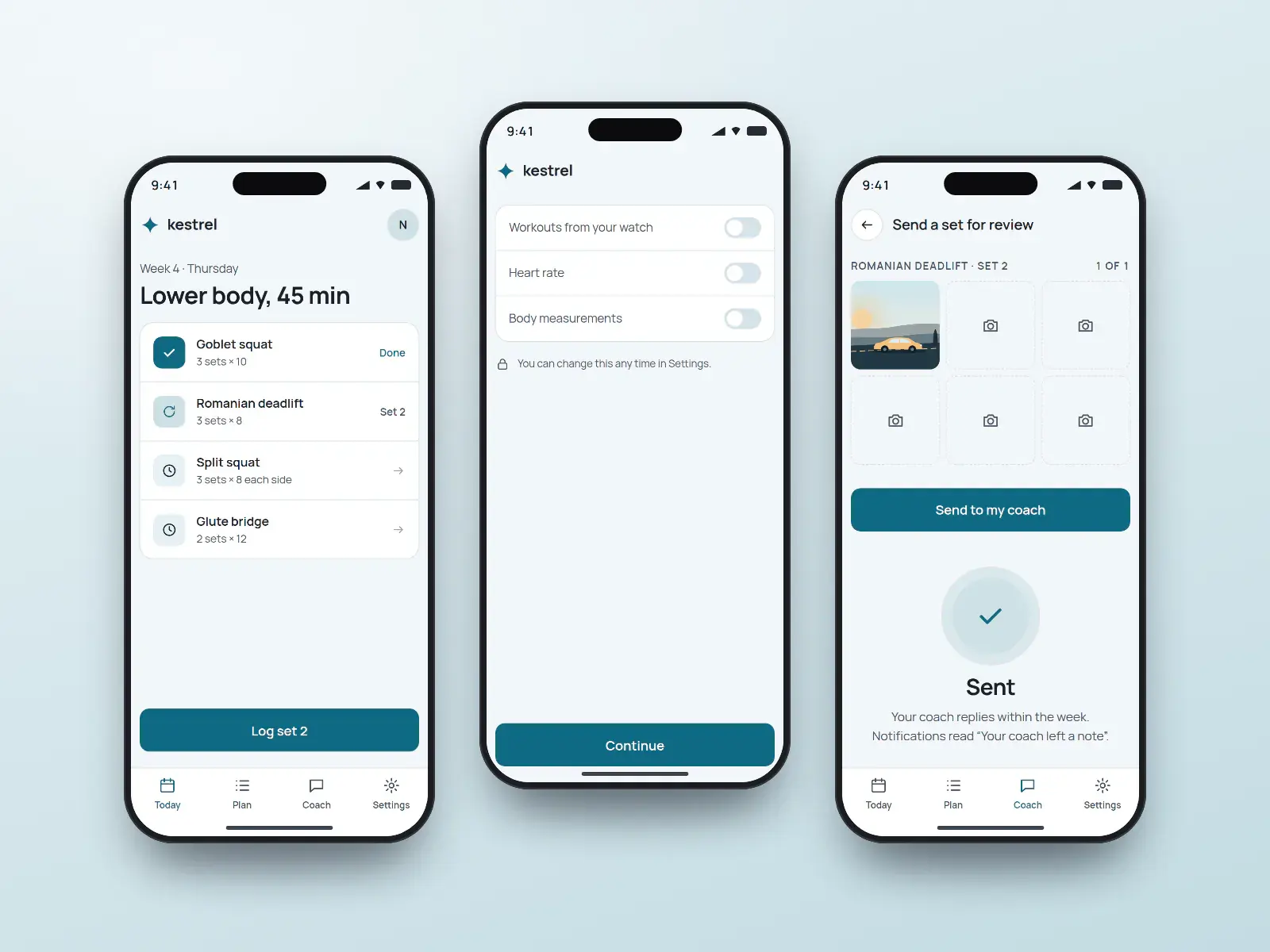
Concept app
Kestrel coaching app
Online clients following a weekly plan
Concept design. The business is fictional.
- Minimal
- Friendly
Quoted per project after a call
Concept app
The Forge Room booking app
Small-group members booking and tracking packs
Concept design. The business is fictional.
- Dark
- Tool-first
Quoted per project after a call
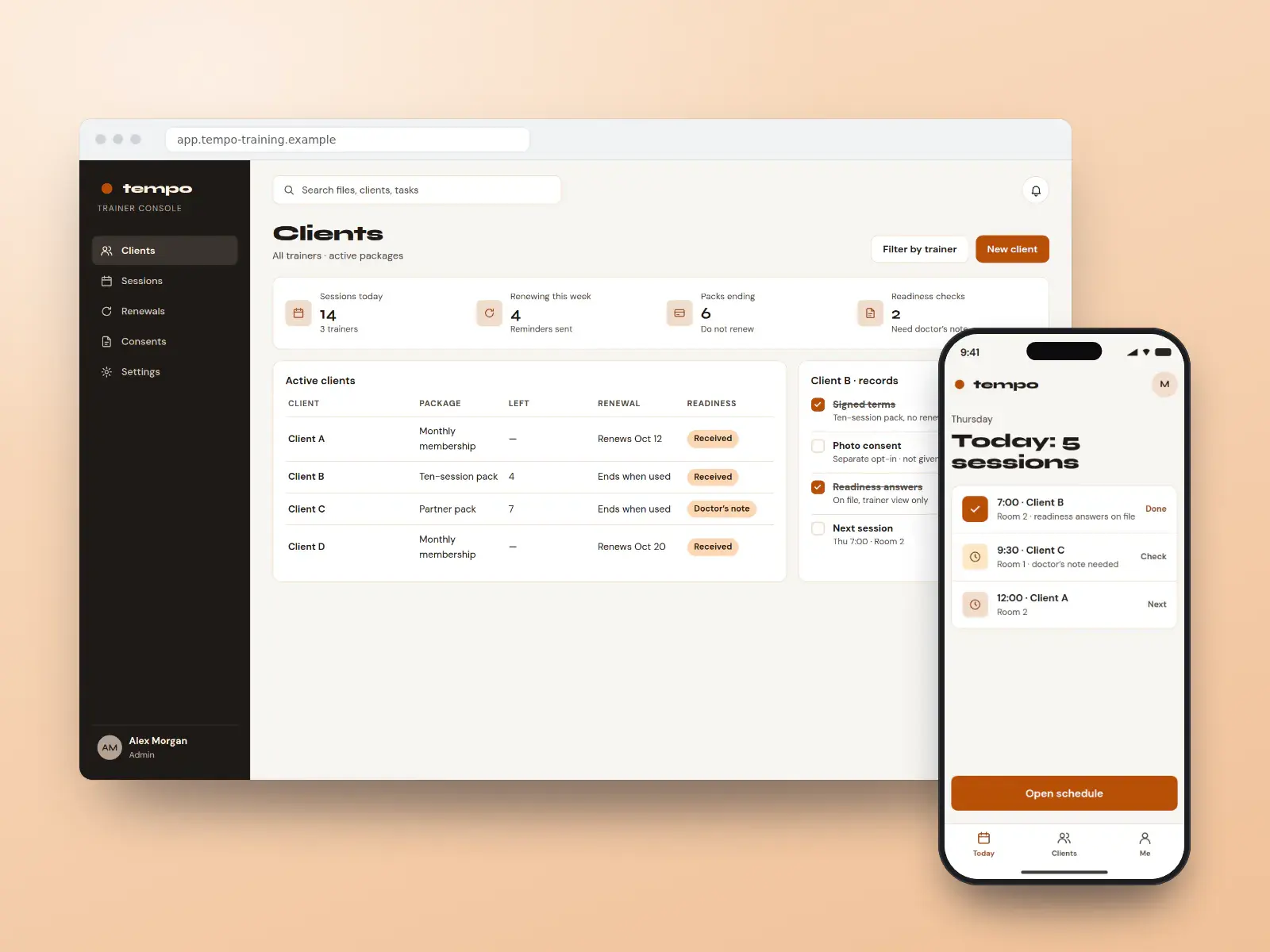
Concept software
Tempo trainer console
Trainers managing clients, sessions and renewals
Concept design. The business is fictional.
- Data-led
- Bold
Quoted per project after a call
Pay monthly, own it
High-converting websites from $150/month
Pick a design, add your brand, content and photos, and launch. Yours after 12 payments, with SEO built in from day one.
- Local website
- $150/monthUp to 25 pages · yours after 12 payments, or $1,500 upfront
- Growth website
- $400/monthUp to 100 pages · yours after 12 payments, or $4,000 upfront
Built in
What every personal trainer website includes
A readiness check before anyone books
A pre-exercise questionnaire in the PAR-Q style on an encrypted form, never the contact form: a client who reports a heart condition, chest pain or dizziness gets the follow-up questions and, where they point that way, is asked to see their doctor before the first session. The trainer reads every answer in advance.
Packages with the renewal terms up front
Which options auto-renew and which end when used, how freezing and cancelling work, and cooling-off rights where they apply, all shown before card details are taken, with an online cancel in the same account the client joined from.
Online coaching applications
An application that asks goals, training days and equipment before a call, so online coaching enquiries arrive qualified, and a plan page that explains check-ins, video form reviews and messaging.
Progress shown without body photos
The designs show how coaching works, not bodies: sessions, plans and what clients generally work towards, in words. No before-and-after shots or weight figures, which keeps the site clear of the FTC’s results-claim rules and of photo-consent disputes.
Certifications shown as certifications
Each trainer’s profile names the certifying body, the credential and first-aid status. Nothing is described as a licence, because personal training is not a licensed profession in most places, and no one is called a physiotherapist, physical therapist, “PT”, dietitian or therapist unless registered as one.
Fitness data kept out of ad platforms
Body measurements, readiness answers and wearable data never reach an ad pixel. Where Washington’s My Health My Data Act applies, the site carries a separate consumer health data policy and asks consent before collecting it.
Reviews asked of every client, fairly
Review requests go to every client after a block of sessions, never only to those who hit a goal. Reviews mentioning dramatic results are not featured on the site without the typical-results context the FTC asks for.
Must-have pages
The pages every personal trainer website needs
Each page answers a question people ask before they book, and each one can rank for that question on its own.
Book an intro or apply
One obvious action on every page: book a first session for local clients, or an application for online coaching, with the next steps spelled out.
Readiness questionnaire
A pre-exercise screening form, encrypted and read by the trainer before the first session, that asks anyone with a warning sign to check with their doctor.
Packages and prices
Each package or membership with what renews, what ends when used, freezing, refunds and cancellation, all before any card field.
About and certifications
Who you are, who you work with best, and each certification with the body that issued it, described as a credential rather than a licence.
Where you train
Studio address and parking, the neighbourhoods a mobile trainer covers, or how online sessions run, so people know whether you fit their week.
How sessions work
What the first session involves, how plans are adjusted, what to bring, and how you work alongside a physiotherapist or doctor when a client has one.
Accessibility
Step-free access to the studio or how home visits work, adapted sessions, and an accessibility statement with a way to ask for changes.
Privacy notice
What the site collects, that screening answers and wearable data never reach ad tools, and the consumer health data policy where Washington law applies.
Search, AI answers and maps
How clients search for personal trainers, and how your site answers
Most people look for a trainer on a phone, either nearby in the map results or online by goal and specialty, and many check social profiles before they enquire. They decide on fit: who you train, where, how much a package costs, and whether you seem safe for their body and history.
How clients search
“Personal trainer near me” and “in-home personal trainer”
Local results with a map. A Business Profile with your area, studio or service radius, and a site page per area you cover, earns the visit.
“Personal trainer for seniors” or “for beginners”
Searches by who the training is for. A short page for each group you actually work with answers it better than one long services list.
“How much is a personal trainer”
Price research. A packages page with real options, what renews and what is included, read from your own prices, keeps the enquiry with you.
“Online strength coach” and “online running coach”
Not local at all. An online coaching page with how check-ins work and an application form is what wins these.
“Is my trainer certified?”
People checking credentials. A profile naming each certifying body, with no licence claim, answers it honestly.
What we build for search, AI answers and maps
- 01
Business Profile set up for a trainer
Primary category “Personal trainer”, a service area for mobile work or the studio address, hours you actually train, and the booking or application link.
- 02
Structured data that matches the page
LocalBusiness (ExerciseGym for a studio) with address or service area, Person markup for each trainer with their certifications as text, Service markup for packages, and no self-awarded ratings.
- 03
Answers assistants can quote
Pages for each client group and package open with two plain sentences (who it is for, what a session involves, how often), so AI answers have something accurate to cite.
- 04
One consistent identity
Your name, business name, area, certifications and links kept identical on the site, social bios and the certifying body’s directory where you are listed.
- 05
Reviews asked of every client
A review request after a block of sessions goes to every client, never only to those who hit a goal, and replies never mention a client’s health or body.
- 06
Monthly reporting
Intro bookings, applications and calls from search, the queries bringing people in, and pages to improve, reported monthly with no ranking promised.
No one can promise a ranking or a place in an AI answer. We build the pages, data and profile that search engines and assistants read, and report what changes.
Compliance
The rules for personal trainers, handled in the design
Trainer websites answer to consumer law on recurring packages, to advertising law on body and weight claims, and to privacy law for fitness data and photos. Here is what each asks, and how every design handles it.
Sources gathered October 1, 2026. This is how our designs handle these rules, not legal advice: rules change and differ by province and state, so your certifying body, your consumer-protection office or your lawyer has the final word, and you approve every page before it goes live.
- US
Standout results need typical-results context
The FTC’s Endorsement Guides say a testimonial showing an unusual result, such as a large weight change, needs either proof it is typical or a clear statement of what people generally achieve; “results not typical” alone is not enough. The designs carry no before-and-after body photos or weight figures, and a trainer who adds client stories later gets that context built in.
- US
Weight-loss and body claims
The FTC’s weight-loss reference guide lists claims, such as fast loss without diet or exercise, that are almost certainly false, and its health guidance says body and health claims need scientific substantiation. The concepts sell coaching, plans and accountability, and promise no amount lost.
FTC — Gut Check: a reference guide for spotting false weight-loss claims
- Ontario
Physiotherapist, physical therapist and “PT”
The College of Physiotherapists of Ontario says only its registrants may call themselves a physiotherapist or physical therapist or use the abbreviation PT, and US state practice acts protect similar titles. Trainers here are called trainers or coaches, never “PT”, and nothing offers to treat or rehabilitate an injury.
College of Physiotherapists of Ontario — Titles, credentials and specialty designations standard
- Canada
Client photos need separate consent
In a 2025 finding about a swim school, the Privacy Commissioner said a business cannot make consent to marketing photos a condition of its service under PIPEDA. Any client photo on the site is opt-in, recorded separately from the training agreement, and removable on request.
- US
Recurring packages under ROSCA
With the 2024 federal cancel-online rule vacated in July 2025, and the FTC’s March 2026 restart still only an advance notice, ROSCA is what applies: material terms shown before billing details are collected, express consent to the recurring charge, and a simple way to stop it. Membership checkouts show renewal terms first and offer online cancellation.
FTC — Enforcement policy statement on negative option marketing
- US · California
Cancel online where you joined online
For California clients, the renewal law changes that took effect in July 2025 (AB 2863) mean a client who signed up online must be able to cancel online, immediately, and that any retention offer must sit beside a visible cancel option. California’s health studio contract law can also reach personal training contracts. The concepts put the cancel control in the client’s account.
- Ontario
Prepaid training as a personal development service
Under Ontario’s Consumer Protection Act, 2002 (its 2023 replacement is not yet in force), fitness training paid for in advance is a personal development service: the client can cancel within ten days of receiving the written contract, which must list services, price, dates and renewal terms, and runs at most a year. Package checkouts in Ontario show those terms.
- US · Washington
Fitness data as consumer health data
Washington’s My Health My Data Act reaches businesses outside HIPAA, and its definition of consumer health data can include fitness, body measurements and other wellness tracking. It asks for a separate health data privacy policy, consent to collect and share, and deletion on request. The online coaching concept links that policy.
Everything for personal trainers
Websites, apps, branding and SEO for personal trainers
Websites
Personal trainers websites built on the designs above, fast and set up for search.
From $150/month
Apps
For trainers whose clients need to do the work between sessions: an app or client area that holds the program, the check-ins and the package balance.
Quoted per project
Apps for personal trainersBranding
A trainer’s brand has to look capable without shouting, and its name must not imply a licence or medical role the trainer does not hold.
Quoted per project
Branding for personal trainersSEO and leads
Ongoing SEO that checks your site every week and fixes what is safe to fix, for more intro sessions, coaching applications and package sales.
From $149/month
SEO plans and prices
Pricing
What a personal trainer website costs
The price of a personal trainer website is the same as any website we build: pay upfront and save, or spread it over 12 months.
Local website
$150/month × 12
or $1,500 upfront. Yours after the 12th payment.
- Up to 25 pages
- Any design on this page
- Technical SEO at launch
- Hosting and care $29/month
Growth website
$400/month × 12
or $4,000 upfront. Yours after the 12th payment.
- Up to about 100 pages
- Teams, offices and more integrations
- Planned with an advisor
- Hosting and care $49/month
SEO plans
$149/month
Local $149 · Growth $399
- Checks your site every week and fixes what is safe to fix
- New pages every month
- 7-day trial
Prices in US dollars. How payments, hosting and ownership work.
How it works
How your personal trainer website goes live
- 01
Pick a design
Choose a concept, or ask for something new. Tell us where you train clients, your packages and the booking or payment tool you use.
- 02
Send your details
Logo, photos, each trainer’s certifications, package and renewal terms, and signed consent from any client who appears in a photo.
- 03
Terms and review
We set the readiness form and checkout to show every term first, check claims for substantiation, and you review every page.
- 04
Launch and grow
Old pages redirected, Google profile updated, and SEO added so local clients and online applicants keep finding you.
Pick my design
See your website before you pay for it
Choose a design and tell us about your business. An advisor emails you to plan a preview with your name, your colours and your details, and the price options. Nothing is charged until you decide.
- 1An advisor replies by email
- 2We plan your preview and scope
- 3You decide, with every price in writing
Questions
Personal trainers: common questions
- How much does a personal trainer website cost?
- A personal trainer website of up to 25 pages is $1,500 paid upfront, or $150 a month for 12 months, and it is yours after the 12th payment. A larger site of up to about 100 pages is $4,000, or $400 a month. Hosting and care is $29 or $49 a month. Prices are in US dollars.
- Can clients fill in a health questionnaire before booking?
- Yes. A pre-exercise readiness questionnaire, in the style of the PAR-Q, sits before booking on an encrypted form, separate from the contact form. Anyone who reports a heart condition, chest pain or dizziness gets follow-up questions and, where needed, is asked to check with their doctor first. You read every answer before the first session, and answers never reach analytics or ad platforms.
- Can I show client before-and-after photos?
- Our designs leave them out. US law does not ban them, but the FTC treats a before-and-after as a claim about results: it needs evidence, and a standout result needs a clear statement of what clients generally achieve. In Canada a client’s photo also needs separate, optional consent. Showing how your coaching works sells the service without those risks.
- How should packages and memberships renew and cancel?
- The checkout says which options auto-renew and which simply end, with every term shown before card details are taken and online cancellation in the client’s account. ROSCA applies across the US, California requires online cancellation for online sign-ups, and Ontario gives a ten-day cooling-off right on prepaid fitness contracts.The FTC’s 2024 click-to-cancel rule was vacated in July 2025, and the rulemaking it restarted in March 2026 has produced no rule yet, so we build to the laws that apply today.
- Can I sell online coaching from the same site?
- Yes. Online coaching gets its own page and application form asking about goals, training days and equipment, so those leads arrive separate from local session enquiries. Program delivery stays in the coaching app you already use where it offers a link, and the site carries a consumer health data policy where fitness data is collected.
- What should a personal trainer website include?
- A way to book an intro session or apply for coaching on every page, a readiness questionnaire on a secure form, packages with prices and renewal terms, your certifications with the bodies that issued them, where you train, how sessions work, accessibility details and a privacy notice. Each answers a question people ask before they contact a trainer.
- How do personal trainers get more clients online?
- Be easy to find and easy to judge. Set up a Business Profile as a personal trainer with your area, publish a short page for each type of client you train, show package options and how sessions work, and make booking an intro one tap away. Then ask every client for a review, not only those who reached a goal.
- Should clients send injuries or health details through my contact form?
- No. The contact form asks for a name, how to reach the client and what they want help with, and says not to include health details. Injuries, conditions and medications go only on the encrypted readiness questionnaire, which you read before the first session and which never feeds analytics, ad tools or an ordinary email inbox.
- Can a personal trainer use the title PT or therapist?
- Not in Ontario: the College of Physiotherapists of Ontario reserves physiotherapist, physical therapist and the abbreviation PT for its registrants, and US states protect physical therapy titles too. Trainers are safest as “personal trainer” or “coach”, with certifications named as private credentials, and with no offer to treat or rehabilitate injuries.
- Will my personal trainer website rank on Google?
- It launches with the technical SEO done: fast pages, clean structure, structured data, local pages and redirects from your old site. To keep climbing, a BOOSTD SEO plan from $149 a month runs 262 checks on your site every week, fixes what is safe to fix and gets the rest ready for your OK.No one can promise a position on Google, and we never do. Google warns businesses about anyone who does.
- Can I get one of these personal training website designs?
- Yes. Each is a complete, ready-to-launch website design BOOSTD made for personal trainers. Pick one and we make it yours, with your name, colours, photos, content and the licence or compliance details your industry expects, from $150 a month and yours after 12 payments.Approved client sites are shown with a “Client work” tag, and only with the client’s written permission.
Guides for personal trainers
Reading for personal trainers before you build
- Planned guidePersonal trainer website checklist: intake, packages and renewalsPlanned: written with a named author and published once reviewed
- Planned guideResults claims for trainers: what the FTC and Competition Act expectPlanned: written with a named author and published once reviewed
- ReviewsHow to ask for Google reviews without breaking the rules
- Local SEOLocal SEO checklist: every step, in the right order
More on personal trainer website design
- Marketing for gyms and fitness studios Local SEO, membership and retention marketing.
- Asking every client for a review
- Websites for gyms and fitness studios Class timetables, online joining and cancellation that works.
- Websites for yoga and pilates studios
- Websites for physiotherapists For registered physiotherapists, whose title trainers may not use.
- Websites for nutritionists and dietitians
- A quote for personal trainers with several locations More locations than a plan covers? Tell us about the network.
Free, about a minute, nothing changes on your site
Start with a free checkup of your current site
See what holds your current website back across every point, free, before you choose a design.
- Free, no cardNo sign-up to see your preview.
- Read-onlyNothing changes on your website.
- 90-day guaranteeIf you join: a better score, or your next month free.