
Websites for dietitians and nutritionists
Dietitian and nutritionist website design that books the first consult
Dietitian and nutritionist website design for private practices: virtual and in-person consults booked online, a secure intake clients finish before the first session, receipts that work with their health plan, and program pages that describe what you do without promising a number on the scale. SEO built in, so clients looking for nutrition help nearby or online find you.
- Website from $150/month, yours after 12 payments
- SEO plans from $149/month
The short answer
What should a dietitian or nutritionist website include?
A nutrition practice website needs consult booking with a virtual option, a secure intake form, a page on insurance receipts, and program pages without weight-loss promises. Titles matter: “dietitian” is protected in every province, “nutritionist” in Alberta, Quebec and Nova Scotia, and US states license differently. Virtual sessions should be offered only where the practitioner is registered or licensed.
- Price
- $1,500 upfront, or $150/month × 12
- Ownership
- Yours after 12 payments
- Hosting and care
- $29 or $49/month
- Build time
- About 4 weeks for a local site
Our designs
Our website and app designs for dietitians and nutritionists
Ready-to-launch concept designs for fictional businesses: pick one and make it yours. 8 websites, 2 apps and 1 software design, each opening on a desktop and a phone, with your brand, content and photos going in. All apps and software
11 of 11 examples shown
Concept website
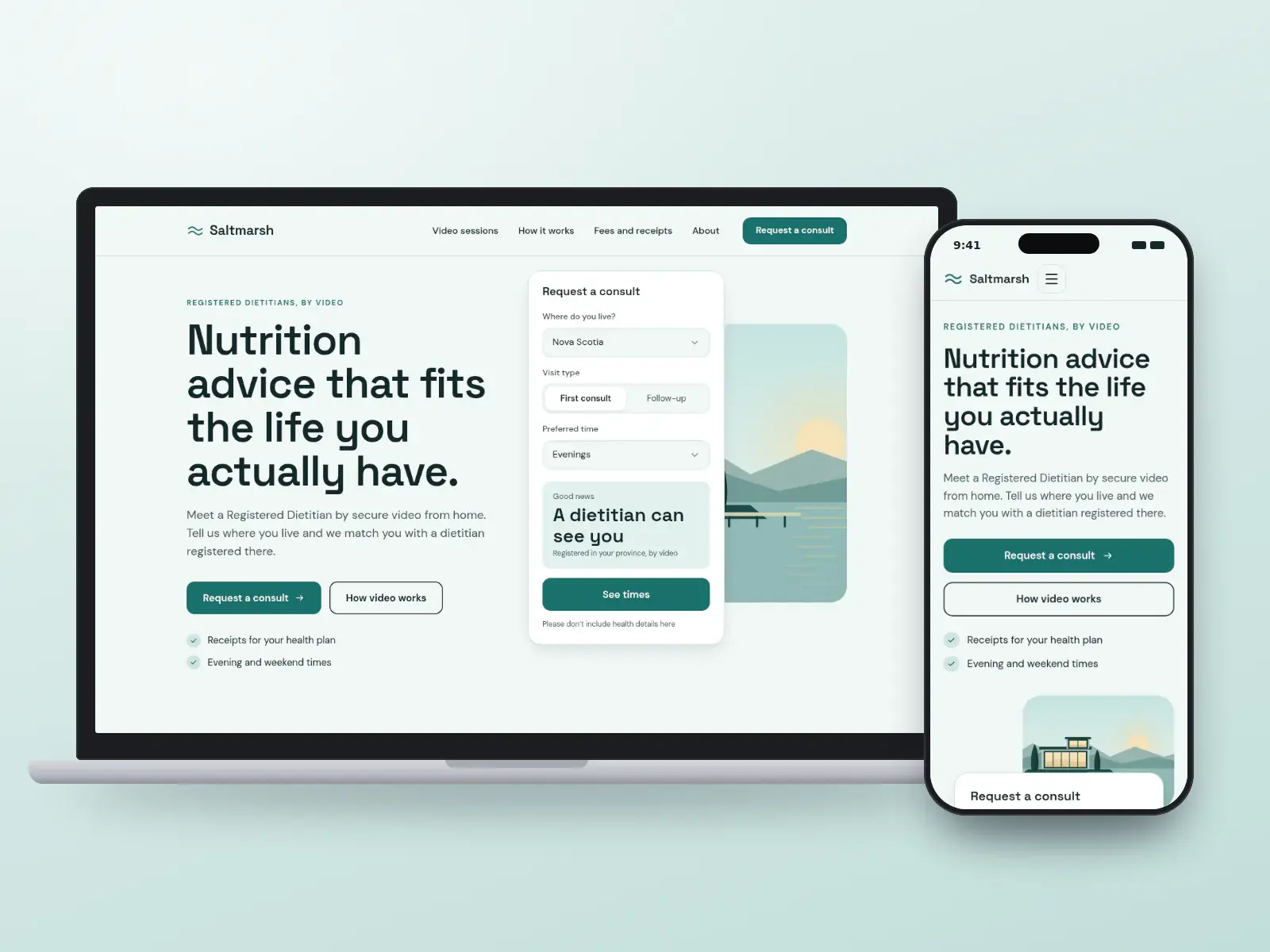
Saltmarsh Nutrition
Dietitians seeing clients by video
Concept design. The business is fictional.
- Tool-first
- Minimal
Local website: yours after 12 payments, or $1,500 upfront
Concept website
Greenfold Dietitians
Clinical dietitians with referral clients
Concept design. The business is fictional.
- Friendly
- Tool-first
Local website: yours after 12 payments, or $1,500 upfront
Concept website
Pantry & Pulse
Nutritionists who teach through writing
Concept design. The business is fictional.
- Editorial
- Warm
Local website: yours after 12 payments, or $1,500 upfront
Concept website
Ladle Nutrition Programs
Practices selling group and meal-plan programs
Concept design. The business is fictional.
- Bold
- Playful
Local website: yours after 12 payments, or $1,500 upfront
Concept website
Coverwell Dietitians
Practices whose clients claim on a plan
Concept design. The business is fictional.
- Dark
- Data-led
Local website: yours after 12 payments, or $1,500 upfront
Concept website
Northline Dietitian Group
Group practices with several dietitians
Concept design. The business is fictional.
- Corporate
- Tool-first
Growth website: yours after 12 payments, or $4,000 upfront
Concept website
Ondine Nutrition
Private practices in prenatal and family nutrition
Concept design. The business is fictional.
- Luxury
- Warm
Local website: yours after 12 payments, or $1,500 upfront
Concept website
Switchback Sport Nutrition
Sport dietitians working with athletes and teams
Concept design. The business is fictional.
- Bold
- Tool-first
Local website: yours after 12 payments, or $1,500 upfront
Concept app
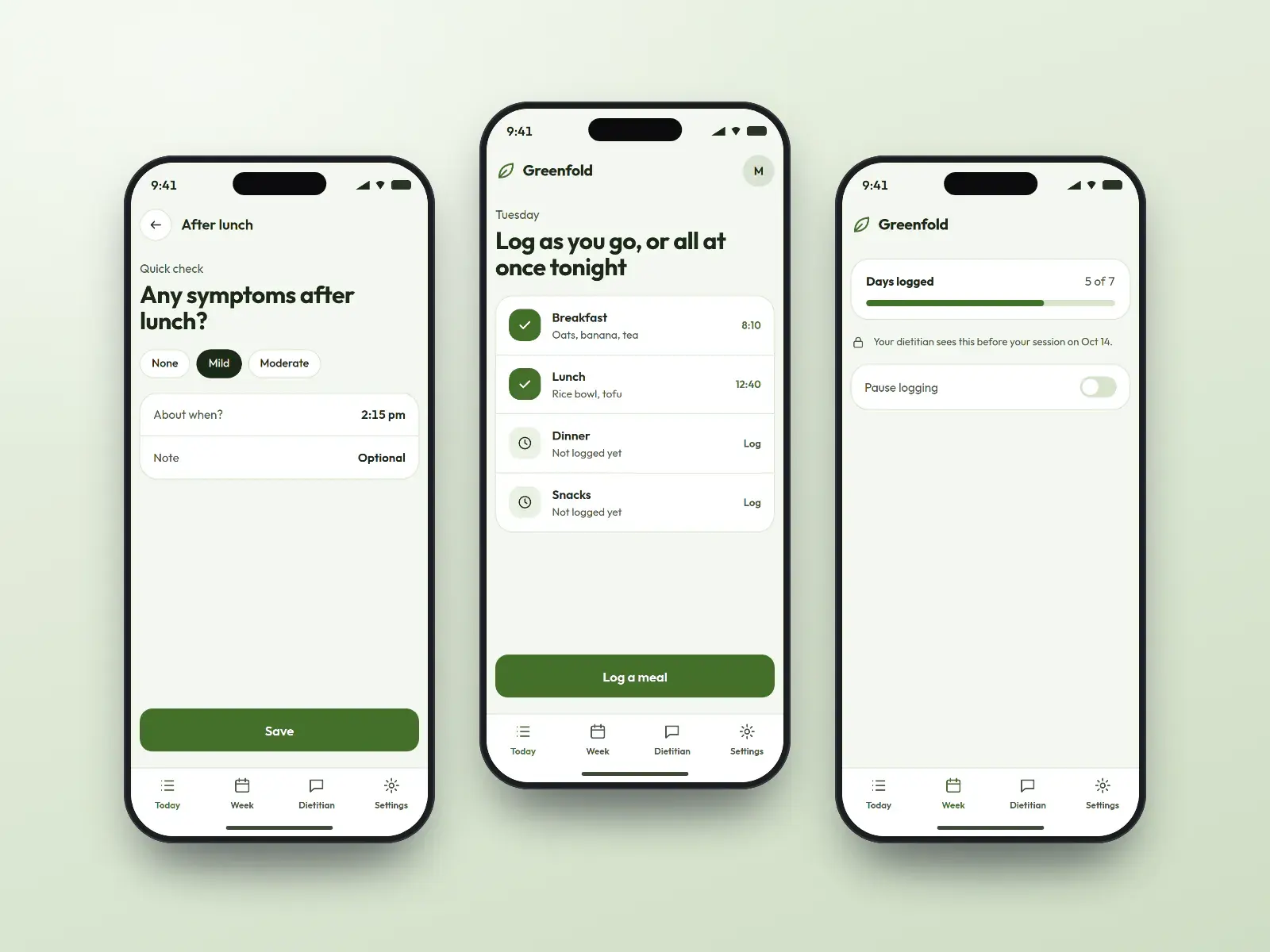
Greenfold food and symptom log
Clients keeping a food and symptom log
Concept design. The business is fictional.
- Friendly
- Minimal
Quoted per project after a call
Concept app
Ladle meal plan app
Program members with a weekly meal plan
Concept design. The business is fictional.
- Dark
- Bold
Quoted per project after a call
Concept software
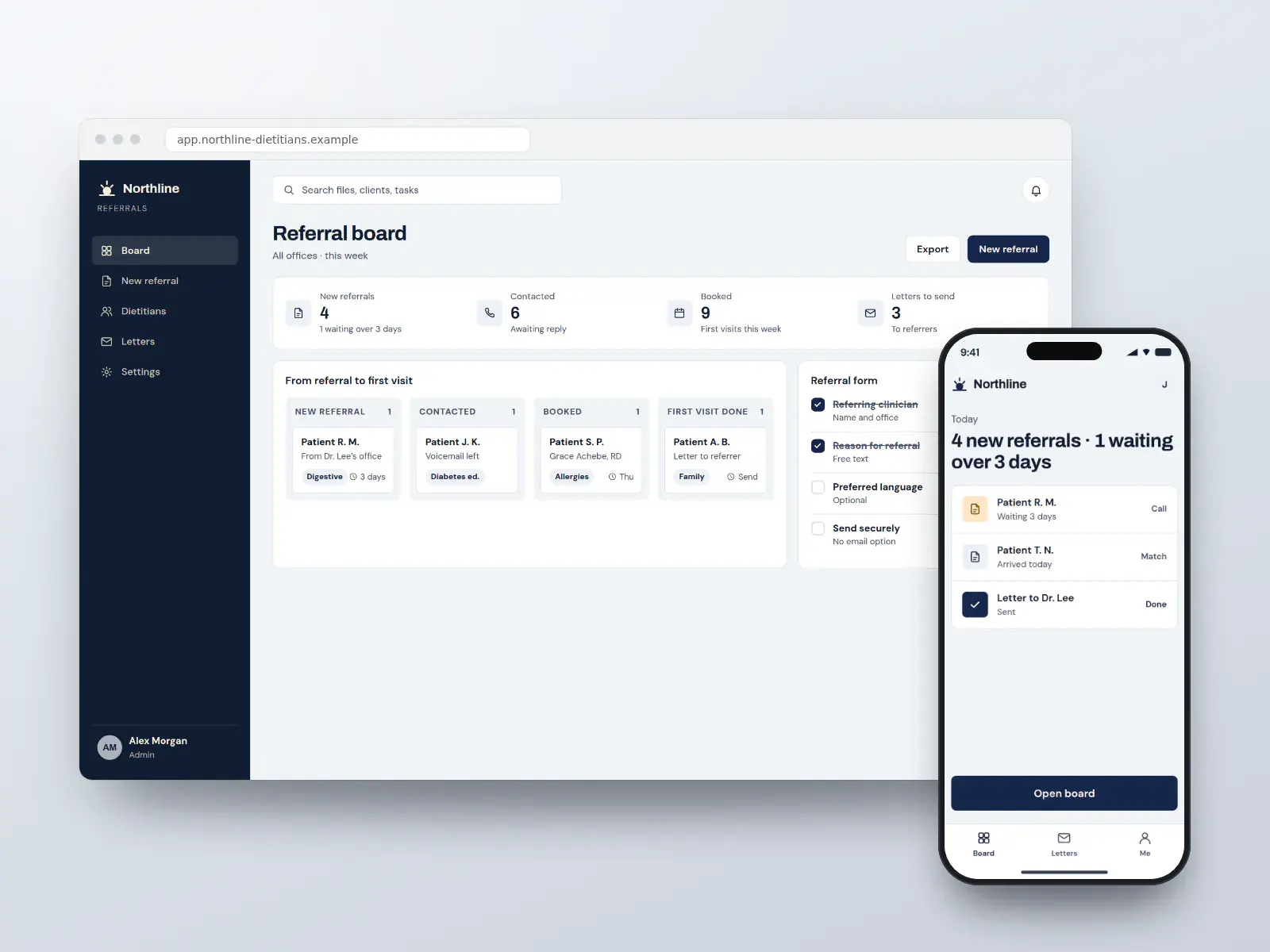
Northline referral portal
Physicians referring patients and the group’s intake team
Concept design. The business is fictional.
- Data-led
- Corporate
Quoted per project after a call
Pay monthly, own it
High-converting websites from $150/month
Pick a design, add your brand, content and photos, and launch. Yours after 12 payments, with SEO built in from day one.
- Local website
- $150/monthUp to 25 pages · yours after 12 payments, or $1,500 upfront
- Growth website
- $400/monthUp to 100 pages · yours after 12 payments, or $4,000 upfront
Built in
What every nutrition practice website includes
Consult booking that checks location first
Clients choose an initial assessment or follow-up, video or in person, and say where they live before picking a time, so a virtual session is never booked in a province or state where the practitioner is not registered or licensed. It connects to the booking tool you use where that tool offers an integration.
A secure intake before session one
Medical history, medications, allergies, food routines and goals on an encrypted form that saves progress, with an optional upload for lab results. The first session starts with the conversation, not a questionnaire read aloud.
An insurance and receipts page
How extended health plans, health spending accounts and US superbills work with your receipts, which details each receipt carries, and whether a doctor’s referral is needed. It answers the question that decides most first bookings.
Program pages without outcome promises
Group programs and meal plans described by what happens each week and what is included, not by kilograms lost. No before-and-after photos, no “results guaranteed”, and cancellation terms in plain view before anyone pays.
Titles worded for where you practise
“Registered Dietitian” and “RD” appear only with a registration number. A nutritionist’s site says it is not a dietitian practice, and drops the word “nutritionist” for clients in Alberta, Quebec and Nova Scotia unless the practitioner is registered there.
Analytics that never see a diagnosis
Intake answers, conditions picked in the wizard and booking details never reach an ad platform. Pages are measured without ad pixels on intake or booking, and vendors that handle client information sign the agreement your jurisdiction expects.
Content that earns search traffic
A recipe and article library built for the searches clients actually make, written in plain language, reviewed by you, and clear that general education is not individual advice.
Must-have pages
The pages every nutrition practice website needs
Each page answers a question people ask before they book, and each one can rank for that question on its own.
Book a consult
Initial assessment or follow-up, video or in person, with the client’s province or state asked first so only sessions you are registered for are offered.
Insurance and receipts
Which extended health plans and health spending accounts usually reimburse a Registered Dietitian, what each receipt shows, referral needs, and superbills or in-network plans for US clients.
Areas of practice
One page per focus, such as digestive health, diabetes, food allergies, prenatal or sport, each saying who it suits and what a session involves, never what the body will do.
Your first session
The secure intake to complete beforehand, what to bring (food log, medications, recent lab results), how long it takes and what happens afterwards.
Credentials and where you practise
Each practitioner’s exact title, registration number and the provinces or states they serve, with the dietitian-versus-nutritionist difference explained in plain words.
Referrals from clinicians
A secure referral form for doctors and nurse practitioners, what happens after a referral arrives, and the letter sent back.
Accessibility and getting here
Step-free access, seating that suits every body size, parking, transit and an accessibility statement with a way to ask for help, plus how video sessions work for people who cannot travel.
Privacy notice
What intake collects and why, where it is stored, who sees it, and that the general contact form is for a name and a way to reach you rather than symptoms or diagnoses.
Search, AI answers and maps
How clients search for dietitians and nutritionists
Clients often look for nutrition help after a diagnosis, a doctor’s suggestion or a frustrating stretch of trying alone, and many are happy to meet by video. They compare credentials and coverage before they book: “is this a registered dietitian, and will my plan pay?” decides most clicks.
How clients search
“Dietitian near me” and “registered dietitian online”
Map results for in-person care, plain results for virtual. A Business Profile and a page stating where you can see clients by video cover both.
“Dietitian for IBS”, “diabetes dietitian”, “sports dietitian”
Condition-led searches. An area-of-practice page per focus, written plainly and without outcome promises, is what ranks and gets quoted.
“Is a dietitian covered by insurance?”
Coverage questions. An insurance page naming plan types, receipt details and referral rules answers it before the phone call.
“Dietitian vs nutritionist”
Credential questions. A short, accurate explainer for your province or state builds trust and is often cited by AI answers.
What we build for search, AI answers and maps
- 01
Business Profile and location
Primary category “Dietitian” (or “Nutritionist” where that is the accurate title), virtual service noted, and hours, services and booking link identical to the site.
- 02
Structured data that matches
LocalBusiness or MedicalBusiness markup with address and hours, Person markup with each practitioner’s credential, FAQ and breadcrumb markup, and no rating markup about yourself.
- 03
Answers built for AI search
Each focus page starts with a two-sentence answer on what the service is and who it suits, with sources for any nutrition fact, so assistants can quote it accurately.
- 04
Consistent credentials everywhere
The same name, title and registration on the profile, the college register, the Dietitians of Canada or Academy directory where you list, and every page of the site.
- 05
Reviews and reporting
Review requests sent to every client the same way, replies that never mention someone’s health, and a monthly report of consults booked from search and pages that slipped.
No one can promise a ranking or a place in an AI answer. We build the pages, data and profile that search engines and assistants read, and report what changes.
Compliance
The rules for dietitians and nutritionists, handled in the design
Nutrition websites answer to title protection in each province and state, to advertising law on health claims and to health-privacy law. Here is what each asks of a practice site, and how every design handles it.
Sources gathered October 1, 2026. This is how our designs handle these rules, not legal advice: rules change and differ by province and state, so your dietetics college or state licensing board, your privacy officer or your lawyer has the final word, and you approve every page before it goes live.
- Ontario
“Dietitian” is a protected title
The College of Dietitians of Ontario says only its registrants may use “Dietitian”, “Registered Dietitian” or “RD”, and that the title should not be modified or paired with “specialist”. The concepts that use the title carry a registration line, and none adds a specialty to it.
College of Dietitians of Ontario — Dietitian, a restricted title
- Ontario
“Nutritionist” is not regulated in Ontario
The CDO is advocating for “nutritionist” to be protected, but as found it is not a restricted title in Ontario today. A site for an unregistered nutritionist therefore must not suggest the title is regulated; the nutritionist concept says outright that it is not a dietitian practice.
College of Dietitians of Ontario — Advancing dietetic practice
- Canada
“Nutritionist” in Alberta, Quebec and Nova Scotia
Dietitians of Canada notes that “nutritionist” is a protected title needing registration in Alberta, Quebec and Nova Scotia. A brand serving clients across provinces should not use it for unregistered staff there, so virtual booking asks the client’s province before a nutritionist session is offered.
Dietitians of Canada — Is there a difference between a dietitian and a nutritionist?
- US · state law
RDN credential and state licensure
The CDR issues the RDN credential, and the state map shows states that license practice, protect only the title, certify, or have no statute, with some also regulating “nutritionist”. Virtual sessions generally follow the client’s state. A Dietitian Licensure Compact has been enacted by a number of states, but privileges to practise under it are not expected before 2027, so a separate licence is still needed today.
- US
Health and weight claims need real evidence
The FTC’s Health Products Compliance Guidance says health claims about foods, supplements or programs need competent and reliable scientific evidence, generally high-quality trials, and that testimonials do not substantiate them; under the Endorsement Guides a client’s weight-loss story implies typical results unless typical results are disclosed. Program pages describe what clients do each week, not what their body will do.
- Canada
Performance claims and proper testing
The Competition Bureau says a claim about how well a product or program performs has to be backed by proper testing carried out first, and proving it is the advertiser’s job. “Drop two sizes in six weeks” is that kind of claim, so no concept makes one.
Competition Bureau — Performance claims not based on adequate and proper tests
- Ontario
Client health information and web vendors
A Registered Dietitian in Ontario is a health information custodian under PHIPA, and website, intake and booking vendors that handle client health information electronically are bound by the Act as service providers. Intake forms are encrypted, hosted in Canada on request and covered by a written agreement.
- Ontario
Advertising and testimonials
The CDO’s advertising and marketing standards, approved in 2024, ask that advertising be truthful, accurate and verifiable, and the College discourages client testimonials in advertising; an endorsement should come from someone who knows the dietitian’s competence. The designs carry no client testimonials or reviews.
College of Dietitians of Ontario — Advertising and marketing standards
Everything for dietitians and nutritionists
Websites, apps, branding and SEO for dietitians and nutritionists
Websites
Dietitians and nutritionists websites built on the designs above, fast and set up for search.
From $150/month
Apps
For practices whose clients do the work between sessions: an app or client area that keeps logs, plans and next appointments in one place.
Quoted per project
Apps for dietitians and nutritionistsBranding
A nutrition brand has to sound warm and practical without sounding like a diet, and its name has to respect title rules: a practice cannot call itself a dietitian practice without a registered dietitian.
Quoted per project
Branding for dietitians and nutritionistsSEO and leads
Ongoing SEO that checks your site every week and fixes what is safe to fix, for more booked consults and program sign-ups.
From $149/month
SEO plans and prices
Pricing
What a nutrition practice website costs
The price of a nutrition practice website is the same as any website we build: pay upfront and save, or spread it over 12 months.
Local website
$150/month × 12
or $1,500 upfront. Yours after the 12th payment.
- Up to 25 pages
- Any design on this page
- Technical SEO at launch
- Hosting and care $29/month
Growth website
$400/month × 12
or $4,000 upfront. Yours after the 12th payment.
- Up to about 100 pages
- Teams, offices and more integrations
- Planned with an advisor
- Hosting and care $49/month
SEO plans
$149/month
Local $149 · Growth $399
- Checks your site every week and fixes what is safe to fix
- New pages every month
- 7-day trial
Prices in US dollars. How payments, hosting and ownership work.
How it works
How your nutrition practice website goes live
- 01
Pick a design
Choose a concept, or ask for something new. Tell us your consult types, where you are registered and the booking tool you use.
- 02
Send your details
Logo, photos, each practitioner’s title and registration number, areas of practice, receipt details and any program terms.
- 03
Claims and privacy review
We check program copy for outcome promises, set analytics to skip intake data, connect forms securely, and you review every page.
- 04
Launch and grow
Old pages redirected, Google profile updated, and SEO added so clients searching for nutrition help can find you.
Pick my design
See your website before you pay for it
Choose a design and tell us about your business. An advisor emails you to plan a preview with your name, your colours and your details, and the price options. Nothing is charged until you decide.
- 1An advisor replies by email
- 2We plan your preview and scope
- 3You decide, with every price in writing
Questions
Dietitians and nutritionists: common questions
- How much does a dietitian website cost?
- A dietitian or nutritionist website of up to 25 pages is $1,500 paid upfront, or $150 a month for 12 months, and it is yours after the 12th payment. A larger site of up to about 100 pages is $4,000, or $400 a month. Hosting and care is $29 or $49 a month. Prices are in US dollars.
- Can clients book virtual consults online?
- Yes. Clients choose an initial assessment or follow-up, video or in person, and pick a time, through the booking tool you already use where it offers an integration. The form asks where the client lives first, so video sessions are offered only in provinces or states where you are registered or licensed to practise.
- Can I call myself a nutritionist on my website?
- It depends on where you and your clients are. “Dietitian” is protected in every province, and in Ontario only College of Dietitians registrants may use it. “Nutritionist” is not protected in Ontario (the College has proposed protecting it) but is in Alberta, Quebec and Nova Scotia, and US states vary. We word your titles for each place you serve.
- Can the site help clients claim sessions on insurance?
- Yes. An insurance page explains how extended health plans, health spending accounts and US superbills work with your receipts, what each receipt shows, and whether a referral is needed. Receipts themselves come from your booking or billing tool; the site tells clients what to expect before they book, which is when they ask.
- Can I show client results or before-and-after photos for my program?
- We advise against it. The FTC says health and weight claims need scientific evidence and that testimonials do not prove them, a client’s result implies it is typical unless typical results are disclosed, and Canada’s Competition Act requires proper testing before a performance claim. Ontario’s college also discourages client testimonials. Program pages describe what clients do each week instead.
- Is the intake form secure enough for health information?
- Intake answers travel over an encrypted form to your team, never by plain email, and are never sent to analytics or ad platforms. In Ontario a Registered Dietitian is a PHIPA custodian, so vendors sign a written agreement and forms can be hosted in Canada; in the US, vendors sign a business associate agreement where HIPAA applies.
- What should a dietitian website include?
- A dietitian website should include online consult booking with a video option, a secure intake form, an insurance and receipts page, a page for each area of practice, each practitioner’s title and registration number, a referral form for clinicians, accessibility details and a privacy notice. Together they answer what clients check before booking: credentials, coverage and fit.
- Can a dietitian use a regular contact form?
- Yes, for a name, a way to reach you and a preferred time, but not for health details. A basic contact form sits outside your secure systems, so it says “please don’t include health details here”, and symptoms, diagnoses, medications and lab results go through the encrypted intake form instead, where your vendor agreement covers them.
- How do dietitians get more clients online?
- Answer the two questions that decide a booking: are you a registered dietitian, and will the client’s plan help pay? Then publish a plain page for each focus, such as digestive health or diabetes, keep your Google profile and directory listings identical to the site, and make booking a video consult a two-minute task on a phone.
- Will my nutrition practice website rank on Google?
- It launches with the technical SEO done: fast pages, clean structure, structured data, local pages and redirects from your old site. To keep climbing, a BOOSTD SEO plan from $149 a month runs 262 checks on your site every week, fixes what is safe to fix and gets the rest ready for your OK.No one can promise a position on Google, and we never do. Google warns businesses about anyone who does.
- Can I get one of these dietitian website designs?
- Yes. Each is a complete, ready-to-launch website design BOOSTD made for dietitians and nutritionists. Pick one and we make it yours, with your name, colours, photos, content and the licence or compliance details your industry expects, from $150 a month and yours after 12 payments.Approved client sites are shown with a “Client work” tag, and only with the client’s written permission.
Guides for dietitians and nutritionists
Reading for dietitians and nutritionists before you build
- Planned guideDietitian website checklist: booking, intake, insurance receipts and titlesPlanned: written with a named author and published once reviewed
- Planned guideMarketing a nutrition program without weight-loss claimsPlanned: written with a named author and published once reviewed
- Local SEOLocal SEO checklist: every step, in the right order
- ReviewsHow to ask for Google reviews without breaking the rules
More on dietitian website design
- Marketing for allied health practices Local SEO and referral marketing for clinics and private practices.
- A local SEO checklist for practices
- Websites for therapists and counsellors Private intake, consultation booking and title rules for therapy practices.
- Websites for personal trainers
- Websites for medical clinics and family doctors
- Pricing for a group or franchise of dietitians and nutritionists More locations than a plan covers? Tell us about the network.
Free, about a minute, nothing changes on your site
Start with a free checkup of your current site
See what holds your current website back across every point, free, before you choose a design.
- Free, no cardNo sign-up to see your preview.
- Read-onlyNothing changes on your website.
- 90-day guaranteeIf you join: a better score, or your next month free.