
Websites for med spas
Med spa website design that books consultations and names your team
Med spa website design for medical spas and aesthetic clinics that books consultations online, shows deposit terms before payment, and names the medical director and every injector with their registered title. Treatment pages are written inside drug-advertising rules, memberships are managed by clients themselves, and SEO is built in so nearby clients find the clinic.
- Website from $150/month, yours after 12 payments
- SEO plans from $149/month
The short answer
What should a med spa website include?
A med spa website needs booking with deposit and cancellation terms shown before payment, the medical director and every injector named with their actual credentials, and treatment pages that say “neuromodulator” rather than a brand. In Canada, prescription-drug advertising is limited to name, price and quantity, so injectable before-and-after photos stay off the site.
- Price
- $1,500 upfront, or $150/month × 12
- Ownership
- Yours after 12 payments
- Hosting and care
- $29 or $49/month
- Build time
- About 4 weeks for a local site
Our designs
Our website and app designs for med spas
Ready-to-launch concept designs for fictional businesses: pick one and make it yours. 7 websites, 1 app and 1 software design, each opening on a desktop and a phone, with your brand, content and photos going in. All apps and software
9 of 9 examples shown
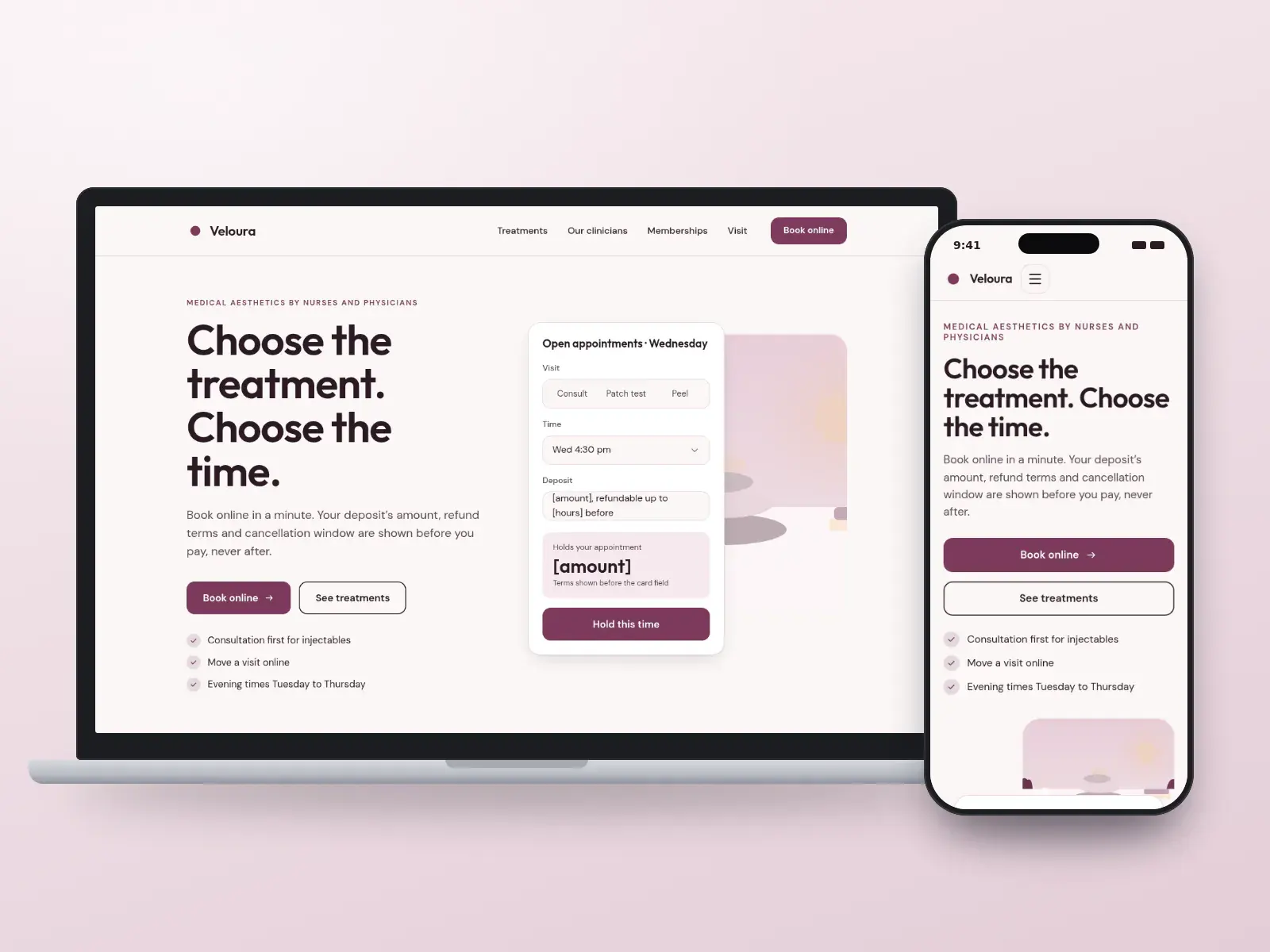
Concept website
Veloura Medical Aesthetics
Clinics that lose bookings to slow phone replies
Concept design. The business is fictional.
- Tool-first
- Friendly
Local website: yours after 12 payments, or $1,500 upfront
Concept website
Solenne Skin & Laser
Laser-led clinics focused on skin texture and tone
Concept design. The business is fictional.
- Editorial
- Minimal
Local website: yours after 12 payments, or $1,500 upfront
Concept website
Arden Medical Aesthetics
Clinics that compete on who does the injecting
Concept design. The business is fictional.
- Dark
- Bold
Local website: yours after 12 payments, or $1,500 upfront
Concept website
Lumea Skin Club
Clinics with recurring facial and peel clients
Concept design. The business is fictional.
- Playful
- Friendly
Local website: yours after 12 payments, or $1,500 upfront
Concept website
Coastline Aesthetics
Clinic groups across several neighbourhoods
Concept design. The business is fictional.
- Map-led
- Minimal
Growth website: yours after 12 payments, or $4,000 upfront
Concept website
Atelier Noor
Physician-owned clinics with a premium, unhurried style
Concept design. The business is fictional.
- Luxury
- Dark
Local website: yours after 12 payments, or $1,500 upfront
Concept website
Corvina Skin Clinic
Nurse-practitioner-led clinics
Concept design. The business is fictional.
- Friendly
- Bold
Local website: yours after 12 payments, or $1,500 upfront
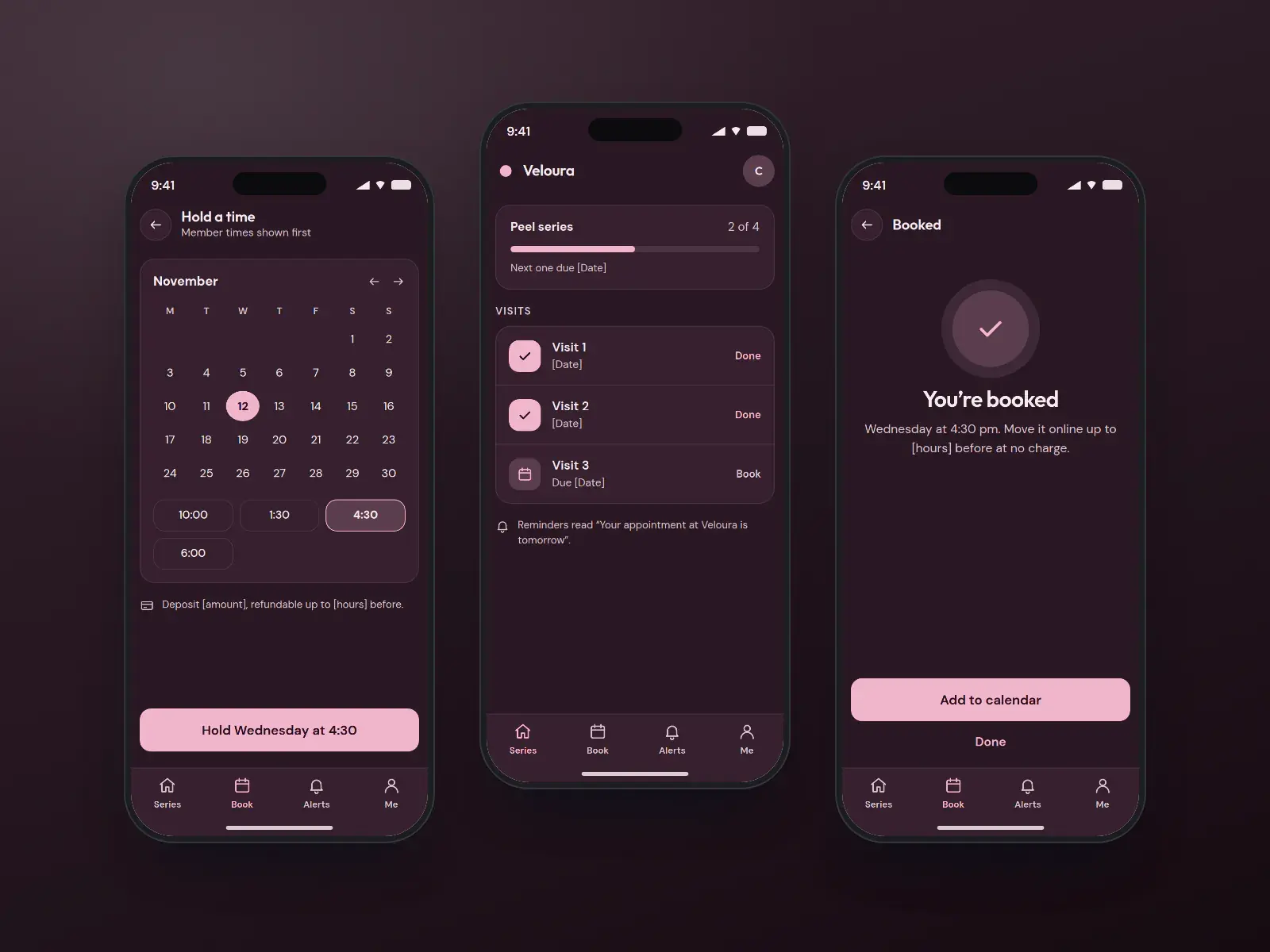
Concept app
Veloura rebook app
Clients on a treatment series
Concept design. The business is fictional.
- Dark
- Friendly
Quoted per project after a call
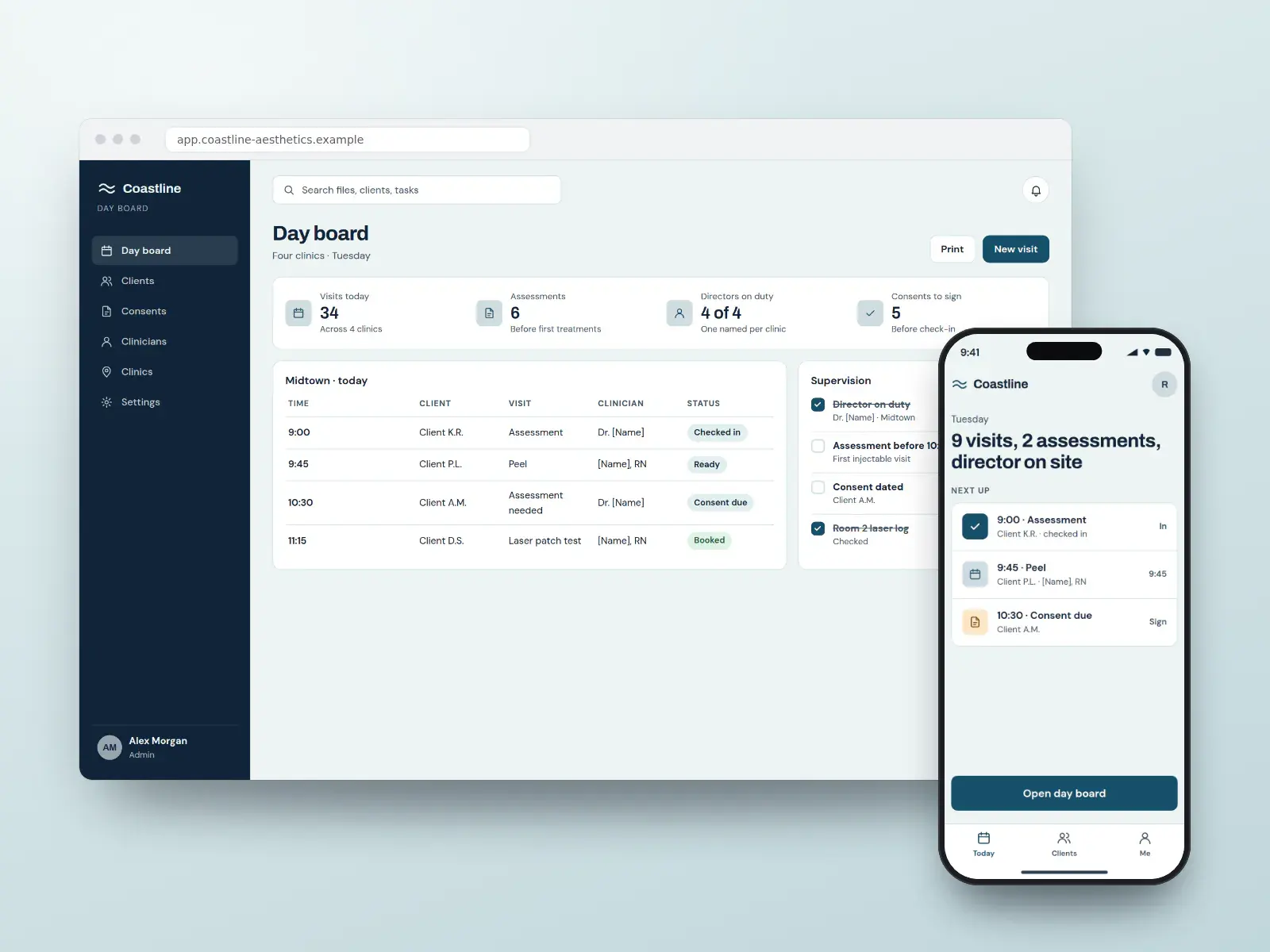
Concept software
Coastline clinic console
Front desks and medical directors across several clinics
Concept design. The business is fictional.
- Data-led
- Corporate
Quoted per project after a call
Pay monthly, own it
High-converting websites from $150/month
Pick a design, add your brand, content and photos, and launch. Yours after 12 payments, with SEO built in from day one.
- Local website
- $150/monthUp to 25 pages · yours after 12 payments, or $1,500 upfront
- Growth website
- $400/monthUp to 100 pages · yours after 12 payments, or $4,000 upfront
Built in
What every med spa website includes
Booking with deposits clients understand
Treatments booked online through the tool you already use where it offers an integration, with the deposit amount, refund terms and cancellation window shown before payment. Card fields are hosted by the payment provider, so card data never touches your site.
Medical team pages that name names
A page for the medical director and one for each injector, with their registered title and registration number placeholder, written so a client can check them on the regulator’s register. Supervision is described clinic by clinic, never as a group-wide promise.
Treatment pages inside drug-ad rules
Injectable pages describe the consultation, the assessment and the clinician, and use class names such as neuromodulator or dermal filler. Never a brand, a benefit claim or an injectable before-and-after in Canada; device and skin treatments carry their own consented galleries.
Memberships with clear renewals
Plans are joined with a ticked consent to the renewal terms, paused and cancelled online, and every renewal is preceded by a reminder. California’s automatic-renewal law, tightened from July 2025, and the federal ROSCA set the floor in the US; Ontario’s consumer rules are checked for Canadian plans.
Client data treated as health data
Booking answers, skin history and photos stay out of ad platforms. A cash-only clinic may sit outside HIPAA yet inside Washington’s My Health My Data Act or FTC rules, so the site ships with a consumer health data policy and opt-in consent where they apply.
Aftercare and complications, written down
Every treatment page links to its aftercare sheet and says who to call after hours if something looks wrong. The complication contact is a clinician, and the page says how quickly the clinic answers.
Reviews that would pass an FTC look
Review requests go to every client after their visit, with no discount for a good rating and no filtering of unhappy clients. Staff never post reviews, and replies never mention the treatment a client had.
Must-have pages
The pages every med spa website needs
Each page answers a question people ask before they book, and each one can rank for that question on its own.
Book a consultation
Consultation and treatment times, the deposit and its refund window on the same screen, and a confirmation that names the clinic, not the treatment.
Medical director and clinicians
Each injector and the medical director with their registered title and number, so a client can look them up on the regulator’s register before booking.
A page for each treatment
Laser, peels, microneedling and injectable consultations, each saying who performs it, how many sessions are usual, downtime, and the risks discussed at assessment.
Fees, deposits and payment
How fees are set, what the deposit holds, and a plain note that cosmetic treatment is paid by the client, since health plans rarely cover it.
Memberships and their terms
What a plan includes, when it renews, how the reminder arrives, and the online route to pause or cancel.
Aftercare and complications
Aftercare by treatment and the clinician to call after hours, so a worried client reaches a nurse or physician rather than a voicemail.
Accessibility and getting here
Step-free entry, treatment-room access, parking and transit, plus an accessibility statement and a contact for adjustments.
Privacy and consumer health data
What booking and skin-history forms collect, who receives it, and, where Washington’s law reaches the clinic, a separate consumer health data policy.
Search, AI answers and maps
How clients search for med spas, and how your site answers
Med spa clients mostly search on a phone, often in the evening, and compare two or three clinics before they book anything. The click goes to the clinic that shows who treats, how close it is, and what a first consultation costs and involves, without a phone call.
How clients search
“Med spa near me” and “laser hair removal near me”
The map pack decides it: a profile in the right category, treatments listed as services, and opening hours that match the site.
“Nurse injector or doctor?”
A clinician page with registered titles, the medical director’s name and when an assessment happens answers it better than any slogan.
“How many laser sessions do I need?” and “microneedling downtime”
Treatment pages that open with sessions, downtime and aftercare in two sentences win the snippet and the AI answer.
“Med spa membership worth it” and “cancel med spa membership”
A terms page showing renewal dates, reminders and online cancellation reassures people before they join.
Brand-name searches for injectables
In Canada the site cannot chase these with drug names, so it ranks on consultation, clinician and neighbourhood pages instead.
What we build for search, AI answers and maps
- 01
Business Profile in the right category
Primary category “Medical spa”, with secondary categories such as “Skin care clinic” where they fit; services named without product brands, and hours matching the site.
- 02
Structured data that matches the clinic
MedicalClinic markup with address, hours and the medical director as a person with credentials, plus FAQ and breadcrumb markup; no rating or review markup about the clinic.
- 03
Answers assistants can quote
Each treatment page starts with who performs it, how many sessions, downtime and when results are assessed, written as questions clients actually ask.
- 04
One set of facts everywhere
Clinic name, address, hours and each clinician’s registered title kept identical across the profile, directories and site, matching the regulator’s register.
- 05
Reviews asked of every client
One request after each visit to every client, no reward for a rating, no filtering, and replies that never mention a treatment.
- 06
Monthly reporting
Consultations and calls from search, treatment pages gaining or losing ground, and profile actions, reported each month.
No one can promise a ranking or a place in an AI answer. We build the pages, data and profile that search engines and assistants read, and report what changes.
Compliance
The rules for med spas, handled in the design
A medical spa sits under drug-advertising law, the rules on who may inject and supervise, consumer-review law and health-data privacy. Here is what each asks of a clinic site, and how every design handles it.
Sources gathered October 1, 2026. This is how our designs handle these rules, not legal advice: rules change and differ by province and state, so your medical director, the relevant college or medical board, or your lawyer has the final word, and you approve every page before it goes live.
- Canada
Prescription injectables: name, price and quantity
Under Food and Drug Regulations C.01.044 a public ad for a prescription drug may state only its name, price and quantity. Health Canada’s guidance names before-and-after photos, procedure videos and benefit testimonials tied to the drug as going beyond that. The designs market the clinician and the consultation, name no injectable brand and show no injectable results.
- Ontario
Delegation and the medical director
Injections are controlled acts. CPSO’s updated Professional Obligations on delegation (2026) expect the physician to assess a new patient before delegating, or within two business days, and to be on site unless the risk is low, staying accountable for the care. The designs name the responsible physician and each injector, and claim no supervision the clinic cannot show.
- Ontario
Physician advertising: no testimonials, careful photos
CPSO’s advertising policy bars testimonials. Before-and-after photos are allowed only with the patient’s specific consent, an outcome that can typically be expected, the same lighting and pose, and only on the clinic’s own site or unpromoted social pages, never in paid or unsolicited ads. Injectable results stay off the site anyway under Health Canada’s rule.
- US · California
Who may inject or use a laser
The Medical Board of California’s med spa guidance says only physicians, and registered nurses, nurse practitioners or physician assistants under physician supervision, may inject or fire an aesthetic laser, never estheticians or medical assistants. Other states set their own ownership and supervision rules, so each design names the medical director and treating clinicians truthfully for the clinic’s state.
- US
Health claims need evidence
The FTC’s health products compliance guidance says claims about a treatment’s effect need competent and reliable scientific evidence, and that a testimonial or expert opinion does not supply it. Treatment pages on these designs describe what a session involves and its downtime, not promised outcomes, and leave efficacy to the consultation.
- US
Fake reviews and suppressed complaints
The FTC’s Consumer Review and Testimonial Rule (16 CFR Part 465, in force since October 2024) bans fake or AI-written reviews, reviews bought for a positive rating, and suppressing negative ones, with civil penalties per violation. Review requests on these designs go to every client, unconditionally, and every gallery pair says results vary.
- US · California
Memberships that renew automatically
For skin plans sold to California clients, the state’s renewal statute (changed by AB 2863 for contracts from July 2025) wants affirmative consent to the terms, a yearly reminder, and a way out online no harder than joining. A federal click-to-cancel rule was vacated in July 2025 and is only at the proposal stage again, so ROSCA and state statutes govern. Membership pages follow the strictest.
- US · Washington
Consumer health data outside HIPAA
Washington’s My Health My Data Act covers consumer health data held by businesses HIPAA does not reach, which can include a cash-only clinic’s booking and skin history. It asks for a separate health data privacy policy and consent before collecting or sharing, and gives consumers a private right of action. For Washington clients the site carries that policy and keeps pixels off booking.
Everything for med spas
Websites, apps, branding and SEO for med spas
Websites
Med spas websites built on the designs above, fast and set up for search.
From $150/month
Apps
For clinics with returning clients: an app that books the next session at the right interval and keeps aftercare in the client’s pocket, not the clinic’s phone line.
Quoted per project
Apps for med spasBranding
A med spa brand sits between beauty and medicine, and the name and look have to signal the medical side without implying a physician who is not there.
Quoted per project
Branding for med spasSEO and leads
Ongoing SEO that checks your site every week and fixes what is safe to fix, for more treatment bookings and consultations.
From $149/month
SEO plans and prices
Pricing
What a med spa website costs
The price of a med spa website is the same as any website we build: pay upfront and save, or spread it over 12 months.
Local website
$150/month × 12
or $1,500 upfront. Yours after the 12th payment.
- Up to 25 pages
- Any design on this page
- Technical SEO at launch
- Hosting and care $29/month
Growth website
$400/month × 12
or $4,000 upfront. Yours after the 12th payment.
- Up to about 100 pages
- Teams, offices and more integrations
- Planned with an advisor
- Hosting and care $49/month
SEO plans
$149/month
Local $149 · Growth $399
- Checks your site every week and fixes what is safe to fix
- New pages every month
- 7-day trial
Prices in US dollars. How payments, hosting and ownership work.
How it works
How your med spa website goes live
- 01
Pick a design
Choose a concept, or ask for another. Tell us your treatments, booking tool, deposit policy and whether you sell memberships.
- 02
Send your details
The medical director and each clinician’s registered title, clinic addresses, and any skin-treatment gallery pairs with consent forms.
- 03
Rules and privacy
We check treatment wording against drug-ad rules, set booking without ad pixels, and you approve every page.
- 04
Launch and grow
Redirects in place, your Google profile updated, and SEO for each treatment and clinic added after launch.
Pick my design
See your website before you pay for it
Choose a design and tell us about your business. An advisor emails you to plan a preview with your name, your colours and your details, and the price options. Nothing is charged until you decide.
- 1An advisor replies by email
- 2We plan your preview and scope
- 3You decide, with every price in writing
Questions
Med spas: common questions
- How much does a med spa website cost?
- A med spa website of up to 25 pages is $1,500 paid upfront, or $150 a month for 12 months, and it is yours after the 12th payment. A larger site of up to about 100 pages is $4,000, or $400 a month. Hosting and care is $29 or $49 a month. Prices are in US dollars.
- Can our website name the injectable brands we use?
- In Canada, a public ad for a prescription drug may give only its name, price and quantity, and Health Canada flags photos, videos and benefit claims around it. The safer route, and the one these designs take, is to market the clinician and the consultation, use class names such as neuromodulator, and discuss products in person.US rules differ by state and by trademark owner; we follow your medical director’s and lawyer’s position for your state.
- Can clients pay a deposit when they book online?
- Yes. The booking flow shows the deposit amount, whether it is refundable and the cancellation window before the client enters a card, and the card fields are hosted by your payment provider. Clear terms at the point of payment are what prevent most deposit disputes, so the same terms also appear in the confirmation.
- Can we show before-and-after photos?
- For laser, peels and other skin treatments, yes, with each client’s written consent, matching light and angle, the procedure named, and a line that results vary. For prescription injectables in Canada, no: Health Canada treats before-and-after images tied to the drug as advertising beyond name, price and quantity.In Ontario, CPSO also keeps such photos to the clinic’s own site and unpromoted social pages. In California, Business and Professions Code §651 asks for comparable photos, the procedure named and a statement that results may not occur for everyone, and the FTC expects results shown to be typical.
- Does HIPAA apply to a med spa website?
- It depends on whether the clinic bills health insurance electronically; many cash-only med spas are not HIPAA covered entities. That does not free the data: Washington’s My Health My Data Act and FTC rules can apply instead. The site keeps ad pixels off booking and intake either way, and ships with a consumer health data policy where needed.
- Can clients join and cancel memberships online?
- Yes. Clients tick to accept the renewal terms before they join, get a reminder before each renewal, and cancel online the same way they signed up. California’s automatic-renewal law, tightened from July 2025, requires that; the FTC’s federal click-to-cancel rule was struck down in 2025, but ROSCA still applies. We word terms for the states and provinces you serve.
- What should a med spa website include?
- Online booking with the deposit and cancellation terms shown before payment, a page naming the medical director and each injector with their registered title, one page per treatment covering sessions and downtime, aftercare with an after-hours clinician contact, membership terms, accessibility details and a privacy notice. In Canada, injectable pages describe the consultation, not the drug.
- How do med spas get more clients from their website?
- Most new clients compare clinics on a phone, so the clinic that answers “who treats me, what does a consultation involve and when can I come in” on one screen gets the booking. A Business Profile in the Medical spa category, treatment pages that answer session and downtime questions, and a review request sent to every client do the rest.
- Can a med spa contact form ask about medical history?
- No. A basic contact form should take a name, a way to reply and the reason for getting in touch, and should say “please don’t include health details here”. Medical history, medications and skin photos belong in the secure intake form sent after booking, which is encrypted, kept off ad pixels and covered by your vendor agreement or consumer health data policy.
- Will my med spa website rank on Google?
- It launches with the technical SEO done: fast pages, clean structure, structured data, local pages and redirects from your old site. To keep climbing, a BOOSTD SEO plan from $149 a month runs 262 checks on your site every week, fixes what is safe to fix and gets the rest ready for your OK.No one can promise a position on Google, and we never do. Google warns businesses about anyone who does.
- Can I get one of these med spa website designs?
- Yes. Each is a complete, ready-to-launch website design BOOSTD made for med spas. Pick one and we make it yours, with your name, colours, photos, content and the licence or compliance details your industry expects, from $150 a month and yours after 12 payments.Approved client sites are shown with a “Client work” tag, and only with the client’s written permission.
Guides for med spas
Reading for med spas before you build
- Planned guideMed spa website checklist: deposits, medical team pages and drug-ad rulesPlanned: written with a named author and published once reviewed
- Planned guideAdvertising injectables in Canada: what a clinic website can sayPlanned: written with a named author and published once reviewed
- ReviewsHow to ask for reviews without breaking the rules
- Google profileGoogle Business Profile optimization: a field-by-field guide
More on med spa website design
- Marketing for med spas Local SEO, rebooking and review marketing for aesthetic clinics.
- Asking every client for a review
- Websites for dermatologists Medical and cosmetic skin care led by a physician specialist.
- Websites for plastic surgeons
- Websites for day spas Relaxation and skin care with no medical treatments.
- A quote for a med spa with many offices More locations than a plan covers? Tell us about the network.
Free, about a minute, nothing changes on your site
Start with a free checkup of your current site
See what holds your current website back across every point, free, before you choose a design.
- Free, no cardNo sign-up to see your preview.
- Read-onlyNothing changes on your website.
- 90-day guaranteeIf you join: a better score, or your next month free.