
Websites for massage therapists
Massage therapist website design that keeps your table booked
Massage therapist website design for registered massage therapists and massage clinics that books sessions online by therapist and length, and collects a secure health history before the first treatment. Receipts carry every detail the college requires, direct billing is explained, and the draping and consent policy is in plain words, with SEO so people searching for an RMT nearby find you.
- Website from $150/month, yours after 12 payments
- SEO plans from $149/month
The short answer
What should a massage therapist’s website include?
A massage therapy website should take bookings by therapist and session length, collect a health history securely before the first treatment, explain insurance receipts and any direct billing, and publish a draping and consent policy. In Ontario, name each RMT exactly as the CMTO register shows, carry no testimonials, and issue receipts only under the treating therapist’s own registration number; in BC, RMTs may not solicit reviews.
- Price
- $1,500 upfront, or $150/month × 12
- Ownership
- Yours after 12 payments
- Hosting and care
- $29 or $49/month
- Build time
- About 4 weeks for a local site
Our designs
Our website and app designs for massage therapists
Ready-to-launch concept designs for fictional businesses: pick one and make it yours. 8 websites, 1 app and 2 software designs, each opening on a desktop and a phone, with your brand, content and photos going in. All apps and software
11 of 11 examples shown
Concept website
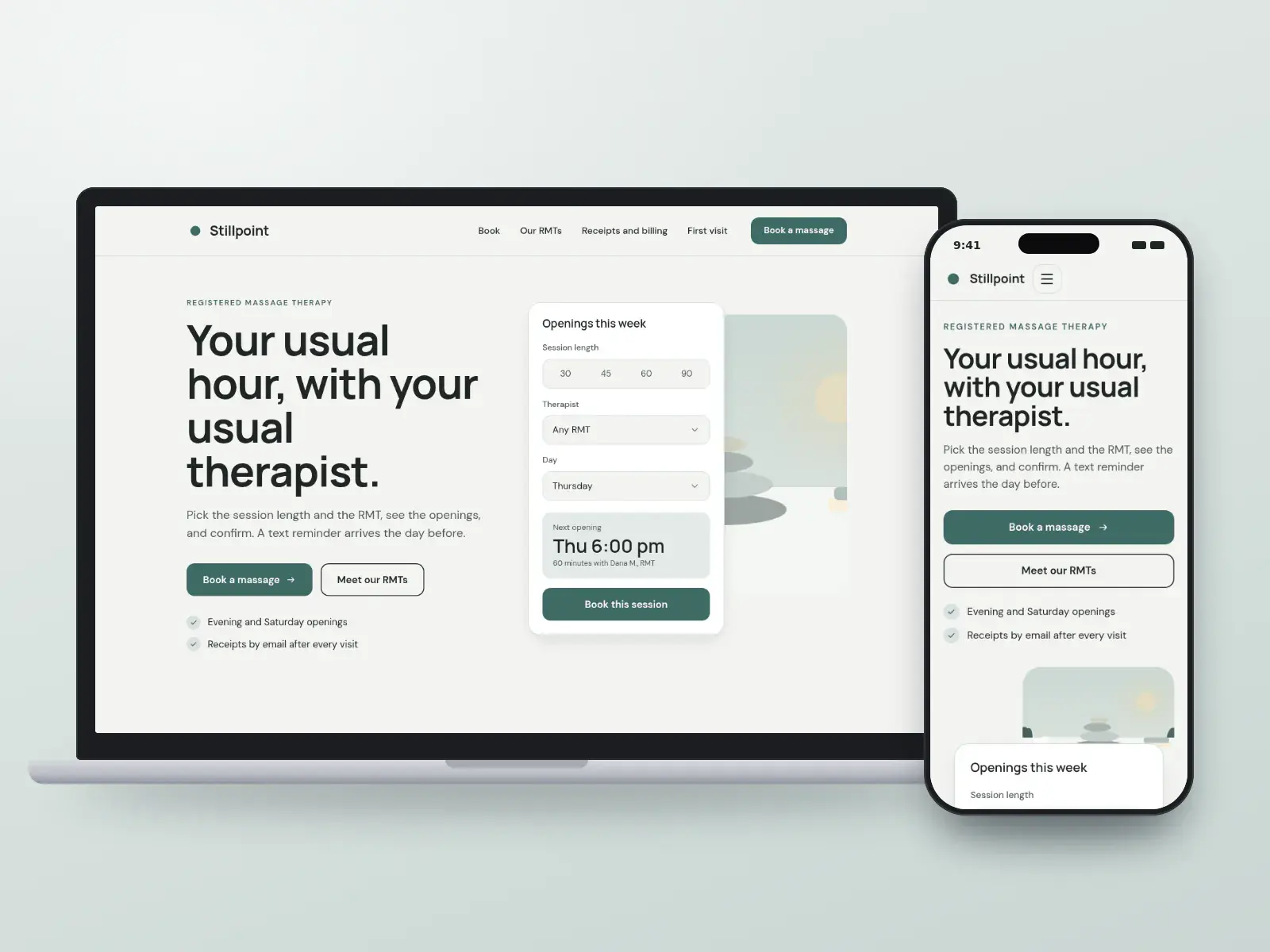
Stillpoint Massage Therapy
Clinics whose calendars are always nearly full
Concept design. The business is fictional.
- Tool-first
- Minimal
Local website: yours after 12 payments, or $1,500 upfront
Concept website
Covered Massage Clinic
Clinics whose clients claim on benefits
Concept design. The business is fictional.
- Corporate
- Tool-first
Local website: yours after 12 payments, or $1,500 upfront
Concept website
Firstlight Massage
Clinics welcoming first-time clients
Concept design. The business is fictional.
- Friendly
- Warm
Local website: yours after 12 payments, or $1,500 upfront
Concept website
Roam Mobile Massage
Mobile RMTs who treat at home
Concept design. The business is fictional.
- Map-led
- Friendly
Local website: yours after 12 payments, or $1,500 upfront
Concept website
The Linden Room
Calm, high-end clinics
Concept design. The business is fictional.
- Luxury
- Minimal
Local website: yours after 12 payments, or $1,500 upfront
Concept website
Plainspoken Massage Therapy
RMTs who want to set expectations clearly
Concept design. The business is fictional.
- Editorial
- Warm
Local website: yours after 12 payments, or $1,500 upfront
Concept website
Cradlewood Prenatal Massage
RMTs working with pregnancy and postpartum clients
Concept design. The business is fictional.
- Warm
- Friendly
Local website: yours after 12 payments, or $1,500 upfront
Concept website
Sagebrush Massage
US licensed massage therapists in solo practice
Concept design. The business is fictional.
- Dark
- Bold
Local website: yours after 12 payments, or $1,500 upfront
Concept app
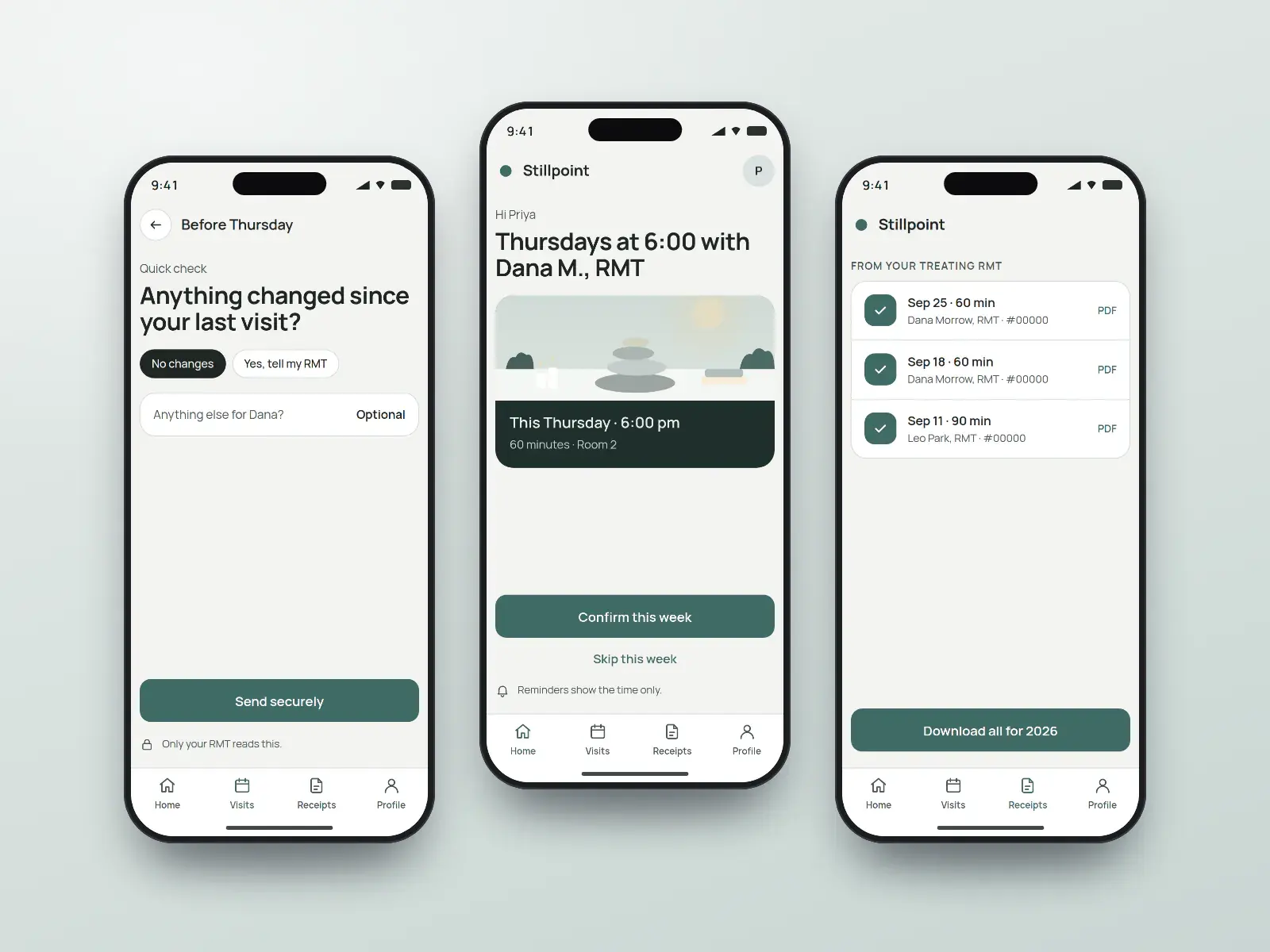
Stillpoint standing appointment app
Regular clients with a standing appointment
Concept design. The business is fictional.
- Minimal
- Friendly
Quoted per project after a call
Concept software
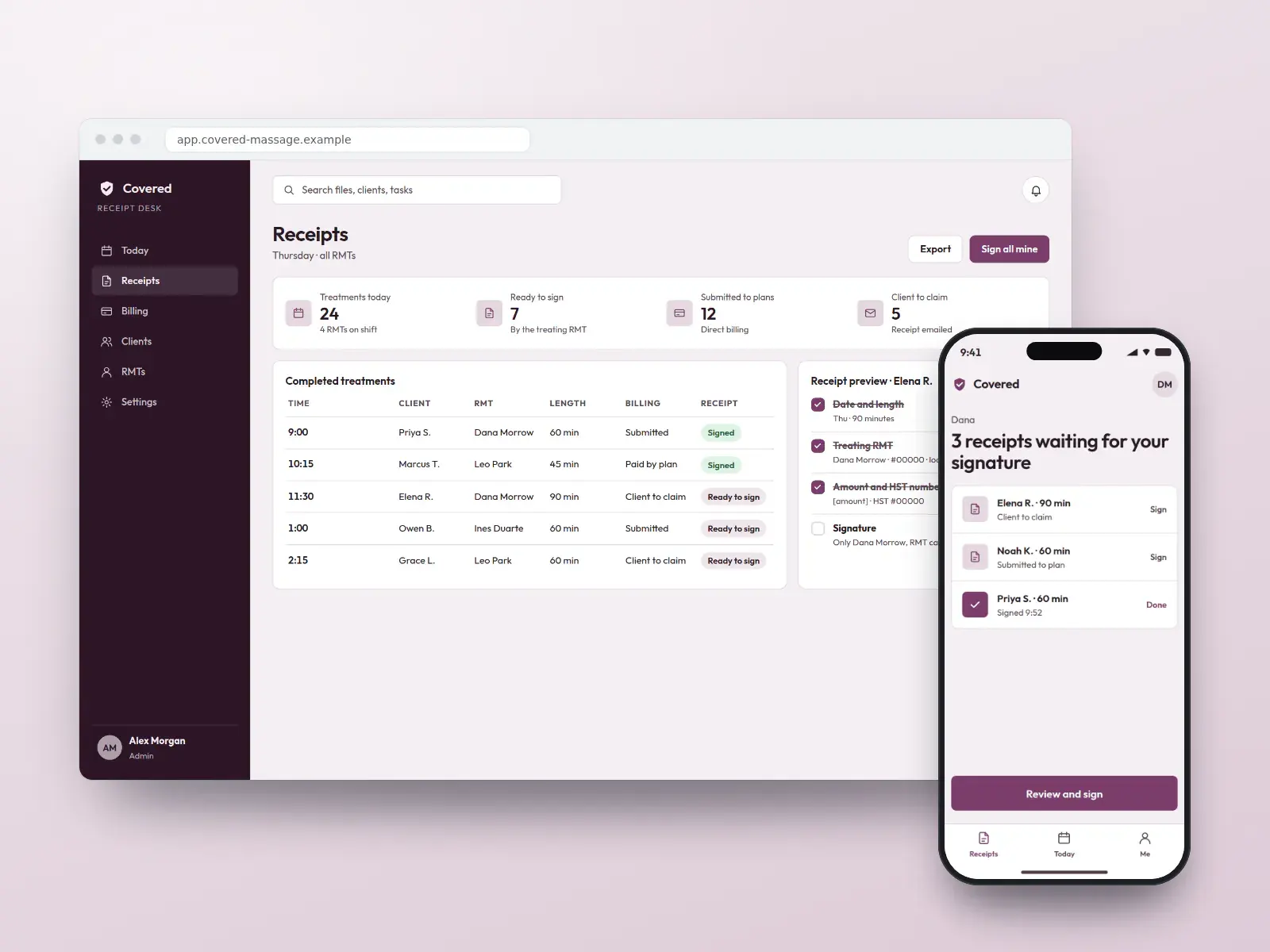
Covered receipt desk
Clinic owners issuing receipts across several RMTs
Concept design. The business is fictional.
- Data-led
- Corporate
Quoted per project after a call
Concept software
Roam route planner
Mobile RMTs planning a day of home visits
Concept design. The business is fictional.
- Map-led
- Tool-first
Quoted per project after a call
Pay monthly, own it
High-converting websites from $150/month
Pick a design, add your brand, content and photos, and launch. Yours after 12 payments, with SEO built in from day one.
- Local website
- $150/monthUp to 25 pages · yours after 12 payments, or $1,500 upfront
- Growth website
- $400/monthUp to 100 pages · yours after 12 payments, or $4,000 upfront
Built in
What every massage therapy clinic website includes
Booking by session length and RMT
Clients choose 45, 60 or 90 minutes and the therapist they prefer, through the clinic booking software you already use where it offers an integration. Late-cancellation terms appear before they confirm, not after.
Health history and consent before the table
A secure form for medications, conditions, pregnancy and areas to avoid, plus consent to treatment, saved as the client types and read by the treating RMT. It never travels by plain email.
Receipts insurers accept
Receipt templates carry the date, the client’s name, the treating RMT’s name, signature and registration number, the amount and any HST number, plus the session length insurers often ask for, issued only under that therapist’s number. Clinics that bill directly list which insurers, and say if an RMT has been delisted by one.
A draping and consent policy page
The clinic’s written policy on draping, undressing, sensitive areas and withdrawing consent, linked from booking and the intake form, so clients read it before the first visit rather than on the table.
Each RMT named as registered
Therapist pages use names exactly as they appear on the college register, show “RMT” or the state’s licence title, and list only training the therapist holds. No implied specialty.
Reviews without testimonials on the site
In Ontario, reviews stay on independent sites such as your Google profile and are never quoted on the website. In BC, RMTs may not ask patients for reviews at all since April 2026, so the BC build sends no request. Elsewhere every client gets the same request, and replies never confirm someone was treated.
Clinic or spa, said clearly
The site says whether massage is registered massage therapy with an assessment and insurance receipts, or a spa service without them, so no client books a spa treatment expecting a claimable receipt.
Must-have pages
The pages every massage therapy clinic website needs
Each page answers a question people ask before they book, and each one can rank for that question on its own.
Book a session
Session lengths, each RMT’s openings and the late-cancellation terms before confirming, so regulars rebook without a message.
First visit and health history
What happens at a first treatment, what to wear, and the secure health history and consent form to finish beforehand.
Receipts and direct billing
Which insurers you bill directly, what every receipt carries, and that receipts come only from the treating RMT. US practices say whether they give superbills, and that HSA or FSA use usually needs a letter of medical necessity.
Our RMTs
Each therapist’s name exactly as on the college register, their registration or licence number, hours and the training they hold.
Draping, consent and boundaries
What stays covered, how consent is asked for sensitive areas, and how a patient stops or changes a treatment at any point.
Home visits and service area
For mobile RMTs: the neighbourhoods served, travel fees, what the therapist brings and the space needed for the table.
Accessibility and getting here
Step-free entry, table height and transfers, washrooms, parking and transit, with an accessibility statement and a contact for help.
Privacy notice
Where health histories are stored, who reads them, and that the contact form is not the place for health details.
Search, AI answers and maps
How clients search for massage therapists, and how your site answers
People look for a massage therapist on a phone, near home or work, and many search with their benefits plan in mind: typing “RMT” rather than “massage” signals they want a receipt their insurer will take. New clients decide on openings this week, direct billing and the therapist’s registration; regulars just want their usual time.
How clients search
“RMT near me” and “massage therapist open Sunday”
Map results lead, so the profile category, hours and a booking link that shows real openings decide the click.
“RMT direct billing” with an insurer’s name
A billing page that names the insurers you bill in plain text, not a logo picture, answers it.
“Is massage covered by insurance?” and “do I need a doctor’s note for massage?”
A short receipts page explaining that coverage and notes depend on the plan wins these searches and the trust that follows.
“Prenatal massage near me” and “mobile massage therapist”
Dedicated pages for pregnancy care and home visits rank for searches a general homepage cannot.
What we build for search, AI answers and maps
- 01
Business Profile as a massage therapist
Primary category “Massage therapist”, the clinic’s real hours, each service listed, and the booking link going straight to open times.
- 02
Structured data for a clinic
MedicalBusiness markup with address and hours, each RMT as a person with their title, plus FAQ and breadcrumb markup; no review or rating markup about the clinic.
- 03
Answers patients can be quoted
Pages on receipts, first visits and session lengths open with a two-sentence answer, so search snippets and AI assistants cite the clinic.
- 04
Names that match the register
Every RMT’s name and number identical on the site, the profile and the college’s public register, which assistants and patients both check.
- 05
Reviews where the college allows them
In Ontario, reviews stay on independent sites and are never reposted; in BC, no requests are sent; in the US, every client gets the same request.
- 06
Monthly reporting
Bookings and calls from search, direct-billing page visits, and the queries bringing new clients, reported each month.
No one can promise a ranking or a place in an AI answer. We build the pages, data and profile that search engines and assistants read, and report what changes.
Compliance
The rules for massage therapists, handled in the design
Massage therapy websites answer to a massage college or state licensing board, to the rules on insurance receipts, and to health-privacy law. Here is what each asks of a clinic site, and how every design handles it.
Sources gathered October 1, 2026. This is how our designs handle these rules, not legal advice: rules change and differ by province and state, so your massage therapy college or licensing board, your privacy officer or your lawyer has the final word, and you approve every page before it goes live.
- Ontario
No testimonials, factual content, RMTs named
CMTO’s Standard of Practice on advertising and social media, in its consolidated form from 8 September 2026, bars testimonials from anyone, patients and their friends or relatives included, and asks for factual, verifiable content with the responsible RMTs named as registered. Reviews on independent sites are not testimonials, but the clinic must not repost them. The designs carry no patient quotes.
- Ontario
Protected titles and “massage therapy”
Under the Massage Therapy Act and CMTO’s guidance, only people on the college register may call themselves a massage therapist or RMT, use MT or any variation, or say they provide massage therapy. Every concept writes “Registered Massage Therapist (RMT)” beside a registration number, and places any course or diploma after that protected title, never before it.
- Ontario
What an insurance receipt must show
CMTO’s Fees and Billing standard says a receipt shows the appointment date, the patient’s name, the RMT’s name, signature and registration number, the amount and any HST number, and comes only from the RMT who gave the treatment. From September 2026 RMTs must also tell patients if an insurer has delisted them. Receipt tools never issue under another therapist’s number.
- British Columbia
No soliciting reviews or testimonials
BC’s College of Complementary Health Professionals, which regulates RMTs, put a new advertising and marketing standard in force on 1 April 2026. It tells licensees not to solicit testimonials or reviews, which includes asking a patient for a review or sending a review link. BC builds therefore carry no review request, no testimonials and no review widget.
- US · state law
LMT and the state’s own title
FSMTB lists massage as licensed in most states, with mandatory registration in Vermont, voluntary certification in California, and no state regulation in Kansas, Minnesota and Wyoming, where bills have been proposed. US designs use “LMT” or the state’s title only where the therapist holds it, and show a licence number where the state asks.
- Ontario
Health histories under PHIPA
Ontario’s health privacy act applies to health information custodians, which include registered massage therapists. Intake, booking and receipt tools that hold patient health histories are named in the clinic’s privacy notice, covered by a written agreement, and hosted in Canada where the clinic asks for it.
- US · Washington
Consumer health data outside HIPAA
Many massage businesses are not HIPAA covered entities. Washington’s My Health My Data Act reaches consumer health data such as a health history, and asks for a separate consumer health data privacy policy and consent before collecting or sharing it, with a private right of action. The designs carry that policy link and ask consent on the intake form.
Everything for massage therapists
Websites, apps, branding and SEO for massage therapists
Websites
Massage therapists websites built on the designs above, fast and set up for search.
From $150/month
Apps
For clinics whose clients come back every few weeks: an app or client area that rebooks the regular slot and keeps receipts where the client can find them.
Quoted per project
Apps for massage therapistsBranding
A massage clinic’s brand has to say clinical care or spa calm, and choose. Clients and insurers both read the difference in the name, the colours and the words.
Quoted per project
Branding for massage therapistsSEO and leads
Ongoing SEO that checks your site every week and fixes what is safe to fix, for more booked treatments and regular clients.
From $149/month
SEO plans and prices
Pricing
What a massage therapy clinic website costs
The price of a massage therapy clinic website is the same as any website we build: pay upfront and save, or spread it over 12 months.
Local website
$150/month × 12
or $1,500 upfront. Yours after the 12th payment.
- Up to 25 pages
- Any design on this page
- Technical SEO at launch
- Hosting and care $29/month
Growth website
$400/month × 12
or $4,000 upfront. Yours after the 12th payment.
- Up to about 100 pages
- Teams, offices and more integrations
- Planned with an advisor
- Hosting and care $49/month
SEO plans
$149/month
Local $149 · Growth $399
- Checks your site every week and fixes what is safe to fix
- New pages every month
- 7-day trial
Prices in US dollars. How payments, hosting and ownership work.
How it works
How your massage therapy clinic website goes live
- 01
Pick a design
Choose a concept, or ask for a new one. Tell us your session lengths, the booking software you use, and whether you bill directly.
- 02
Send your details
Logo, room photos, each RMT’s name and number as registered, your draping and cancellation policies, and your intake questions.
- 03
Receipts and privacy
We check receipt fields and therapist titles, set analytics without health data, and you approve every page.
- 04
Launch and grow
Old pages redirected, Google profile and booking links updated, and SEO to keep your table booked.
Pick my design
See your website before you pay for it
Choose a design and tell us about your business. An advisor emails you to plan a preview with your name, your colours and your details, and the price options. Nothing is charged until you decide.
- 1An advisor replies by email
- 2We plan your preview and scope
- 3You decide, with every price in writing
Questions
Massage therapists: common questions
- How much does a massage therapy website cost?
- A massage therapy clinic website of up to 25 pages is $1,500 paid upfront, or $150 a month for 12 months, and it is yours after the 12th payment. A larger site of up to about 100 pages is $4,000, or $400 a month. Hosting and care is $29 or $49 a month. Prices are in US dollars.
- Will my receipts work with clients’ insurance?
- The site and booking setup issue receipts with the fields CMTO requires: the appointment date, the client’s name, the treating RMT’s name, signature and registration number, the amount and any HST number, plus the session length insurers often ask for. A receipt must come from the RMT who gave the treatment, so the setup never issues one under another therapist’s number.Whether a plan pays is set by the insurer, so the billing page says that coverage, limits and any doctor’s note depend on the client’s plan.
- Can clients fill in their health history before the first visit?
- Yes. A secure form collects medications, conditions, pregnancy, areas to avoid and consent to treatment, saves as the client types, and goes only to the treating therapist. It never travels by plain email, and the client can update it before each visit with a short “anything changed?” check.
- Can I show client reviews on my massage therapy website?
- Not in Ontario: CMTO bars testimonials, so the site carries no client quotes and reviews stay on independent sites such as Google. In BC, since 1 April 2026, RMTs may not even ask patients for reviews. In the US, the FTC bars fake, filtered or staff-written reviews, so every client gets the same request. Replies never confirm someone was treated.
- Should my site show a draping and consent policy?
- We recommend it. A page explaining that only the treated area is uncovered, that consent is asked before sensitive areas, and that clients can stop or change anything at any time answers what first-time clients worry about. It is linked from booking and the intake form, so it is read before the session.
- What should a massage therapist website include?
- Online booking by session length and therapist, a first-visit page with a secure health history form, a receipts and direct billing page, each RMT named as on the college register with their number, a draping and consent policy, accessibility details and a privacy notice. Mobile therapists add their service area. Each page answers something clients check before booking.
- Can a spa or an unregistered therapist advertise massage therapy?
- Not in Ontario: “massage therapist”, “RMT” and “MT” are reserved for CMTO registrants, and CMTO says only registrants may claim to provide massage therapy. BC, Newfoundland and Labrador, New Brunswick and PEI also regulate the profession. A spa can offer relaxation massage, but not under those titles, and cannot issue RMT insurance receipts.
- Can clients send health information through my contact form?
- They shouldn’t, and the form says so. A basic contact form asks only for a name, a way to reply and the question, with a line asking clients not to include health details. Medications, conditions and injuries go on the secure health history form, which is encrypted and covered by your vendor agreement under PHIPA in Ontario, the applicable provincial or federal privacy law elsewhere in Canada, or HIPAA where it applies.
- Will my massage therapy clinic website rank on Google?
- It launches with the technical SEO done: fast pages, clean structure, structured data, local pages and redirects from your old site. To keep climbing, a BOOSTD SEO plan from $149 a month runs 262 checks on your site every week, fixes what is safe to fix and gets the rest ready for your OK.No one can promise a position on Google, and we never do. Google warns businesses about anyone who does.
- Can I get one of these massage therapy website designs?
- Yes. Each is a complete, ready-to-launch website design BOOSTD made for massage therapists. Pick one and we make it yours, with your name, colours, photos, content and the licence or compliance details your industry expects, from $150 a month and yours after 12 payments.Approved client sites are shown with a “Client work” tag, and only with the client’s written permission.
Guides for massage therapists
Reading for massage therapists before you build
- Planned guideMassage therapy website checklist: booking, health history, receipts and policiesPlanned: written with a named author and published once reviewed
- Planned guideInsurance receipts and direct billing for RMTs: what the website should sayPlanned: written with a named author and published once reviewed
- ReviewsHow to ask for Google reviews without breaking the rules
- Local SEOLocal SEO checklist: every step, in the right order
More on massage therapist website design
- Marketing for allied health clinics Local SEO and review marketing for massage clinics.
- Websites for physiotherapists Assessment-led clinics with direct billing and home exercise pages.
- Websites for chiropractors
- Websites for day spas Relaxation massage, packages and gift cards, without RMT receipts.
- A quote for massage therapists with several locations More locations than a plan covers? Tell us about the network.
Free, about a minute, nothing changes on your site
Start with a free checkup of your current site
See what holds your current website back across every point, free, before you choose a design.
- Free, no cardNo sign-up to see your preview.
- Read-onlyNothing changes on your website.
- 90-day guaranteeIf you join: a better score, or your next month free.