
Websites for law firms
Law firm website design for every practice and size
Websites for law firms of every size and practice: a page for each area you practise, lawyer profiles a client can actually compare, consultation booking that runs a conflict check first, a secure portal for documents, and the advertising lines your bar or law society asks for, placed where they belong.
- Website from $150/month, yours after 12 payments
- SEO plans from $149/month
The short answer
What should a law firm website include?
A law firm website should have one page per practice area, a profile for each lawyer with their bar admissions, and a way to book or request a consultation that checks for conflicts before asking for details. It needs the name of the responsible lawyer, clear notice that an enquiry is not a retainer, and secure upload instead of email for documents.
- Price
- $1,500 upfront, or $150/month × 12
- Ownership
- Yours after 12 payments
- Hosting and care
- $29 or $49/month
- Build time
- About 4 weeks for a local site
Our designs
Our website and app designs for law firms
Ready-to-launch concept designs for fictional businesses: pick one and make it yours. 8 websites, 1 app and 1 software design, each opening on a desktop and a phone, with your brand, content and photos going in. All apps and software
10 of 10 examples shown
Concept website
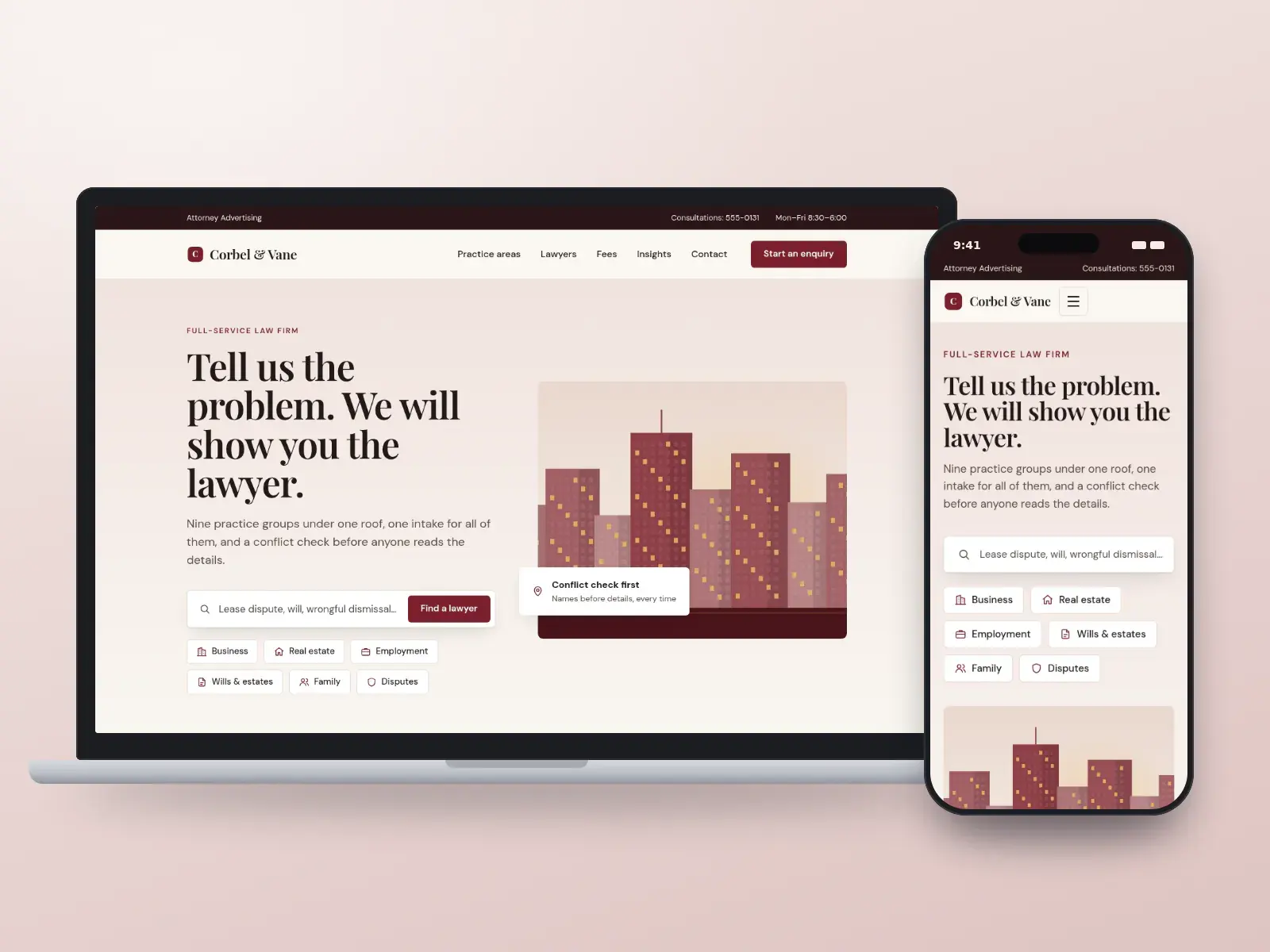
Corbel & Vane LLP
General practice and multi-practice firms
Concept design. The business is fictional.
- Corporate
- Editorial
Growth website: yours after 12 payments, or $4,000 upfront
Concept website
Ashgrove Partners
Partner-led boutiques
Concept design. The business is fictional.
- Editorial
- Luxury
Local website: yours after 12 payments, or $1,500 upfront
Concept website
Tallis Grant Law
Litigation and disputes firms
Concept design. The business is fictional.
- Dark
- Data-led
Local website: yours after 12 payments, or $1,500 upfront
Concept website
Quorum Law Office
Small firms that live on consultations
Concept design. The business is fictional.
- Tool-first
- Warm
Local website: yours after 12 payments, or $1,500 upfront
Concept website
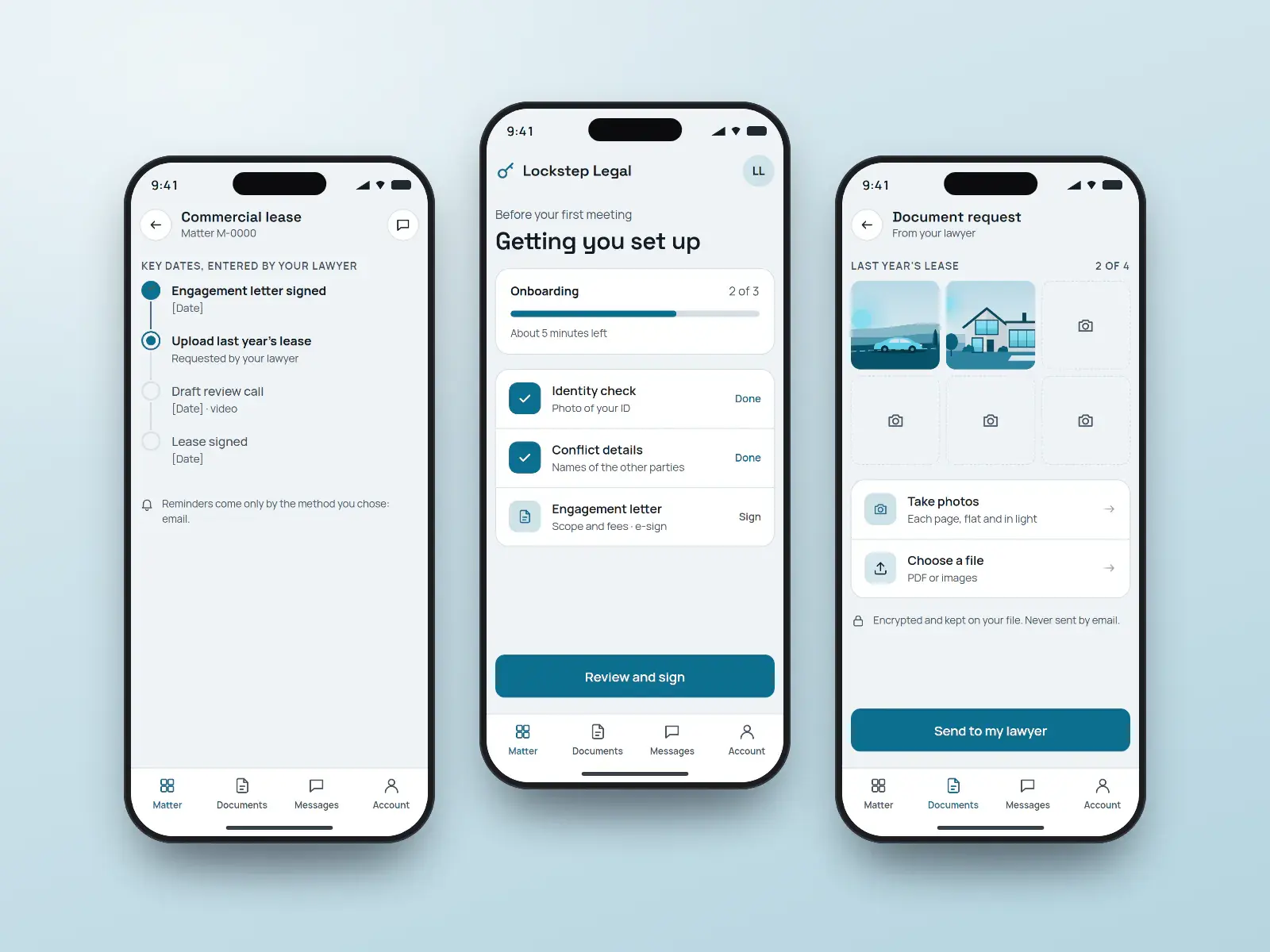
Lockstep Legal
Firms with many active client matters
Concept design. The business is fictional.
- Tool-first
- Minimal
Local website: yours after 12 payments, or $1,500 upfront
Concept website
Ponte Law Group
Firms serving newcomer and diaspora communities
Concept design. The business is fictional.
- Friendly
- Warm
Local website: yours after 12 payments, or $1,500 upfront
Concept website
Northgate Kerr LLP
Mid-size firms with several offices
Concept design. The business is fictional.
- Corporate
- Dark
Growth website: yours after 12 payments, or $4,000 upfront
Concept website
Saltmarsh & Fenn
Small-town general practice serving several towns
Concept design. The business is fictional.
- Map-led
- Warm
Growth website: yours after 12 payments, or $4,000 upfront
Concept app
Lockstep Legal client app
Current clients onboarding and following a matter
Concept design. The business is fictional.
- Minimal
- Tool-first
Quoted per project after a call
Concept software
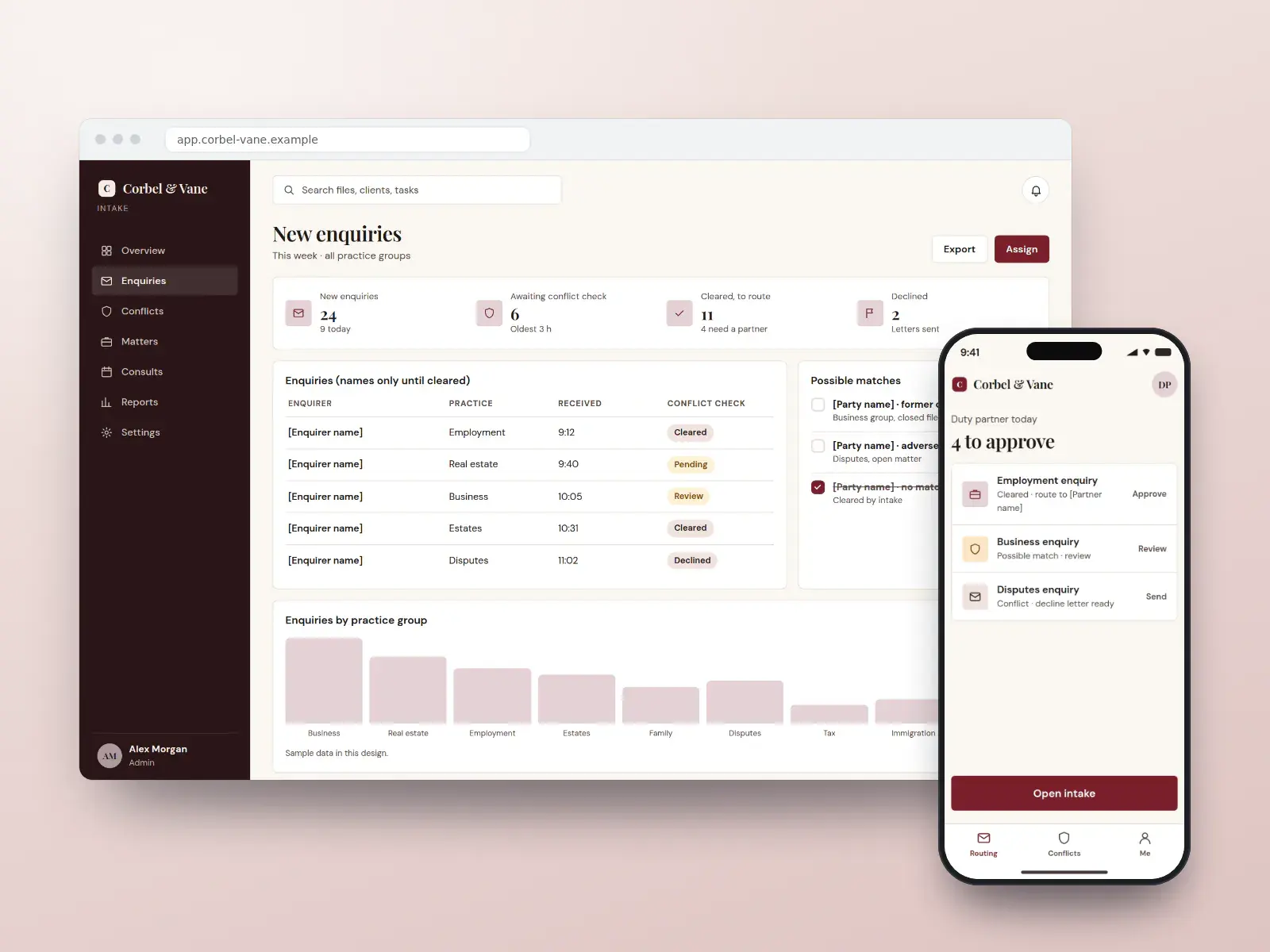
Corbel & Vane intake console
Intake teams routing enquiries and clearing conflicts
Concept design. The business is fictional.
- Data-led
- Corporate
Quoted per project after a call
Pay monthly, own it
High-converting websites from $150/month
Pick a design, add your brand, content and photos, and launch. Yours after 12 payments, with SEO built in from day one.
- Local website
- $150/monthUp to 25 pages · yours after 12 payments, or $1,500 upfront
- Growth website
- $400/monthUp to 100 pages · yours after 12 payments, or $4,000 upfront
Built in
What every law firm website includes
A page for each practice area
Each area you practise gets its own page: who handles it, what a first meeting covers, how fees are set and the questions clients ask most. Search engines and AI assistants can then match a specific legal problem to your firm.
Lawyer profiles built for comparison
Bar admissions, year of call, languages, practice groups and the kinds of matters each lawyer takes, in a consistent layout with Person structured data, so a client can choose between two partners without phoning.
Conflict check before the story
Every intake path asks for the names of the people involved first and the facts second, and tells the visitor what happens to what they send, so your firm can decline a conflicted enquiry without having read it.
Consultation booking with fees shown
Visitors pick a real open time from your calendar, see whether the first meeting is free or charged before they confirm, and get reminders by email or text that they asked for.
A secure client portal
Engagement letters signed online, identity documents and records uploaded over encryption rather than email, invoices and trust statements in one place, with two-step sign-in.
Office pages and local search
One page per office with its address, hours, lawyers and practice groups, matched to your business profiles, so “lawyer near me” searches in each city find the right office.
How clients search
The searches and pages a law firm website needs
People rarely search for a law firm by name. They type their problem: a landlord withholding a deposit, a will to update, a letter from a former employer’s lawyer. Many start on a phone, add their town or “near me”, and read the Google Business Profile and its reviews before they open a site. A referred client still looks the lawyer up, and more people now ask ChatGPT or Google’s AI Mode to explain the problem first, so plain, cited practice pages are what get read and quoted.
- “lawyer near me”
- “real estate lawyer for closing near me”
- “how much does a lawyer charge for a will”
- “employment lawyer free consultation”
- “small business lawyer for contracts”
- “do i need a lawyer for a lease dispute”
- “lawyer who speaks spanish near me”
- 01
One page per practice area
Each area gets its own page naming the lawyers who handle it, the problems it covers, what a first meeting involves and how fees are set, so a search for one legal problem lands on the answer rather than a list of everything the firm does.
- 02
Lawyer profiles
Year of call, bar admissions, languages, practice groups and the kinds of matters each lawyer accepts, laid out the same way for every lawyer, with a photo and a booking link. Clients compare people, so the profile pages often decide who gets the call.
- 03
Fees and first consultation
How the firm charges by matter type (hourly, flat, contingency), whether a first meeting is free or paid, and what the engagement letter will set out. A page like this answers the most common question before the phone rings.
- 04
Office and location pages
One page for each office with its address, hours, parking, the lawyers who work there and the courts nearby, matched to that office’s Google Business Profile so each city sees the right door.
- 05
Intake with a conflict check
An enquiry page that explains what happens to what is sent, asks for the parties’ names first and the facts later, and states that writing in does not make the visitor a client.
- 06
Client portal sign-in
A sign-in for current clients to upload documents, sign engagement letters and read messages, which keeps identity documents and drafts out of ordinary email and gives returning visitors a clear route.
- 07
Plain-language guides
Short articles answering the questions each practice hears weekly, each with the reviewing lawyer’s name and the date it was checked, which builds the expertise signals search engines look for on legal topics.
SEO, AEO and GEO
How law firms get found in Google and in AI answers
A Google Business Profile per office
Google offers categories such as Law firm, Lawyer and practice-specific ones like Estate planning attorney. Each office gets its own verified profile with the right primary category, consistent name, address and phone, and photos of the real office and team.
Structured data that fits
LegalService for each office and Person for each lawyer, with bar admissions and languages, plus FAQPage only where a page truly answers questions. Markup describes the page; it never adds review stars the firm wrote itself.
Answers AI assistants can quote
Each practice page opens with a two- or three-sentence answer to the question it targets, then the detail. Clear, attributed answers are what Google’s AI Overviews, ChatGPT and Perplexity tend to summarise and link, and they help a reader too.
Directories and bar listings
Bar and law society directories, Avvo, Justia, Lawyers.com and local chamber listings all carry the firm’s name, address and phone; keeping them identical with the website is ordinary local SEO and helps assistants match the firm to its city.
Local Services Ads where Google offers them
Google runs Local Services Ads for many legal categories in the US and Canada, with its own screening and the Google Verified badge. Eligibility is Google’s decision; the site’s practice and office pages support the application.
Compliance
The rules for law firms, handled in the design
Every lawyer’s website is lawyer advertising under the rules of their bar or law society. These are the rules that shape a firm’s name, its lawyer profiles, its intake forms and its client portal, and what each design does about them.
Sources gathered October 6, 2026. This is how our designs handle these rules, not legal advice: rules change and differ by province and state, so your bar or law society (or your firm’s ethics partner) has the final word, and you approve every page before it goes live.
- US · ABA Model Rule 7.1
Firm names and trade names
Rule 7.5 on firm names was deleted from the Model Rules in 2018; its content now sits in the comment to Rule 7.1, which allows a trade name that is not misleading and warns against names implying a link to a government agency, a non-lawyer or a lawyer not with the firm. Concepts use invented names, and your real name is checked against your state’s version.
- US · ABA Model Rule 7.2
Certification and the name on every page
Rule 7.2(c) lets a lawyer say they are certified as a specialist only when a body approved by a state authority or accredited by the ABA certified them and the communication names that body, and Rule 7.2(d) asks each communication to name at least one responsible lawyer or firm with contact details. States add their own versions: California names its Board of Legal Specialization, and New York asks for a statement that a private certifier is not a government body. Profiles show practice areas unless a certification and its body are entered, and the footer names the responsible lawyer.
- US · ABA Model Rule 7.3
Chat and text follow-up without live solicitation
Rule 7.3 bars soliciting work through live person-to-person contact, meaning in person, live telephone or real-time video or audio, when pecuniary gain is a significant motive; its comment treats chat and text that a recipient can ignore differently. Website chat opens only when the visitor starts it, and staff reply to the visitor rather than cold-calling, since some states treat texts as solicitation too.
- US · ABA Opinion 10-457
Prospective clients who write to the firm
Formal Opinion 10-457 says that a website inviting visitors to submit details about their matter can make them prospective clients under Rule 1.18, with confidentiality duties and possible conflicts. The intake forms say what will happen to the information before it is typed, and ask only for names until a conflict check clears.
- US · ABA Opinion 477R
Securing what clients send
Formal Opinion 477R asks lawyers to make reasonable efforts to prevent unauthorised access to client information, weighing its sensitivity, and says some information calls for more than ordinary email. The portal encrypts uploads in transit and at rest, uses two-step sign-in and keeps messages on the client file.
- Canada · FLSC Model Code and Ontario
“Specialist” is a protected word
Under the Federation of Law Societies’ Model Code, adopted province by province, and Ontario’s rules 4.2-1 and 4.3-1, marketing must be demonstrably true, accurate and verifiable, and the noun “specialist” is reserved for lawyers their law society has certified. A 2021 Law Society Tribunal appeal decision held that truthfully saying a firm specializes in an area is a different claim, but the Canadian designs still say a lawyer practises in or focuses on an area unless a certification is entered.
Law Society of Ontario — Rules of Professional Conduct, chapter 4
- US · FTC
Client reviews shown fairly
The FTC’s Endorsement Guides and its rule on consumer reviews and testimonials (16 CFR Part 465, in force since October 2024) bar fake or bought reviews and presenting selected testimonials as typical when they are not. Review sections show real reviews only, with the bar’s required wording where a state asks for it, and never a star score the firm wrote itself.
Everything for law firms
Websites, apps, branding and SEO for law firms
Websites
Law firms websites built on the designs above, fast and set up for search.
From $150/month
Apps
A firm with several practice groups runs on documents, signatures and deadlines. A client app or portal moves that traffic out of email and gives every client one place to look.
Quoted per project
Apps for law firmsBranding
Law firm brands are often a list of surnames that clients cannot spell or remember. A strong firm brand works on a letterhead, a court filing and a phone screen alike.
Quoted per project
Branding for law firmsSEO and leads
Ongoing SEO that checks your site every week and fixes what is safe to fix, for more consultation requests and new matters.
From $149/month
SEO plans and prices
Pricing
What a law firm website costs
The price of a law firm website is the same as any website we build: pay upfront and save, or spread it over 12 months.
Local website
$150/month × 12
or $1,500 upfront. Yours after the 12th payment.
- Up to 25 pages
- Any design on this page
- Technical SEO at launch
- Hosting and care $29/month
Growth website
$400/month × 12
or $4,000 upfront. Yours after the 12th payment.
- Up to about 100 pages
- Teams, offices and more integrations
- Planned with an advisor
- Hosting and care $49/month
SEO plans
$149/month
Local $149 · Growth $399
- Checks your site every week and fixes what is safe to fix
- New pages every month
- 7-day trial
Prices in US dollars. How payments, hosting and ownership work.
How it works
How your law firm website goes live
- 01
Pick a design
Choose one, or ask for something new. Tell us your practice groups, offices and how clients usually find you.
- 02
Send your details
Logo, lawyer photos and bios, bar admissions, the responsible lawyer, office addresses and consultation terms.
- 03
Review before launch
Your lawyers check every profile, practice page and disclaimer against your bar’s rules and ask for changes.
- 04
Launch and grow
We redirect your old pages, go live, then add practice and office pages that bring in consultations.
Pick my design
See your website before you pay for it
Choose a design and tell us about your business. An advisor emails you to plan a preview with your name, your colours and your details, and the price options. Nothing is charged until you decide.
- 1An advisor replies by email
- 2We plan your preview and scope
- 3You decide, with every price in writing
Questions
Law firms: common questions
- How much does a law firm website cost?
- A law firm website of up to 25 pages is $1,500 paid upfront, or $150 a month for 12 months, and it is yours after the 12th payment. A larger site of up to about 100 pages is $4,000, or $400 a month. Hosting and care is $29 or $49 a month. Prices are in US dollars.
- What pages does a law firm website need?
- At minimum: a home page, one page per practice area, a profile for each lawyer, an office or contact page per location, a page explaining fees and the first consultation, and a privacy page. Practice pages carry most of the search traffic, so each one names who does that work and answers the questions clients ask first.
- Can a law firm use a trade name on its website?
- In most US states and Canadian provinces, yes, if the name is not misleading. The ABA moved its firm-name rule into the comment to Model Rule 7.1 in 2018, and it warns against names that suggest a government connection or a lawyer who is not with the firm. Some states add their own conditions, so we check yours before launch.
- Does a contact form on a lawyer website create a client relationship?
- Not by itself, but it can make the sender a prospective client with confidentiality rights, as ABA Formal Opinion 10-457 explains. Our forms say what happens to the information before the visitor types, ask for the names of the people involved first so you can check conflicts, and keep the facts for after that check.
- Should our firm have one website or one per practice area?
- One website, with a strong page for each practice area, usually wins. Authority builds on one domain, lawyer profiles and reviews are shared, and you maintain one set of advertising lines. Separate sites make sense mainly when a practice serves a very different audience under a separate trade name your bar allows.
- Can lawyers use client testimonials on their website?
- In most US states and Canadian provinces, yes, with conditions. The review must be real and given with the client’s consent, must not imply that every client gets the same result, and some bars add wording: New York, for example, requires “Prior results do not guarantee a similar outcome” beside testimonials. Bought or invented reviews also break the FTC’s 2024 rule on fake reviews.
- Will my law firm website rank on Google?
- It launches with the technical SEO done: fast pages, clean structure, structured data, local pages and redirects from your old site. To keep climbing, a BOOSTD SEO plan from $149 a month runs 262 checks on your site every week, fixes what is safe to fix and gets the rest ready for your OK.No one can promise a position on Google, and we never do. Google warns businesses about anyone who does.
- Can I get one of these law firm website designs?
- Yes. Each is a complete, ready-to-launch website design BOOSTD made for law firms. Pick one and we make it yours, with your name, colours, photos, content and the licence or compliance details your industry expects, from $150 a month and yours after 12 payments.Approved client sites are shown with a “Client work” tag, and only with the client’s written permission.
Guides for law firms
Reading for law firms before you build
- Planned guideLaw firm names and trade names: what the advertising rules allowPlanned: written with a named author and published once reviewed
- Planned guideWebsite intake forms and prospective-client confidentialityPlanned: written with a named author and published once reviewed
- RedesignWebsite redesign checklist: what to decide before design starts
- MigrationWebsite migration SEO checklist for six types of move
More on law firm website design
- Immigration lawyer websites
- Marketing for law firms SEO and intake marketing for legal practices.
- Websites for personal injury lawyers
- Websites for family lawyers
- Websites for criminal defence lawyers
- A quote for law firms with several locations More locations than a plan covers? Tell us about the network.
Free, about a minute, nothing changes on your site
Start with a free checkup of your current site
See what holds your current website back across every point, free, before you choose a design.
- Free, no cardNo sign-up to see your preview.
- Read-onlyNothing changes on your website.
- 90-day guaranteeIf you join: a better score, or your next month free.