
Websites for managed service providers
MSP website design that makes trust visible before the first ticket
Websites for managed service providers, IT support firms and cybersecurity services that make a cautious buyer comfortable: plans explained without jargon and quoted per user, a support portal clients can actually find, a security assessment that starts the sales conversation, and security claims your audits and contracts can back.
- Website from $150/month, yours after 12 payments
- SEO plans from $149/month
The short answer
What should an MSP or IT services website include?
An MSP website should explain what each plan covers in plain language, show response times you commit to in contracts, and offer a free assessment or IT review as the main call to action. It needs a visible support portal link for existing clients, local service-area pages, and security claims limited to certifications and attestations you actually hold.
- Price
- $1,500 upfront, or $150/month × 12
- Ownership
- Yours after 12 payments
- Hosting and care
- $29 or $49/month
- Build time
- About 4 weeks for a local site
Our designs
Our website and app designs for managed service providers
Ready-to-launch concept designs for fictional businesses: pick one and make it yours. 7 websites, 2 apps and 1 software design, each opening on a desktop and a phone, with your brand, content and photos going in. All apps and software
10 of 10 examples shown
Concept website
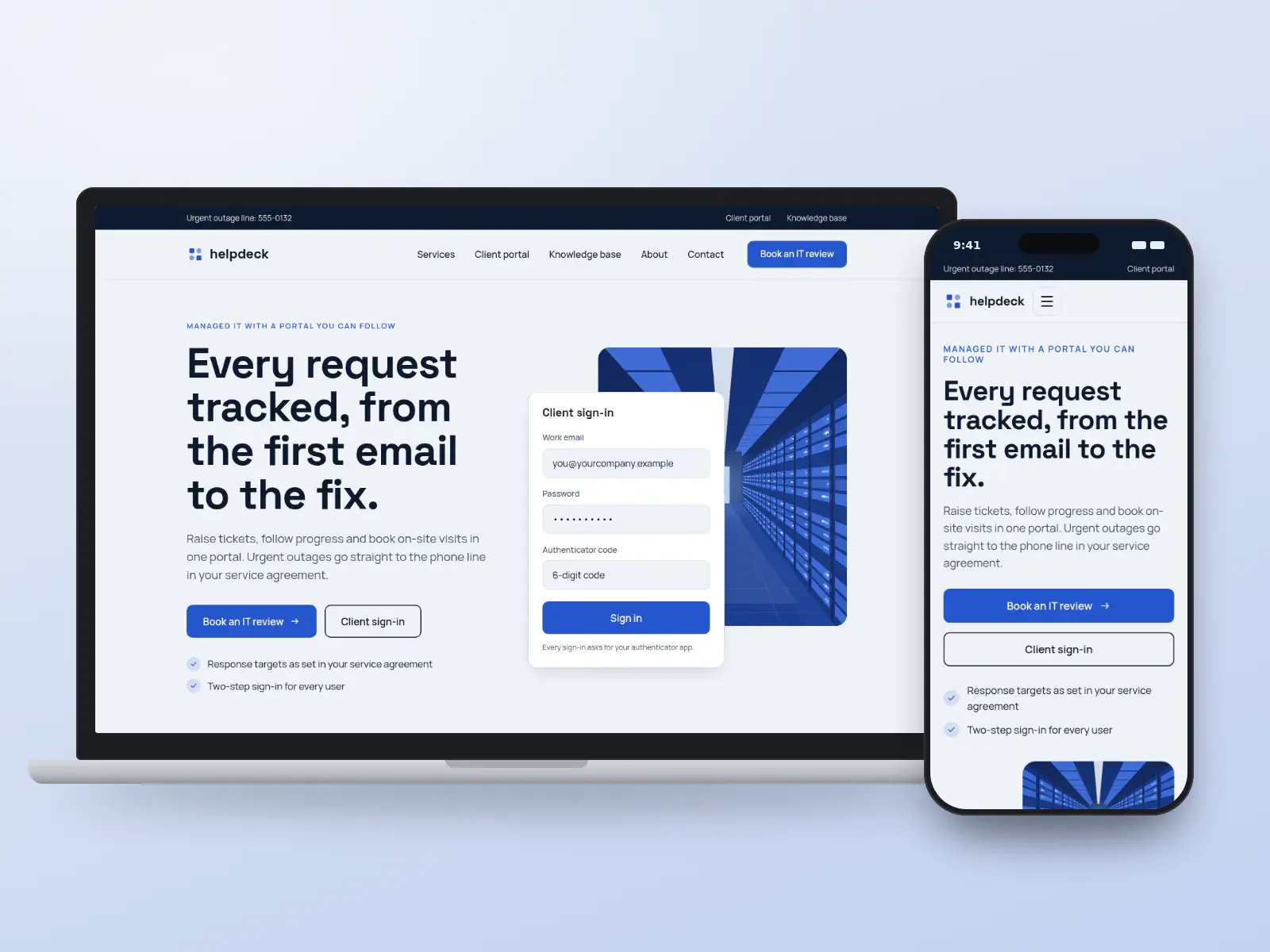
Helpdeck IT
MSPs with an active client base
Concept design. The business is fictional.
- Tool-first
- Corporate
Local website: yours after 12 payments, or $1,500 upfront
Concept website
Blackfen Security
Managed detection and response providers
Concept design. The business is fictional.
- Dark
- Data-led
Growth website: yours after 12 payments, or $4,000 upfront
Concept website
Keystone Cyber
Firms that sell through a security assessment
Concept design. The business is fictional.
- Tool-first
- Friendly
Local website: yours after 12 payments, or $1,500 upfront
Concept website
Tallbridge Managed IT
MSPs with tiered plans
Concept design. The business is fictional.
- Corporate
- Data-led
Growth website: yours after 12 payments, or $4,000 upfront
Concept website
Riverbend Tech Support
Local IT support for small offices
Concept design. The business is fictional.
- Map-led
- Friendly
Local website: yours after 12 payments, or $1,500 upfront
Concept website
Cleardesk IT
MSPs for medical, dental and legal offices
Concept design. The business is fictional.
- Editorial
- Minimal
Local website: yours after 12 payments, or $1,500 upfront
Concept website
Halfmoon IT
Small-business MSPs that quote fast
Concept design. The business is fictional.
- Bold
- Warm
Local website: yours after 12 payments, or $1,500 upfront
Concept app
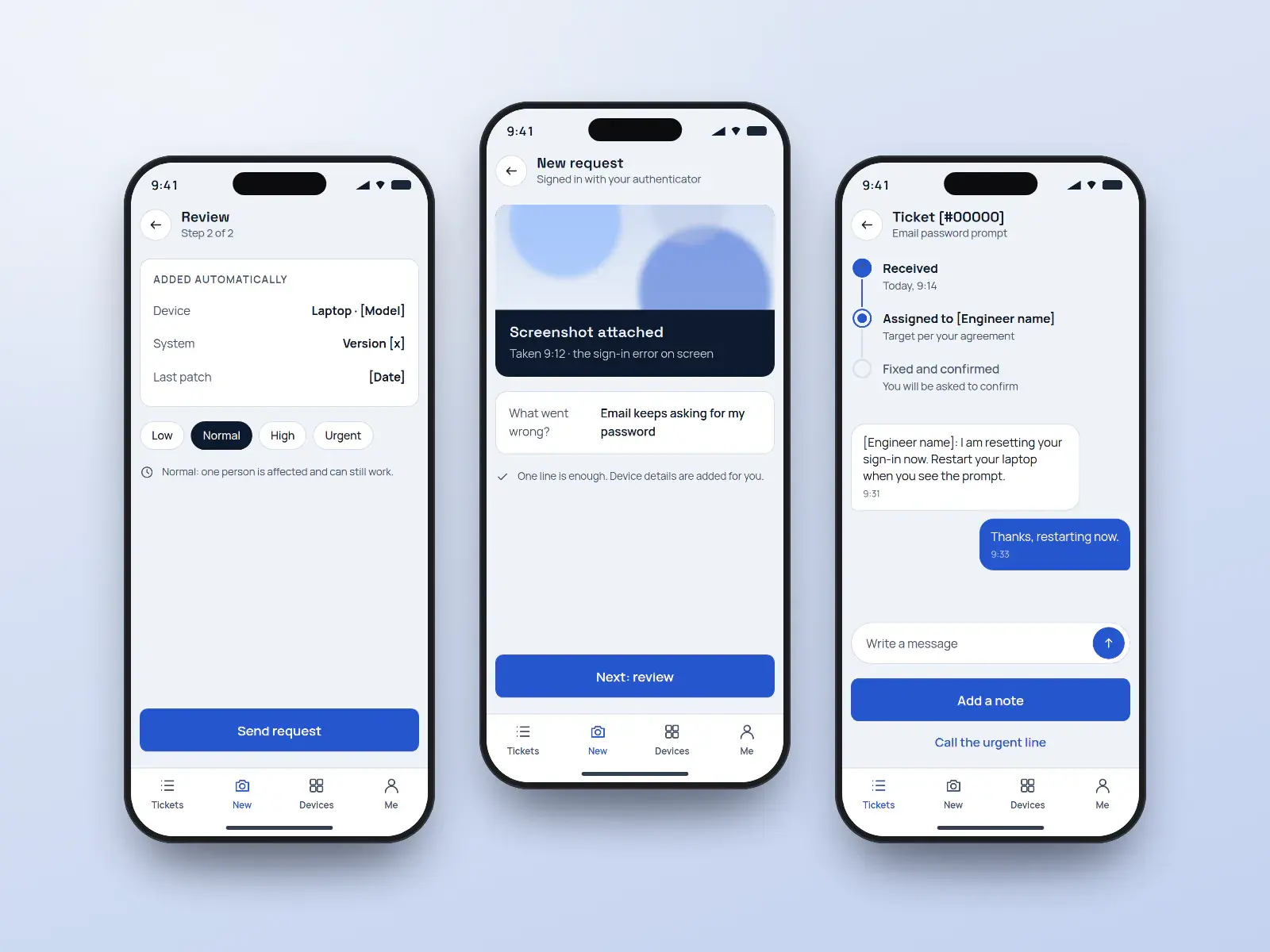
Helpdeck ticket app
Client staff raising tickets from a phone
Concept design. The business is fictional.
- Minimal
- Tool-first
Quoted per project after a call
Concept app
Halfmoon approvals app
Client managers approving IT purchases
Concept design. The business is fictional.
- Friendly
- Tool-first
Quoted per project after a call
Concept software
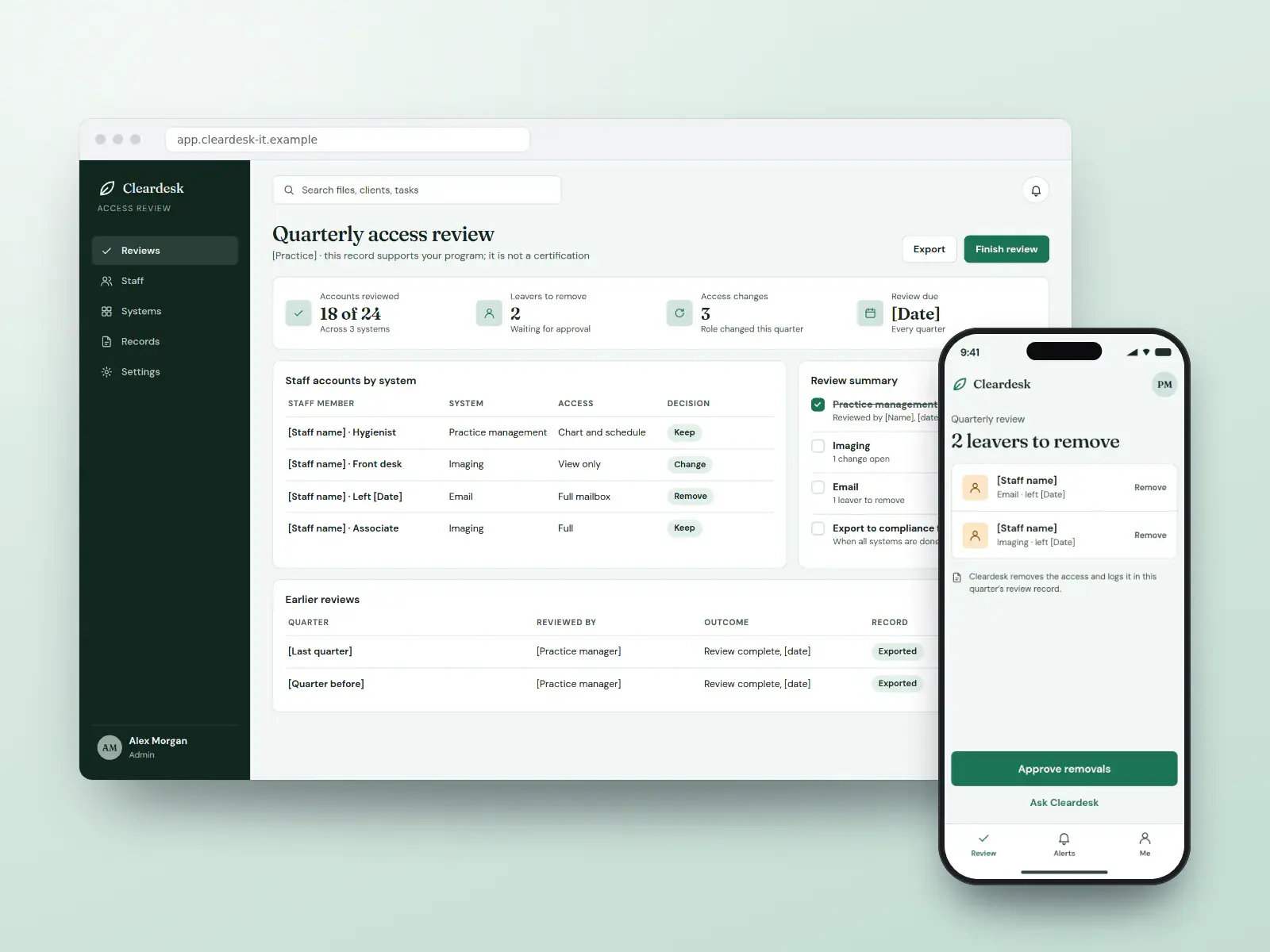
Cleardesk access review
Practice managers running quarterly access reviews
Concept design. The business is fictional.
- Data-led
- Minimal
Quoted per project after a call
Pay monthly, own it
High-converting websites from $150/month
Pick a design, add your brand, content and photos, and launch. Yours after 12 payments, with SEO built in from day one.
- Local website
- $150/monthUp to 25 pages · yours after 12 payments, or $1,500 upfront
- Growth website
- $400/monthUp to 100 pages · yours after 12 payments, or $4,000 upfront
Built in
What every MSP and IT services website includes
Plans explained, quoted per user
A comparison of what each tier includes, written for an office manager rather than an engineer, with a per-user quote request in place of a price list you have to keep updating.
A client portal link that is easy to find
A clear “Get support” route on every page for existing clients, separate from the sales path, so a locked-out user reaches the help desk and not the quote form.
A security assessment that sells
A short questionnaire on sign-ins, backups and devices that produces a request for a written review, giving your engineers context before the first conversation.
Security claims tied to evidence
SOC 2 reports, ISO 27001 certificates and CMMC status sit in fields you switch on with the issuer, scope and date, uptime appears only as the service-level target in your contracts, and claims about protection describe process, never an outcome.
Industry and city pages
A page for each sector you serve, such as dental, legal or manufacturing, and each town in your service area, so local and niche searches find you.
Incident and outage routes
An emergency number and an incident form that skip the sales queue, plus a status page link, because a breach is the moment a prospect tests whether you answer.
How clients search
The searches and pages an MSP and IT services website needs
IT services are bought in two moods. The planned purchase is an owner or office manager comparing managed IT providers before a contract renews, reading plan pages, reviews and security pages on a desktop over several visits. The urgent one is a business that is locked out, hit by ransomware or watching a server fail, searching on a phone for help today. Regulated offices add their sector to the search, defense suppliers add CMMC, and many buyers now ask an AI assistant to shortlist providers in their city first.
- “managed it services near me”
- “it support for small business”
- “msp for dental offices”
- “how much do managed it services cost per user”
- “ransomware help for a small business”
- “cmmc help for defense contractors”
- “outsourced it support toronto”
- “cybersecurity company for small business”
- 01
Plan comparison
What each tier includes and excludes, how onboarding works and how a per-user quote is built, written for the office manager who signs. It answers the cost question buyers type, without a price list that is out of date by spring.
- 02
Sector pages
Dental, legal, accounting, manufacturing, defense suppliers: one page each on the systems and duties that sector lives with, such as imaging software, client files or CMMC, stating that you support the client’s compliance work rather than certify it.
- 03
Service-area pages
Each town or district you cover, with on-site travel expectations and the remote-first approach explained. A small office searching for local IT support wants evidence that a technician can reach the door, not a generic national page.
- 04
Incident help page
An emergency number and first-hour steps for a suspected breach or outage, reachable without signing in and kept out of the sales funnel. Prospects in trouble search for exactly this, and existing clients need it when nothing else works.
- 05
Security and trust page
The attestations and certificates you hold, each with its issuer, scope and date; how client credentials are protected; the tools and subprocessors you use; and a contact for reporting vulnerabilities. Larger buyers ask for this before any proposal.
- 06
Get support
A plain route to the help desk, portal sign-in and support hours for current clients, linked from every page header. It keeps a locked-out user away from the quote form and shows prospects that requests are tracked.
SEO, AEO and GEO
How managed service providers get found in Google and in AI answers
Business Profile and local pack
A Google Business Profile with the closest category, for example computer support and services, your real service area and support hours. Reviews from clients describing a specific fix or migration carry more weight with buyers than generic praise, and they keep the local listing current.
Answers for the comparison stage
Dated pages answering what managed IT includes, what drives a per-user price and how switching providers works, with engineer bylines listing credentials actually held, plus ProfessionalService and Organization structured data for Google. Clear, dated answers in the page text are what AI Overviews and assistants can quote when a buyer asks for a shortlist; the markup itself does not earn the mention.
Partner directories you qualify for
Vendor partner locators and local business associations send referral traffic and citations, but only list where your partner status is current. Keep the business name, address and phone identical across them so search engines connect every listing to one firm.
Your own site’s hygiene
HTTPS everywhere, security headers, email authentication on your domain and a fast, accessible site. Technical buyers check these on an IT firm’s own site before they trust it with theirs, and the same work helps crawling and Core Web Vitals.
Compliance
The rules for managed service providers, handled in the design
IT and security firms are not licensed like lawyers, but their marketing is policed as advertising: security claims, certifications, trademarks and performance statements. These are the rules that shape an MSP site’s promises and badges, and what each design does about them.
Sources gathered October 6, 2026. This is how our designs handle these rules, not legal advice: rules change and differ by province and state, so your lawyer (and your auditor for any attestation) has the final word, and you approve every page before it goes live.
- US · FTC Act section 5
Security claims you can stand behind
The FTC treats misleading statements about data security as deceptive and settled with a smart-lock maker that called its product “unbreakable”. The designs describe monitoring, patching and response as process with scope set by contract, and never use “unhackable”, “fully secure”, “military-grade” or zero-breach wording.
- AICPA · SOC logo guidelines
SOC 2 is a report, shown only once issued
A SOC 2 is an attestation report a licensed CPA firm issues for a stated period, not a certification. The AICPA lets a service organisation show its SOC logo only after such a report is issued, under its logo terms. The designs say “SOC 2 Type II report available” with the period, never “SOC 2 certified”, and keep the badge off until you have the report.
AICPA & CIMA — SOC for Service Organizations logo guidelines
- ISO · certification
ISO 27001 certification names the body that issued it
ISO writes the standard but does not certify anyone or allow its logo in connection with certification; certificates come from independent certification bodies, ideally accredited ones. A firm that holds one says it is certified to ISO/IEC 27001 by the named body, with the scope and expiry, and never shows the ISO logo.
- US · DoD CMMC, 48 CFR
CMMC status stated exactly
Defense contracts have been able to require a CMMC status since November 10, 2025. In the first phase most requirements are met by self-assessment; Level 2 certification by an authorised third-party assessor is phased in from November 2026. MSPs serving defense suppliers state the level and whether it was self-assessed or certified, and say “CMMC certified” only after a certification assessment.
- US · HHS
No “HIPAA certified” claims
HHS says no standard requires a covered entity to certify Security Rule compliance and that it does not recognise private “certifications”. Healthcare pages say the MSP supports a practice’s compliance work and signs business associate agreements, and never call the firm or a client HIPAA certified.
HHS — Are we required to certify our compliance with the standards?
- US · FTC Safeguards Rule, 16 CFR 314
Safeguards Rule help, described accurately
The FTC’s Safeguards Rule requires covered financial institutions, such as tax preparers and mortgage brokers, to keep a written information security program with a qualified individual and a risk assessment. Pages for these clients describe the help an MSP can give without implying the MSP takes over the client’s legal duty.
- Canada · Competition Act s. 74.01(1)(b)
Uptime and response claims need proof
Canada’s Competition Act requires a claim about performance or effectiveness to rest on an adequate and proper test done before the claim is made. Uptime, response-time and detection figures are entered only from your measured records or contract terms, shown as service-level targets where that is what they are, and never as “100% uptime”.
Competition Bureau — Performance claims not based on an adequate and proper test
- All · trademarks
Vendor partner badges only with permission
Software and hardware vendors control how partners may use their names and logos, usually through partner program terms. The designs leave vendor badges out by default and add each one only when you confirm your partner status and the vendor’s usage rules allow it.
Everything for managed service providers
Websites, apps, branding and SEO for managed service providers
Websites
Managed service providers websites built on the designs above, fast and set up for search.
From $150/month
Apps
For an MSP the client app is the help desk in a pocket: raise a ticket with a screenshot, see when a technician is coming, and approve a purchase without a phone call.
Quoted per project
Apps for managed service providersBranding
Many IT firm brands blur together in blue gradients and padlocks. A distinctive, calm identity tells a buyer you are organised before they read a word.
Quoted per project
Branding for managed service providersSEO and leads
Ongoing SEO that checks your site every week and fixes what is safe to fix, for more IT reviews and managed service contracts.
From $149/month
SEO plans and prices
Pricing
What an MSP and IT services website costs
The price of a MSP and IT services website is the same as any website we build: pay upfront and save, or spread it over 12 months.
Local website
$150/month × 12
or $1,500 upfront. Yours after the 12th payment.
- Up to 25 pages
- Any design on this page
- Technical SEO at launch
- Hosting and care $29/month
Growth website
$400/month × 12
or $4,000 upfront. Yours after the 12th payment.
- Up to about 100 pages
- Teams, offices and more integrations
- Planned with an advisor
- Hosting and care $49/month
SEO plans
$149/month
Local $149 · Growth $399
- Checks your site every week and fixes what is safe to fix
- New pages every month
- 7-day trial
Prices in US dollars. How payments, hosting and ownership work.
How it works
How your MSP and IT services website goes live
- 01
Pick a design
Choose one, or ask for another. Tell us your plans, the sectors you serve and your service area.
- 02
Send your details
Logo, plan contents, your support portal and phone routes, and any SOC report, ISO certificate or partner status you can show.
- 03
Review before launch
You check every security claim, badge and response-time statement against your contracts and attestations.
- 04
Launch and grow
We redirect old pages, connect the portal link, go live, and build sector and city pages that bring in IT reviews.
Pick my design
See your website before you pay for it
Choose a design and tell us about your business. An advisor emails you to plan a preview with your name, your colours and your details, and the price options. Nothing is charged until you decide.
- 1An advisor replies by email
- 2We plan your preview and scope
- 3You decide, with every price in writing
Questions
Managed service providers: common questions
- How much does an MSP website cost?
- A managed IT services website of up to 25 pages is $1,500 paid upfront, or $150 a month for 12 months, and it is yours after the 12th payment. A larger site of up to about 100 pages is $4,000, or $400 a month. Hosting and care is $29 or $49 a month. Prices are in US dollars.
- Should an MSP publish its prices online?
- Most do better publishing what each plan includes and quoting per user. Prices depend on device counts, security tools and on-site needs, so a published figure is either padded or misleading. The plan comparison makes tiers easy to tell apart, and a short quote form asks for users, offices and email platform so you can reply with a written number quickly.
- Can my IT company website say we are HIPAA certified or SOC 2 compliant?
- Not “HIPAA certified”: HHS does not recognise any HIPAA certification, so say you sign business associate agreements and support clients’ Security Rule work. A SOC 2 is an attestation report, not a certification: once a CPA firm has issued yours, say you have a SOC 2 Type II report for the stated period, under the AICPA’s logo terms.ISO/IEC 27001 is different: it is a certification, issued by an independent certification body, so name that body, the scope and the expiry date.
- Can I show vendor partner logos on my MSP website?
- Only where your partner status is current and the vendor’s partner program terms allow it. Vendors set rules on how their names and logos appear. The designs leave every vendor badge out until you confirm both, and describe your skills in plain words, such as cloud email migration, which also matches what buyers search for.
- What should a cybersecurity company avoid saying on its website?
- Absolutes. Words like unhackable, fully secure or guaranteed protection are claims no provider can support, and the FTC has acted against companies that made them. Describe what you monitor, how fast your team responds under contract and what happens during an incident. Buyers who understand security trust that more.
- Can an MSP advertise uptime or response-time guarantees?
- Only what your contract actually commits to. Write uptime and response times as service-level targets, say what is measured and what happens if a target is missed, and never claim 100% uptime or a network that cannot be breached. Canadian law wants performance claims tested before they are made, and the FTC treats unsupported security claims as deceptive.
- Can we say we are CMMC certified?
- Only after a certification assessment. Defense contracts have been able to require CMMC status since November 10, 2025; in the first phase most Level 1 and Level 2 requirements are met by self-assessment, and third-party Level 2 certification phases in from November 2026. State the level and whether it was self-assessed or certified, matching your record in the Defense Department’s supplier system.
- Will my MSP and IT services website rank on Google?
- It launches with the technical SEO done: fast pages, clean structure, structured data, local pages and redirects from your old site. To keep climbing, a BOOSTD SEO plan from $149 a month runs 262 checks on your site every week, fixes what is safe to fix and gets the rest ready for your OK.No one can promise a position on Google, and we never do. Google warns businesses about anyone who does.
- Can I get one of these MSP and IT website designs?
- Yes. Each is a complete, ready-to-launch website design BOOSTD made for managed service providers. Pick one and we make it yours, with your name, colours, photos, content and the licence or compliance details your industry expects, from $150 a month and yours after 12 payments.Approved client sites are shown with a “Client work” tag, and only with the client’s written permission.
Guides for managed service providers
Reading for managed service providers before you build
- Planned guideWriting MSP security claims that hold upPlanned: written with a named author and published once reviewed
- Planned guideShowing SOC 2, ISO 27001 and partner badges the right wayPlanned: written with a named author and published once reviewed
- Local SEOLocal SEO checklist: what to do, and in what order
- HomepageWhat should be on a homepage so Google and customers get it
More on MSP website design
- Staffing agency websites
- Law firm websites for corporate and startup clients
- Marketing for IT services firms SEO and lead generation for MSPs.
- Websites for consultants
- Websites for SaaS startups
- Websites for marketing agencies
- The step-by-step local SEO checklist
- A quote for managed service providers with several locations More locations than a plan covers? Tell us about the network.
Free, about a minute, nothing changes on your site
Start with a free checkup of your current site
See what holds your current website back across every point, free, before you choose a design.
- Free, no cardNo sign-up to see your preview.
- Read-onlyNothing changes on your website.
- 90-day guaranteeIf you join: a better score, or your next month free.