
Websites for architects
Architecture firm websites built around your built work
Websites for architecture practices that let the buildings do the talking: a project archive with the photographer and collaborators credited on every image, a page for each building type you design, a plain account of the phases from feasibility to construction administration, and an enquiry form that sorts real projects from browsers.
- Website from $150/month, yours after 12 payments
- SEO plans from $149/month
The short answer
What should an architecture firm website include?
An architecture website needs a project archive organised by building type, with credits for photographers, consultants and partner firms beside each project. It should explain your phases of service, name the licensed architects and the jurisdictions they hold licences in, and offer an enquiry form that asks for site, budget range and timing so you can qualify projects before the first meeting.
- Price
- $1,500 upfront, or $150/month × 12
- Ownership
- Yours after 12 payments
- Hosting and care
- $29 or $49/month
- Build time
- About 4 weeks for a local site
Our designs
Our website and app designs for architects
Ready-to-launch concept designs for fictional businesses: pick one and make it yours. 7 websites, 2 apps and 1 software design, each opening on a desktop and a phone, with your brand, content and photos going in. All apps and software
10 of 10 examples shown
Concept website
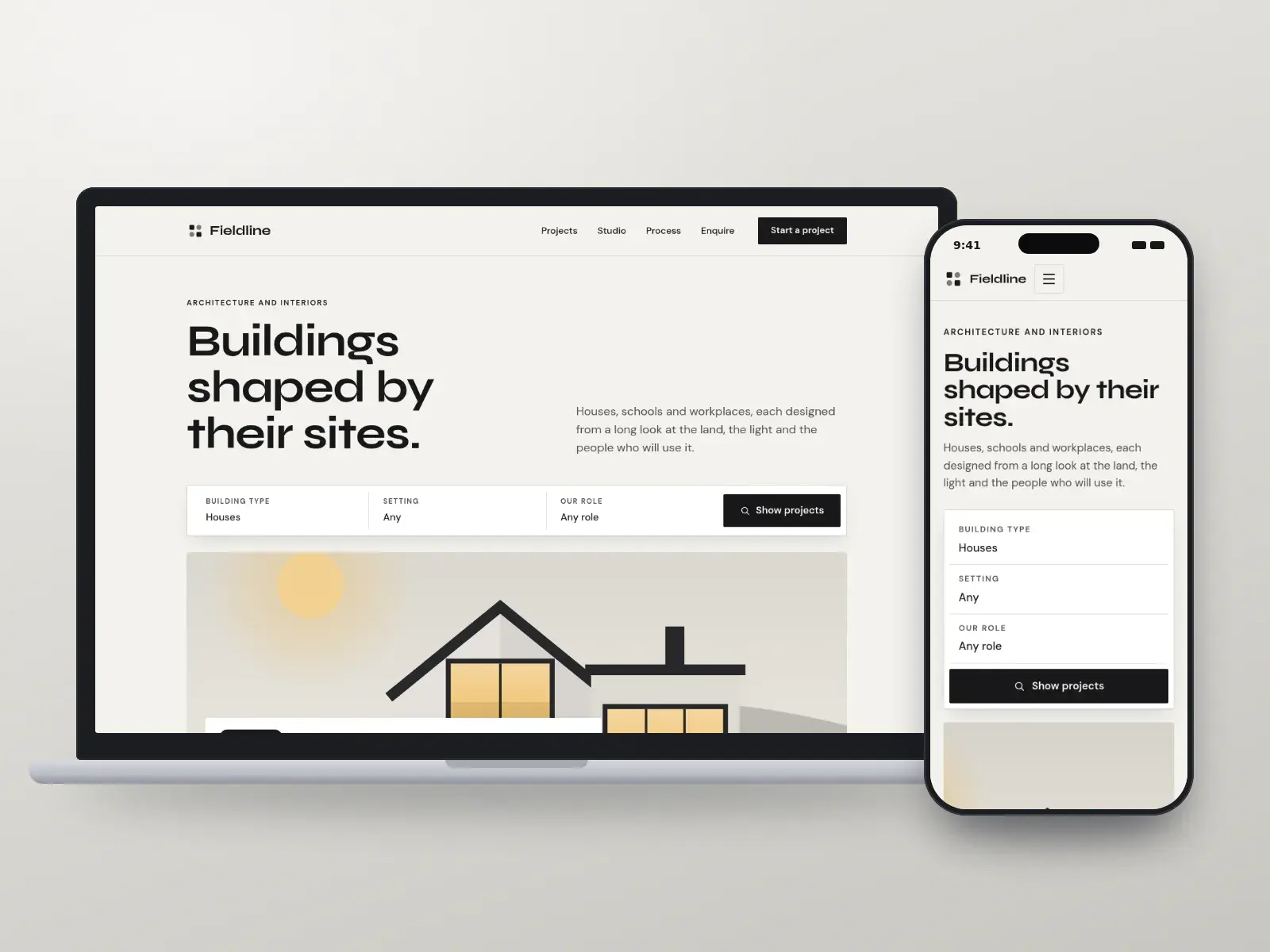
Fieldline Architects
Design-led studios with strong photography
Concept design. The business is fictional.
- Minimal
- Editorial
Local website: yours after 12 payments, or $1,500 upfront
Concept website
Quarto Studio
Small practices that write about their work
Concept design. The business is fictional.
- Editorial
- Warm
Local website: yours after 12 payments, or $1,500 upfront
Concept website
Tessellate Architecture
Mid-sized firms across building types
Concept design. The business is fictional.
- Corporate
- Minimal
Growth website: yours after 12 payments, or $4,000 upfront
Concept website
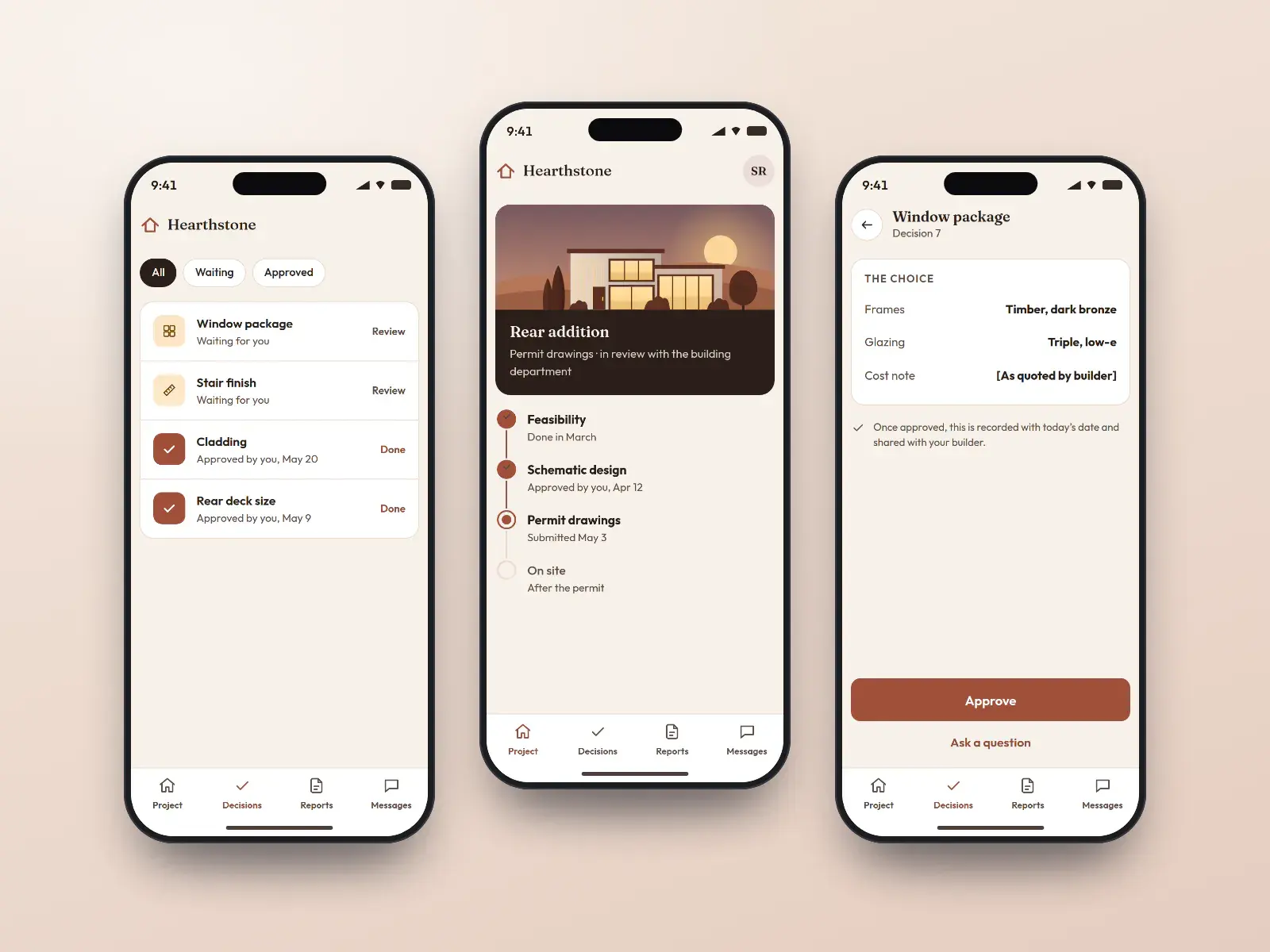
Hearthstone Residential Architects
Residential architects working with homeowners
Concept design. The business is fictional.
- Warm
- Friendly
Local website: yours after 12 payments, or $1,500 upfront
Concept website
Halvard Moss Architects
Firms bidding for public work
Concept design. The business is fictional.
- Dark
- Corporate
Growth website: yours after 12 payments, or $4,000 upfront
Concept website
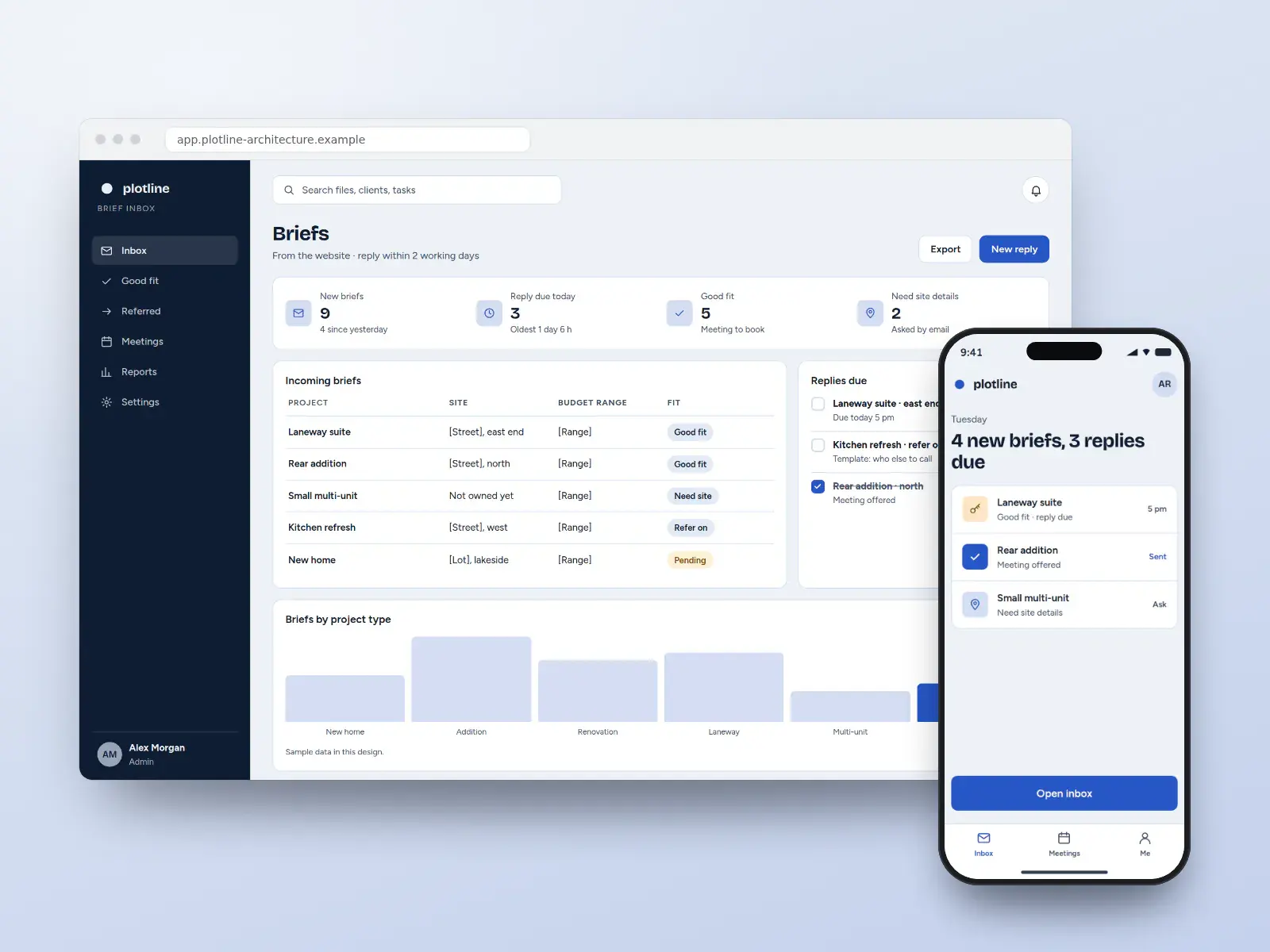
Plotline Architecture
Firms qualifying a flood of enquiries
Concept design. The business is fictional.
- Tool-first
- Friendly
Local website: yours after 12 payments, or $1,500 upfront
Concept website
Lintel & Lime Architects
Heritage and adaptive-reuse practices
Concept design. The business is fictional.
- Map-led
- Editorial
Local website: yours after 12 payments, or $1,500 upfront
Concept app
Hearthstone decision log app
Homeowners mid-project, signing off choices
Concept design. The business is fictional.
- Warm
- Minimal
Quoted per project after a call
Concept app
Halvard Moss drawing viewer app
Owners and builders reading the current set on site
Concept design. The business is fictional.
- Minimal
- Tool-first
Quoted per project after a call
Concept software
Plotline brief inbox
Studios triaging incoming project briefs
Concept design. The business is fictional.
- Data-led
- Tool-first
Quoted per project after a call
Pay monthly, own it
High-converting websites from $150/month
Pick a design, add your brand, content and photos, and launch. Yours after 12 payments, with SEO built in from day one.
- Local website
- $150/monthUp to 25 pages · yours after 12 payments, or $1,500 upfront
- Growth website
- $400/monthUp to 100 pages · yours after 12 payments, or $4,000 upfront
Built in
What every architect website includes
A project archive with credits built in
Every project page has fields for the photographer, the architect of record, partner firms and consultants, so credit is given on the image itself and a reused photo never loses its owner.
Sector and building-type pages
Custom homes, multi-unit, heritage, schools, healthcare: each sector gets its own page of projects and approvals know-how, the pages that rank for “architect for a heritage renovation in [city]”.
A phase-by-phase service page
Feasibility, schematic design, design development, permit drawings and construction administration explained in plain words, so homeowners understand what they are paying for at each stage.
An enquiry form that qualifies
Site, building type, construction budget range and hoped-for start date, asked in that order, so the studio spends first meetings on projects it can actually take.
Licensure shown correctly
Each team profile carries the person’s exact title and the jurisdictions they are licensed in, entered by you, with the practice certificate or firm registration in the footer.
Qualifications for public clients
A downloadable qualifications package and a project table filtered by owner type and delivery method, for the selection committees that shortlist on experience before fee.
How clients search
The searches and pages an architect website needs
People rarely hire an architect on impulse. A homeowner planning an addition, or a developer weighing a small apartment building, searches by building type and place: “architect for a home addition near me”, “heritage renovation architect” plus the city. Many first browse on a phone after seeing a house they admire, then come back on a laptop to study projects, read the process and check who is licensed. Referrals still lead, but the referred client looks the practice up before calling, and some now ask an AI assistant what an architect does or costs first.
- “architect for home addition near me”
- “how much does an architect cost for a house”
- “do I need an architect or a designer for a renovation”
- “heritage renovation architect”
- “architect for a laneway house”
- “residential architect [city]”
- “what does an architect do during construction”
- 01
Building-type pages
One page each for custom homes, additions, multi-unit housing, heritage work and institutional buildings, with the built projects, the approvals that type usually needs and who led it. These are the pages that answer “architect for a [building type] in [city]”.
- 02
Project pages with credits
Each project names the place, year and building type, the firm’s role as architect of record or design architect, and the partner firms, consultants and photographer. The words give search engines and assistants something to read beyond the images.
- 03
Services, phase by phase
Feasibility, schematic design, design development, permit drawings, tendering and construction administration in simple terms, with what the client receives and decides at each stage. Homeowners searching for what an architect actually does arrive here.
- 04
How fees work
Whether the practice charges a percentage of construction cost, a fixed fee or hourly rates, what moves the fee, and when it is agreed in writing. It answers the commonest question before the first call without quoting a figure that would be wrong for most projects.
- 05
People and licensure
Every person with their exact title, the jurisdictions where licensed staff are registered and their role on projects, and the practice certificate or firm registration in the footer. Homeowners and selection committees both check who is actually licensed.
- 06
A project brief form
Site, building type, construction budget range and timing, asked in that order, so the studio can tell a real project from early browsing and reply with useful next steps, or a referral, within the time it promises.
- 07
A journal of client questions
Short articles on reading a zoning by-law, permit timelines or keeping old walls. They earn links from local press and associations, give AI assistants clear passages to cite, and show prospective clients how the practice thinks.
SEO, AEO and GEO
How architects get found in Google and in AI answers
Google Business Profile as an architect
Google offers “Architect” as a business category. Use it as the primary category, list the building types you design as services, post finished projects with the photographer credited, and keep the studio name, address and phone identical on the website and every directory.
Registers and association directories
The citations that carry weight here are the licensing body’s public register, association member directories where the practice qualifies, and design publications that credit your projects with a link. Make sure every one spells the practice and principals exactly as the website does.
Structured data that fits a practice
Schema.org has no architect type, so mark the firm up as a ProfessionalService with its service area, each principal as a Person with hasCredential for the licence, and project pages with a clear name, place and date. It helps search engines connect people, places and buildings.
Answers assistants can quote
AI Overviews, ChatGPT and Perplexity lift short, direct passages. A phase page that explains construction administration in one paragraph, or a fees page that explains how architects charge, is the kind of answer they cite. Nobody can promise a citation; clear pages make one more likely.
Compliance
The rules for architects, handled in the design
The title “architect” is protected by each state and province, and credit for a building is shared by many hands. These are the rules that shape a practice’s team pages, project credits and claims, and what each design does about them.
Sources gathered October 6, 2026. This is how our designs handle these rules, not legal advice: rules change and differ by province and state, so your licensing board or association (or your professional liability insurer) has the final word, and you approve every page before it goes live.
- US · state law (e.g. California B&P Code §5536)
“Architect” belongs to licensed people
Every US state and territory licenses architects through its own board, and the title follows the licence. California’s Architects Practice Act, for example, makes it a misdemeanour for an unlicensed person to call themselves an architect, use a confusingly similar term, or advertise as one. Team profiles use titles the client confirms against each person’s licence, and unlicensed staff are described by their role, never as architects.
- Ontario · Architects Act
Title and the Certificate of Practice
Under Ontario’s Architects Act only licensed architects may use the title, and architectural services may be offered to the public only through a practice holding an OAA Certificate of Practice. Ontario versions show the certificate in the footer and do not promote services under a practice name until it is approved.
Ontario Association of Architects — Illegal practice and Act enforcement
- US · AIA Code of Ethics Rule 4.201
Claiming only your share of the credit
AIA members may not make misleading claims about their qualifications, experience or performance, and must state the scope of their responsibility for work they claim. Each project lists the firm’s actual role, architect of record or design architect, and names partner firms beside it.
- US · Copyright Office Circular 41
Designs and photographs have owners
US copyright protects an architectural work as a building, plans or drawings, and a photograph is a separate work owned by its photographer unless rights are transferred. The archive records the licence for each image and credits the photographer, and renderings of other firms’ buildings are never shown as the practice’s work.
- US · FTC 16 CFR 255 and 465
Client words that are real and disclosed
The FTC’s Endorsement Guides require testimonials to reflect a real client’s honest experience and any connection to be disclosed, and its 2024 rule bans fake or bought reviews. Client quotes appear only with written permission, and the concepts carry none until a real client supplies one.
- All
No awards or rankings you cannot show
AIA Rule 4.201 bars misleading claims about qualifications, experience or performance, and licensing boards police misleading advertising. The concepts carry no “award-winning” line; an award appears only when you supply its name, the awarding body and the year.
Everything for architects
Websites, apps, branding and SEO for architects
Websites
Architects websites built on the designs above, fast and set up for search.
From $150/month
Apps
For practices running several jobs on site at once: a client app keeps drawings, decisions and site photos in one place instead of scattered across email threads.
Quoted per project
Apps for architectsBranding
An architecture brand lives on title blocks, hoarding boards and award submissions as much as on a website. It has to sit quietly beside the work without competing with it.
Quoted per project
Branding for architectsSEO and leads
Ongoing SEO that checks your site every week and fixes what is safe to fix, for more project enquiries and commissions.
From $149/month
SEO plans and prices
Pricing
What an architect website costs
The price of a architect website is the same as any website we build: pay upfront and save, or spread it over 12 months.
Local website
$150/month × 12
or $1,500 upfront. Yours after the 12th payment.
- Up to 25 pages
- Any design on this page
- Technical SEO at launch
- Hosting and care $29/month
Growth website
$400/month × 12
or $4,000 upfront. Yours after the 12th payment.
- Up to about 100 pages
- Teams, offices and more integrations
- Planned with an advisor
- Hosting and care $49/month
SEO plans
$149/month
Local $149 · Growth $399
- Checks your site every week and fixes what is safe to fix
- New pages every month
- 7-day trial
Prices in US dollars. How payments, hosting and ownership work.
How it works
How your architect website goes live
- 01
Pick a design
Choose one, or ask for something new. Tell us the building types you design and where you are licensed.
- 02
Send your details
Project photos with their licences, credits for each project, team titles, licence numbers and your practice certificate.
- 03
Review before launch
You check every title, credit and project role against your licensing body’s rules, and ask for changes.
- 04
Launch and grow
We redirect your old project pages, go live, and add sector and city pages that bring in commissions.
Pick my design
See your website before you pay for it
Choose a design and tell us about your business. An advisor emails you to plan a preview with your name, your colours and your details, and the price options. Nothing is charged until you decide.
- 1An advisor replies by email
- 2We plan your preview and scope
- 3You decide, with every price in writing
Questions
Architects: common questions
- How much does an architecture firm website cost?
- An architecture firm website of up to 25 pages is $1,500 paid upfront, or $150 a month for 12 months, and it is yours after the 12th payment. A larger site of up to about 100 pages is $4,000, or $400 a month. Hosting and care is $29 or $49 a month. Prices are in US dollars.
- Can staff who are not licensed be called architects on our website?
- No. In every US state and Canadian province the title “architect”, and terms confusingly close to it, belong to licensed individuals, and in Ontario the practice also needs a Certificate of Practice. Team profiles show the exact title each person holds, such as intern architect or project designer, and the jurisdictions where licensed staff are registered, all confirmed by you before launch.
- Can we post professional photographs of our buildings on our site?
- Only on the terms the photographer licensed to you. A commissioned photograph usually stays the photographer’s copyright, and the licence says where you may use it and how to credit it. The project archive has a credit and licence field for every image, so a photo shared by a partner firm or a magazine is never used outside its terms.
- What should an architect’s project page say besides the images?
- The building type, place and year, the firm’s actual role such as architect of record or design architect, the partner firms and consultants, and a short story of the brief and the constraints. That text is what search engines and AI assistants read, and it is what a selection committee checks before a shortlist.
- Can our website say we are an award-winning practice?
- Only with the award named. A general “award-winning” line reads as an unverifiable claim, and licensing boards and the AIA treat exaggeration as misleading. The designs list awards only when you supply the award, the awarding body, the project and the year, shown on that project’s page.
- Do architects need a website if most work comes by referral?
- Yes. A referred client or a selection committee usually looks the practice up before calling, and what they check is the work: projects like theirs, the firm’s actual role, who is licensed and how fees are set. A site that answers those questions turns a referral into a first meeting, and building-type pages bring in clients who had no referral at all.
- Will my architect website rank on Google?
- It launches with the technical SEO done: fast pages, clean structure, structured data, local pages and redirects from your old site. To keep climbing, a BOOSTD SEO plan from $149 a month runs 262 checks on your site every week, fixes what is safe to fix and gets the rest ready for your OK.No one can promise a position on Google, and we never do. Google warns businesses about anyone who does.
- Can I get one of these architecture website designs?
- Yes. Each is a complete, ready-to-launch website design BOOSTD made for architects. Pick one and we make it yours, with your name, colours, photos, content and the licence or compliance details your industry expects, from $150 a month and yours after 12 payments.Approved client sites are shown with a “Client work” tag, and only with the client’s written permission.
Guides for architects
Reading for architects before you build
- Planned guideCrediting photographers and partner firms on an architecture websitePlanned: written with a named author and published once reviewed
- Planned guideWhat a residential client should know before hiring an architectPlanned: written with a named author and published once reviewed
- RedesignWebsite redesign checklist: what to decide before design starts
- Local SEOLocal SEO checklist: what to do, and in what order
More on architect website
- Websites for engineering firms For the consultants you design with.
- Websites for interior designers
- Websites for home builders For the builders who take your drawings to site.
- The website redesign checklist
- A quote for architects with several locations More locations than a plan covers? Tell us about the network.
Free, about a minute, nothing changes on your site
Start with a free checkup of your current site
See what holds your current website back across every point, free, before you choose a design.
- Free, no cardNo sign-up to see your preview.
- Read-onlyNothing changes on your website.
- 90-day guaranteeIf you join: a better score, or your next month free.