
Websites for marketing agencies
Marketing agency website design that proves the work, no overclaiming
Websites for digital, creative and SEO agencies that sell the way good work sells itself: case studies published with each client’s sign-off and honest context, a services hub that ranks for what buyers search, a discovery call in two clicks, and a reporting portal that keeps retained clients from wondering what they pay for.
- Website from $150/month, yours after 12 payments
- SEO plans from $149/month
The short answer
What makes a good marketing agency website?
A strong agency website shows the work: case studies with the client’s permission, the brief, what you did and results you can evidence, with context beside any number. It names a niche or clear services, offers a short discovery call, and avoids ranking promises and fake reviews, because prospects judge your marketing by your own site first.
- Price
- $1,500 upfront, or $150/month × 12
- Ownership
- Yours after 12 payments
- Hosting and care
- $29 or $49/month
- Build time
- About 4 weeks for a local site
Our designs
Our website and app designs for marketing agencies
Ready-to-launch concept designs for fictional businesses: pick one and make it yours. 6 websites, 1 app and 1 software design, each opening on a desktop and a phone, with your brand, content and photos going in. All apps and software
8 of 8 examples shown
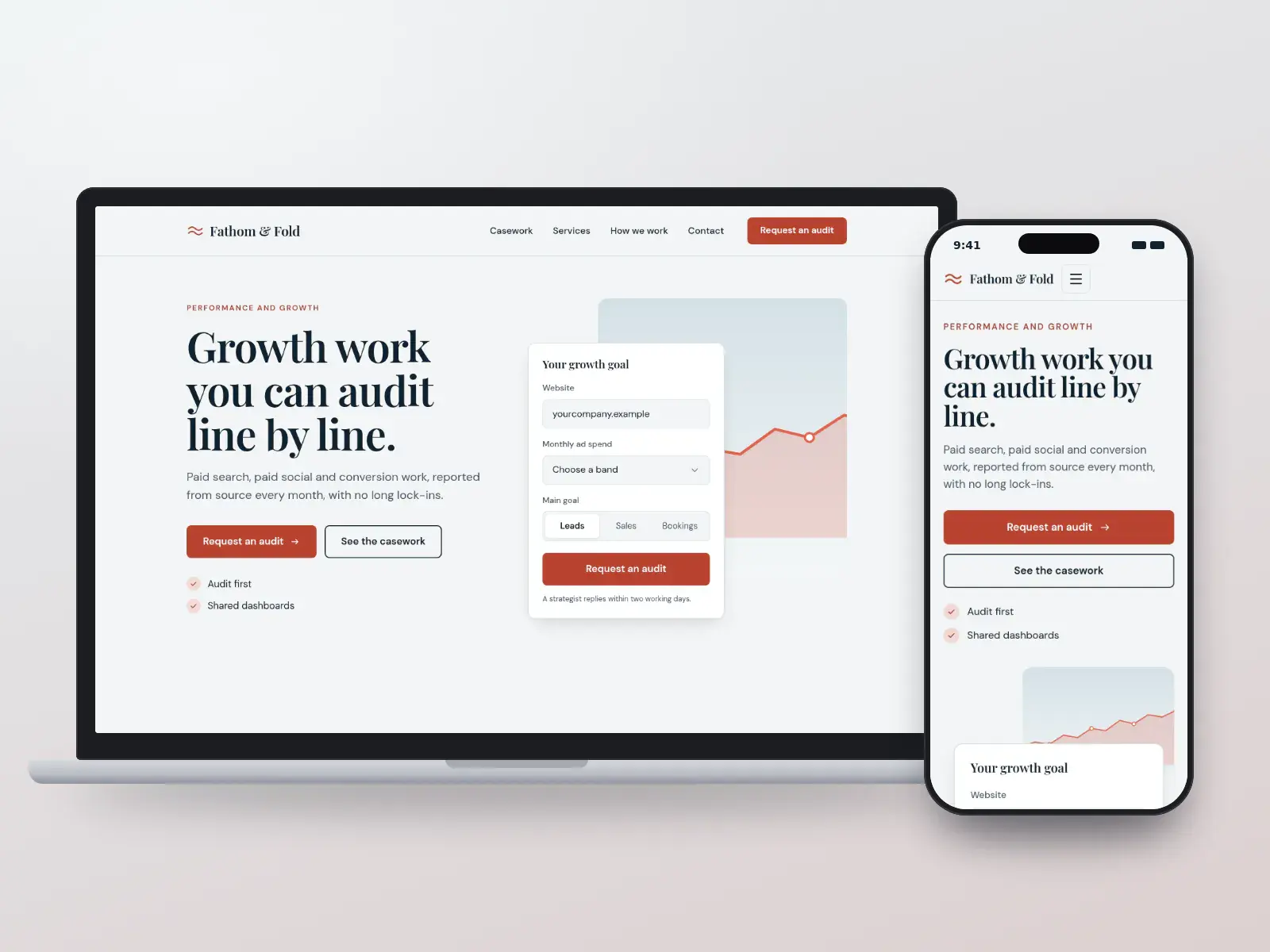
Concept website
Fathom & Fold
Performance and growth agencies
Concept design. The business is fictional.
- Editorial
- Data-led
Local website: yours after 12 payments, or $1,500 upfront
Concept website
Loud Orchard
Creative and brand studios
Concept design. The business is fictional.
- Bold
- Playful
Local website: yours after 12 payments, or $1,500 upfront
Concept website
Signal & Spire Digital
Full-service digital agencies
Concept design. The business is fictional.
- Corporate
- Bold
Growth website: yours after 12 payments, or $4,000 upfront
Concept website
Kindling Growth Co.
Founder-led boutique agencies
Concept design. The business is fictional.
- Dark
- Warm
Local website: yours after 12 payments, or $1,500 upfront
Concept website
Dashline
Retained agencies that report monthly
Concept design. The business is fictional.
- Dark
- Data-led
Local website: yours after 12 payments, or $1,500 upfront
Concept website
Northstack Demand
B2B and SaaS demand generation agencies
Concept design. The business is fictional.
- Tool-first
- Corporate
Local website: yours after 12 payments, or $1,500 upfront
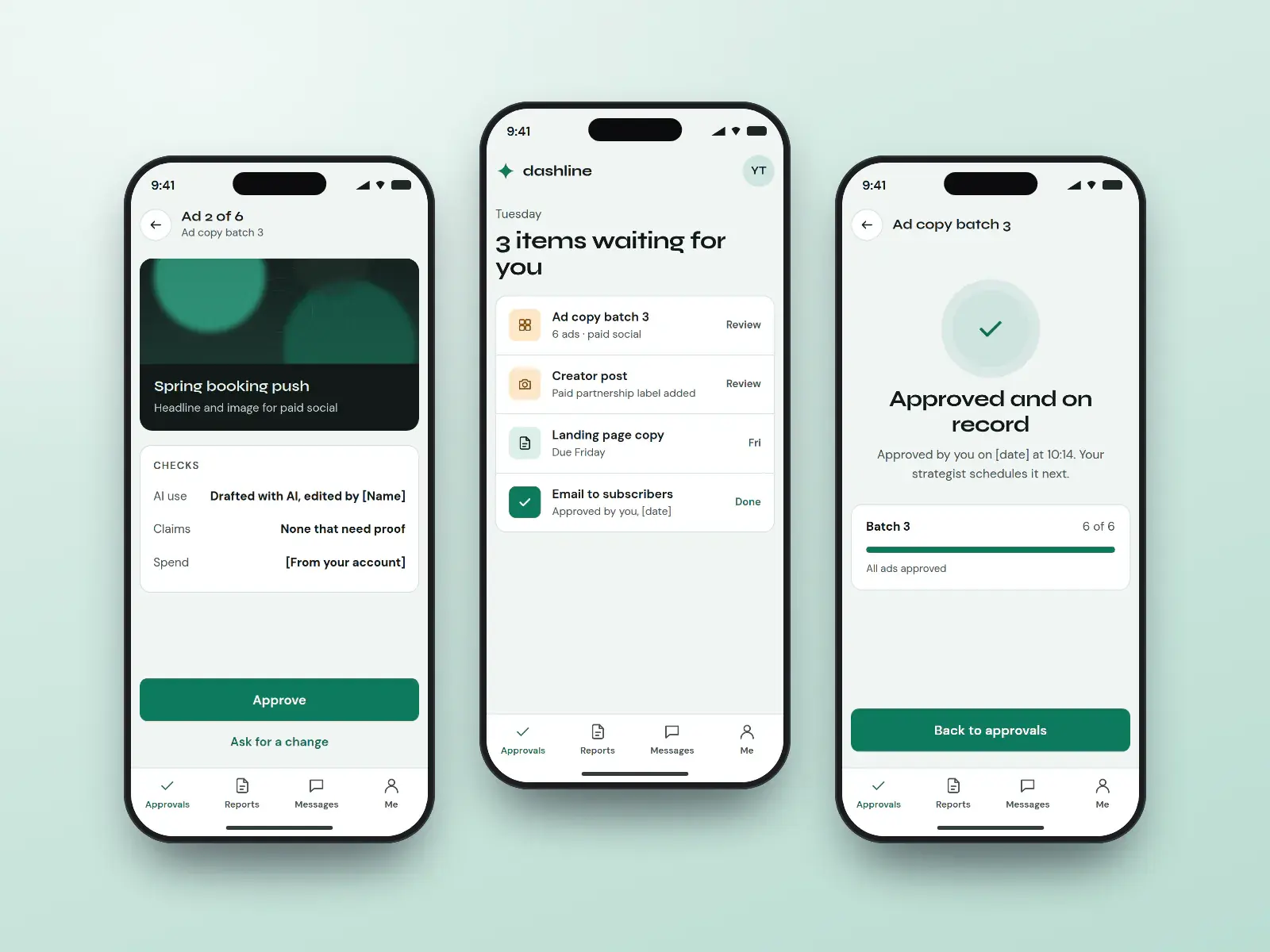
Concept app
Dashline approvals app
Clients approving ads and posts from a phone
Concept design. The business is fictional.
- Tool-first
- Minimal
Quoted per project after a call
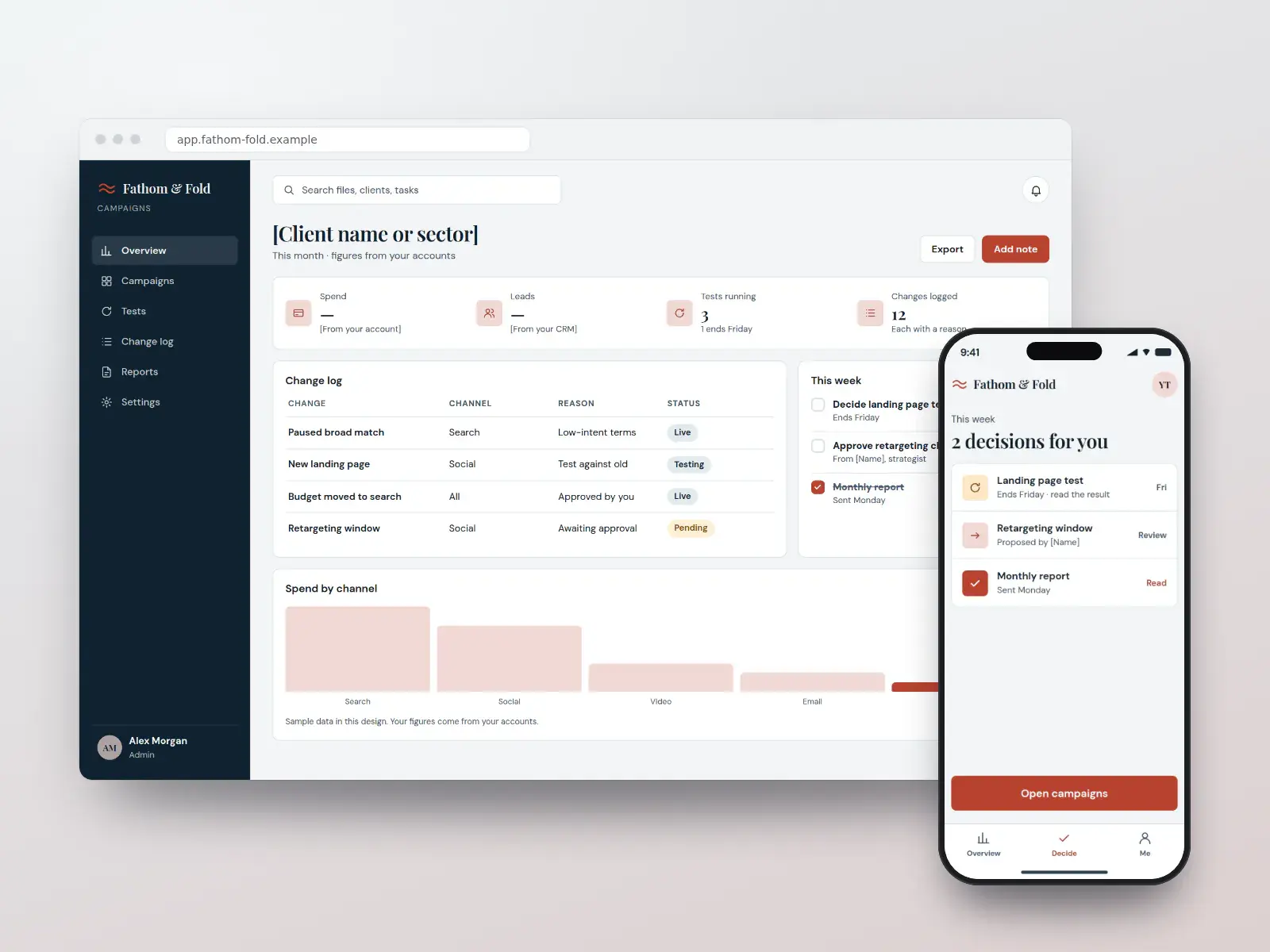
Concept software
Fathom & Fold campaign view
Clients and strategists reading live campaigns
Concept design. The business is fictional.
- Data-led
- Corporate
Quoted per project after a call
Pay monthly, own it
High-converting websites from $150/month
Pick a design, add your brand, content and photos, and launch. Yours after 12 payments, with SEO built in from day one.
- Local website
- $150/monthUp to 25 pages · yours after 12 payments, or $1,500 upfront
- Growth website
- $400/monthUp to 100 pages · yours after 12 payments, or $4,000 upfront
Built in
What every marketing agency website includes
Case studies with sign-off tracked
Each case study records the client’s approval of name, logo, quotes and figures, and the template places a context note beside any result, so a number never appears without its budget and market behind it.
A services hub that ranks
A page for each service and each industry you serve, with scope, deliverables and the specialist who leads it, built to rank for what a marketing director actually searches.
Discovery booking with fit questions
A short form before the calendar asks budget band, goal and timing, so founders spend calls with prospects who can become clients.
A reporting and approvals portal
Retained clients sign in for monthly reports, copy approvals and drafts, with an audit trail of who approved what and when.
Reviews collected the fair way
Review requests go to every client after a project, never only happy ones, with no incentives tied to a star count and staff reviews disclosed.
Proof of your own SEO
Fast pages, structured data, author pages and clean internal linking, because a prospect will check how your own site performs before trusting you with theirs.
How clients search
The searches and pages a marketing agency website needs
Hiring an agency is rarely one search. A founder or marketing lead starts from a problem or a channel, such as an SEO agency for a law firm, someone to fix paid social or a Shopify specialist, then builds a shortlist from referrals, partner directories, review platforms and, more and more, an AI assistant’s suggestions. Before booking a call they open your site on a laptop and look for proof: work in their sector, the people who would do it, how you report, and whether your own site practises what you sell.
- “seo agency for law firms”
- “b2b marketing agency”
- “shopify marketing agency”
- “how much does a marketing agency cost per month”
- “google ads agency near me”
- “branding agency vancouver”
- “content marketing agency for saas”
- “marketing agency for dentists”
- 01
One page per service
SEO, paid search, paid social, email, web design: each with scope, deliverables, what is out of scope, how it is reported and who leads it. Specific service pages are what rank for channel searches, and they answer the scoping questions before the call.
- 02
Niche and industry pages
A page for each sector you genuinely serve, with the problems particular to it and the work you have permission to show. A buyer searching for an agency for dentists or SaaS wants to see their own world described, not a generic capabilities list.
- 03
Case studies with sign-off
The brief, the constraints, what you changed and the result the client approved, with budget level, market and period beside every figure. Case studies are the page buyers read longest, and the one regulators look at first.
- 04
How we work and price
Retainer versus project, what a typical engagement includes, notice terms and who owns the ad and analytics accounts. Agencies that explain their model qualify their own leads, and buyers searching for agency costs land on a straight answer instead of a form.
- 05
Team and credentials
Real people with roles, the platform certifications each one actually holds, and the articles they have written. Named practitioners give buyers and search engines a reason to trust the advice on the rest of the site.
- 06
Discovery booking
A calendar with fit questions about goal, budget band and timing, plus what the first call covers. It turns a shortlisted visit into a conversation the same day, before the prospect moves on to the next tab.
SEO, AEO and GEO
How marketing agencies get found in Google and in AI answers
Your own SEO as the proof
Service, niche and city pages with clean internal links, Organization and ProfessionalService markup, and Person markup for named practitioners. Prospects check where an agency ranks for its own services; an agency that cannot be found for what it sells struggles to explain why.
Directories and partner listings
Partner directories and review platforms send shortlist traffic, but only list where your status is current and every review is genuine. Platform badges go on the site only once earned, and come off when they lapse.
Being named by AI assistants
Assistants shortlist agencies that state a clear niche, publish specific case studies and are mentioned by others. Original guides under named authors, a plain sentence on who you serve, and consistent descriptions across profiles give AI Overviews and chat tools something accurate to repeat.
A Business Profile that matches
A Google Business Profile in a fitting category such as marketing agency, with your real address or service area. Ask every client for a review after a project, never staff, and never only the happy ones; insider reviews need disclosure under the FTC rule.
Compliance
The rules for marketing agencies, handled in the design
Agencies write advertising for a living, so regulators hold them to it: since 2023 the FTC names agencies in its endorsement rules, and fake-review penalties reach whoever creates them. These are the rules that shape an agency’s own case studies, reviews and SEO promises, and what each design does about them.
Sources gathered October 6, 2026. This is how our designs handle these rules, not legal advice: rules change and differ by province and state, so your lawyer has the final word, and you approve every page before it goes live.
- US · FTC 16 CFR 255.1(d)
Agencies share liability for the endorsements they make
The 2023 revision of the FTC’s Endorsement Guides says advertising agencies, PR firms, review brokers and similar intermediaries may be liable for endorsements they create or spread when they know or should know they are deceptive. Agency sites show client testimonials only as given, disclose any material connection, and influencer case studies show the disclosure that ran.
Federal Register — Endorsement Guides, final revision (July 2023)
- US · FTC 16 CFR 465
Never buy, write or suppress reviews
The FTC’s reviews and testimonials rule, in force since October 21, 2024, prohibits fake reviews including AI-written ones, incentives conditioned on a positive review, undisclosed insider reviews, and suppressing reviews by threats or by presenting a filtered set as all of them. The FTC sent its first warning letters under it in December 2025. Agency review sections show unpaid reviews only, and no service page offers review writing or gating.
Federal Register — Trade Regulation Rule on the Use of Consumer Reviews and Testimonials
- Google Search Central
No promised rankings
Google’s guidance on hiring an SEO says no one can guarantee a top ranking on Google and warns against those who claim a special relationship with it. SEO service pages describe the work and the reporting, and never promise a position, a page one result or a timeline to rank.
- Google Partners · badge guidelines
Platform badges only once earned
Google lets only current Partners and Premier Partners show its badge, through the official snippet on the sites listed in their company profile, and never in a way that implies Google endorses the agency; Meta and other platforms set their own partner terms. Badges stay off the designs until your status is confirmed, and come down if it lapses.
- Canada · Competition Act s. 74.01(1)(b)
Uplift claims need proper testing
Canada’s Competition Act says a claim about how a service performs must be backed by adequate and proper testing carried out beforehand, and the Bureau notes that one-off or chance results do not qualify. Results in case studies are tied to the client’s own data and period, never averaged into a promise.
Competition Bureau — Performance claims not based on an adequate and proper test
- Canada · Competition Act, 2022 and 2024 amendments
Green claims and drip pricing in client campaigns
Since June 2022 drip pricing, advertising a price that hides unavoidable fees, is named a deceptive practice, and since June 20, 2024 environmental claims about a product or a business must be substantiated, with Bureau guidelines published in June 2025. Agencies that write sustainability or pricing copy for clients show it with its substantiation noted, and their own fees are stated in full.
Competition Bureau — Final guidelines on environmental claims (June 2025)
- US · FTC Operation AI Comply
AI claims and AI-made content, described honestly
The FTC’s 2024 enforcement sweep on AI targeted firms that overstated what their AI did and one that sold AI-generated reviews. Agencies that use AI describe what the tools do and where people review the output, and creative made with AI is labelled where it could be mistaken for real people or events.
- Canada · CASL
Agency newsletters and nurture sequences
CASL requires consent, sender identification and an unsubscribe mechanism for commercial email, and the CRTC’s guidance covers how consent is obtained and recorded. Agency sign-up forms use unticked boxes and keep consent records, and the same pattern is offered for client campaigns.
Everything for marketing agencies
Websites, apps, branding and SEO for marketing agencies
Websites
Marketing agencies websites built on the designs above, fast and set up for search.
From $150/month
Apps
Agencies lose retained clients when the value becomes invisible. A client app or portal makes the work, the approvals and the numbers visible every week.
Quoted per project
Apps for marketing agenciesBranding
An agency’s brand is its loudest case study. It has to look like the standard of work you sell and still be recognisable in a crowded pitch list.
Quoted per project
Branding for marketing agenciesSEO and leads
Ongoing SEO that checks your site every week and fixes what is safe to fix, for more discovery calls and retainers.
From $149/month
SEO plans and prices
Pricing
What a marketing agency website costs
The price of a marketing agency website is the same as any website we build: pay upfront and save, or spread it over 12 months.
Local website
$150/month × 12
or $1,500 upfront. Yours after the 12th payment.
- Up to 25 pages
- Any design on this page
- Technical SEO at launch
- Hosting and care $29/month
Growth website
$400/month × 12
or $4,000 upfront. Yours after the 12th payment.
- Up to about 100 pages
- Teams, offices and more integrations
- Planned with an advisor
- Hosting and care $49/month
SEO plans
$149/month
Local $149 · Growth $399
- Checks your site every week and fixes what is safe to fix
- New pages every month
- 7-day trial
Prices in US dollars. How payments, hosting and ownership work.
How it works
How your marketing agency website goes live
- 01
Pick a design
Choose one, or ask for another. Tell us your services, your niche and the clients you want more of.
- 02
Send your details
Logo, team bios, approved case studies and quotes, client sign-off records and your reporting setup.
- 03
Review before launch
You confirm every client name, figure and testimonial has written approval, and we drop anything that does not.
- 04
Launch and grow
We redirect old pages, go live, and build service and industry pages that bring in discovery calls.
Pick my design
See your website before you pay for it
Choose a design and tell us about your business. An advisor emails you to plan a preview with your name, your colours and your details, and the price options. Nothing is charged until you decide.
- 1An advisor replies by email
- 2We plan your preview and scope
- 3You decide, with every price in writing
Questions
Marketing agencies: common questions
- How much does a marketing agency website cost?
- A marketing agency website of up to 25 pages is $1,500 paid upfront, or $150 a month for 12 months, and it is yours after the 12th payment. A larger site of up to about 100 pages is $4,000, or $400 a month. Hosting and care is $29 or $49 a month. Prices are in US dollars.
- Can an agency show client results and logos on its website?
- Yes, with each client’s written approval for the name, logo, quotes and figures you publish, and with context beside every number: the budget level, the market and the period. The designs record that approval on each case study and show the context note next to the result, so a figure never stands alone.
- Can an SEO agency promise first-page rankings?
- No. Google’s own guidance on hiring an SEO says no one can guarantee a top ranking and tells site owners to be wary of anyone who does. Agency service pages in these designs describe the work, the reporting and how progress is measured, which is what an informed buyer wants to read anyway.
- Are agencies responsible for fake reviews they create for clients?
- They can be. The FTC’s 2023 Endorsement Guides say advertising agencies and review brokers may be liable for deceptive endorsements they create or spread, and its reviews rule, in force since October 2024, bans fake, bought and AI-invented reviews. An agency site should offer review requests sent to every customer, never review writing or gating.
- Should a marketing agency specialise in one niche on its website?
- Often, yes. A page that says you market dental practices or B2B software companies tells the right buyer they are in the right place and ranks for searches that include the niche. Full-service agencies can get the same effect with an industry page for each sector they serve well.
- Can my agency show a Google Partner or Meta badge on its website?
- Only once you have earned it, and only while you keep it. Google lets current Partners and Premier Partners show its badge through the official snippet on the sites listed in their profile, never in a way that suggests Google endorses you. Meta’s partner program sets its own terms. Each design keeps platform badges off until your status is confirmed.
- Will my marketing agency website rank on Google?
- It launches with the technical SEO done: fast pages, clean structure, structured data, local pages and redirects from your old site. To keep climbing, a BOOSTD SEO plan from $149 a month runs 262 checks on your site every week, fixes what is safe to fix and gets the rest ready for your OK.No one can promise a position on Google, and we never do. Google warns businesses about anyone who does.
- Can I get one of these agency website designs?
- Yes. Each is a complete, ready-to-launch website design BOOSTD made for marketing agencies. Pick one and we make it yours, with your name, colours, photos, content and the licence or compliance details your industry expects, from $150 a month and yours after 12 payments.Approved client sites are shown with a “Client work” tag, and only with the client’s written permission.
Guides for marketing agencies
Reading for marketing agencies before you build
- Planned guidePublishing agency case studies clients will approvePlanned: written with a named author and published once reviewed
- Planned guideWhat the FTC’s review rule means for agenciesPlanned: written with a named author and published once reviewed
- ReportingWhat a monthly marketing report should include: five numbers
- Agency practiceSEO agency red flags to check before you sign
More on marketing agency website design
- Recruitment agency websites
- White label SEO for agencies Run SEO for your clients on BOOSTD, under your brand.
- Websites for consultants
- Websites for IT services and MSPs
- Websites for videographers
- The five numbers in a marketing report
- Pricing for a group or franchise of marketing agencies More locations than a plan covers? Tell us about the network.
Free, about a minute, nothing changes on your site
Start with a free checkup of your current site
See what holds your current website back across every point, free, before you choose a design.
- Free, no cardNo sign-up to see your preview.
- Read-onlyNothing changes on your website.
- 90-day guaranteeIf you join: a better score, or your next month free.