
Websites for interior designers
Interior design websites that book the right clients
Websites for interior design studios that book the right clients: a portfolio of finished rooms with the photographer credited, a style questionnaire that arrives before the first call, e-design packages a client can buy from another city, and a clear page on how your fees, purchasing and trade pricing work.
- Website from $150/month, yours after 12 payments
- SEO plans from $149/month
The short answer
What should an interior designer’s website include?
An interior design website needs a portfolio of finished rooms grouped by project, with photographer credits, and a page explaining how you charge, including design fees and how furnishings are purchased and priced. A short style questionnaire before the consultation saves a meeting, and your title must match your jurisdiction, such as ARIDO registration in Ontario.
- Price
- $1,500 upfront, or $150/month × 12
- Ownership
- Yours after 12 payments
- Hosting and care
- $29 or $49/month
- Build time
- About 4 weeks for a local site
Our designs
Our website and app designs for interior designers
Ready-to-launch concept designs for fictional businesses: pick one and make it yours. 7 websites, 1 app and 1 software design, each opening on a desktop and a phone, with your brand, content and photos going in. All apps and software
9 of 9 examples shown
Concept website
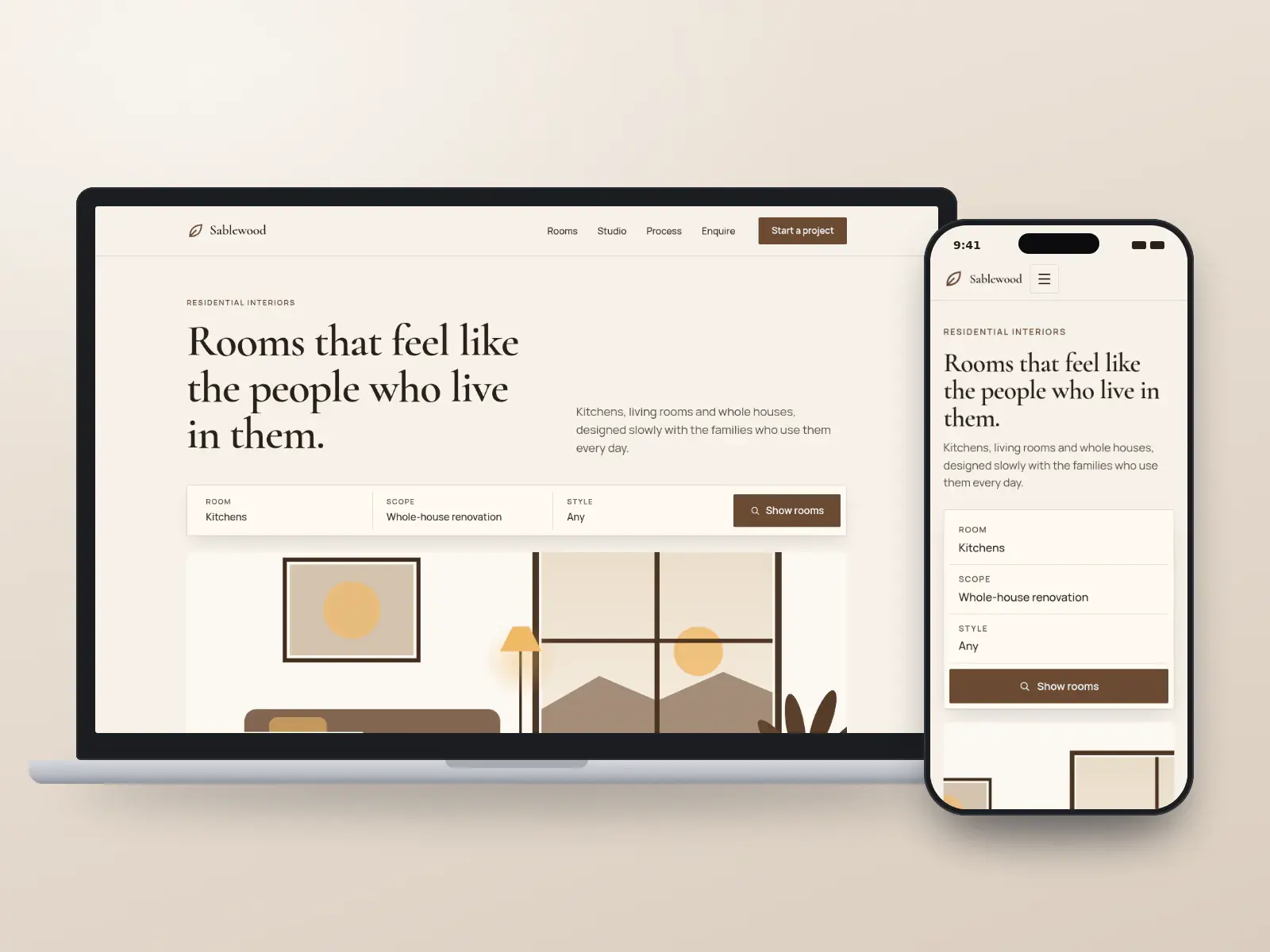
Sablewood Interiors
Residential studios with professional photography
Concept design. The business is fictional.
- Editorial
- Warm
Local website: yours after 12 payments, or $1,500 upfront
Concept website
Maison Velin
High-end residential studios
Concept design. The business is fictional.
- Luxury
- Dark
Local website: yours after 12 payments, or $1,500 upfront
Concept website
Roomkit Studio
Studios selling e-design anywhere
Concept design. The business is fictional.
- Playful
- Bold
Local website: yours after 12 payments, or $1,500 upfront
Concept website
Fernhouse Design Co.
Studios qualifying with a style questionnaire
Concept design. The business is fictional.
- Tool-first
- Friendly
Local website: yours after 12 payments, or $1,500 upfront
Concept website
Lobbyworks Interiors
Commercial, workplace and hospitality studios
Concept design. The business is fictional.
- Corporate
- Minimal
Growth website: yours after 12 payments, or $4,000 upfront
Concept website
Hearthline Interiors
Solo designers selling an in-home consultation
Concept design. The business is fictional.
- Warm
- Friendly
Local website: yours after 12 payments, or $1,500 upfront
Concept website
Saltgrass Kitchen & Bath Studio
Kitchen and bath design studios
Concept design. The business is fictional.
- Editorial
- Minimal
Local website: yours after 12 payments, or $1,500 upfront
Concept app
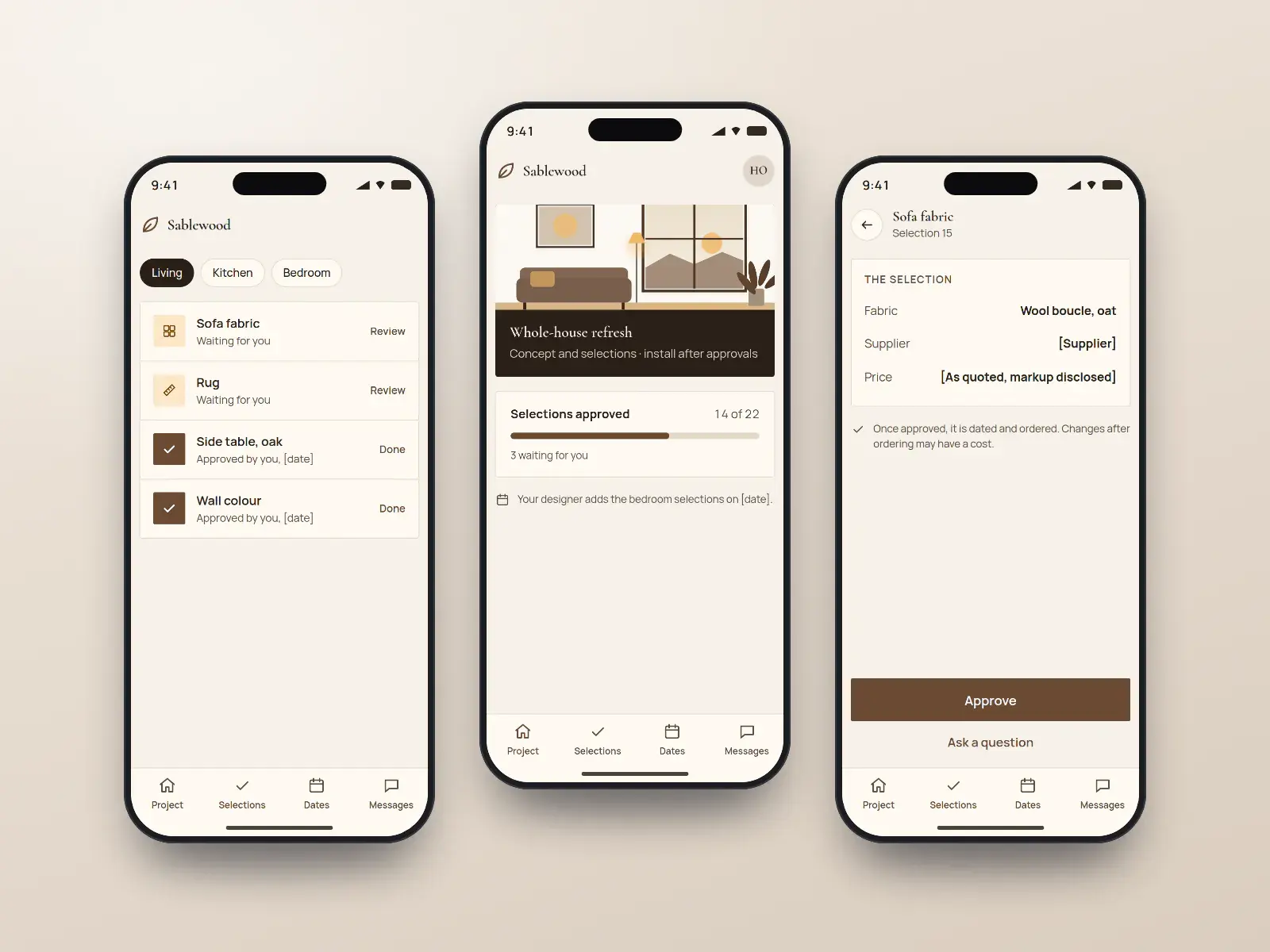
Sablewood selections app
Clients approving selections mid-project
Concept design. The business is fictional.
- Warm
- Minimal
Quoted per project after a call
Concept software
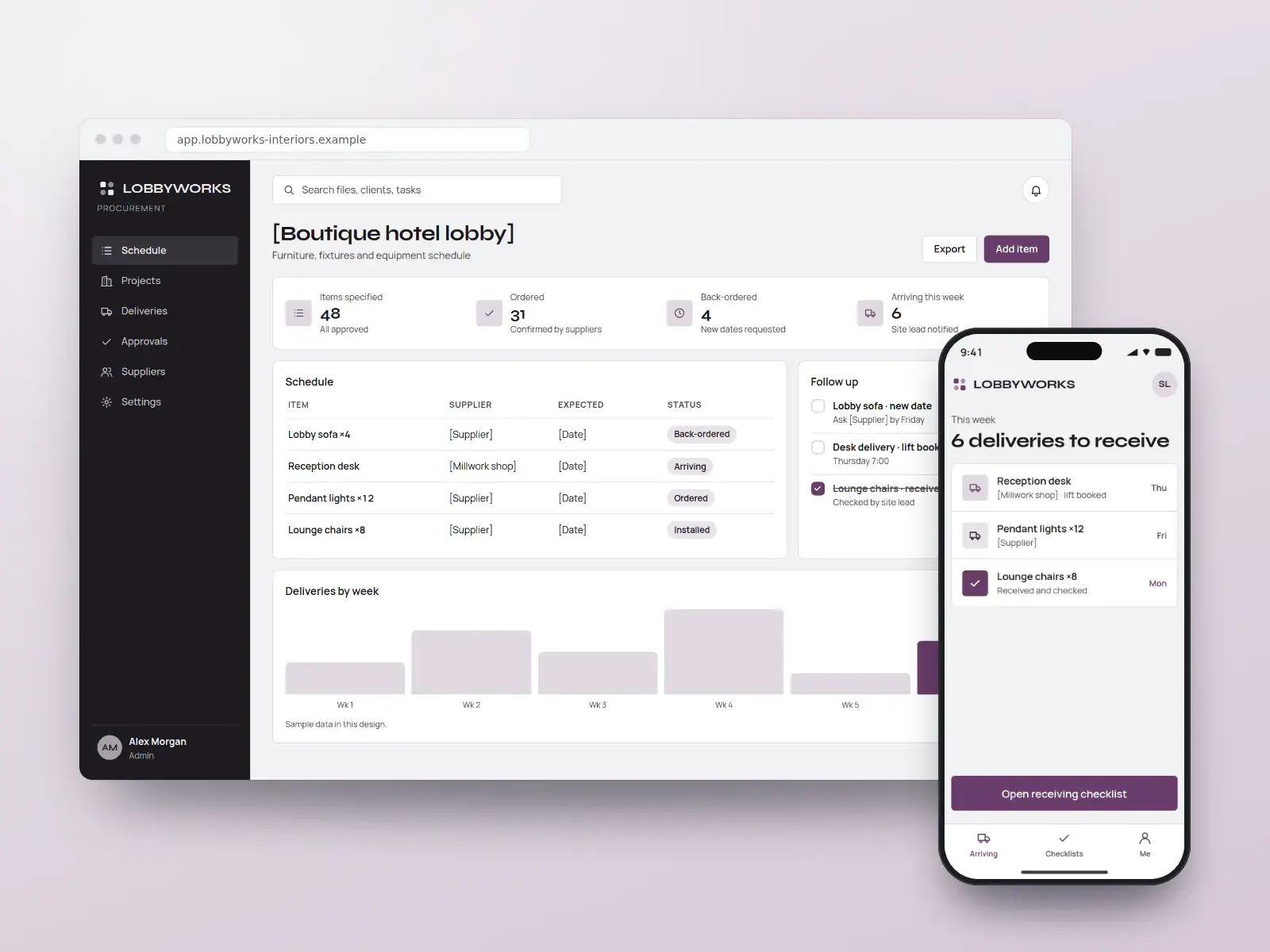
Lobbyworks procurement desk
Studios tracking orders and deliveries
Concept design. The business is fictional.
- Data-led
- Corporate
Quoted per project after a call
Pay monthly, own it
High-converting websites from $150/month
Pick a design, add your brand, content and photos, and launch. Yours after 12 payments, with SEO built in from day one.
- Local website
- $150/monthUp to 25 pages · yours after 12 payments, or $1,500 upfront
- Growth website
- $400/monthUp to 100 pages · yours after 12 payments, or $4,000 upfront
Built in
What every interior designer website includes
A portfolio of rooms, credited
Projects broken into rooms, each image with the photographer’s credit and the homeowner’s permission recorded, so a kitchen search lands on your kitchens and every picture is cleared to use.
A style questionnaire before the consultation
Four short questions on feel, rooms, budget range and timing, sent to the designer before the first meeting, so discovery calls start with a brief instead of a blank page.
E-design packages clients can buy
Package pages with inclusions, revision rounds and your own prices from your price list, checkout and an upload step for photos and measurements, for clients outside your city.
A plain page on fees and purchasing
How the design fee works, whether furnishings are bought at trade pricing, and how any markup or commission is handled, written with you, so clients compare studios on facts.
Titles that match your registration
Each designer’s title is entered exactly as their jurisdiction allows: ARIDO registration in Ontario, “registered interior designer” only where a state has granted it, NCIDQ only for active certificate holders.
Room and neighbourhood pages
Pages for the rooms and areas you design most, kitchens in [neighbourhood], condo interiors in [city], so the studio ranks where its clients live, not only for its own name.
How clients search
The searches and pages an interior designer website needs
Interior design clients usually start with pictures. They save rooms on Instagram, Pinterest or Houzz, then search with a place attached: “interior designer near me”, “kitchen designer” plus their neighbourhood. Most browse portfolios on a phone in the evening, then look for what a photo cannot tell them: how fees work, whether the studio takes a single room, and whether it offers e-design. Reviews on the studio’s Google profile are read closely before anyone books a consultation, and some clients now ask an AI assistant what a designer costs.
- “interior designer near me”
- “how much does an interior designer cost”
- “online interior design services”
- “interior designer vs decorator”
- “kitchen designer [neighbourhood]”
- “interior designer for condo [city]”
- “e-design for one room”
- 01
A portfolio by project and room
Finished projects broken into rooms, each photo captioned with the room, the neighbourhood and the photographer, with the homeowner’s permission recorded. Room pages let a kitchen search land on your kitchens rather than on a homepage of mixed images.
- 02
Services, one by one
Full-service design, consultations, e-design and styling, each with what it includes, how long it takes and what the client decides. People weighing a designer against a decorator read this page closely before they enquire.
- 03
Fees and purchasing
How the design fee works, flat, hourly or by project, how furnishings are bought, and how trade pricing, markup or commission is handled. Stated plainly, it turns away poor fits and earns the trust a portfolio alone cannot.
- 04
E-design packages
For clients in other cities: package pages with inclusions, revision rounds and the studio’s own prices, checkout, and an upload step for room photos and measurements, with affiliate links on shopping lists labelled as such.
- 05
Style questionnaire and booking
A few questions on feel, rooms, budget range and timing, then open consultation times. The designer opens the first meeting with a brief, and clients without a realistic budget find out before anyone drives across town.
- 06
Designers and their titles
Each designer’s title exactly as their jurisdiction allows, NCIDQ only while the certificate is active, association memberships and a short story of the studio. Clients hiring someone to work inside their home want to know who that is.
- 07
Neighbourhood pages
Pages for the areas the studio works in most, with projects from that area and the homes typical of it, condo, heritage or new build, so the studio is found where its clients actually live.
SEO, AEO and GEO
How interior designers get found in Google and in AI answers
Google Business Profile and reviews
Use “Interior designer” as the primary category, add services such as e-design and consultations, and post new rooms with the photographer credited. Ask finished clients for a review and reply to each one, but never reward a review on condition that it is positive.
Image search that knows the room
Rooms are found through image results too. Descriptive file names, alt text naming the room and its materials, and a caption on every project page help Google Images and AI assistants understand photos that would otherwise be anonymous.
Structured data without star ratings
Mark the studio up as a ProfessionalService with its service area, e-design packages as Offers, and each designer as a Person with hasCredential for a registration or NCIDQ certificate where held. Leave out review or rating markup for your own business.
Answers to cost and e-design questions
Assistants are asked how much an interior designer costs or what e-design includes. A fees page and an e-design page that answer in a short paragraph, in the studio’s own terms, give AI Overviews, ChatGPT and Perplexity something accurate to quote.
Compliance
The rules for interior designers, handled in the design
Who may call themselves an interior designer depends on the province or state, and portfolios are full of other people’s homes and photographs. These are the rules that shape a studio’s titles, prices and portfolio, and what each design does about them.
Sources gathered October 6, 2026. This is how our designs handle these rules, not legal advice: rules change and differ by province and state, so your registration body or provincial association has the final word, and you approve every page before it goes live.
- Ontario · ARIDO Act, 1999
“Interior Designer” is reserved in Ontario
Ontario’s private act for ARIDO (the Association of Registered Interior Designers of Ontario Act, 1999) gives registered members the exclusive use of the title “Interior Designer” and the ARIDO designation, alone or combined with other words, with an exemption for licensed architects. Ontario versions show the title only for registered members and describe other staff by role, such as design associate or decorator.
- Florida · F.S. §481.223
Registered interior designer in Florida
Florida reserves the title “registered interior designer” to licence holders and requires a licence for interior design outside residential work, while the current statute leaves “interior designer” and “interior design firm” unrestricted. Florida versions use “registered” only for licensed designers and show the licence placeholder beside their name.
- US · state title and practice acts
Texas, Nevada, Louisiana and others differ
Texas regulates only the title “registered interior designer” through its architecture board, while Nevada and Louisiana require registration for regulated interior design work, which largely means spaces other than private homes. The launch checklist asks which acts apply where the studio works, and titles follow the answer.
- US and Canada · CIDQ
NCIDQ only for active certificate holders
CIDQ lets active NCIDQ certificate holders use the NCIDQ appellation under its appellation agreement, and a lapsed certificate means the designation must come off. Profiles show NCIDQ as a field the studio confirms each year, never as a studio-wide badge.
- US · FTC 16 CFR 255
Disclosed affiliate links and real testimonials
The FTC’s Endorsement Guides require a material connection, such as an affiliate commission on a recommended sofa, to be disclosed clearly, and testimonials to reflect real clients’ experience. E-design shopping lists disclose affiliate links, and the concepts carry no testimonials until a client supplies one.
- Canada · Competition Act
Prices and savings that are not misleading
The Competition Bureau treats false or misleading representations, including about price, as deceptive marketing. Package pages show the studio’s actual prices and inclusions, and no “trade savings” claim appears unless the studio can support it.
Everything for interior designers
Websites, apps, branding and SEO for interior designers
Websites
Interior designers websites built on the designs above, fast and set up for search.
From $150/month
Apps
For studios running several installs at once: a client app keeps selections, approvals and delivery dates in one place, so the designer is not the switchboard for every courier.
Quoted per project
Apps for interior designersBranding
An interior design brand is judged by the same eye clients use on a room. It has to feel composed on a website, a sample board and a delivery label alike.
Quoted per project
Branding for interior designersSEO and leads
Ongoing SEO that checks your site every week and fixes what is safe to fix, for more consultation bookings and design projects.
From $149/month
SEO plans and prices
Pricing
What an interior designer website costs
The price of a interior designer website is the same as any website we build: pay upfront and save, or spread it over 12 months.
Local website
$150/month × 12
or $1,500 upfront. Yours after the 12th payment.
- Up to 25 pages
- Any design on this page
- Technical SEO at launch
- Hosting and care $29/month
Growth website
$400/month × 12
or $4,000 upfront. Yours after the 12th payment.
- Up to about 100 pages
- Teams, offices and more integrations
- Planned with an advisor
- Hosting and care $49/month
SEO plans
$149/month
Local $149 · Growth $399
- Checks your site every week and fixes what is safe to fix
- New pages every month
- 7-day trial
Prices in US dollars. How payments, hosting and ownership work.
How it works
How your interior designer website goes live
- 01
Pick a design
Choose one, or ask for something new. Tell us whether you design homes, commercial spaces or both.
- 02
Send your details
Room photos with their licences, homeowner permissions, package inclusions, your fee approach and each designer’s registered title.
- 03
Review before launch
You check every title, price and credit against your association’s rules, and ask for changes.
- 04
Launch and grow
We redirect your old pages, go live, and build room and neighbourhood pages that bring in consultations.
Pick my design
See your website before you pay for it
Choose a design and tell us about your business. An advisor emails you to plan a preview with your name, your colours and your details, and the price options. Nothing is charged until you decide.
- 1An advisor replies by email
- 2We plan your preview and scope
- 3You decide, with every price in writing
Questions
Interior designers: common questions
- How much does an interior design website cost?
- An interior design studio website of up to 25 pages is $1,500 paid upfront, or $150 a month for 12 months, and it is yours after the 12th payment. A larger site of up to about 100 pages is $4,000, or $400 a month. Hosting and care is $29 or $49 a month. Prices are in US dollars.
- Can I call myself an interior designer on my website?
- It depends where you practise. In Ontario the title “Interior Designer” belongs to ARIDO registered members, and Florida and Texas reserve “registered interior designer” for those registered with their boards. In most US states the plain title is open, though a few, such as Nevada and Louisiana, regulate the work itself. Each profile shows the title you confirm, and decorators or design associates are described by their role.
- Should an interior designer show prices on the website?
- For e-design packages, yes: a client buying from another city expects to see the price and inclusions before paying. For full-service work, explain how you charge, flat fee, hourly or a percentage of the project, and how furnishings are priced, without a number you would have to change for every home. Package prices come from your own price list.
- Can I post photos of clients’ homes in my portfolio?
- Yes, with the homeowner’s written permission and the photographer’s licence. Many clients agree if the address and family names stay private, so the portfolio captions rooms by neighbourhood, not street. Each image records who took it and the terms, so a photo commissioned by a builder or a magazine is used only as agreed.
- What is a style questionnaire and does it help bookings?
- A style questionnaire is a short set of questions a client answers before the first consultation: how the home should feel, which rooms, a budget range and the timing. It helps because the designer arrives with a brief, and clients who cannot answer the budget question usually reveal themselves before the calendar is spent.
- Is Instagram enough, or does an interior designer need a website?
- Instagram shows taste, but it does not answer the questions that decide a booking: what you charge, which areas you cover, whether you take a single room and how a project runs. A website holds those answers, can rank for “interior designer near me”, takes e-design orders and consultation bookings, and stays yours whatever a platform changes.
- Will my interior designer website rank on Google?
- It launches with the technical SEO done: fast pages, clean structure, structured data, local pages and redirects from your old site. To keep climbing, a BOOSTD SEO plan from $149 a month runs 262 checks on your site every week, fixes what is safe to fix and gets the rest ready for your OK.No one can promise a position on Google, and we never do. Google warns businesses about anyone who does.
- Can I get one of these interior design website designs?
- Yes. Each is a complete, ready-to-launch website design BOOSTD made for interior designers. Pick one and we make it yours, with your name, colours, photos, content and the licence or compliance details your industry expects, from $150 a month and yours after 12 payments.Approved client sites are shown with a “Client work” tag, and only with the client’s written permission.
Guides for interior designers
Reading for interior designers before you build
- Planned guideExplaining design fees, trade pricing and markup on an interior design websitePlanned: written with a named author and published once reviewed
- Planned guideSelling e-design packages to clients in other citiesPlanned: written with a named author and published once reviewed
- ReviewsHow to ask for Google reviews without breaking the rules
- Local SEOLocal SEO checklist: every step, in the right order
More on interior design website
- Structural and building engineer websites
- Websites for architects For the architects you work alongside.
- Websites for remodelers For the contractors who build your designs.
- Websites for furniture stores
- How to ask clients for reviews
- Pricing for a group or franchise of interior designers More locations than a plan covers? Tell us about the network.
Free, about a minute, nothing changes on your site
Start with a free checkup of your current site
See what holds your current website back across every point, free, before you choose a design.
- Free, no cardNo sign-up to see your preview.
- Read-onlyNothing changes on your website.
- 90-day guaranteeIf you join: a better score, or your next month free.