
Websites for family lawyers
Family law website design built for safety and calm
Websites for family law practices that respect what a separating parent is going through: a quick-exit button and safe-contact options on every page, calm consultation booking, a support estimate that says it is an estimate, and clear pages on divorce, parenting, support, property and mediation.
- Website from $150/month, yours after 12 payments
- SEO plans from $149/month
The short answer
What should a family law firm website have?
A family law website needs a quick-exit button and a safe way to be contacted, because some visitors are leaving an abusive home. It should explain divorce, parenting arrangements, support, property and out-of-court options clearly, offer calm consultation booking, and label any child support tool as an estimate under the official guidelines, never a promise.
- Price
- $1,500 upfront, or $150/month × 12
- Ownership
- Yours after 12 payments
- Hosting and care
- $29 or $49/month
- Build time
- About 4 weeks for a local site
Our designs
Our website and app designs for family lawyers
Ready-to-launch concept designs for fictional businesses: pick one and make it yours. 7 websites, 1 app and 1 software design, each opening on a desktop and a phone, with your brand, content and photos going in. All apps and software
9 of 9 examples shown
Concept website
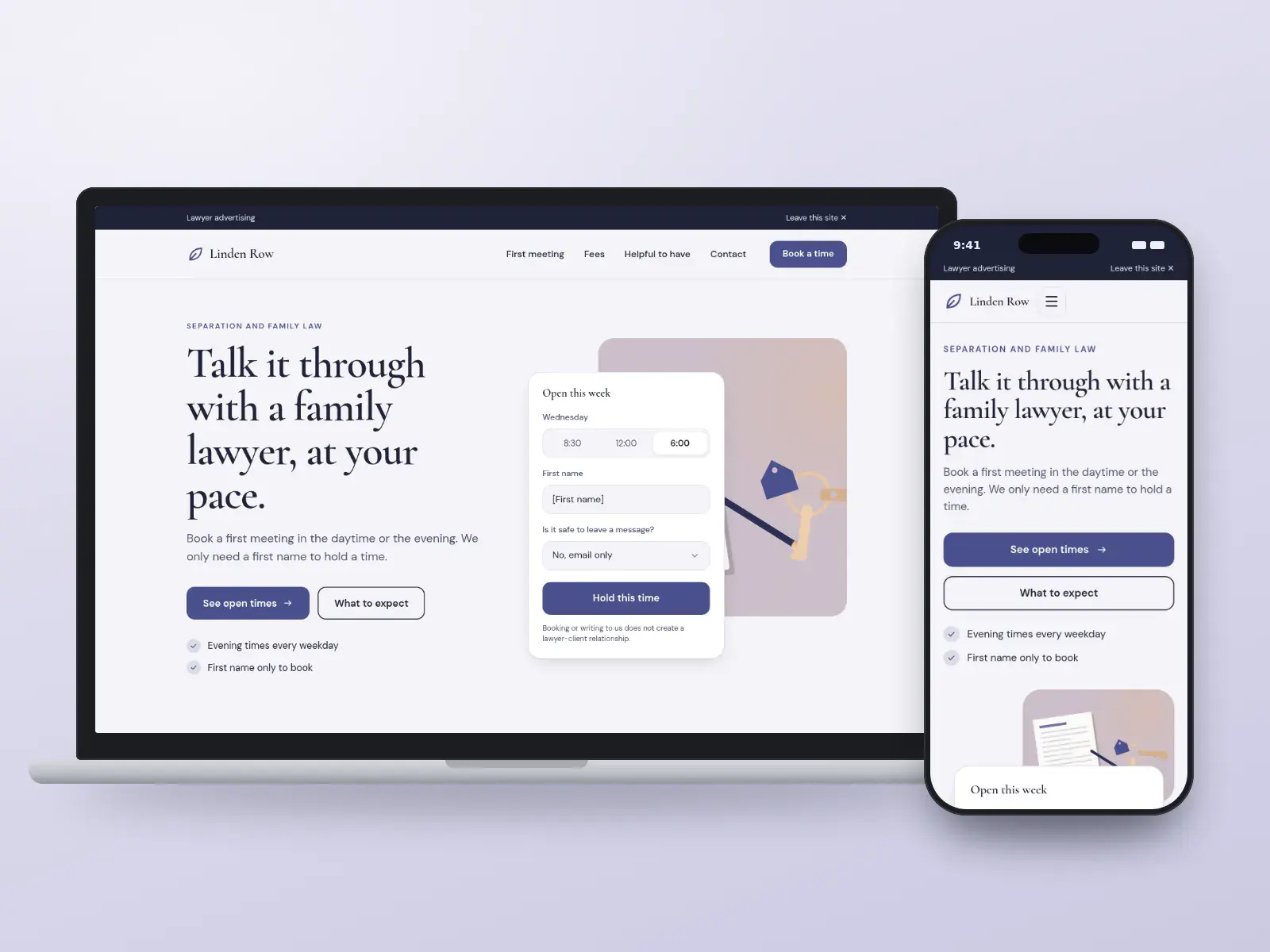
Linden Row Family Law
Family lawyers whose clients book after a hard week
Concept design. The business is fictional.
- Warm
- Minimal
Local website: yours after 12 payments, or $1,500 upfront
Concept website
Waymark Family Law
Practices with many clients leaving abusive relationships
Concept design. The business is fictional.
- Dark
- Minimal
Local website: yours after 12 payments, or $1,500 upfront
Concept website
Tidewell Family Law
Practices with many support enquiries
Concept design. The business is fictional.
- Tool-first
- Data-led
Local website: yours after 12 payments, or $1,500 upfront
Concept website
Common Table Family Law & Mediation
Mediators and collaborative family lawyers
Concept design. The business is fictional.
- Editorial
- Warm
Local website: yours after 12 payments, or $1,500 upfront
Concept website
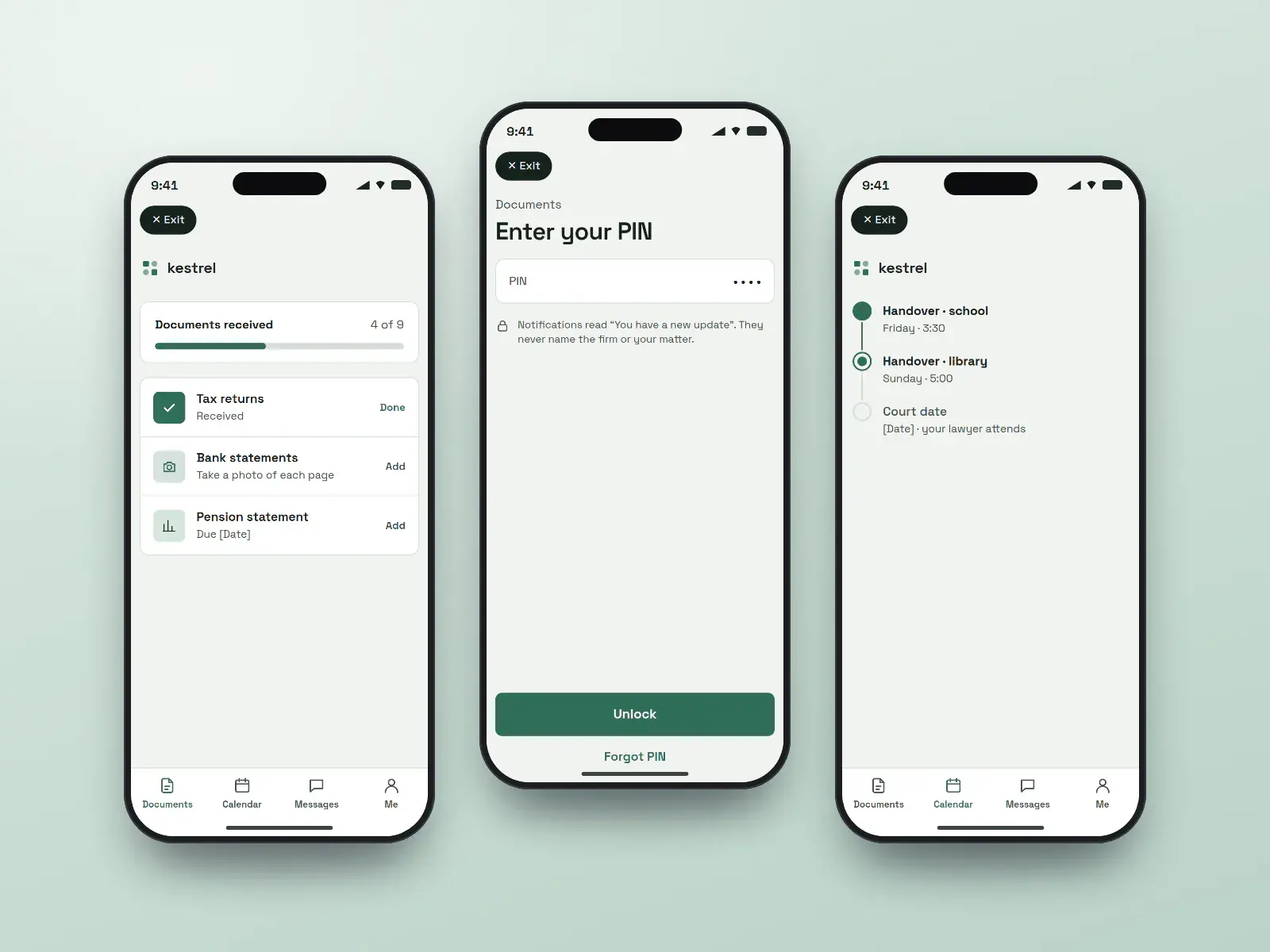
Kestrel Family Law
Practices handling financial disclosure
Concept design. The business is fictional.
- Dark
- Data-led
Local website: yours after 12 payments, or $1,500 upfront
Concept website
Maple & Mesa Family Law
Family lawyers serving several language communities
Concept design. The business is fictional.
- Friendly
- Warm
Local website: yours after 12 payments, or $1,500 upfront
Concept website
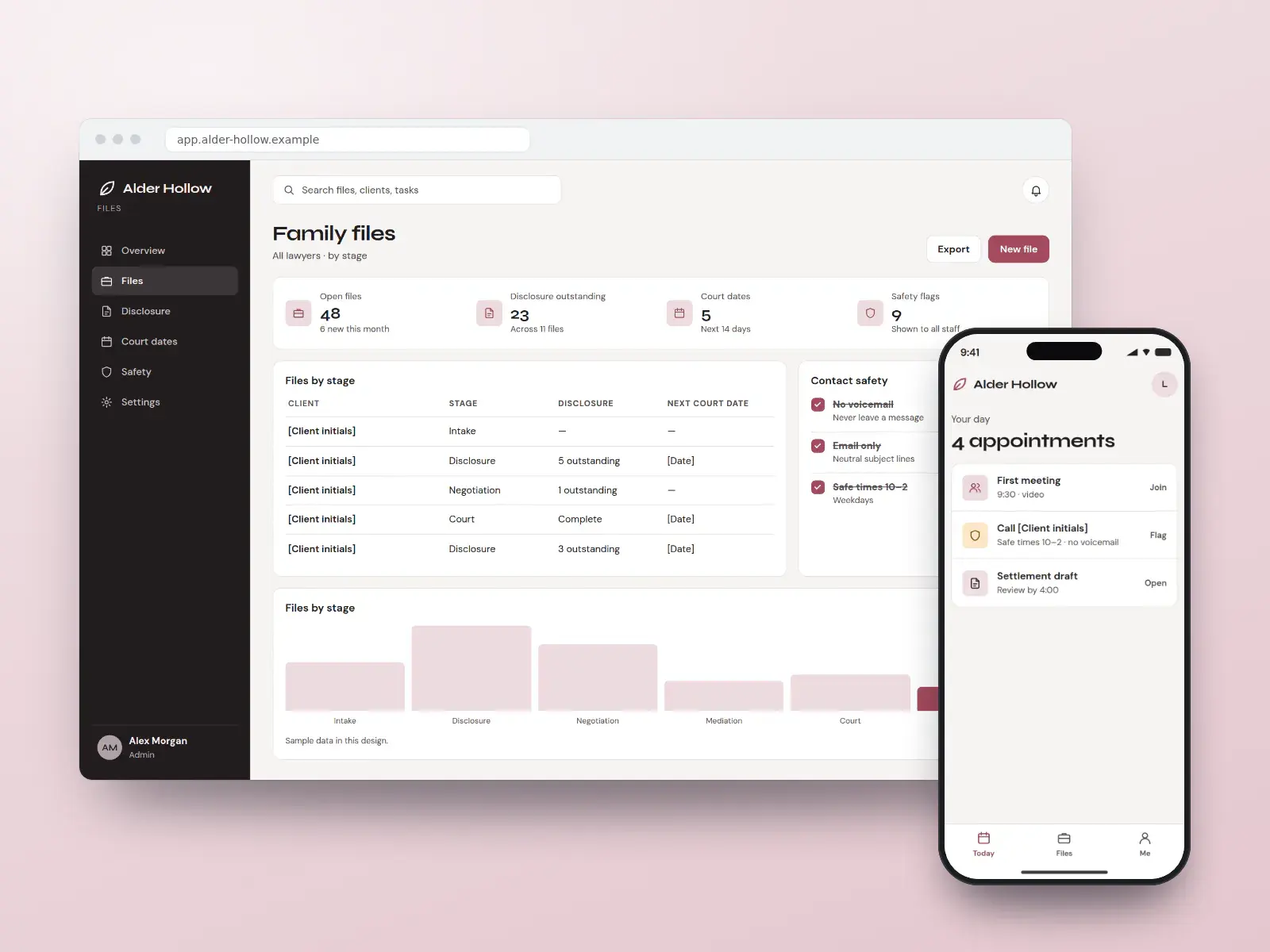
Alder Hollow Family Lawyers
Family law groups with several lawyers
Concept design. The business is fictional.
- Corporate
- Friendly
Growth website: yours after 12 payments, or $4,000 upfront
Concept app
Kestrel client app
Clients gathering disclosure and following the parenting schedule
Concept design. The business is fictional.
- Minimal
- Tool-first
Quoted per project after a call
Concept software
Alder Hollow matter console
Lawyers and clerks running family files
Concept design. The business is fictional.
- Data-led
- Corporate
Quoted per project after a call
Pay monthly, own it
High-converting websites from $150/month
Pick a design, add your brand, content and photos, and launch. Yours after 12 payments, with SEO built in from day one.
- Local website
- $150/monthUp to 25 pages · yours after 12 payments, or $1,500 upfront
- Growth website
- $400/monthUp to 100 pages · yours after 12 payments, or $4,000 upfront
Built in
What every family lawyer website includes
Quick exit on every page
A clearly labelled button, fixed in the same corner on every page and reachable with the Escape key, that replaces the site with a neutral one. A short page explains that it does not erase history and how to browse more safely.
Safe-contact intake
Forms ask how and when it is safe to be contacted and whether a message may be left, and those answers sit at the top of the request so your staff never call at the wrong time.
Support estimates labelled as estimates
An optional child support estimate that reads the official guideline tables for the paying parent’s province or state, states what it leaves out, and points to a lawyer before anyone relies on the number.
Pages for each family law issue
Divorce, parenting time and decision-making, child and spousal support, property, separation agreements, marriage contracts and protection orders, each explained for your province or state so it ranks for the question asked.
Out-of-court options explained
Mediation, collaborative law and negotiation compared in plain words, with a clear note on when they are not appropriate, which suits clients and the duties family lawyers already have.
Private disclosure portal
Financial statements, tax returns and valuations uploaded against a checklist, with neutral notification emails that never name the firm or the matter in the subject line.
How clients search
The searches and pages a family lawyer website needs
Family law searches usually start privately and late at night, on a phone the other spouse may never see. People type the question before they type “lawyer”: how custody works, what child support would be, whether they can move with the children, how to divorce without court. Many check reviews and whether the lawyer mediates, look for a free first call, and ask an AI assistant to explain their province’s or state’s rules first, so calm, accurate answers win the consultation.
- “divorce lawyer near me”
- “how much does a divorce cost”
- “how is child support calculated”
- “can i move with my child after separation”
- “family mediation near me”
- “uncontested divorce lawyer”
- “how to get a protection order”
- 01
Divorce and separation
The steps from separation to divorce where you practise, contested and uncontested, with timelines and what the court needs, written so a person who has not yet told anyone can understand what happens next.
- 02
Parenting and custody
Parenting time and decision-making (Canada’s terms since 2021) or custody and visitation (most US states), what a court weighs, and relocation, without suggesting any parent will “win”.
- 03
Child and spousal support
How the official guideline works, what income counts, and when amounts change, with an estimate tool labelled as an estimate and a clear path to a consultation before anyone relies on a figure.
- 04
Mediation and collaborative law
The out-of-court options compared, who is in the room, what they cost in time and money, the credentials of the firm’s mediators and collaborative lawyers, and when these routes are not safe.
- 05
Safety and protection orders
What protection or restraining orders do and how fast they can be made, with the quick exit on screen, safe-contact options and the local emergency and support lines, reviewed by a lawyer.
- 06
Fees and first consultation
Whether the first meeting is free, hourly rates or flat fees for uncontested matters and agreements, retainers, and what drives the cost of a contested case, which is the question most callers are afraid to ask.
SEO, AEO and GEO
How family lawyers get found in Google and in AI answers
Family law categories in Google
Google Business Profile offers Family law attorney and Divorce lawyer categories, among others. The office picks the one that matches its work as primary, keeps hours accurate, and answers questions in the profile without naming any client or case.
Answers for question searches
Family searches are questions. Pages open with a short, direct answer for the jurisdiction (how support is calculated, how long a divorce takes), then the detail, which is what featured snippets, AI Overviews and assistants such as ChatGPT tend to quote.
Credentials search engines can read
Lawyer pages list bar admissions, any certification with the body that granted it, and mediator or collaborative training with its exact title, marked up as Person on a LegalService page. For a YMYL topic like family law, named authors and review dates matter.
Reviews without exposing families
Ask clients for reviews after their matter closes and suggest they leave out names and details. Reply without confirming anyone was a client. Directory and map listings carry the same name, address and phone as the site.
Compliance
The rules for family lawyers, handled in the design
Family lawyers advertise under their bar or law society’s rules, and in Canada the Divorce Act adds duties about out-of-court options. These are the rules that shape a family law site’s promises, intake, support estimates and safety features, and what each design does about them.
Sources gathered October 6, 2026. This is how our designs handle these rules, not legal advice: rules change and differ by province and state, so your bar or law society (or your ethics counsel) has the final word, and you approve every page before it goes live.
- US · ABA Model Rule 7.1
No promises about custody or support
Rule 7.1 and its comment treat a statement as misleading when it creates unjustified expectations about what a lawyer can achieve. Family pages describe how parenting and support are decided and what a court weighs, and never suggest a parent will “win” custody or a set level of support.
- US · ABA Model Rule 7.3
No pressure on people in a crisis
Rule 7.3 bars live person-to-person solicitation for gain, and any solicitation involving coercion, duress or harassment or contacting someone who has said they do not want it. Separating spouses are often in exactly that state, so the sites wait for the visitor to reach out and staff follow up only in the way the visitor chose.
- Canada · Divorce Act s. 7.7
Family dispute resolution, unless it is unsafe
Section 7.7 of the Divorce Act asks a legal adviser to encourage clients to try a family dispute resolution process such as negotiation, mediation or collaborative law, unless that would clearly not be appropriate, and to tell them about family justice services. Canadian versions explain those processes and the safety exception on their own page.
- Canada · Federal Child Support Guidelines
Support estimates from the official tables
The Federal Child Support Tables set base monthly amounts by province or territory, number of children and the paying parent’s income, and Justice Canada publishes its own look-up for estimates. The estimate tool uses the current tables, names the version, and says special expenses and shared parenting can change the amount.
- US · 45 CFR 302.56
Each state’s own support guideline
Federal rules require every state to set child support guidelines, so the formula differs from state to state. US versions of the estimate run only on the guideline of the state the firm practises in, link to that state’s official calculator where one exists, and never show a figure for a state the firm does not serve.
- US · ABA Opinion 10-457
Confidential details only after a conflict check
Formal Opinion 10-457 warns that a site inviting a visitor to describe their matter can make them a prospective client owed confidentiality. In family law the other spouse may already have called the firm, so forms collect both spouses’ names first and ask for the story only after the check.
- Ontario
Certified specialists in family law
Ontario’s rule 4.2-1 asks that marketing be demonstrably true and not misleading, and rule 4.3-1 reserves “specialist” for lawyers the Law Society has certified, which it does for family law. Profiles say a lawyer practises family law unless a certification is entered, and then name the Law Society as the certifying body.
Law Society of Ontario — Rules of Professional Conduct, chapter 4
- Florida · Ontario · mediator titles
Mediator credentials named as granted
Florida’s rules for court-certified mediators treat “Florida Supreme Court certified” as misleading unless the area of certification, such as family, is named, and bar a general claim to be “certified” without a real certification process. In Ontario, Accredited Family Mediator is a designation of the Ontario Association for Family Mediation. Profiles show each mediation or collaborative credential with its exact title and the body that granted it.
Florida Rules for Certified and Court-Appointed Mediators — Rule 10.610
Everything for family lawyers
Websites, apps, branding and SEO for family lawyers
Websites
Family lawyers websites built on the designs above, fast and set up for search.
From $150/month
Apps
Separation runs for months on paperwork and handovers. A client app keeps disclosure, schedules and messages private and out of a shared inbox or family phone.
Quoted per project
Apps for family lawyersBranding
A family law brand has to feel safe to someone at their lowest point and still look capable to a judge and opposing counsel. Warmth without softness is the brief.
Quoted per project
Branding for family lawyersSEO and leads
Ongoing SEO that checks your site every week and fixes what is safe to fix, for more consultation bookings and safe-contact requests.
From $149/month
SEO plans and prices
Pricing
What a family lawyer website costs
The price of a family lawyer website is the same as any website we build: pay upfront and save, or spread it over 12 months.
Local website
$150/month × 12
or $1,500 upfront. Yours after the 12th payment.
- Up to 25 pages
- Any design on this page
- Technical SEO at launch
- Hosting and care $29/month
Growth website
$400/month × 12
or $4,000 upfront. Yours after the 12th payment.
- Up to about 100 pages
- Teams, offices and more integrations
- Planned with an advisor
- Hosting and care $49/month
SEO plans
$149/month
Local $149 · Growth $399
- Checks your site every week and fixes what is safe to fix
- New pages every month
- 7-day trial
Prices in US dollars. How payments, hosting and ownership work.
How it works
How your family lawyer website goes live
- 01
Pick a design
Choose one, or ask for something new. Tell us whether you mediate, litigate or both, and the courts you appear in.
- 02
Send your details
Logo, photos, bar numbers, the responsible lawyer, consultation terms and the languages your team actually speaks.
- 03
Review before launch
You test the quick exit and safe-contact form, and check each support page and estimate against your rules.
- 04
Launch and grow
We redirect your old pages, go live, and build issue and city pages that bring in consultations.
Pick my design
See your website before you pay for it
Choose a design and tell us about your business. An advisor emails you to plan a preview with your name, your colours and your details, and the price options. Nothing is charged until you decide.
- 1An advisor replies by email
- 2We plan your preview and scope
- 3You decide, with every price in writing
Questions
Family lawyers: common questions
- How much does a family law website cost?
- A family law website of up to 25 pages is $1,500 paid upfront, or $150 a month for 12 months, and it is yours after the 12th payment. A larger site of up to about 100 pages is $4,000, or $400 a month. Hosting and care is $29 or $49 a month. Prices are in US dollars.
- Why does a family law website need a quick-exit button?
- Because some visitors are reading in a home where the person they are leaving can see the screen. A quick-exit button, fixed in the same place on every page, replaces your site with a neutral one in a single tap. We add a short page on clearing browsing history, since the button cannot hide a visit already recorded.
- Can a family lawyer website include a child support calculator?
- Yes, if it is labelled as an estimate and built on the official guideline. In Canada that means the current Federal Child Support Tables for the paying parent’s province; in the US, your state’s guideline. The tool names the table version, lists what it leaves out, such as special expenses and shared parenting, and invites a consultation instead of promising a figure.
- Should a divorce lawyer show client testimonials?
- Carefully, if at all. Many family clients do not want their separation linked to their name, and some bars restrict testimonials or require a disclaimer beside them. If you show reviews, use only real ones given with consent, avoid details that identify a family, and add the wording your bar requires on the same screen.
- Do family law websites need to mention mediation?
- In Canada it helps you meet a real duty: section 7.7 of the Divorce Act asks lawyers to encourage family dispute resolution unless it is clearly not appropriate. A page comparing mediation, collaborative law and negotiation, with a plain note on when they are unsafe, also answers a question separating couples often search.
- How should a family lawyer list mediation or collaborative credentials?
- Exactly as granted, with the body that granted them. Florida’s mediator rules, for example, treat “Florida Supreme Court certified” as misleading unless the area, such as family, is named; in Ontario, Accredited Family Mediator comes from the Ontario Association for Family Mediation. Collaborative training is described as training, and “certified specialist” appears only with the certifying body.
- Will my family lawyer website rank on Google?
- It launches with the technical SEO done: fast pages, clean structure, structured data, local pages and redirects from your old site. To keep climbing, a BOOSTD SEO plan from $149 a month runs 262 checks on your site every week, fixes what is safe to fix and gets the rest ready for your OK.No one can promise a position on Google, and we never do. Google warns businesses about anyone who does.
- Can I get one of these family law website designs?
- Yes. Each is a complete, ready-to-launch website design BOOSTD made for family lawyers. Pick one and we make it yours, with your name, colours, photos, content and the licence or compliance details your industry expects, from $150 a month and yours after 12 payments.Approved client sites are shown with a “Client work” tag, and only with the client’s written permission.
Guides for family lawyers
Reading for family lawyers before you build
- Planned guideQuick-exit buttons and safe contact on family law websitesPlanned: written with a named author and published once reviewed
- Planned guideChild support calculators on a law firm website: estimates, not promisesPlanned: written with a named author and published once reviewed
- ReviewsHow to ask for reviews without breaking the rules
- Local SEODo you need a website if you have a Google Business Profile?
More on family law website design
- Websites for immigration law firms
- Marketing for family lawyers SEO and intake marketing for family law practices.
- Websites for law firms of every practice
- Websites for criminal defence lawyers
- Websites for estate planning lawyers
- Pricing for a group or franchise of family lawyers More locations than a plan covers? Tell us about the network.
Free, about a minute, nothing changes on your site
Start with a free checkup of your current site
See what holds your current website back across every point, free, before you choose a design.
- Free, no cardNo sign-up to see your preview.
- Read-onlyNothing changes on your website.
- 90-day guaranteeIf you join: a better score, or your next month free.