
Websites for consultants
Consulting website design that starts the right conversation
Websites for management, strategy and operations consultants that let a buyer judge your thinking before the first call: essays and briefings that show how you diagnose a problem, engagement stories shared with client permission, a clear list of what you take on, and a discovery call booked in two clicks.
- Website from $150/month, yours after 12 payments
- SEO plans from $149/month
The short answer
What should a consulting firm website include?
A consulting website should name the problems you solve and the buyers you solve them for, show your thinking through articles or briefings, and present engagement stories only with the client’s written permission and the evidence behind any outcome. It needs a short discovery-call booking, a page per capability, and named consultants with real credentials.
- Price
- $1,500 upfront, or $150/month × 12
- Ownership
- Yours after 12 payments
- Hosting and care
- $29 or $49/month
- Build time
- About 4 weeks for a local site
Our designs
Our website and app designs for consultants
Ready-to-launch concept designs for fictional businesses: pick one and make it yours. 6 websites, 1 app and 1 software design, each opening on a desktop and a phone, with your brand, content and photos going in. All apps and software
8 of 8 examples shown
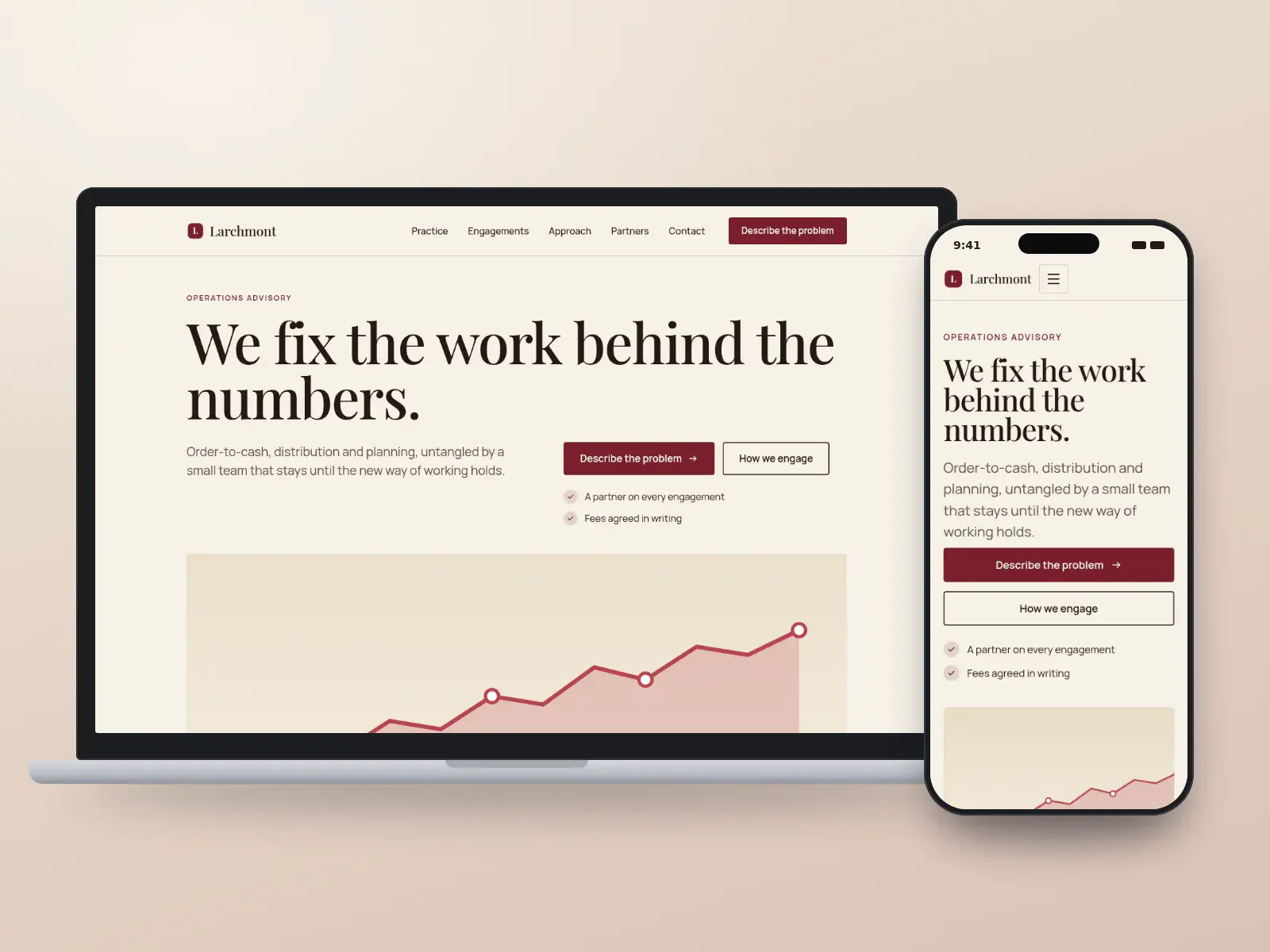
Concept website
Larchmont Advisory
Boutique firms with permission to name their work
Concept design. The business is fictional.
- Editorial
- Luxury
Local website: yours after 12 payments, or $1,500 upfront
Concept website
Fieldnote Partners
Firms that win work through ideas
Concept design. The business is fictional.
- Editorial
- Minimal
Local website: yours after 12 payments, or $1,500 upfront
Concept website
Quarry & Vale
Two- and three-partner firms
Concept design. The business is fictional.
- Tool-first
- Minimal
Local website: yours after 12 payments, or $1,500 upfront
Concept website
Northgate Operations Group
Multi-practice firms
Concept design. The business is fictional.
- Corporate
- Bold
Growth website: yours after 12 payments, or $4,000 upfront
Concept website
Wren Hale Advisory
Independent advisors and fractional executives
Concept design. The business is fictional.
- Luxury
- Dark
Local website: yours after 12 payments, or $1,500 upfront
Concept website
Lumen Workshop Co.
Facilitators and trainers who run public sessions
Concept design. The business is fictional.
- Dark
- Bold
Local website: yours after 12 payments, or $1,500 upfront
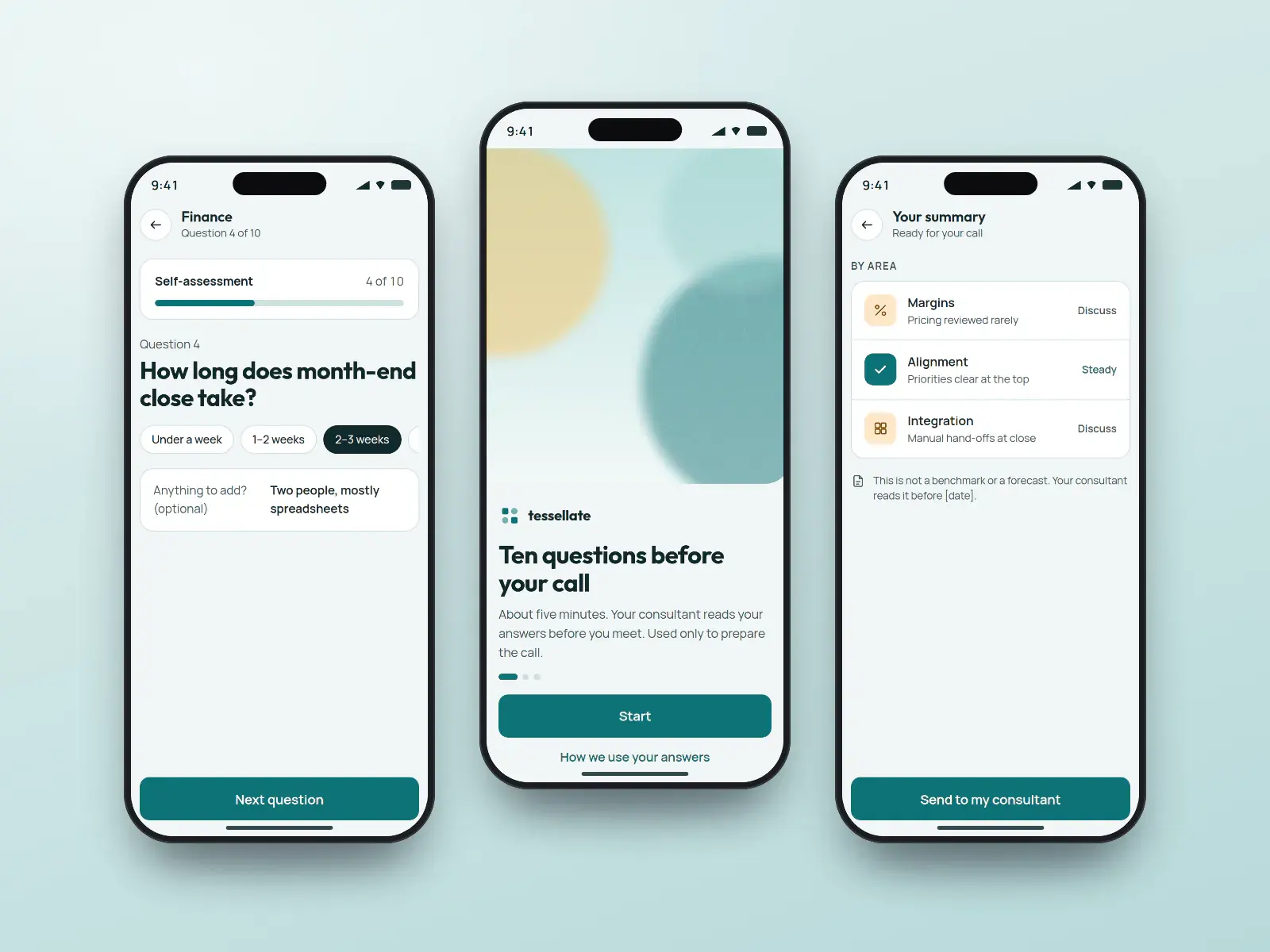
Concept app
Tessellate diagnostic app
Firms that want prospects to prepare before a call
Concept design. The business is fictional.
- Tool-first
- Friendly
Quoted per project after a call
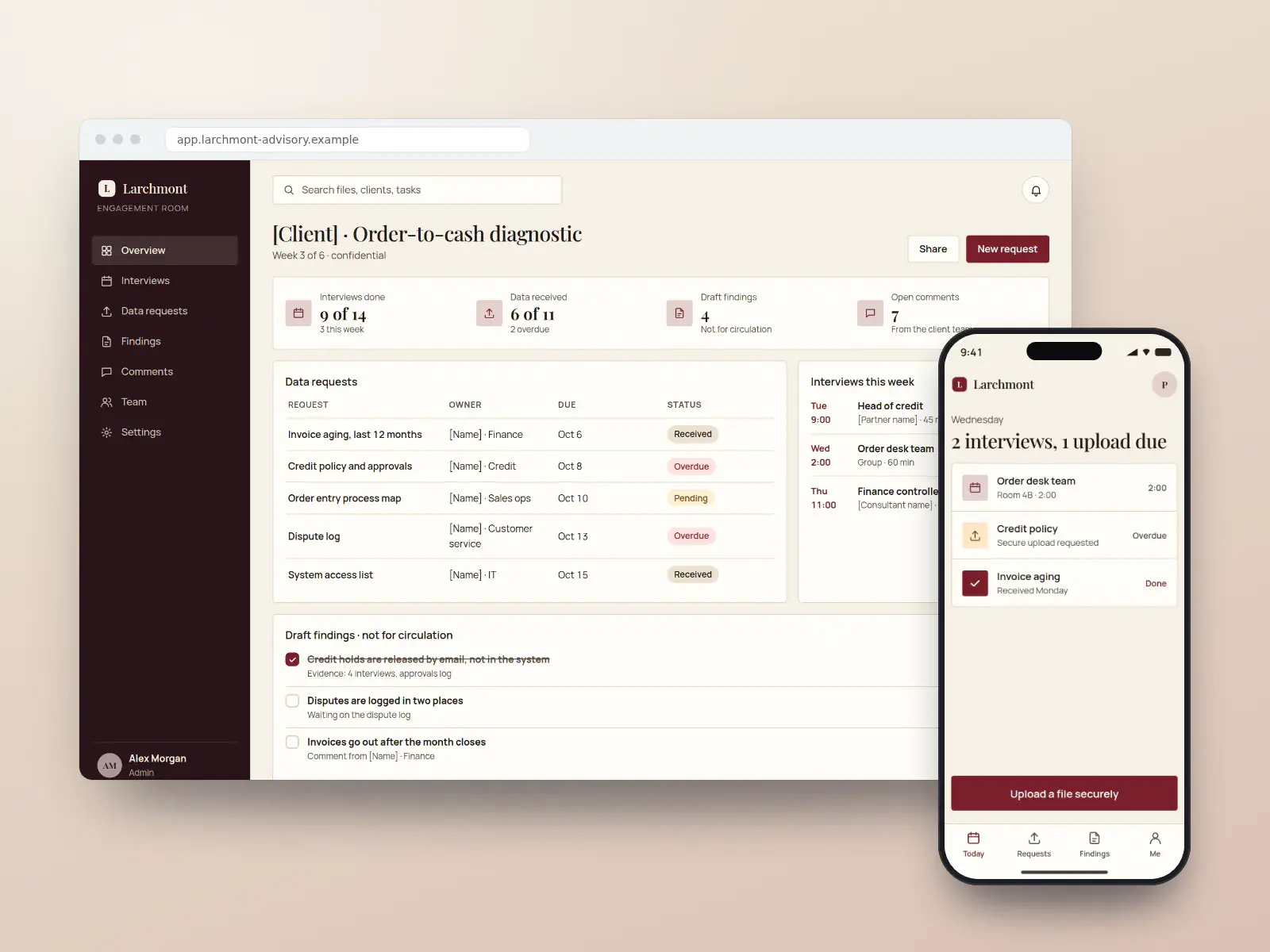
Concept software
Larchmont engagement room
Engagement teams sharing one confidential workspace with the client
Concept design. The business is fictional.
- Data-led
- Corporate
Quoted per project after a call
Pay monthly, own it
High-converting websites from $150/month
Pick a design, add your brand, content and photos, and launch. Yours after 12 payments, with SEO built in from day one.
- Local website
- $150/monthUp to 25 pages · yours after 12 payments, or $1,500 upfront
- Growth website
- $400/monthUp to 100 pages · yours after 12 payments, or $4,000 upfront
Built in
What every consultant website includes
Engagement stories with permission on file
Each engagement page records whether the client approved its name, logo and outcome, and shows only what was approved; everything else is described by sector and size.
A discovery call that qualifies
A booking flow that asks the buyer’s role, the problem in a sentence and the timing, then offers open times, so partners spend calls on work they can actually take.
Capability pages that rank for problems
One page per problem a buyer searches for, such as slow month-end close or a stalled integration, each naming the consultant who leads that work and the usual deliverables.
A publishing system for your thinking
Essays, briefings and frameworks with author pages, dates and article schema. Named authors and dates in the page text let readers and AI assistants attribute your ideas to the people who wrote them; the schema helps search engines read the page.
Lead magnets with real consent
Gated diagnostics and reports collect only the fields you need, explain what you will send, and keep proof of newsletter consent for each subscriber.
Credentials shown precisely
Designations such as CMC, degrees and board seats appear on each consultant’s profile with the granting body named, and drop off when someone leaves the firm.
How clients search
The searches and pages a consultant website needs
Buyers of consulting rarely search for “a consultant”. They search for the problem, “how to speed up month-end close” or “post-merger integration plan”, or, after a referral, for the consultant’s own name. Most of it happens at a desk during the working day, and the research is long: articles read, profiles checked, a peer asked. Some buyers now ask an AI assistant to explain the problem or suggest who works on it, so the firm that has written clearly about that problem is the one more likely to be named.
- “management consultant for small business”
- “how to fix a slow month-end close”
- “post merger integration consultant”
- “operations consultant [city]”
- “fractional coo”
- “how much does a management consultant charge”
- “strategic planning facilitator for nonprofit board”
- 01
Capability pages named for problems
One page per problem a buyer searches for, such as a slow month-end close or a stalled integration, naming who leads that work, the usual scope, the deliverables and how long it tends to take. These rank where one services page cannot.
- 02
Insights with named authors
Dated essays, briefings and frameworks under the consultant who wrote them, in the buyer’s words rather than the firm’s jargon. They show how the firm thinks, earn links and give AI assistants clear passages to quote and attribute.
- 03
Engagement stories by permission
Engagements described by sector, size, problem and approach. A client name, logo or outcome appears only where written permission and supporting evidence are on file, with a note beside it that results depend on each organisation.
- 04
Consultant profiles
Each consultant with the work they lead, their background and any designation, such as CMC, with the granting body named. Referred buyers read these first, to see who would actually be in the room and whether they have met this problem before.
- 05
Discovery call booking
A short step asking role, the problem in a sentence and timing, then open times. A clear note on what the call covers, and the work the firm declines, saves both sides a meeting that was never going to fit.
- 06
How engagements and fees work
How work is scoped, whether fees are fixed, phased or on retainer, and what the client’s own team contributes. Buyers comparing a boutique with a large firm look for this before they ask anyone for a proposal.
SEO, AEO and GEO
How consultants get found in Google and in AI answers
People as entities
Advice is bought on trust in people, so each consultant needs a clear profile page with role, credentials and writing, linked from every article they author and consistent with their professional profiles elsewhere. Search engines and assistants use those connections to judge experience and expertise.
Local profile only where it is real
A firm that meets clients at a staffed office can use a Google Business Profile with a category such as “Business management consultant”; a firm without one should not invent an address. Either way, keep the firm name and contact details identical across the site and association listings.
Structured data for advice
Mark the firm up as a ProfessionalService, each consultant as a Person with hasCredential for designations actually held, every essay as an Article with author and date, and each capability as a Service. Skip review markup for testimonials the firm publishes about itself.
Quotable answers to buyer problems
Assistants answer “how do I fix X” before naming anyone. A capability page that opens with a plain answer to the buyer’s problem, then the firm’s approach, is what AI Overviews, ChatGPT and Perplexity tend to cite. No one can promise a citation, only make one easier.
Compliance
The rules for consultants, handled in the design
Consulting is not a licensed profession in most places, so the rules that bite are advertising and privacy rules: endorsements, reviews, performance claims and consent. These are the ones that shape a consulting site’s proof, newsletter and lead forms, and what each design does about them.
Sources gathered October 6, 2026. This is how our designs handle these rules, not legal advice: rules change and differ by province and state, so your lawyer (and, for CMC holders, your institute) has the final word, and you approve every page before it goes live.
- US · FTC 16 CFR 255
Client testimonials that reflect real experience
The FTC’s Endorsement Guides, revised in 2023, say a testimonial must reflect the endorser’s honest experience and that results it describes must be typical or come with clear context. Testimonials appear only with the quoted client’s approval and without edits that change their meaning.
Federal Register — Guides Concerning the Use of Endorsements and Testimonials (2023)
- US · FTC 16 CFR 465
No bought, fake or insider reviews
Since 21 October 2024 the FTC’s Trade Regulation Rule on consumer reviews and testimonials (16 CFR Part 465) has made fake or AI-invented testimonials, reviews rewarded on condition they are positive, and undisclosed reviews by a firm’s own officers and managers civil-penalty matters. Review widgets pull only verified client feedback, and partners’ friends are not quoted as clients.
- Canada · Competition Act s. 74.01(1)(b)
Performance claims need a test done first
Canada’s Competition Act treats a claim about how well a product or service performs as deceptive unless it rests on an adequate and proper test made before the claim. Outcome lines are placeholders the firm fills only with figures it can support, and method pages describe the approach rather than promise a result.
Competition Bureau — Performance claims not based on an adequate and proper test
- CMC-Canada · Code of Professional Conduct
Client confidentiality, including names and logos
CMC-Canada administers the Certified Management Consultant designation, conferred by its provincial institutes, and the code of professional conduct CMCs follow forbids disclosing confidential client information without the client’s specific consent. Engagement pages default to sector and size, and a client’s name, logo or quote is switched on only once written approval is recorded.
- Canada · CASL
Newsletters and briefings by consent
Canada’s anti-spam law requires consent before sending commercial email, identification of the sender and a working unsubscribe link. Briefing sign-ups use an unticked consent box, store when and where consent was given, and every send carries the firm’s address and an unsubscribe link.
- Canada · PIPEDA
Lead magnets that explain what happens to the data
PIPEDA asks organisations to identify why they collect personal information and to obtain meaningful consent; the Privacy Commissioner’s guidance asks for that information in a clear, timely way. Download forms say what is collected and why on the form itself, and EU visitors see the GDPR basis in the privacy notice.
Office of the Privacy Commissioner — Guidelines for obtaining meaningful consent
Everything for consultants
Websites, apps, branding and SEO for consultants
Websites
Consultants websites built on the designs above, fast and set up for search.
From $150/month
Apps
Consulting work produces documents, decisions and follow-ups across weeks. A client workspace keeps them in one place instead of a dozen email threads.
Quoted per project
Apps for consultantsBranding
A consulting brand has to signal judgement, not size. Buyers compare you with large firms and with freelancers, so the identity must look considered without looking expensive for its own sake.
Quoted per project
Branding for consultantsSEO and leads
Ongoing SEO that checks your site every week and fixes what is safe to fix, for more discovery calls and proposals.
From $149/month
SEO plans and prices
Pricing
What a consultant website costs
The price of a consultant website is the same as any website we build: pay upfront and save, or spread it over 12 months.
Local website
$150/month × 12
or $1,500 upfront. Yours after the 12th payment.
- Up to 25 pages
- Any design on this page
- Technical SEO at launch
- Hosting and care $29/month
Growth website
$400/month × 12
or $4,000 upfront. Yours after the 12th payment.
- Up to about 100 pages
- Teams, offices and more integrations
- Planned with an advisor
- Hosting and care $49/month
SEO plans
$149/month
Local $149 · Growth $399
- Checks your site every week and fixes what is safe to fix
- New pages every month
- 7-day trial
Prices in US dollars. How payments, hosting and ownership work.
How it works
How your consultant website goes live
- 01
Pick a design
Choose one, or ask for another. Tell us the problems you solve and the buyers you want more of.
- 02
Send your details
Logo, consultant bios and designations, the engagements clients have approved for publication, and any essays to migrate.
- 03
Review before launch
You confirm every client name, outcome and credential, and we hold back anything without written permission.
- 04
Launch and grow
We redirect your old pages, go live, and build capability and insight pages that bring in qualified calls.
Pick my design
See your website before you pay for it
Choose a design and tell us about your business. An advisor emails you to plan a preview with your name, your colours and your details, and the price options. Nothing is charged until you decide.
- 1An advisor replies by email
- 2We plan your preview and scope
- 3You decide, with every price in writing
Questions
Consultants: common questions
- How much does a consulting firm website cost?
- A consulting firm website of up to 25 pages is $1,500 paid upfront, or $150 a month for 12 months, and it is yours after the 12th payment. A larger site of up to about 100 pages is $4,000, or $400 a month. Hosting and care is $29 or $49 a month. Prices are in US dollars.
- Can I put client logos and case studies on my consulting website?
- Yes, with the client’s written permission for each name, logo, quote and figure you publish. Many consulting contracts and NDAs forbid naming the client at all, so the designs describe engagements by sector, size, problem and approach by default, and switch on the client’s name only once their approval is recorded.Any outcome you publish should be one you can support with evidence and is shown with a note that results vary.
- What should a consultant’s homepage say first?
- The problem you solve and who you solve it for, in the buyer’s words, not your method’s name. A COO searching for help with a slow month-end close should see that phrase, a short line on how you approach it, and a way to book a call. Frameworks and credentials come next, as support.
- Do consultants need a blog or insights section?
- For most firms, yes. Buyers of advice judge the adviser by their thinking, and essays, briefings and frameworks give them something to judge. Articles with named authors and dates also help search engines and AI assistants attribute your ideas to you, which matters when a buyer asks an assistant for consultants in your field.
- Can my site show a CMC or other consulting designation?
- Yes, if each consultant holds it and is in good standing with the body that grants it. Profiles show the designation with that body named, such as CMC from a CMC-Canada provincial institute or IMC USA, and the firm removes it when a consultant leaves or lets it lapse, so the site never overstates the team’s credentials.
- How do consultants get clients from their website?
- Mostly by converting people who already have a reason to look: a referral, a talk, an article someone forwarded. The site has to show quickly which problem you solve, how you think and who would do the work, then make booking a call easy. Pages and essays about specific problems add buyers who find you by searching for the problem itself.
- Will my consultant website rank on Google?
- It launches with the technical SEO done: fast pages, clean structure, structured data, local pages and redirects from your old site. To keep climbing, a BOOSTD SEO plan from $149 a month runs 262 checks on your site every week, fixes what is safe to fix and gets the rest ready for your OK.No one can promise a position on Google, and we never do. Google warns businesses about anyone who does.
- Can I get one of these consulting website designs?
- Yes. Each is a complete, ready-to-launch website design BOOSTD made for consultants. Pick one and we make it yours, with your name, colours, photos, content and the licence or compliance details your industry expects, from $150 a month and yours after 12 payments.Approved client sites are shown with a “Client work” tag, and only with the client’s written permission.
Guides for consultants
Reading for consultants before you build
- Planned guidePublishing consulting case studies with client permissionPlanned: written with a named author and published once reviewed
- Planned guideTurning a discovery call form into a qualifying stepPlanned: written with a named author and published once reviewed
- PositioningHow to write a value proposition, with a simple template
- AI searchHow to write content for AI search: five habits assistants quote
More on consulting website design
- Websites for recruiters and staffing firms
- Business lawyer websites
- Marketing for consulting firms SEO and demand generation for consultancies.
- Websites for marketing agencies
- Websites for IT services and MSPs
- Websites for accounting firms For the advisers your clients already work with.
- How to write a value proposition
- Pricing for a group or franchise of consultants More locations than a plan covers? Tell us about the network.
Free, about a minute, nothing changes on your site
Start with a free checkup of your current site
See what holds your current website back across every point, free, before you choose a design.
- Free, no cardNo sign-up to see your preview.
- Read-onlyNothing changes on your website.
- 90-day guaranteeIf you join: a better score, or your next month free.